New Dacia Spring revealed: small EV gets 50% price hike, but a big jump in quality
The new Spring will be based on the adorable Renault Twingo and built here in Europe

There’s a new Dacia Spring set for showrooms, but this time it won’t be fighting to be one of the cheapest electric cars in the UK. While local pricing is yet to be finalised, it’s expected to carry a £6,000 premium compared with the current model – or 50 per cent more – at around £18,000.
But before you dismiss it, this could be the very reason a new Spring might be worth considering. While the last car had a lack of substance, one might say, this all-new generation is a different proposition. This could be a new electric city car you might actually want to buy, rather than be forced to drive due to budget.

The latest Spring only shares its name with the original – everything else is new and largely borrowed from the Renault Twingo, which draws much of its technical underpinnings from the Renault 5. This platform is called RG-EV Small in Dacia speak, and with it comes a big increase in width and length, as well as the Renault Group’s truncated 100-week development programme.
However, more than just being a rebody of the funky Twingo, the new Spring has its own priorities to focus on and audience to seek, as Dacia CEO and brand director Katrin Adt explained – because it is more practical and rugged, while usefully undercutting the Twingo on price.
Exterior design
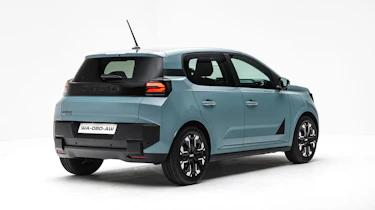
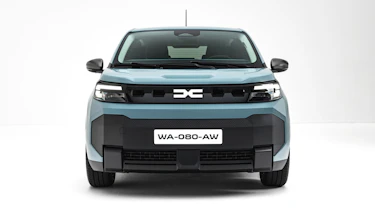
One look at the silhouette will tell you this is very much a sibling car to the Twingo, but Dacia’s job of diversifying the two is more than skin-deep. To visually separate it from the Renault, the Spring has a more pronounced bonnet, making it less of a one-box shape and unlocking a small (yet optional) 17-litre space under the bonnet. This might sound of little use, it has been shaped specifically to hold charging cables.
Every exterior panel is different to those of the Twingo, but the Renault’s unusual hardpoints were a challenge to work around. Yet David Durand, Dacia’s head of design, enjoyed the task.
He told Auto Express: “Sometimes, when you have a blank sheet to work from, you have all these ideas, all these options, but these can be hard to imagine, especially on a project like the Spring. But within our constraints, it was a very enjoyable experience to push and pull the design to a point which we were happy with. Sometimes design isn’t just about creativity, it’s about the challenge.”
There’s also some of Dacia’s design intelligence in there, too. The front and rear lamps cleverly use reflected light to avoid the need to illuminate secondary daytime running elements. Both front and back lights are connected with a textured black plastic panel that is designed specifically to avoid scratches.
However, the really important part – and the elements that perhaps best reflect its use case – are the impact-absorbing bumpers at both ends. These don’t just offer a practical benefit, but will also keep insurance and repair costs down to an absolute minimum. Even the wheels are only available in steel options with plastic covers.
Interior and technology
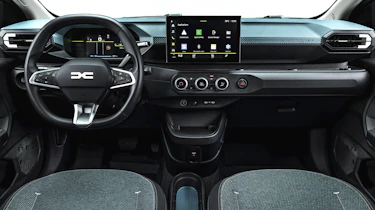
Much like the exterior design, the interior’s shared hardpoints are noticeable, but this still results in a sensible layout. The dashboard is rather tall and slightly confrontational, but its more angular design is still practical. Some of the Twingo’s fun coloured inserts have been replaced to deliver a more technical and rugged appearance, but it’s still interesting to look at and feels robust.
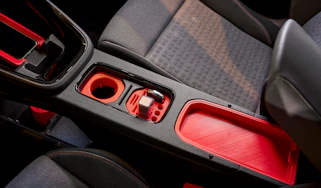
With a little help from Dacia’s YouClip system, the cabin is also highly customisable. Between the front seats is a centre console that starts life as a simple tray, but can be accessorised with a big centre console, flip-top cubbies or even a clever armrest that has zip-up storage within. There’s also a handy phone shelf, albeit without any wireless phone charging, and another shelf on the dash.
The rear seats offer a reasonable amount of space – as might be expected with its exterior dimensions. There’s no sliding seat base, as you’ll find in the Renault, but the seat backs can still be folded down, and there’s also a false boot floor with two opening halves, something the Twingo doesn’t have. As with the current Chinese-built Spring, rear headroom is merely adequate, while the pop-out rear windows will get annoying on hot days.
Much of the extra room has been delivered via additional boot capacity, with an impressive 337 litres with the seats up, and an incredible 1,278 with them down.
All models feature a seven-inch driver’s display with clear layouts, but a 10.1-inch touchscreen is only available on the upper Journey trim, leaving the entry-level version to make do with a smartphone mount and a Dacia app that can wirelessly connect to the car. When fitted, the touchscreen is a good one, though, with embedded navigation in addition to wireless Apple CarPlay and Android Auto. There’s also full online support for maps, and access to remote services such as cabin pre-warming and charging management.
Charging, battery and electric motors
Dacia has a simple powertrain line-up, with just one battery and electric motor offered across the two models. Capacity is rated at 27.5kWh with an LFP chemistry and Dacia quotes a combined WLTP range of 155 miles. The more aerodynamically efficient Twingo offers up to 163 miles, but the Spring’s range is 16 miles up on that of the current car and fairly typical for the current crop of electric city cars.
While 50kW DC fast charging is expected to be an option on European-market models, it’s expected to be fitted as standard on UK-spec Springs. This it’s not exactly cutting edge, but it’ll top the battery pack up from 15-80 per cent in around 28 minutes. However, Dacia says that owner data suggests that many customers tend to only drive the current Spring on short, but frequent journeys, and that the new model has been optimised for those usage patterns.
The 79bhp front-mounted electric motor’s performance is also fairly average, with the benchmark 0-62mph dash taking 12.1 seconds. But judging from the performance available in the Twingo, this will feel perfectly adequate in town.
Pricing and availability
There’s no ignoring that this Spring is far more expensive than the current one. At present, the entry-level car costs from just £11,990, making the potential £18k starting price of this fresh model a £6k increase. But this newcomer isn’t sourced from China, it’s built in Europe and aside from feeling more substantial, it’s in with a good chance of eligibility for the UK’s Electric Car Grant.
Dacia hasn’t said which band it expects the car to qualify for, but even with the lesser £1,500 grant the Spring could reach showrooms at £16,500 – a price that’s more tantalising. Regardless of the increase, though, the new Spring is still shaping up to be one of the most affordable new cars on sale not just to buy, but to run – a core deliverable for the manufacturer’s smallest model.
Did you know you can sell your car through Auto Express? We’ll help you get a great price and find a great deal on a new car, too.