Hyundai Kona review
The Hyundai Kona is comfortable, refined, spacious and overflowing with technology

Our opinion on the Hyundai Kona
The Hyundai Kona is a fantastic example of how a brand can listen to feedback and act upon it. Hyundai has grown its small SUV sensibly in order to deliver enough practicality to satisfy those looking for their next family car. Its interior has been improved, too, with a smart look, logical layout, and an intuitive infotainment system.
Admittedly, the daring, sci-fi-inspired styling might not be for everyone, and there are cheaper compact SUVs out there, but the Kona – and the Kona Electric in particular – looks extremely good value for such a mature, well equipped and well-rounded car.
About the Hyundai Kona
The latest Hyundai Kona may have grown in size compared with its predecessor, but its key rivals remain the cream of the crop in the small SUV and crossover segment. Among them are the Ford Puma, Renault Captur, and Skoda Kamiq, plus the Kona’s Niro sister car. A few of these are also offered with a choice of combustion and electric power, in the case of the Kia Niro, Jeep Avenger, and Peugeot 2008.
The Kona has stuck with the same choice of petrol, hybrid, and electric powertrains as its predecessor. The entry-level petrol only comes with a six-speed manual gearbox, while the more powerful 1.6 petrol is available in manual or seven-speed dual-clutch automatic forms. The hybrid comes with its own six-speed dual-clutch automatic. All versions of Kona are front-wheel drive.
Used - available now


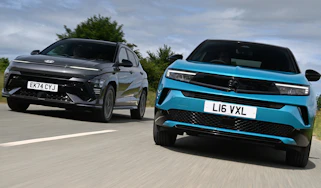
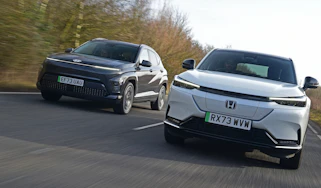
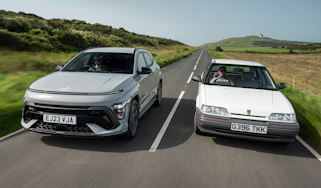
We’ve tested the Hyundai Kona in its petrol, hybrid and electric forms, including a twin test with the Vauxhall Mokka after which the Kona was declared the better buy. If you’re in the market for the EV, be sure to read our dedicated Hyundai Kona Electric review.
Engines, performance and drive
Pros |
|
Cons |
|
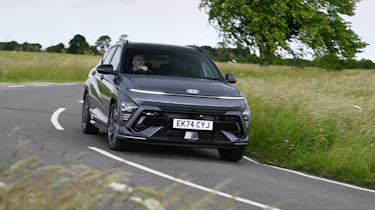
The Hyundai Kona is a car that encourages you to take it easy when behind the wheel, and has been set up to be a comfortable family car rather than one that’ll set your trousers on fire. It’s happiest around town, where you can drive the Kona Hybrid and Kona Electric with just the accelerator thanks to one-pedal driving modes, recuperating energy and boosting the car’s efficiency.
Performance, 0-60mph acceleration and top speed
The 1.0-litre petrol Kona produces just 99bhp and 172Nm of torque, and is the slowest model in the range: it’ll ‘sprint’ from 0-62mph in 13.3 seconds, and go onto a top speed of 105mph. It’s sufficient for keeping up with traffic in town, and you can keep the engine on the boil using the pleasingly accurate and relatively short throw of its standard six-speed manual gearbox, which we found to be much more satisfying to use than the manual in the Nissan Juke.
The 1.6-litre petrol models produce a healthier 136bhp and 250Nm of torque – enough for 0-62mph in 10.2 seconds and a top speed of 121mph. But while the 1.6-litre motor packs decent punch, we found progress can be spoiled by the jerky dual-clutch automatic transmission, which never felt properly in tune with the engine. Stick with the manual.
The Kona Hybrid pairs a 1.6-litre petrol engine with a single electric motor to drive the front wheels. Combined, the set-up produces 127bhp and 265Nm of torque, which is good for 0-62mph in 12.0 seconds. However, we found that after the initial pep of the electric motor, the petrol engine provides more noise than it does propulsion, and the acceleration tails off significantly once you go past 50mph. Once you’re at motorway speeds, though, there’s still enough oomph available for overtaking.
The Kona Electric use a single 215bhp electric motor driving the front wheels. It's 255Nm has no trouble overcoming the extra weight of its heavier battery pack, giving it a 0-62mph dash of just 7.8 seconds. If you’d like to know more, we have a dedicated review of the Hyundai Kona Electric via the link provided.
| Model | Power | 0-62mph | Top speed |
| Kona 1.0T manual | 99bhp | 13.3 seconds | 105 mph |
| Kona 1.6T manual | 136bhp | 10.2 seconds | 121mph |
| Kona 1.6 hybrid | 127bhp | 12.0 seconds | 93 mph (Eco mode), 103 mph (Sport mode) |
| Kona Electric | 215bhp | 7.8 seconds | 107 mph |
Town driving, visibility and parking
Despite the Kona being bigger in every physical dimension, it remains just as manoeuvrable as its predecessor, with a tight 10.6-metre turning circle helping to deliver decent manoeuvrability around town. The steering is so light that you can turn the wheel with one finger, which is a real boon when parking. The trade-off is virtually no feedback, though.
All editions come with front and rear parking sensors plus a reversing camera as standard. A 360-degree camera system is fitted to high-end N-Line S and Ultimate trims, along with a blind spot camera feed of what’s alongside you, which is shown in the instrument cluster when you use the indicators.
Overall, the Kona is comfortable, with nothing that will upset occupants too severely, and bumps are soaked up easily by the suspension.
Country road driving and handling
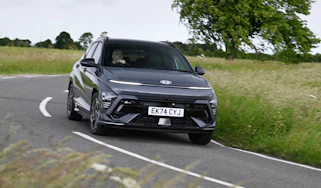
The chassis of the Kona offers safe and predictable handling. It isn’t particularly thrilling, and the steering remains light and devoid of feedback at higher speeds. It’s certainly no Ford Puma when it comes to driving satisfaction.
The sportier N Line model doesn’t receive any stiffer suspension settings, which is probably a good thing because the standard set-up delivers a good balance between tidy handling and a comfortable ride.
Motorway driving and long-distance comfort
At higher speeds, the petrol engine in the hybrid version works a lot harder than the electric motor, which is a bit noisy as well as taking its toll on fuel efficiency. Wind noise when cruising at the national limit also harms the overall refinement. The ride in N-Line models becomes more unsettled at speed, too, although some rivals, such as the Vauxhall Mokka, are even more unruly.
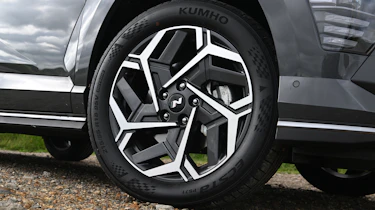
If you value comfort over looks on a long trip, the 17-inch rims that feature on entry-level Advance-spec models (and are an option on Ultimate trim Kona Electric models to lessen rolling resistance and improve electric range) contribute to a more settled ride quality. We think the lower trim petrol offers more compliance than the higher-end editions and the electric version. The latter helped, no doubt, by the fact that it weighs a few hundred kilos less than those carrying hefty EV batteries.
Activate the adaptive cruise control with steering assist, and the system responds to other traffic well, while smoothly following the curve of the lane you’re in.
“Different drive modes are designed to boost performance or efficiency, but I find that for most of the time, the standard setting is perfectly acceptable.” – Dean Gibson, senior road test editor
MPG, CO2 and running costs
Pros |
|
Cons |
|
Like the original, the Mk2 Hyundai Kona is available with a choice of pure-petrol, full-hybrid or all-electric power. The 1.0-litre petrol Kona will return up to 47.9mpg and 135g/km on average. Meanwhile, 1.6-litre petrol Konas can average up to 45.6mpg and 141g/km.
The Kona Hybrid pairs a 1.6-litre four-cylinder petrol engine and six-speed automatic transmission with an electric motor and a tiny 1.32kWh battery. Because this is a full-hybrid, not a plug-in hybrid (PHEV), you don’t charge the Kona Hybrid yourself; instead, the car recuperates energy when you slow down and helps the Hyundai’s petrol-electric powertrain to deliver decent real-world fuel efficiency
During our time with the Hybrid, we saw a return of 53.7mpg while driving on a mix of roads. This included a number of motorway miles, where the petrol engine does more work than the electric part of the drivetrain – if you’re able to avoid high-speed runs, we see no reason why the Kona’s claimed fuel economy of 60.1mpg couldn’t be within reach.
One minor gripe we have is the Kona Hybrid’s comparatively small fuel tank. At 38 litres, it’s smaller than the 47-litre tank in the petrol Kona, and is even beaten by the more compact Vauxhall Mokka, which has a 42-litre tank. However, the theory goes that electric running will compensate for the capacity drop, so you shouldn’t have to stop any more frequently in the Hybrid than in its rivals.
| Model | MPG | CO2 | Insurance group |
| Kona 1.0T manual | 48.7mpg | 131g/km | 14E |
| Kona 1.6T manual | 45.5mpg | 141g/km | 21A |
| Kona 1.6 hybrid | 60.1mpg | 106g/km | 16E |
Electric range, battery life and charge time
All versions of the Kona Electric come with the same battery capacity of 65.4kWh. The best version for electric driving range is the entry-level Advance model with smaller 17-inch wheels, offering 319 miles of range. The bigger wheels of N-Line, N-Line S and Ultimate cut the range to 289 miles, although you can opt for smaller wheels on the Ultimate trim to increase your range. Read more about the Hyundai Kona Electric in our dedicated review.
Insurance groups
Your powertrain choice has the biggest impact on the car’s group rating, with the least powerful petrol models falling into group 14, the Hybrid starts in group 16, the more powerful petrols in group 21 and the all-electric variants as high as group 31.
If you need a small SUV with lower insurance costs, the SEAT Arona could be the solution, it merely sits in group nine in its entry-level form. Alternatively, if you’re after a hybrid, the Toyota Yaris Cross sits as low as group 11.
Tax
In today's market, the rule with company car tax is that only fully electric cars bring the very lowest Benefit-in-Kind (BiK) rates. This means that business buyers will be far better off moving towards the Hyundai Kona Electric rather than the combustion cars.
Both private and company buyers can breathe fairly easily when using the Kona configurator, though, as the vast majority of specifications swoop below the £40,000 luxury car tax bracket for combustion cars.
Depreciation
The petrol and hybrid Hyundai Konas put up a reasonable fight against depreciation. Our market data shows that they’ll retain between 47 and 53 per cent of their original value after three years or 36,000 miles. The Kona Electric, meanwhile, only holds on to 43 to 44 per cent.
There are some stronger small SUVs in this regard as the cheaper Dacia Duster manages to retain a healthy 56 to 60 per cent of its value.
To get an accurate valuation on a specific model check out our free car valuation tool...
Interior, design and technology
Pros |
|
Cons |
|
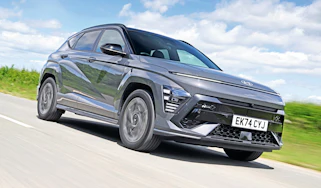
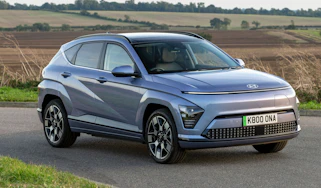
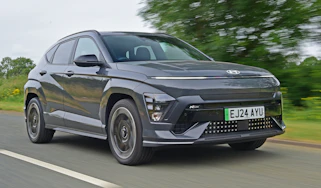
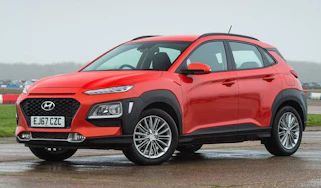
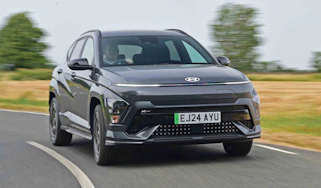
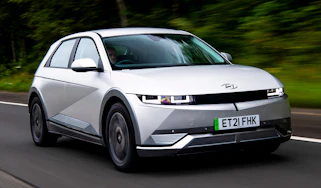
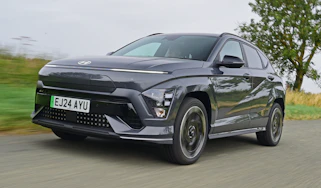
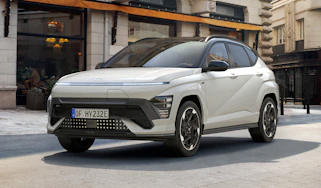
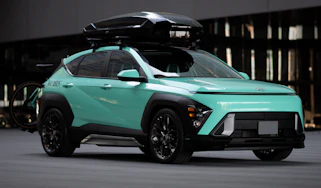
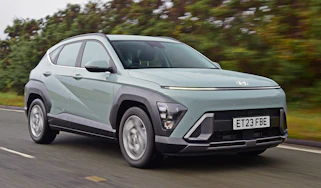
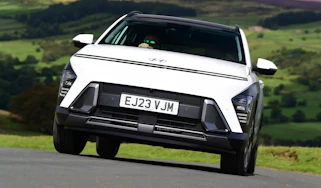
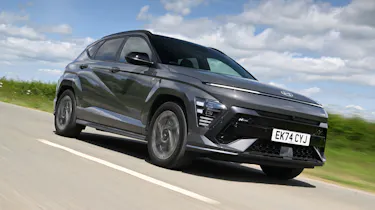
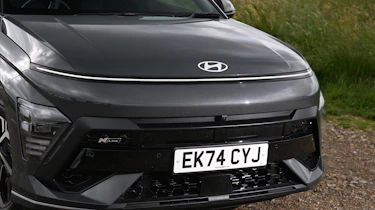
Its space-age exterior design owes a lot to Hyundai’s futuristic Ioniq EVs, although the Kona still manages to have a look all of its own. It combines this with plenty of practical touches and logically laid-out tech.
Entry-level Advance trim gets 17-inch alloy wheels (18-inch on hybrids), dual-zone climate control, a 12.3-inch central touchscreen with sat-nav and Apple CarPlay and Android Auto smartphone connectivity, front and rear parking sensors, plus a reversing camera.
Our preferred N Line trim has a sporty look, but also includes other useful features such as:
- Heated front seats
- Heated steering wheel
- Wireless smartphone charging
- Powered tailgate
Interior and dashboard design
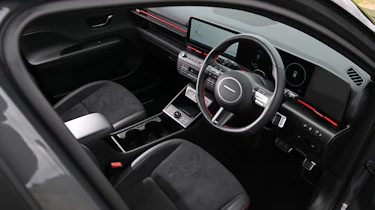
While the Kona’s exterior features plenty of flamboyant touches, the cabin is a more straightforward affair. The colours and materials vary according to trim level, with the sportier N Line versions featuring a darker overall theme with plenty of red detailing throughout and some suede-effect upholstery on N-Line S trim.
The Kona’s twin-screen layout features a pair of 12.3-inch displays set side-by-side, but the rest of the buttons are a little spread out around the cabin – there are buttons immediately below the main screen, but then there are more further back surrounding the infrequently used drive-mode selector, which seems like it’s been added as an afterthought.
Materials and build quality
The feel of the materials inside is good, although the plastic trim used for the button panels on the centre console is a little on the hard side. The controls themselves work without an issue, though, with a positive action for the buttons and rotary controls, while the overall fit and finish is good. It’s not quite as plush as a premium model, but occupants shouldn’t have any complaints.
Infotainment, sat-nav and stereo
Every Kona features a 12.3-inch display behind the steering wheel paired with another 12.3-inch central touchscreen. The displays all look great and are fairly responsive, too.
The home page is made up of large blocks, so finding the right menu is relatively straightforward, but you can always use the physical shortcut buttons below the screen if you want. Alternatively, you can also use your favourite music and navigation apps via Apple CarPlay or Android Auto, which are standard-fit but not wireless.
“N-Line S and Ultimate trim models feature a blind-spot camera system. It’s a clever idea, but in practice the images are sent to the driver’s display where they’re rather out of sight if you’re looking at your surroundings.” - Dean Gibson, senior road test editor
Practicality, comfort and boot space
Pros |
|
Cons |
|
Larger exterior dimensions than its predecessor mean that the second-generation Kona has more usable space than before, making it a viable option for families.
Dimensions and size
The Kona has grown in size compared to the previous model, and it’s longer and wider than some key rivals as a result.
| Dimensions comparison | |||
| Model | Hyundai Kona | Skoda Kamiq | Renault Captur |
| Length | 4,350mm (4,385mm N-Line & N-Line S) | 4,241mm | 4,239mm |
| Width | 1,825mm (2,100mm inc mirrors) | 1,793mm (1,986mm inc mirrors) | 1,797mm (2,004mm) |
| Height | 1,585mm | 1,531mm | 1,575mm |
| Wheelbase | 2,660mm | 2,651mm | 2,639mm |
| Boot space | 466-1,300 litres | 400-1,395 litres | 422-1,363 litres |
Seats & passenger space
There’s plenty of room in the front of the Kona, while the steering wheel and seat have a wide range of adjustment for most body types to get comfortable.
Storage is generous, with the wide centre console being a particular highlight. The cup-holders feature spring-loaded sides that can be moved out of the way to make space for larger items, and there are trays ahead of and behind this section, too. One gripe we have is that there isn’t a hidden storage compartment under the central armrest, but otherwise, there’s plenty of space for odds and ends.
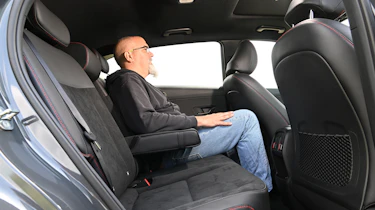
Leg and headroom in the back of the Kona is much improved over the previous generation, so much so that it’s one of the best small SUVs around – it offers nearly as much space as the larger Hyundai Tucson.
It’s not quite as wide, though, so shoulder space is tighter, but still good for the class. There’s a centre armrest (a feature not offered in smaller rivals such as the Vauxhall Mokka), while rear passengers also benefit from seatback nets, twin air vents and a pair of USB-C sockets to match the two up front. One minus point is the door bins, which are only big enough for a drinks bottle.
Two Isofix child seat mounting points are provided on the outer positions of the 2nd row seats.
Boot space
Choose a Kona in N Line spec or above, and it will have a height-adjustable powered tailgate. This opens to reveal a low loading lip and a generous 466 litres of space, which is more than the 400 litres provided in the Skoda Kamiq and the 422 litres of space found in a Renault Captur.
There aren’t many novel features offered in the Kona Hybrid, such as under-floor storage or a sliding rear bench like you get in a Renault Captur, nor the nifty underfloor storage box in the Ford Puma that can be easily washed out if you happen to put muddy hiking boots in it. You do get a 40:20:40 split rear seat, adding some additional flexibility when dropping the rear seats, and revealing up to 1,300 litres of space. That’s a respectable amount for a small SUV, but it is around 100 litres shy of the Kamiq.
Towing
The entry-level 99bhp petrol Kona has a maximum towing capacity of 1,210kg, but the 136bhp petrol can haul up to 1,310kg. The 1.6 Hybrid drops down to 1,010kg.
One of the strongest small SUVs for towing is the Dacia Duster TCe 130, which can take on up to 1,500kg.
"I like that there’s plenty of storage spaces dotted around the cabin, although I wish a couple more were covered in some way to help keep valuables out of sight." – Ellis Hyde, news reporter.
Reliability and safety
Pros |
|
Cons |
|
The Mk2 Kona only received a four-star (out of five) Euro NCAP safety rating when it was tested in 2023. The safety experts criticised structures behind the dashboard posing an injury risk, and that the driver slipped under the seatbelt in the frontal collision test (a scenario known as submarining), potentially causing damage to the knees and femur.
Every Kona is equipped with multiple airbags, driver attention warning, forward collision avoidance assist, lane keep and lane follow assist, tyre pressure monitoring, front and rear parking sensors, and a reversing camera. Any automatic petrol, hybrid, or electric Kona also gets adaptive cruise control with stop-and-go functionality, whereas all manuals come with regular cruise control.
N Line S and Ultimate spec also feature a rear cross traffic collision avoidance system to warn you of vehicles crossing your path – useful if you have to reverse onto a main road, blind spot monitoring to let you know of any vehicles alongside you on the motorway if you wish to change lanes, and a 360-degree camera system, among other kit.
During our group test of the Kona against a Vauxhall Mokka, we found that the Kona has a distracted driver sensor that’s a bit too keen to beep if you take your eyes off the road. You can program a shortcut to the star button on the steering wheel to turn off the speed limit warning.
| Euro NCAP safety ratings | |
| Euro NCAP safety rating | Four-stars (2023) |
| Adult occupant protection | 80% |
| Child occupant protection | 83% |
| Vulnerable road user protection | 64% |
| Safety assist | 60% |
The Hyundai Kona was ranked as the 14th best car to own out of 50 in the 2026 Driver Power owner satisfaction survey. While this isn’t a class-leading finish, it is still a respectable one. Key highlights for owners included fuel economy and powertrain smoothness, but build quality wasn’t rated quite as highly as some might have expected.
| Hyundai Kona | Position | Score |
| Overall | 14 | 85.89% |
| Powertrain | 8 | 89.61% |
| Exterior | 26 | 87.95% |
| Interior | 21 | 84.62% |
| Practicality & Bootspace | 24 | 83.37% |
| Ride & Handling | 20 | 88.84% |
| Safety Features | 24 | 83.18% |
| Economy & Running Costs | 5 | 83.78% |
| Quality & Reliability | 37 | 85.71% |
| Infotainment | 15 | 85.40% |
| Value | 19 | 84.38% |
What owners said
- “Good all-rounder with excellent running costs. Very practical for the size.”
- “Love the space inside for a small car. Safety features are excellent.”
- “Reliable and economical. The infotainment could be better.”
If you own a Hyundai Kona or any other car, let us know what you think of it: Take the Driver Power survey today...
Buying, prices and deals
- Best buy: Hyundai Kona N-Line
If you’re going down the combustion Kona route, the entry-level petrol model keeps the price well under control while still offering pretty strong efficiency. Entry-level Advance trim comes with plenty of equipment for the money at around £27,500, but we’d recommend investing a bit more for the N-Line, as this adds quite a few luxurious and sporty features for £29,100.
You can build your new Hyundai Kona with the Auto Express Buy A Car service. We also have a range of Kona leasing deals and used Kona models to choose from.
Hyundai Kona alternatives
The Kona remains one of our preferred small SUV choices, but if you're looking for practicality on a budget, the excellent Dacia Duster offers the former in spades while maintaining a sensible list price.
Keen drivers will be best served by the Ford Puma. It remains unmatched despite being around for a while, and its zippy 1.0-litre Ecoboost engines feature mild-hybrid technology to boost fuel economy. We also highly rate its innovative MegaBox storage solution, which allows taller items to be stored in the boot without having to fold the seats down.
The Renault Captur has a party trick of its own: the back seats slide to offer more rear leg room or a bigger boot, depending on your needs at the time. We also highly rate its Google-based infotainment system as being one of the quickest and easiest to use.
Key updates of the Hyundai Kona review
- 22 June 2026: Latest pricing and depreciation data.
Frequently Asked Questions
All versions of Hyundai Kona come with the brand’s five-year, unlimited mileage warranty, which is amongst the best around. Only sibling brand Kia and rival MG offer longer seven-year policies, while Toyota offers you up to 10 years of cover – but there are caveats.
Deals on the Hyundai Kona and alternatives