New Hyundai Nexo 2026 review: hydrogen power is no match for a pure-EV in the UK
The Nexo is an interesting SUV, but the usual hydrogen accessibility issues hold it back

Verdict
Technically, Hyundai has absolutely mastered hydrogen fuel-cell technology with the new Nexo, and if there’s a hydrogen filling station near you, this is a very interesting alternative to an electric SUV. But no matter how well made, refined or generally impressive this car is, the lack of infrastructure means it won’t work for the overwhelming majority of motorists, and it’s hard to imagine that this situation will change anytime soon. Plus it will be very expensive.
Hydrogen has long been considered a beacon of hope for clean mobility, because fuel-cell cars emit zero emissions like an EV, but take just five minutes to fill up, not half-an-hour, plus offer longer ranges. However, that hope for hydrogen cars has produced little to no progress in the real-world. This is especially true for the infrastructure, which, despite politicians' grand promises of “technological openness”, is still being treated like a poor relation.
Five years ago, there were about a dozen public hydrogen filling stations dotted around the UK, but today there’s six. Other countries have made more of an effort, with around 100 hydrogen filling stations in Germany, although 20 of these are currently being dismantled. If we’re being honest, it would seem that fuel-cell cars don’t really stand a chance of succeeding.
Used - available now

2021 Skoda
Karoq
40,400 milesAutomaticPetrol1.5L
Cash £13,990
2025 Volkswagen
T-Roc
20,327 milesAutomaticPetrol1.5L
Cash £22,810
2021 Lexus
UX 300e
12,470 milesAutomaticElectric
Cash £16,660
2024 Volkswagen
Polo
2,391 milesAutomaticPetrol1.0L
Cash £18,400Despite this, Hyundai is rolling out the second generation of the Nexo, fighting a lonely battle on the fuel-cell frontier. The Toyota Mirai is the other only fuel-cell model around, and not a single one was sold in the UK in 2024. They say the only way is up, but the prospects for the Nexo don’t look much rosier.
The SUV will arrive in Europe in Q2 2026, costing approximately 68,000 Euros (£59,000). Hyundai says it is working on a sales strategy for the UK which, when defined, will enable dealers to place factory orders for interested buyers – likely allowing the company to assess consumer suitability on a case-by-case basis.
Why though, if hydrogen-powered cars are the most niche of niches? Well, because Hyundai can afford to, and it wants to showcase its 27 years of fuel-cell expertise to the public. The Koreans also have more than 1.37 billion miles of road experience, and it sees the Nexo as a rolling research lab, making the whole subject of fuel cells viable for the future.

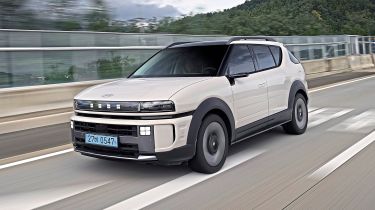
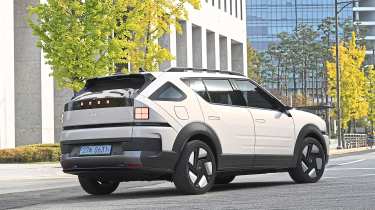
And the new Nexo is also the first road car to follow Hyundai’s new 'Art of Steel' design philosophy: sculpted and sharp. The front is aggressive and angular, while the rear has a dome-like profile. There are some very funky elements such as the floating rear-quarter windows, the heavily sloped rear windscreen and horizontal indentations along the doors that give it a retro style. But it’s all connected to Hyundai’s other models by the pixel-motif lights at the front and rear.
At 4.75 metres, the Mk2 Nexo is seven centimetres longer than the original, and it delivers one thing above all: space. The 993-litre boot – or 1,719 litres with the rear seats folded – is a big benefit of the 2.79-metre wheelbase, and the hydrogen fuel tanks hardly taking up any space.
The cabin also feels bright, airy and welcoming. It uses a proven layout very similar to other Hyundais, featuring mostly foam-backed surfaces that feel premium and the two 12.3-inch displays on the dashboard that merge into a wide curved unit.
The new Nexo comes with digital exterior mirrors project their view onto small, separate monitors on either side of the dashboard, and we found they took some time to get used to. Meanwhile, the voice control continuously learns via artificial intelligence (AI).
Over-the-air updates beam straight into the car. Your phones can not only be charged on a double wireless pad, and also serve as a digital key. In terms of safety kit, the new Nexo gets the full suite of driver aids and overall this is virtually fully loaded straight out of the box, with only a handful of optional extras to choose from.
Crucially, the Nexo boasts Vehicle-to-Load (V2L) tech for the first time, letting you power or charge external devices such as e-bikes while you're on the move. Even better, the European model can tow a hefty 1,000kg, although that can’t match the 1,600kg Hyundai’s Ioniq 5 EV can haul.
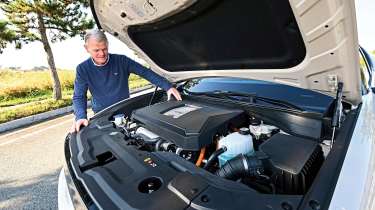
Under the skin, the Mk2 Nexo benefits has its own bespoke platform and a completely revamped fuel-cell powertrain, including a new electric motor that kicks out 201bhp. So it can go from 0-62mph in 7.8 seconds; much quicker than the 9.2 seconds the old car needed.
The fresh 2.64kWh battery is much bigger too (up from 1.56kWh in the previous Nexo), and the updated motor management system is now faster and more efficient. Plus, there are three new-material tanks that can store up to 6.69kg of hydrogen, which is more than the old model, and they can be refuelled quicker than before.
Power is sent exclusively to the front wheels via the e-motor. It's energised by the fuel cell, which generates the necessary electricity by reacting hydrogen and oxygen. Fill up with green hydrogen from renewable sources, and the Nexo runs entirely CO2-free. The significantly improved maximum range of 513 miles is now comfortably on par with a diesel car, and it takes about the same time to fill up.
Hyundai invested a huge amount of effort to ensure the fuel cell is ready to go in a flash, even in freezing temperatures. That was always a major pain point with the previous Nexo.
Once you get going, the new Nexo is the epitome of calm; active noise cancellation (ANC-R) and all-round double glazing largely block out external irritations, and the ride is comfortable. Handling and dynamics aren’t the Nexo's core strengths, but no noise comes from the drivetrain.
The fuel cell runs completely without vibration somewhere in the background, while the electric motor delivers linear acceleration that is quite powerful for a car weighing more than two tonnes. When hydrogen meets oxygen, the power flows smoothly and silently, and only water drips out the back.
This hydrogen SUV drives largely like a battery-electric vehicle. However, the comparison falls flat when you look at the cost analysis. Firstly, cars with a technically complex fuel cell are still noticeably more expensive than their electric rivals, where falling battery prices are making the purchase increasingly attractive.
Furthermore, the price of hydrogen is not competitive, because its production is extremely energy-intensive and involves high investment costs. It currently costs as much as £15 per kilogram, but that would realistically get the Nexo barely 60 miles. A fill-up would cost about £100. Ultimately, without more support, the hydrogen fuel cell remains a long way from being an attractive or cost-effective EV alternative.
| Model: | Hyundai Nexo |
| Price | €68,000 (est £59,000_) |
| On sale: | TBC |
| Powertrain: | 1x e-motor plus hydrogen fuel cell |
| Power/torque: | 201bhp/350Nm |
| Transmission: | Single-speed, front-wheel drive |
| 0-62mph: | 7.8 seconds |
| Top speed: | 111mph |
| Range: | 513 miles |
| L/W/H: | 4,750/1,865/1,640mm |