Radical new Range Rover GT gets ready to rival BMW iX3 and Volvo EX60
A fifth Range Rover model will join the range, targeting luxury and driving dynamics like never before

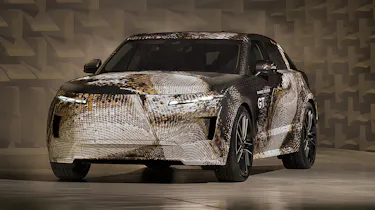
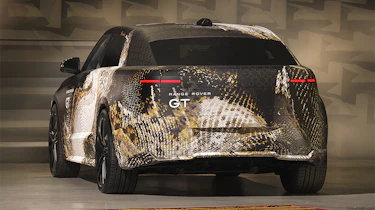
This is the Range Rover GT, an unambiguous sign the iconic British brand is about to move into a new space with a striking low-slung electric four-door coupe. It’ll be the fifth model in Range Rover’s portfolio and go on sale in 2027 alongside the existing range, which will by then also include the all-electric Range Rover and Range Rover Sport.
The GT name sums up the car’s positioning: this is a long, spacious and sleek grand tourer that will sit above the 4.8m-long Range Rover Velar in the line-up. After years of testing prototypes, JLR has finally shown off its new offering in more detail, revealing just how different this new model will really be to others in the Range Rover range.
One of the pictures shows the new car in a semi-anechoic chamber, a soundproofed room designed to identify squeaks and rattles to optimise on-board tranquility – crucial for an electric car. By picturing the car in such surroundings, Range Rover is making a very clear statement about the refinement expectations of its new model.
What’s behind its radical design?

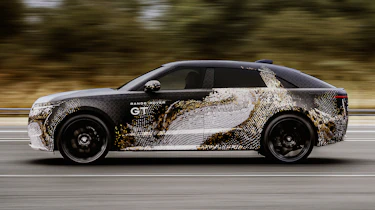
The ‘fastback’ silhouette is a dramatic development of Range Rover’s two-box SUV form, with looks that telegraph this is the brand’s most dynamic model ever. The sharply angled windscreen flows into a roofline that sweeps downwards just after the rear wheel’s centre cap, creating a much more slanted rear screen than the Velar’s, and a rounded rump. It looks likely this is the lowest model in the brand’s history, and a 736kg battery pack between the wheels will drop the centre of gravity further to help stick the GT to the road.
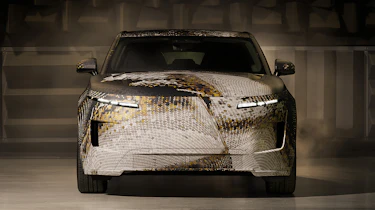
The silhouette is all about creating visual drama and aerodynamic efficiency, with the tapered rear end maximising electric range. And the ratio between the slitty, trapezoidal glasshouse and the deep expanse of sheet metal gives a pronounced coupe-SUV look. Big wheels and horizontal light signatures are trademark Range Rover design features.
What’s the Range Rover GT’s cabin like?
JLR has also revealed the car’s cockpit – and Auto Express sat in a camouflaged test car yesterday to experience it. The cockpit pictured is the flagship of three interior combinations, with a duotone palette mixing shades from the single-tone dark and lighter grey alternatives.
The cabin is so dominated by straight lines it appears lifted from a draughtman’s drawing board. A subtle full-width air vent runs across the centre of the dash, above a horizontal shelf bathed in ambient light and inspired by an upright piano lid, reveals interior design manager Lee Perry. The flat dash top is upholstered in fabric, with the porous material able to let sound pour out from a hidden central speaker.
Fans of buttons will be disappointed by Range Rover’s trademark reductive design philosophy – there are barely any apart from on the steering wheel and the typical arm rest switch pack. “Buttons are used only where they enhance tactility and safety,” argues chief interior designer Alex Watkin, adding that the GT’s new operating system will be much more responsive to natural conversation.
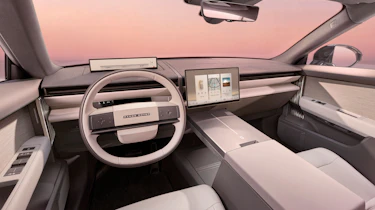
JLR is refusing to enter the touchscreen arms race: the central OLED screen is pegged at 13”, making it look like a swollen iPad, and 17mm thick. It’s complimented by a sleek digital driver’s binnacle and a standard Head-Up Display; rather than the trio replicate functions, information will be prioritised on the most appropriate displays.
The front seat layout is architecturally similar to the Jaguar Type 00 concept’s, with an extended centre console – ’the bridge’ – separating the driver and passenger. Its slide-away cover is translucent, allowing the glow of smartphones in the twin wireless chargers to radiate upwards. Another nice touch are the vertical chromed strips forming lovely bookends at the end of the dash.
And what’s the GT like in the rear seats?
As befits its grand tourer status, owners will be able to choose a sporty four-seat layout, or a typical rear bench for five. We sat in the rear seats, and the eight-inches of kneeroom verifies Range Rover’s claim the big GT is more spacious than the BMW iX3 or Volvo EX60.
Headroom is fine despite the biggest panoramic roof in Range Rover history – a stat that gives a sense of the car’s length – with the electrochromatic glass interrupted by a semi-circular area that houses the roof’s telematics pod. But the indent tapers above the fifth seat to avoid impinging on headroom.
In the four-seat configuration, a central arm rest folds down and a screen mounted between the seats controls their heating, cooling and the rear climate. And the front bridge’s partypiece is repeated with twin chargers in the tray, while twin cup holders slide out by your legs. The air-con screen is transferred to the back of the forward console in a five-seater. All the seats will fold flat in both configurations, to maximise the hatchback’s practicality.
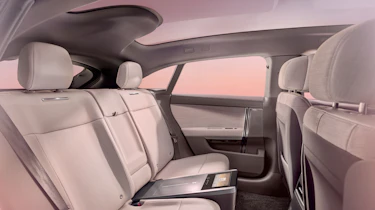
The sculpted seats front and rear are clothed in Ultrafabric, which feels like leather to the touch but has an elasticity which makes it easier to fasten with more hidden seams. They’ll also be less prone to extremes of temperature.
“The GT’s blend of effortless performance, first-class long-haul refinement and all-terrain capability is pure Range Rover,” claims Range Rover managing director Martin Limpert, adding, “its calming interior previews our vision of a modern grand tourer.”
And it’s set to be very quiet on board the GT: designer Perry says even at 130mph on JLR’s proving ground, it’s easy for the front passenger to converse with people in the rear without having to turn and cock their ear.
Range Rover GT technical details
Under the skin the GT will introduce Land Rover’s new Electric Modular Architecture (EMA), conceived ‘electric first’.
“EMA is our next architecture for medium-size vehicles,” said former JLR CEO Adrian Mardell when the firm announced the platform in 2023. “Originally conceived to be hybrid, it’s now only going to be fully electrified,” he said at the time.
Mardell had shelved the hybrid when EV sales were growing strongly around the world, but as electric take-up became more inconsistent, JLR was forced to reinstate hybrid in the product plan. As a result of the hiatus, it won’t be ready for the car’s launch in 2027 as a pure EV: expect it in 2028 at the earliest.
Range Rover GT: batteries and range
A great deal of what goes into EMA – the battery, electric drive units, thermal management system and clever software – emanates from the flagship Range Rover Electric, due for launch before the end of 2026, and the Range Rover Sport Electric, which won’t be too far behind. Sources say the hardware will naturally shrink on smaller SUVs, but its fundamentals will “plug and play” across the range.
The battery cells – set to ultimately come from JLR parent company Tata’s £4billion Gigafactory in Bridgwater, Somerset – are a case in point. The prismatic cells fit snugly together, enabling them to be packed into rectangular modules and scaled up in batches to create a range of powerpacks. Their ‘cell-to-pack’ design eliminates some of the framework housing the battery, which saves weight and cost, and enables more cells to be crammed into each module.
But unlike some Teslas and BYDs, the EMA pack is not truly ‘cell-to-body’, where it doubles up as the entire floor, shaving off more mass and boosting rigidity.
The upcoming flagship Range Rover Electric has a 118kWh battery in twin layers (though 138kWh is its MLA platform’s absolute maximum): the EMA architecture can accommodate up to 120kWh. This is housed in a single layer battery tray with the power electronics housed transversely across it at the rear – under the rear seats where a fuel tank would typically sit.
With a battery pack in excess of 100kWh, the GT should be gunning for 500-miles of range, like its long-legged competitors from BMW and Volvo. Carefully honed aerodynamics will help extract every possible mile of range, and a single-pedal driving mode will maximise regenerative braking.
The GT also sports an 800-volt electrical system enabling ultra-rapid DC peak charging around 350kW, to refuel the battery from 10-80 per cent in as close to 20 minutes as possible.
In-house electric motors for new Range Rover EVs
JLR says Range Rover’s electric motors were developed in-house, after scouring suppliers for 18 months and failing to find tech suitable for both low-speed off-roading and high on-road efficiency. The Electric Drive Units (EDU) are permanently excited synchronous motors, mated to a highly efficient, heat-resistant silicon carbide inverter that rapidly switches the battery’s direct current into AC for the EDUs, then reverses to harvest energy from regenerative braking.
In the big Range Rover, one EDU spins each axle for a combined output of 542bhp and 850Nm of torque. Such high outputs aren’t out of the question for the GT, given its sporty positioning: expect lower-powered versions too. The electric motors are manufactured in JLR’s Electric Propulsion Manufacturing Centre near Wolverhampton, where we saw the prototype.
Range Rover GT: all-wheel drive is a given
The launch car is set to be all-wheel drive to underline Range Rover’s ‘go anywhere’ breadth of capability – just like the big Range Rover Electric. This has the brand’s customary Terrain Response system to optimise the all-wheel drivetrain and chassis so it can tackle sand, grass/gravel/snow and crawl over rocks, and wade to the combustion car’s 900mm depth.
Indeed, since the start of the electric development programme more than six years ago, JLR’s engineers have been excited by the precise control offered by electric motors, which can instantly deliver high revs, with braking at each individual wheel to control slip. The firm’s clever Integrated Traction Management software can detect and eliminate slip 100 times quicker than a mechanical system, with an EDU’s fast response so much better at getting on and off the power than a combustion engine.
Will the new GT be made in Britain?
The 4x4 will be assembled at the upgraded Halewood plant on Merseyside, going down the same line as the Evoque and Discovery Sport. JLR has pumped £250million into Halewood to prep it for EMA, adding a new electric body assembly building and ensuring the circa 4.8m-long SUV can be trimmed and painted on revised production lines. JLR has boosted its paint shop’s capacity to deliver more contrasting roof colours, for instance.
Production is scheduled to start in the first half of 2027. EMA body assembly includes robots fitting doors and glass panels for precise panel gaps, with battery installation closely managed to ensure its weight doesn’t cause any misalignment.
How much will the Range Rover GT cost?
The current Velar – with its petrol, diesel and plug-in hybrid engines – costs from around £57,000. Prices for its electric cousin are yet to be confirmed, but with its step-change technology, electric drivetrain and Range Rover’s luxury positioning, expect a figure in excess of £70,000.
Did you know you can sell your car through Auto Express? We’ll help you get a great price and find a great deal on a new car, too.