BMW iX5 review
The BMW iX5 blends everything we love about the iX3 with some useful extra space – but it’ll cost you


Our opinion on the BMW iX5
The new BMW X5 is clever, and not just because it tries to cover all bases with its multi-fuel powertrain offering. It’s big, practical and loaded with intuitive, life-enhancing tech, and it continues to set the dynamic benchmark – even after three decades and four generations. The trouble is, all that’s true of the iX3, as well. The gap between the two is narrower now than ever before. Try one of those before you buy one of these.
About the BMW iX5
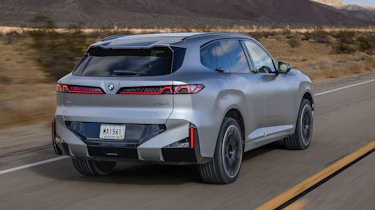
The BMW X5 was the original sporty, driver’s SUV when it launched back in 1999. This ethos hasn’t faltered over the last 27 years and four generations; it still competes for the dynamic benchmark in a segment that also features the Mercedes GLE and Audi Q7, as well as electric rivals such as the Porsche Cayenne and Volvo EX90.
But now there’s a new one. And BMW isn’t putting all its chips on petrol, or even plug-in hybrid. This new X5 is available in diesel, plug-in hybrid and electric guises – there are even pure-petrol and hydrogen versions planned for foreign markets. But does this multi-fuel strategy dilute the model’s appeal, and create a compromised five-seat SUV that’s lost its edge?
Used - available now

2020 Suzuki
Vitara
17,287 milesManualPetrol1.4L
Cash £12,900
2023 Tesla
Model 3 Premium
75,005 milesAutomaticElectric
Cash £19,990
2023 Tesla
Model Y Premium
47,828 milesAutomaticElectric
Cash £23,990
2023 Tesla
Model Y Premium
53,004 milesAutomaticElectric
Cash £23,470Far from it. Building on the success of the smaller iX3, the X5 – and specifically the electric iX5 variant – follows a similar recipe, but with more cabin space and a bigger boot. It gets a huge 141kWh battery for up to 528 miles of range, plus 460kW charging to facilitate super-quick on-the-road top-ups.
Just one version of the iX5 will be offered at launch: the xDrive60. We expect cheaper single-motor and go-faster M models to be added to the range later. The iX5 (and combustion-powered X5) join BMW’s expansive line-up of X-badged SUVs; no coupé-styled X6 or iX6 has been confirmed for the Neue Klasse generation.
Performance & driving experience
Pros |
|
Cons |
|
The iX5’s breadth of ability makes you question the need for a plug-in hybrid or diesel model in this day and age. It’s quick, quiet and fun to drive, and the big battery gives it a level of long-legged motorway composure that’s comparable with this car’s combustion rivals.
| Model | Power | 0-62mph | Top speed |
| BMW iX5 xDrive60 | 570bhp | 4.6s | 130mph |
Electric motors, 0-60mph acceleration and top speed
There is only one version of the iX5 available at launch, but the xDrive60 isn’t lacking punch. The 570bhp, dual-motor powertrain will rocket the 2.8-tonne SUV from 0-62mph in just 4.6 seconds and it’ll keep accelerating up to 130mph where the law allows.
The throttle pedal is easy to modulate, without that snappy sensation that you’ll find in a Tesla or some of this car’s faster EV alternatives. Speed builds alongside a suitably sci-fi backing track; while this won’t be to all tastes, we found it welcome on some of the twistier roads we drove it on – adding important engagement that is missing in more silent rivals.
Town driving, visibility and parking
Our experience of driving the iX5 in town comes with a caveat: we tried it first in southern California, where the roads are wide and the parking spaces designed for trucks with double-wheel rear axles. So while the BMW felt absolutely fine in context, we’ll need to wait until we’ve got the car back in the UK to draw any reasonable conclusions on what it’s like to drive in an urban environment.
That said, the light steering, decent visibility and plethora of parking cameras should mean it’s only marginally harder to park than its iX3 sibling – and no worse than the previous, combustion-only X5.
Country road driving and handling
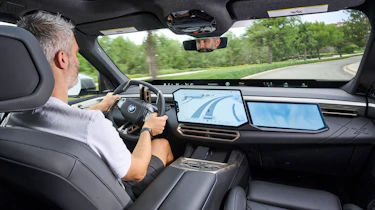
We were really impressed with how the iX5 dealt with country roads during our first drive. Our route took in plenty of elevation and lots of tight switchbacks, which the electric SUV dispatched with ease. Despite its lofty kerbweight, the iX5 never felt anything other than decidedly rapid, while the direct steering and incredible body control gave it a reactive, engaging feel at all times – and not at the expense of ride comfort.
Almost every element of the iX5’s handling is class leading. We’d like easier access to the car’s brake-recuperation settings, however; diving into the infotainment menus feels laborious when some rivals offer steering wheel-mounted paddles for quick, easy access on the fly. Still, the adaptive system is one of the best we’ve tried, meaning you’ll probably not need to play with the modes all that much anyway.
Motorway driving and long-distance comfort
The iX5 is also an incredibly accomplished motorway cruiser. It feels fast and stable at 70mph, and if you’re not careful with the throttle it’ll have you at licence-losing speeds in the blink of an eye. The ride is very good on the whole, although the inherent stiffness that helps the car’s handling when you want to push on also prevents it feeling as fluid as a Volvo EX90 at steady speeds.
During our drive, we found the iX5 (and the petrol 40) to be very refined for the most part. The EV did throw up a bit of road noise, plus some noticeable wind whistle around the door mirrors – something we noticed was better drowned out by the petrol engine in the ICE car.
BMW’s range of advanced driver-assistance systems (ADAS) allows for hands-free highway driving, and is among the better systems we’ve tried. It’s still a little bouncy between the white lines, but if you ratchet back the speed and take it easy, it’d make for a very relaxing way to end the day.
“The BMW iX5 challenges the handling benchmark in the large premium SUV class, feeling amazingly agile for something that weighs so much…” - Richard Ingram, Deputy Editor
Range, charging & running costs
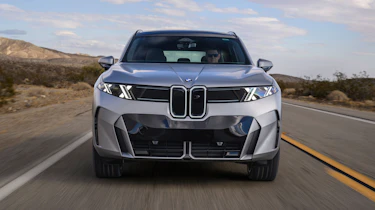
Pros |
|
Cons |
|
It’d be wrong of us to suggest that an £85,000 premium SUV will be cheap to run, but if you can charge at home – or run one as a company car – the BMW iX5 has the ability to put its petrol, diesel or plug-in hybrid rivals to shame. The huge 141kWh battery is too big to fill on an overnight, off-peak tariff, but implement a little-and-often approach, and you could enjoy over 500 miles of range for less than a tenner.
Electric range, battery life and charge time
All BMW iX5s use the same 141kWh battery. The most efficient model (the mid-spec M Sport) claims up to 528 miles of range thanks to its aero body and special wheels. The base model isn’t quite as slippery; BMW says it’ll do up to 512 miles depending on exact specification.
But any concerns that the big battery will take an age to charge are put to rest by the cutting-edge 800-volt electrical architecture. This helps the iX5 to a 460kW peak charge speed, allowing owners to recharge to 80 per cent in as little as 23 minutes. A full top-up will take more than 20 hours via a typical 7kW home wallbox, though.
| Model | Battery size | Range | Insurance group |
| BMW iX5 xDrive60 | 141kWh | 512 miles | NA |
| BMW iX5 xDrive60 M Sport | 141kWh | 528 miles | NA |
Insurance groups
Insurance groups for the new BMW X5 and iX5 haven’t been revealed, but don’t expect policies to be cheap; top-spec cars are likely to sit in the very top groups and typically command four-figure premiums.
Tax
Every version of the BMW X5 and iX5 costs more than £50,000, so no matter what fuels it, you’ll be paying top-rate road tax for the first six years. The EV, however, falls into the very lowest four per cent BiK band (2026/27), which should help lower bills for company car drivers.
Depreciation
Residual value data for the latest X5 hasn’t been released yet, but historically, the model has performed well. The previous version, even later in its life, was claimed to retain 48 to 55 per cent of its original value after three years or 36,000 miles – with the plug-in hybrids resisting depreciation best.
Interior, design & technology
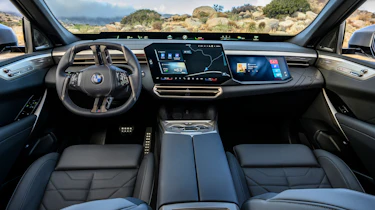
Pros |
|
Cons |
|
If you can separate any subjective opinions about the car’s interior or exterior design, there’s an intuitive and user-friendly SUV lurking within. The technology is first rate, as is the car’s comfort and refinement; the iX5 is proof that if you want a relaxing – and, at times, rapid – driving experience, then electric is the way to go.
At launch, three specifications will be offered: base, M Sport and M Sport Pro. All cars come with at least 21-inch wheels, adaptive LED lights, a panoramic roof and that wonderful full-width iDrive display. M Sport brings a subtly different design, adaptive suspension and beefier brakes with blue calipers, while M Sport Pro adds further dark detailing and bigger wheels.
Interior and dashboard design
The iX5’s dashboard looks to be lifted almost unchanged from the iX3, although there are some subtle differences. We love the Panoramic Vision iDrive display, which runs the width of the dash along the base of the windscreen; it presents the car’s key info within your line of sight, and can be customised to feature everything you need and nothing you don’t.
The main differences between the iX5 and smaller iX3 come when you glance down at the main screen arrangement, which in the larger car is oriented more towards the driver. Our test model also featured the optional £1,300 passenger display, which we found distracting and, by and large, a total waste of money. The £1,400 Bowers & Wilkins stereo is a better investment.
Materials and build quality
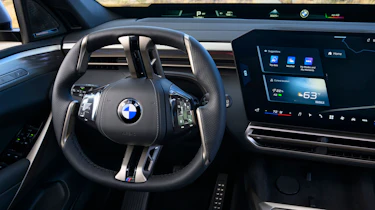
When it comes to material and build quality, the iX5 feels well worth its £80k-plus price tag. There are loads of soft, tactile finishes, and everything you touch feels built to last.
Our test car had the optional (£1,200) automatic doors. This tech, first seen on the 7 Series, has a novelty factor, but its real-world use case puzzled us. More often than not we weren’t standing in quite the right place, which meant the door failed to open fully and we had to pull it for the final few degrees. Simply hitting the brake pedal to close the door is pretty cool, however.
Infotainment, sat-nav and stereo
We lamented the demise of BMW’s rotary iDrive controller when it ceased production a few years back, but the modern alternative is so good we now barely notice it’s gone. The iX5’s main screen is so responsive and clearly laid out that operating it solely via touch is no chore at all. The digital instrument cluster is easy to read and populated with all the data you need, while the innovative Panoramic Vision iDrive system keeps key info in your line of sight.
Yet all of this means the standard head-up display and optional passenger screen are simply surplus to requirements. Neither serves a purpose or function that cannot be completed on the main screen; having videos playing in your peripheral vision is distracting and even the slightest glance will see them paused – much to the annoyance of anyone riding shotgun. A phone or tablet is a better (and cheaper) solution.
While we’ve not used the MyBMW app on the iX5 specifically, our experience with it on other models is almost entirely positive. It’s reliable and has loads of functionality, making it easy to monitor charge progress or pre-heat the cabin on a cold morning.
“Look past the iX5’s polarising aesthetic; the technology hidden within the Panoramic Vision iDrive system is first rate.” - Richard Ingram, Deputy Editor
Boot space & practicality
Pros |
|
Cons |
|
You expect the BMW X5 to be a bigger, more practical take on the X3. Yet in reality, there’s not much in it; the cabin’s a little roomier and there’s slightly more boot space, but there’s no seven-seat option, and up front the cars are all but indistinguishable.
Dimensions and size
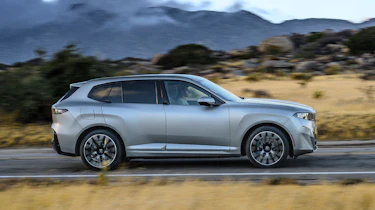
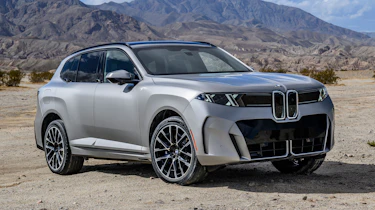
The X5 and electric iX5 are big cars. Measuring very nearly five metres long, the bulbous BMW comfortably competes in the large, premium SUV class. It’s a good chunk longer (212mm) than an iX3, and competitive with its main rivals – the (seven-seat) Volvo EX90 and Porsche Cayenne Electric.
Dimensions comparison | |||
| Model | BMW iX5 | Volvo EX90 | Porsche Cayenne Electric |
| Length | 4,994mm | 5,037mm | 4,986mm |
| Width | 2,000mm | 1,964mm | 1,981mm |
| Height | 1,748mm | 1,744mm | 1,674mm |
| Wheelbase | 3,035mm | 2,985mm | 3,023mm |
| Boot space | 650/1,850 litres | 697/2,135 litres | 781/1,554 litres |
Seats & passenger space
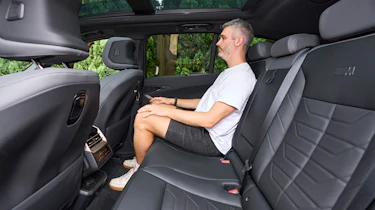
You’ll not be left wanting, whichever of the X5’s seats you choose to sit in. There is plenty of headroom and legroom in the back, although there’s no scope to slide the rear bench back or forth, or recline for greater comfort. Nor is there a seven-seat option like you’ll find in the Volvo EX90; BMW says historical take-up didn’t justify the extra engineering expense on this fifth-generation model.
Boot space
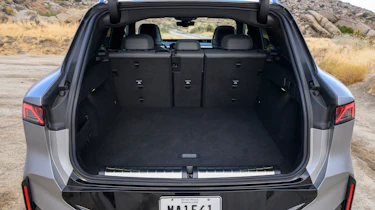
A 650-litre boot is competitive in this part of the market, although on paper, both the Volvo EX90 (697 litres) and Porsche Cayenne (781 litres) are bigger. Still, it’s enough to justify the substantially higher price point versus an equivalent iX3; that car’s 520-litre boot is much smaller and more restrictive if you’re regularly loading your family SUV to the rafters. If you are, however, it’s worth noting that the difference shrinks to just 100 litres – 1,850 litres (iX5) vs 1,750 litres (iX3) – with the rear-seats folded down. A 53-litre frunk gives you an easy place to store the charge cables, too.
Towing
The BMW iX5 will pull an impressive 2,700kg, and strong electric torque available from zero revs (plus xDrive all-wheel drive) will make it an adept tow car no matter the conditions. The big battery should mitigate any range anxiety, too.
“Make sure you check out the iX3 before buying an iX5; you might find the smaller car is plenty practical enough.” - Richard Ingram, Deputy Editor
Reliability & safety
Pros |
|
Cons |
|
The BMW X5 and iX5 are too new to have been tested by Euro NCAP, but historical high scores for the iX3 – and other top-end BMW models – should stand the new car in good stead.
The X5 comes loaded with safety features, including an accomplished and intuitive Motorway Assistant, which offers seamless, hands-off support for highway driving at speeds up to 81mph. We tried it, and found it largely capable, although it did bounce about a bit between the white lines at times. Still, at the end of a long day, we can imagine this kit being a welcome addition to the X5’s capabilities.
BMW has also seen a resurgence in our annual Driver Power owner satisfaction survey in recent years, finishing fifth overall (out of 30) in 2026. A throng of BMWs also featured in our top 50 car rundown, with the 2 Series taking second spot behind the Tesla Model 3. Larger models also earned your praise: the 5 Series came 17th, with strong scores for its powertrain, as well as its infotainment, connectivity and electrics.
| Euro NCAP safety ratings | |
| Euro NCAP safety rating | NA |
| Safe driving | NA |
| Crash avoidance | NA |
| Crash protection | NA |
| Post crash safety | NA |
Buying, prices and deals
- Best buy: BMW iX5 xDrive60 M Sport
If you’re looking at a new BMW X5, the electric iX5 is our pick. It has bags of performance, good refinement, excellent technology, plus strong range and charging specs. Of the available trim lines, we’d opt for the M Sport or M Sport Pro; these cars tend to have the most robust residual values, and include desirable kit including sportier styling and interior flourishes. If you need an ICE model, the forthcoming plug-in hybrid should mix a meaningful EV range with the back-up of a six-cylinder petrol engine. But when the iX5 will do 400-plus real-world miles and charge to 80 per cent in less than 25 minutes, why bother?
BMW iX5 alternatives
There are plenty of alternatives in this part of the market. The Porsche Cayenne Electric is the only car that can truly compete with the BMW iX5 from a dynamic perspective, but rivals like the seven-seat Volvo EX90 are more practical. We’d discount the Mercedes EQE, but the latest Range Rover Sport – also available as an EV – is worth considering.
BMW iX5 pictures
Frequently Asked Questions
BMW still lags behind the competition when it comes to warranty cover: three years, unlimited miles really isn’t good enough in this day and age. Still, customers are content; BMW finished fifth overall in the 2026 Driver Power survey.