Iconic cars of the 1990s: the decade’s greatest high performance heroes together at last
The nineties saw some big changes culturally, but also plenty of star cars. We brought together some of the decade’s icons


There was a lot going on in the nineties. The Internet started to creep across the globe, while mobile phones became smaller and more affordable. In the cinema, blockbusters such as Jurassic Park and Titanic did battle with a new wave of independent movies, such as Quentin Tarantino’s Pulp Fiction, and in the music charts, pop groups battled Britpop, grunge, hip-hop and rave culture for success. Famous names such as Princess Diana, Bill Clinton and Nelson Mandela hit the headlines for different reasons, too, but what about the cars?
There were plenty of vehicular highlights through the decade, and we’ve lined up some of them here for our 1990’s icons test. Each one left a mark that has lasted well beyond its time on sale.
The nineties still saw turbocharging as a performance-car upgrade, whether that was from the factory or as part of the modified scene covered by the likes of Max Power magazine. Electrification was largely the domain of milk floats, while the SUV was just that, a 4x4 with the emphasis firmly on utility. Many production models were still forged in competition, too, with touring cars, rallying and endurance racing all proving a test bed for vehicles that you could theoretically buy in your local dealership. And in Formula One, the deaths of Ayrton Senna and Roland Ratzenberger at Imola during the 1994 San Marino Grand Prix weekend changed motorsport forever.
Used - available now

2019 Volvo
V40
59,730 milesManualPetrol2.0L
Cash £7,812
2019 Vauxhall
Grandland X
73,412 milesManualDiesel1.5L
Cash £8,890
2022 MG
ZS EV
30,146 milesAutomaticElectric
Cash £15,330
2018 BMW
X5 M
22,189 milesAutomaticPetrol4.4L
Cash £39,995The supercar hit another level, first with the arrival of the Jaguar XJ220 just in time for a global recession, and the McLaren F1 then tore up the supercar rulebook.
Did you know you can sell your car through Auto Express? We’ll help you get a great price and find a great deal on a new car, too.
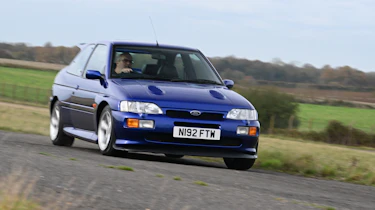
Ford Escort RS Cosworth
Ford has been intertwined with motorsport ever since the dawn of the motor car. Over the years, the brand has enjoyed success at Le Mans, in Formula One, the Indy 500, Nascar, touring cars, and, of course, rallying. The Ford Escort has played its part on the rally stage – it’s where the Escort Mexico earned its name – and in the nineties the RS Cosworth arrived to maximise Ford’s chances on the special stages.
But all is not what it seems, because while the Cossie looks like a Mk5 Escort with a crazy bodykit, under the skin it was essentially a Sierra Cosworth. That car blitzed the opposition in touring car championships, but its size and rear-drive configuration meant the model wasn’t suitable for rallying.
Ford’s engineers added four-wheel drive with the Sapphire Cosworth, but a shorter wheelbase was called for, and so the existing Sierra running gear was squeezed into a shell. It looked like the latest Escort, but in reality only the roof and doors are the same.
The RS Cosworth delivered some success in rallies, but the likes of Toyota, Subaru and Mitsubishi prevented Ford from achieving its goals with the rally programme. In the meantime, the roadgoing version of the Cossie has gone on to earn cult status, making it one of the most desirable and highly valued of all the RS models.
It certainly turns heads, with the deep skirts, wide wheelarches and, of course, that huge rear wing delivering flashbacks to the Max Power era for those of a certain age.
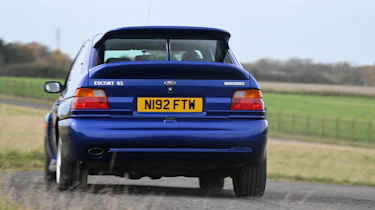
From behind the wheel, the first thing you’re greeted by in right-hand-drive examples is the cramped footwell, courtesy of a big lump in the floor to clear the Sierra running gear beneath. The seat is tall, too, giving you a bit of perch with the dashboard and windscreen scuttle set low ahead of you.
Fire up the Cosworth YB powerplant, and there’s plenty of rattle and noise from this Pinto-derived four-cylinder, and when you pull away, the response is more like that of a Post Office van than a raging rally special.
But once you hit 2,750rpm, all hell breaks loose. The turbocharger spools up and launches the Escort towards the horizon, giving you just enough time to react and slot home the next gear. The ratios are short and the shift isn’t the most fluid, but they do at least keep the turbo spinning and on boost, allowing you to revel in the acceleration.
While the four-wheel drive system gets power to the road, the rear bias to the set-up means the RS Cosworth is more tail happy than you might imagine, while the challenge of keeping the turbocharger spinning to maintain momentum delivers the kind of entertainment that’s much harder to come by with newer performance cars.
| Model: | Ford Escort RS Cosworth |
| Years: | 1992-1996 |
| Engine: | 2.0-litre 4cyl in-line turbo |
| Power/torque: | 224bhp/304Nm |
| Transmission: | Five-speed manual, four-wheel drive |
| 0-62mph/ top speed: | 5.7 seconds/150mph |
| Price new: | £26,750 |
| Value today: | £70,000+ |
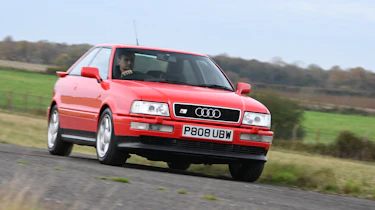
Audi S2 Coupe
The eighties saw Audi demonstrate the value of four-wheel drive in performance cars. But by the time the nineties arrived, the firm wanted to establish itself as a serious rival to BMW and Mercedes. So, the Coupé that arrived in 1991 paved the way for a new generation of Audis.
It was also the basis for the first S performance model, the S2 Coupé that you see here, although it also came as an Avant estate and rare saloon. However, while it was a fresh start, the S2 still had connections with the past. The regular Coupé uses the same platform and running gear as the 80 and 90 saloons, but the S2 turned things up a notch, courtesy of the 2.2-litre turbocharged five-cylinder 20-valve engine and four-wheel drive system from its Quattro predecessor.
One significant change was the styling, with the Coupé introducing a sleeker shape; Audi was focused on efficient aerodynamics at the time, so the clean lines of the Coupé were in-keeping with the rest of Audi’s line-up.
The S2 Coupé is handsomely understated, especially when lined up next to the wild Escort RS Cosworth here. Audi’s heritage model is a particularly fine example: with fewer than 1,800 miles on the clock, it’s barely run in, and it feels as fresh as if it has just left the Ingolstadt factory. That low roof means that taller drivers can skim the headlining when finding a comfortable driving position, but from behind the wheel the S2 has a familiar Audi feel.
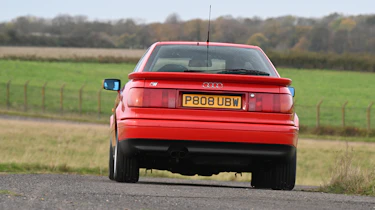
Unlike any modern Audi there are no screens beyond the LCD trip computer and the panel on the cassette deck’s removable fascia. Instead, you get white-faced analogue dials, plus three additional gauges low on the centre console with vital information. Overall, the cabin feels upmarket, with the physical controls offering a tactile feel that’s lacking from newer cars.
Audi’s trademark five-cylinder warble is present, albeit a little subdued. At lower speeds the power-assisted steering is as light as a modern car’s, and the Coupé’s compact dimensions make it easy to manoeuvre. The steering weights up at higher speeds, but isn’t packed with feedback, while four-wheel drive ensures plenty of traction.
The six-speed manual gearbox has a solid, accurate shift, but it’s clear that the Coupé is designed for the autobahn, because the ratios are long. At low revs, it’s all very docile, but things kick up a notch when the turbo comes online at around 3,000rpm, and it feels rapid enough for a 227bhp GT.
The combination is satisfying, and it feels like it could cruise for days while offering up fun when the chance arises.
| Model: | Audi S2 Coupe |
| Years: | 1991-1995 |
| Engine: | 2.2-litre 5cyl in-line turbo |
| Power/torque: | 227bhp/380Nm |
| Transmission: | Five or six-speed manual, four-wheel drive |
| 0-62mph/ top speed: | 5.9 seconds/153mph |
| Price new: | £30,000 |
| Value today: | £26,000 |
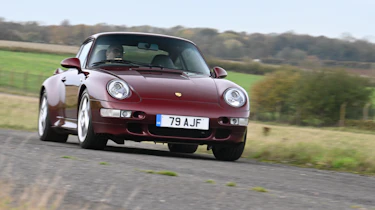
Porsche 911 Turbo
The nineties were a period of major upheaval in the timeline of the iconic Porsche 911. The air-cooled engine was finally put out to pasture in 1998 in favour of an all-new water-cooled unit, but before that happened, the 993-generation car went out with a bang. At the very top of the range, the GT cars are pure-bred racers for the road, while the Turbo and Turbo S versions deliver a more refined performance, but still with plenty of character.
Although the 993 follows the same basic silhouette as the original 911, especially around the roofline and window frames, the smooth front and rear ends added a more modern look.
For the Turbo this was augmented by wider wheelarches and a rear wing that harked back to the original 930 Turbo. Add in the deep Arena Red paint of the car in our pictures (which was also the launch colour of the 993 Turbo), and the car has a look that stands the test of time.
Despite the wider body, the 993 Turbo is still a small car. Even next to contemporaries such as the Audi S2 and Escort Cosworth, it feels compact and low slung, while the snug driving position offers familiar Porsche cues, such as the upright windscreen, thin window pillars and floor-hinged pedals.
The flat-six fires up with a bark before settling into a familiar clattering purr that only an air-cooled motor can deliver, while the car’s controls have a weight about them that reminds you that this is a performance car with purpose. Slot the stubby lever into first gear and the acceleration feels eager from the outset, although the big punch is reserved for around 4,000rpm. That’s when the twin turbos are in full flight, the rear end squats down and the car hurls itself forwards with full power unleashed. It’s quite the rush, and the 993 has a snappy response that makes it feel eager to please, while the flat-six delivers an addictive roar.
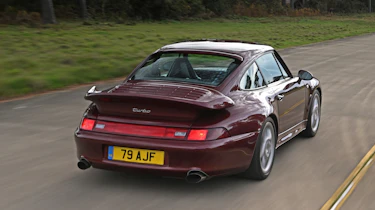
Four-wheel drive offers improved traction when compared with previous 911 Turbos, but this is still a car that needs respect in corners, courtesy of that rear-mounted engine. You can feel the weight of the car behind you, and while the steering provides great feedback, it does feel light.
The 993 Turbo in our pictures is owned by Alan Friedman, who bought the car new. It’s been lightly modified with a performance exhaust and some engine tweaks, but this just helps with its everyday usability, and he’s closing in on 100,000 miles at the wheel.
“I love it,” Alan told us. “I’m not one for keeping a car as a museum piece. I know that once I’m gone, my family will just sell it, so why not make the most of it while I can?” We couldn’t agree more!
| Model: | Porsche 911 Turbo 993 |
| Years: | 1991-1995 |
| Engine: | 3.6-litre flat-six twin-turbo |
| Power/torque: | 402bhp/540Nm |
| Transmission: | Six-speed manual, four-wheel drive |
| 0-62mph/ top speed: | 4.5 seconds/180mph |
| Price new: | £92,000 |
| Value today: | £190,000 |
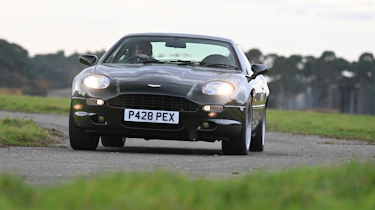
Aston Martin DB7
Looking back at the history of Aston Martin reveals a company that has had plenty of ups and downs, but the DB7 was a car that marked the dawn of a new era for the British luxury marque. However, it actually wasn’t originally meant to be an Aston, because the initial development work was conducted by Jaguar.
You see, both companies were owned by Ford at the time, and when Jag couldn’t make the numbers add up to build a replacement for the XJS, Tom Walkinshaw (whose TWR outfit ran Jaguar’s successful Le Mans sports cars at the time) picked up the project and repackaged it as a new ‘entry-level’ model (for want of a better description) for Aston Martin. And the Jaguar connections didn’t end there, with the DB7 being built at Wykham Mill in Bloxham, Oxfordshire, just after the factory ceased making the Jaguar XJ220 supercar.
Between 1994 and spring 1999, the only engine offered in the DB7 was the supercharged 3.2-litre straight-six we’ve driven here, which again was based on Jag tech: its AJ6 motor. From 1999 the DB7 gained a wailing 5.9-litre V12 that helped set it apart from Jaguar’s XK8, but don’t discount the six-cylinder unit, because it has a wonderful character of its own.
Peak torque comes in at 3,000rpm and you can rev the engine up to 5,500rpm, which doesn’t sound like a particularly wide power band, but don’t forget, this is a five-speed manual with a 165mph top speed, so in typical grand tourer fashion, the gearing is long. The precise-feeling gearshift is a really rewarding aspect of the DB7, too.
There’s also the sound the Aston makes. The supercharger takes over proceedings with a whine that somewhat overshadows the surprisingly burbly exhaust note that has subtle tones of Jaguar’s classic XK six. However, at speed the DB7’s engine is wonderfully smooth.
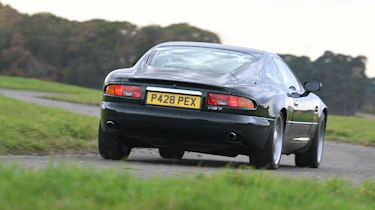
The DB7’s ability as a grand tourer is obvious from the moment you set off. The suspension is noticeably soft and while you feel most of the DB7’s not-inconsiderable 1,725kg weight in the bends, the steering loads up after an initial vagueness at the straight-ahead. Later Volantes and V12 models had a stiffer set-up, but the overall compliance of the supercharged DB7 does give you the confidence that it’ll cross continents without much fuss.
As with any Aston Martin, the way the DB7 drives is only part of the reason you’d have it on your wishlist. On a limited budget from parent company Ford, legendary car designer Ian Callum really came up with the goods when he drew its shape. It’s easy to overlook the rear lights borrowed from the Mazda 323F and various window switches and door handles that also appear in the MX-5 and Escort Cosworth here, because as a whole the DB7 was, and still is, a beautiful machine.
| Model: | Aston Martin DB7 |
| Years: | 1994-1999 |
| Engine: | 3.2-litre 6cyl in-line, supercharged |
| Power/torque: | 335bhp/489Nm |
| Transmission: | Five-speed manual, rear-wheel drive |
| 0-62mph/ top speed: | 5.8 seconds/165mph |
| Price new: | £78,500 |
| Value today: | £24,995 for the car here, available to buy at Stratton Motor Company, Norwich |

Volvo 850
For a completely different take on the nineties performance car, we head north to Sweden and the company that made its name as a safety pioneer. In an attempt to earn some street cred, Volvo went radical, teaming up with the TWR racing team to enter the 850 Estate in the British Touring Car Championship. There was modest success, but the cars themselves became legendary, and the roadgoing version, the 850 T5-R, has earned a similar reputation.
Although the racer had to stick to 2.0-litre Super Touring rules, the T5-R was fitted with a 2.3-litre five-cylinder turbocharged powerplant. Porsche was also drafted in to ensure this front-wheel-drive machine delivered more than just straight-line pace.
Helping it stand out from the rest of the 850 line-up was the Cream Yellow paint of the car in our pictures; while the 850 wasn’t the largest estate sold at the time, this distinctive hue certainly helped to turn heads.
Inside, there aren’t that many clues to the 850 T5-R’s potential. It just feels like a plush, upmarket estate car with plenty of goodies, including leather-and-Alcantara heated seats and a sunroof. The dashboard has lots of buttons handling everything from dimming the dials (you can turn them off completely if you like, which is fun to do at night) to switching between Eco, Sport and Winter modes to adjust the powertrain’s response, and there’s even some wood trim to make it look rather grown up.
As with the Audi Coupé, there’s a muted warble from the five-cylinder engine under the bonnet, while our car also felt restrained due to its four-speed automatic gearbox. If we were buying, the five-speed manual would be our preference, because the auto is pretty slow to respond, which stifles the engine’s 237bhp potential. You can give things a boost by selecting Sport mode, although one benefit of the auto box is that its slow response reduces the risk of tyre-shredding torque steer from a full-power launch.
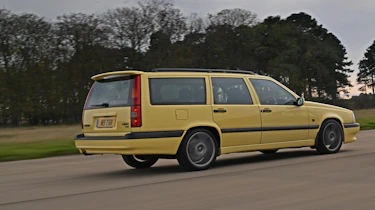
Once up to speed, the engine rumbles away in the background, while the ride is on the firm side, but not enough to cause discomfort for passengers. The 850 T5-R comes from a time when its 17-inch alloys were considered large, and although these wheels and low-profile tyres do add a firm edge, it’s no worse than any modern performance car, so motorway cruising is a doddle.
In corners, there’s some body roll, but it’s well controlled, while getting on the power on the exit of a corner does cause the inside front wheel to spin up, but then that’s a pretty common trait of any front-wheel-drive performance car from the nineties with more than 200bhp to play with. At least the steering has a direct feel and offers enough feedback to let you know what’s going on.
| Model: | Volvo 850 T5-R |
| Years: | 1995-1996 |
| Engine: | 2.3-litre 5cyl in-line turbo |
| Power/torque: | 237bhp/340Nm |
| Transmission: | Five-speed manual or four-speed auto, front-wheel drive |
| 0-62mph/ top speed: | 7.3 seconds/152mph |
| Price new: | £28,840 |
| Value today: | £12,500 |
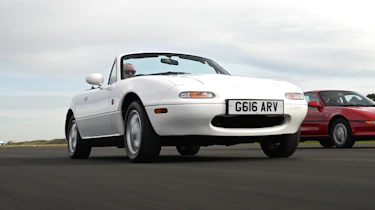
Mazda MX-5
In the world of performance cars, the late eighties and early nineties was witness to an arms race between car makers as they attempted to break the 200mph barrier and then aim for ever-higher top speeds. But in Japan, Mazda took a completely different approach to the idea of making a car that’s fun and entertaining to drive. Using classic British sports cars such as the MGB and Lotus Elan as inspiration, a team of engineers and designers set about reviving the front-engined, rear-drive roadster, and the result has gone on to be the best-selling open-topped two seater in history, the MX-5.
You can see the original MX-5’s inspiration from every angle, with the rounded nose and pop-up headlights taking cues from the Elan, while the proportions would do justice to any number of now-defunct British sports car makers. The first generation was known internally at Mazda as the NA, and when it arrived, buyers couldn’t get enough of its affordable performance. At the end of the nineties the NA was followed by the NB, while the NC and current ND came after that with more tech and space, but one thing that has remained constant is the format of a front-engine, rear-drive set-up that has just enough power to deliver a fun drive.
While the NA is snug inside, especially with the roof up, there is enough space for even tall occupants to get comfortable, while the simplicity of the cabin allows you to focus on what the MX-5 does best – make you smile.
Early cars come with a 1.6-litre naturally aspirated petrol engine, while models from 1994 upgraded to a bigger 1.8 with more power and torque. But whichever version you choose, the combination of a 50:50 chassis weight balance and a relatively modest power output mean the MX-5 is a car that can help sports car novices get a feel of rear-wheel-drive handling without having to do so at breakneck speeds.
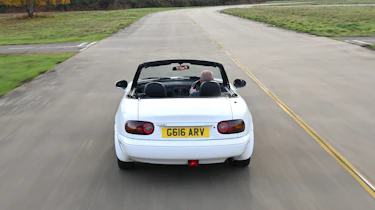
The steering offers good feedback about the road beneath you, while the short throw of the five-speed gearbox is easy to get along with when you want to ensure the engine is working at its best. Even better is the fact the MX-5’s light weight and relatively soft suspension set-up mean it’s perfectly happy dealing with bumpy British B-roads.
With the oldest versions of the MX-5 now more than 35 years old, it’s in the same position today as the MGB was when Mazda first launched its roadster; namely, if you’re looking for a car for a weekend blast that will put a smile on your face for not much cash, you can’t go wrong. It’ll probably be more reliable than an MGB, too.
| Model: | Mazda MX-5 (Mk1) |
| Years: | 1989-1997 |
| Engine: | 1.6-1.8-litre 4cyl in-line |
| Power/torque: | 114-133bhp/136-155Nm |
| Transmission: | Five-speed manual, rear-wheel drive |
| 0-62mph/ top speed: | 8.6 seconds/117mph |
| Price new: | £14,250 |
| Value today: | From £5,000 |
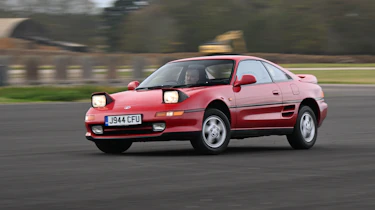
Toyota MR2
While the MX-5 created a new era of rear-wheel-drive sports cars, the Toyota MR2 flew the flag for mid-engined machines. The second generation was sold for the whole of the nineties, and the combination of sporty looks and Toyota dependability meant it was a fairly popular proposition on the new-car market.
Following in the tracks of the wedge-shaped original, the Mk2 (known internally by the model code SW20) was larger and more powerful, while the bodywork was curvier. For most of the nineties, the MR2 was the most affordable mid-engined sports car you could buy.
The smooth lines caused some onlookers to refer to the MR2 as a poor man’s Ferrari, and indeed some MR2s have been sacrificed at the altar of kit cars to make knock off Prancing Horse replicas, but the Mk2 is too good to deserve that kind of fate.
Power for UK cars came from a 2.0-litre naturally aspirated four-cylinder engine that was also used in the Carina E, but the MR2’s mid-engined layout and 156bhp output meant it performed far more enthusiastically here than in the family hatchback. It’s a free-revving unit that offers a linear power delivery, so while there’s no turbo punch as in some of our other hero cars, there’s a constant wave of power, while the five-speed gearbox offers an accurate shift.
One of the most surprising aspects of the MR2 is its comfort. Sure, the five-speed gearbox means the revs are kept high at motorway speeds, and there’s a distinct lack of storage if you’re planning to go away on a trip for two, but the Toyota’s ride is surprisingly comfortable; you’ll be suffering from ringing ears rather than a numb backside after a long trip.
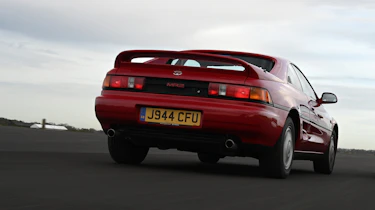
Another highlight is the spacious feel that the cabin offers, thanks in part to the large glass area that incorporates a big wraparound rear window, although this is in contrast to the sea of grey plastic trim inside the Toyota.
And then there’s the handling. Initially the MR2 came in for criticism from some outlets, which claimed that the car’s set-up and mid-engine layout meant snap oversteer was on offer to the inexperienced. However, that’s a criticism that could be levelled at any other mid-engined car of the era (remember that electronic stability control was still in its infancy at the time). Nevertheless, Toyota did make some adjustments to the MR2’s suspension and tyres to help inspire confidence.
Today, the MR2 feels light and nimble, just as a sports car should do, and it’s rewarding to drive on a twisty road; you’ve just got to keep in mind that this isn’t a front-wheel-drive hatch and treat it accordingly. Its revvy engine and fast steering offer plenty of sporty appeal to keep keen drivers entertained.
| Model: | Toyota MR2 Mk2 |
| Years: | 1989-1999 |
| Engine: | 2.0-litre 4cyl in-line |
| Power/torque: | 156bhp/186Nm |
| Transmission: | Five-speed manual, rear-wheel drive |
| 0-62mph/ top speed: | 7.8 seconds/137mph |
| Price new: | £15,400 |
| Value today: | From £3,000 |
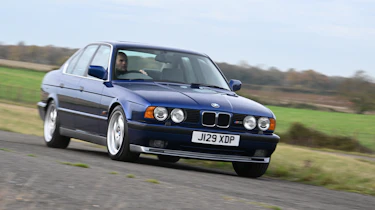
BMW M5
If one car company is known for building roadgoing machines with their roots in racing, it’s BMW. After all, the M badge that’s applied to all of its flagship performance machines does stand for Motorsport. The first E28 generation M5 had racing roots, courtesy of the M88 in-line six it shared with the M1 supercar and successful M635 touring car, but the subsequent E34 M5 changed direction, and created a super-saloon template that has defined a whole class of performance car.
When the E34 was launched in 1988, it hit showrooms in a period when BMW embraced in-line six-cylinder engines. For the new model, BMW fitted its S38 unit, which was an evolution of the M88 and is now regarded as one of the best powerplants that BMW has ever produced. In its final incarnation in the E34 M5 driven here, it certainly impresses. This free-revving, naturally aspirated 3.8-litre unit packs 335bhp and 400Nm of torque, while a crisp-shifting six-speed manual gearbox makes the most of its performance.
Today, the M5 feels like a lithe and compact machine when compared with newer generations. It’s agile when you want it to be, but relaxed when you don’t, and the addition of a sixth gear boosts refinement.
There is a distinct lack of electronic driver aids, which is refreshing when compared with the mobile supercomputer that is the current M5. But the E34’s balanced chassis and precise throttle mean it’s a car that’s easy to control without having to resort to electronic assistance.
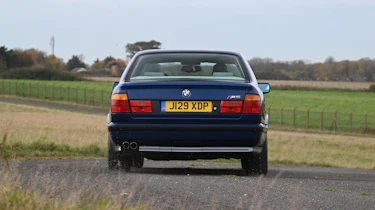
Given that the M5 was the flagship of the range, it featured plenty of luxuries, although there were still numerous options that could be added. One extra missing from the car in our pictures is leather trim – the cloth upholstery of the car here is something of an anomaly where hide was often the default choice, and the chintzy grey fabric plastered everywhere is a bit of a surprise.
The distinctive orange glow of the dials on this generation of BMW feels homely, but rather less impressive is the M5’s On-Board Computer (OBC). With its tiny keypad and single-line matrix display, the OBC was a precursor to the modern trip read-outs found in most new cars, but here it almost feels like an aftermarket upgrade, with too many fiddly buttons and a small display next to the main radio head unit.
Among the defining features of the M5 from this era is its sheer subtlety. Apart from the M badges on the nose and bootlid, deeper bumpers and door sills, plus the large-for-the-time 18-inch alloy wheels (designed to draw cooling air to the brakes), there aren’t many clues to the M5’s performance potential. Find one in a dark colour and the M5 is a genuine Q-car, albeit one that has now been firmly branded as a modern classic.
| Model: | Toyota MR2 Mk2 |
| Years: | 1989-1999 |
| Engine: | 2.0-litre 4cyl in-line |
| Power/torque: | 156bhp/186Nm |
| Transmission: | Five-speed manual, rear-wheel drive |
| 0-62mph/ top speed: | 7.8 seconds/137mph |
| Price new: | £15,400 |
| Value today: | From £3,000 |
Tell us which new car you’re interested in and get the very best offers from our network of over 5,500 UK dealers to compare. Let’s go…