Premium electric SUV supertest: BMW iX3 vs Tesla Model Y, Audi SQ6, Alpine A390 and Lexus RZ550e
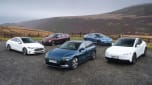
The BMW iX3 has impressed us in isolation, but it has to face up to talented rivals from Alpine, Audi, Lexus and Tesla if it’s to claim class honours

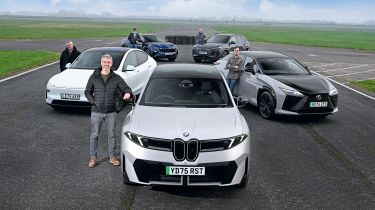
Failure is not an option for BMW’s all-new iX3. It’s the German firm’s most important car for two decades and everything is all-new: its hi-tech digital cockpit experience, pared-back design language, clean-sheet electric motor and battery tech – for a £58,755 starting price. This ‘Neue Klasse’ formula will shape every BMW that follows, from a sleek new 3 Series to the seven-seat X7, plus numerous electric cars sharing its platform. There’s a lot at stake.
Our test car is the iX3 xDrive50 M Sport Pro, with twin motors providing all-wheel drive, a punchy 463bhp in total and a range within a whisker of 500 miles. But it doesn’t exist in a vacuum. Every premium manufacturer has an electric mid-size SUV in its stable, and we’ve brought together the cream of the crop for dynamics, tech, efficiency, interior design and quality.
Top of the guest list is the world’s best-selling electric car three years running: the Tesla Model Y. This one is the Premium All-Wheel Drive (£51,990), which should provide a stern efficiency test for the BMW, as well as edging it in a drag race thanks to the Tesla’s 4.8-second 0-62mph time.
Then there’s BMW’s Bavarian frenemy, Audi, and we’re throwing its flagship SQ6 e-tron quattro at the iX3. Built on the VW Group’s cutting-edge PPE platform, it promises lightning-fast charging and up to 400 miles of range. The SQ6 is also representing Porsche’s electric Macan, which shares its chassis and technology but wasn’t made available for a comparison test. Make of that what you will.
Used - available now

2026 Renault
Clio
7,336 milesManualPetrol1.0L
Cash £14,100
2021 Suzuki
Swift
24,432 milesManualPetrol1.2L
Cash £10,699
2024 Audi
A3 Sportback
27,786 milesAutomaticPetrol1.0L
Cash £20,399
2022 Renault
Arkana
33,255 milesAutomaticPetrol1.6L
Cash £14,199No matter: we have France’s wannabe Porsche brand, Alpine. The niche sports car company’s brand-new A390 GT is all about dynamics, and its intriguing tri-motor layout, pointy steering and sporty suspension set-up should vie with the iX3 for driver appeal.
Finally there’s the recently updated Lexus RZ, complete with yoke-enabled steer-by-wire offering something unique in an overpopulated class.
| Model: | BMW iX3 xDrive50 M Sport Pro | Alpine A390 GT | Lexus RZ550e F Sport Takumi | Tesla Model Y Premium Long Range AWD | Audi SQ6 e-tron Black Edition |
| Price: | £62,755 | £61,390 | £69,995 | £51,990 | £87,650 |
| Powertrain: | 113kWh battery, 2x e-motors | 89kWh battery, 3x e-motors | 77kWh battery, 2x e-motors | 84.7kWh battery, 2x e-motors | 100kWh battery, 2x e-motors |
| Power/torque: | 463bhp/645Nm | 395bhp/661Nm | 402bhp/269Nm | 370bhp (est)/N/A | 510bhp/855Nm |
| WLTP range: | 492 miles | 345 miles | 280 miles | 391 miles | 365 miles |
| 0-62/top speed: | 4.9 seconds/130mph | 4.8 seconds/124mph | 4.4 seconds/112mph | 4.8 seconds/125mph | 4.3 seconds/142mph |
| Size (L/W/H): | 4,782/1,895/1,635mm | 4,615/1,885/1,525mm | 4,805/1,895/1,635mm | 4,790/1,982/1,624mm | 4,771/2,193/1,702mm |
| Buy | Latest iX3 deals | Latest A390 deals | Latest RZ550e deals | Latest Model Y deals | Latest SQ6 deals |
So, can the BMW iX3 live up to its initial rave reviews, beat these talented alternatives and be crowned the world’s best electric SUV? Fine-tooth comb at the ready, we’re about to find out…
Did you know you can sell your car through Auto Express? We’ll help you get a great price and find a great deal on a new car, too.
Performance and driving experience
How did our contenders measure up on the road?
BMW iX3
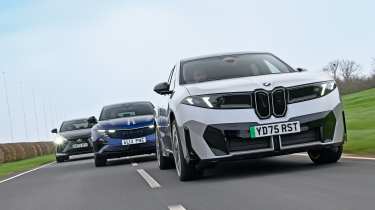
While BMW’s historic ‘Ultimate Driving Machine’ tagline may not feature on its TV ads or media campaigns anymore, it remains core to everything the firm does. An under-engineered estate, bland Z-car or sloppy 7 Series isn’t in the firm’s DNA; every model is designed to be the driver’s choice – and the iX3 should be no different.
First impressions don’t necessarily tally, however. Starting up, you’re instantly struck by how light the steering is. It makes parking and low-speed manoeuvring incredibly effortless – bolstered by the crystal-clear 360-degree cameras – but doesn’t fill you with any sort of confidence that this SUV will handle like one of the maker’s saloon cars.
Yet as soon as you move off, that apparent sense of disconnection evaporates; turn-in is razor sharp and body control is beautifully BMW. Sure, the trade-off for being able to switch direction on a sixpence is a slightly firm ride, but even on 22-inch wheels this isn’t a car you’d call uncomfortable. High-speed refinement is excellent, too – only the Audi comes close for cruising comfort.
It’s easy to overcomplicate things in this new iX3. There are settings for everything – from powertrain response to the widgets found in BMW’s new Panoramic Vision iDrive infotainment system. But we find it best to keep things simple. The adaptive regen is the most accomplished set-up we’ve experienced; BMW reckons it will halt the car in 95 per cent of braking events, bringing the SUV to a smooth stop. Despite its much-vaunted electronic architecture, it’s not perfect – occasionally braking too much or, at times, not enough. A human driver is smoother, especially when you can easily flick the car into ‘B’ mode for a true one-pedal experience.
Alpine A390
The iX3 is wonderfully quiet on the motorway, just like the SQ6. But when we pull off onto twisty roads, the Alpine comes to the fore. With its slippery, coupé-like shape – more on the compromises in practicality later – the A390 doesn’t just look like a sports car, it handles like one, too. Alpine refers to the A390 as a “racing car in a suit”, and on the road it has the substance to largely back that up.
With almost 400bhp, the entry-level A390 GT feels deliciously quick; 0-62mph takes 4.8 seconds, and while it tails off as you breach the national speed limit, holding the ‘OV’ button or keeping the throttle pinned past the kick-down point keeps the car hurtling towards the horizon. Beware though, the brakes could do with a bit more bite; the intuitive and easily adjustable regeneration system does a lot of heavy lifting in everyday driving, but the pedal can feel a bit dead when you really stand on it.
Every version of the Alpine – even this base GT – gets a triple-motor powertrain, with one on the front axle and two at the rear. This unique feature makes the A390 feel decidedly rear-driven, and while it won’t leave you desperately trying to correct surprise oversteer, it does give you that welcome feeling of being pushed through corners. If it’s driving thrills you’re after, the Alpine wins.
Lexus RZ550e
And that’s the beauty of a test such as this; driving these cars back to back does as much to highlight the positives as it does to draw less desirable character traits into clearer light. Jump into the Lexus at 70mph and you’d think all was fine – it’s comfortable, quiet, and in RZ550e guise, pretty damn quick. But this car is as polarising as American politics, thanks to one unique feature.
That is, of course, the yoke-style steering wheel and associated steer-by-wire system. It’s only right to approach these things with an open mind: the world would be very different if everyone had dismissed the original Nissan Leaf or Tesla Model S. But the Lexus and I get off on the wrong foot navigating the drive-thru Starbucks at our early morning meeting point, and it’s downhill from there.
The issues here stem from an eagerness to self-centre. While the set-up doesn’t require much lock, if you let go even slightly it’ll ping back into position and leave you scrabbling around and crossing your arms, desperately trying to regain control before running into the kerb. Also, fixing the indicator stalk to the wheel might work on paper, but in reality it’s overtly fiddly and takes longer than necessary to get your head around. And the tiny paddles for the regenerative braking system are welcome, but they’re too small to access easily on the fly.
Things improve dramatically at higher speeds, where the ergonomic driving position works well with the yoke; it’s no trouble to rest your arm on the door, and the lack of a proper steering wheel gives an unrestricted view of the road ahead. Ultimately, however, the Lexus would be (and is) a much more resolved car with a conventional steering wheel.
Tesla Model Y
If the idea of driving something technically advanced and more akin to a computer appeals, then the Tesla comes up trumps. But it can’t hold a candle to the Alpine for fun, the Audi for comfort, or the BMW for its all-round ability.
It’s easy to see why the Model Y is so popular. It comfortably undercuts the other cars here, yet sacrifices seemingly little when it comes to everyday usability. It’s super simple to just hop in and drive – as soon as you get used to the screen-operated gear selector and minimalist cabin – and you’ll not be left wanting for straight-line speed.
The Premium Long Range’s dual-motor set-up produces an estimated 370bhp, and while its sensitive throttle and ballistic torque make for eye-popping acceleration, this double act – along with a firm and unsettled ride – can make your passengers feel like they’re on a cross-channel ferry. The hyper-sensitive steering offers very little feedback; Tesla – for all its advances in semi-autonomous driving – isn’t a connoisseur in deft-handling SUVs.
Audi SQ6
It’s easy to forget the Q6 in this company. It offers strong comfort and refinement, yet in many ways feels dated – despite having been on sale for less than two years. In SQ6 guise it’s powerful, with immense traction and grip, but you really feel the car’s weight and the steering is numb. There are plenty of reasons to buy it, but not for driving thrills.
Interior design and technology
Which SUV sets the standard with its interior and tech?
Audi SQ6
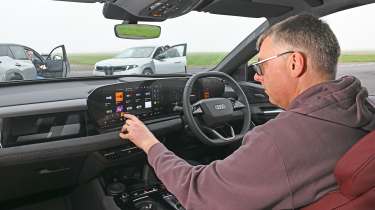
Where the SQ6 does shine is interior quality, design and technology. Audi worked really hard to make its new-generation models more premium and easier to use, and this is very evident in the SQ6’s cabin.
Granted, in this specification you’re not getting much change from £100,000, but even the basic 288bhp, rear-wheel-drive SQ6, which starts at around the same price as the 463bhp, all-wheel-drive BMW (awkwardly for Audi), feels exquisitely trimmed. The thin-rimmed steering wheel is at odds with the chunky offerings that tend to be offered in this part of the market, while the figure-hugging, quilted-leather seats wouldn’t feel out of place in a Porsche or a Bentley. We’re not sure how glossy the piano-black centre console will look after a three-year lease, however.
The Audi’s infotainment may not have the wow factor of BMW’s Panoramic Vision iDrive display, yet its simplicity is a strength. That doesn’t mean it lacks features, but the menus are easy to navigate and the fonts are clear. Audi’s been doing digital instruments longer than most, and it really shows; the SQ6’s Virtual Cockpit features everything you need and nothing you don’t.
The huge head-up display is another highlight, and we love how the speed readout grows in size when you put your foot down, subtly bringing key information into focus. Features like a clip for your phone to stop it moving around in the wireless charging tray further boost usability, but the optional passenger display is nothing more than a gimmick; chances are you’ll use it once or twice.
Tesla Model Y
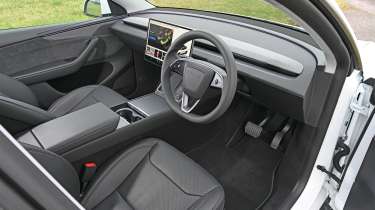
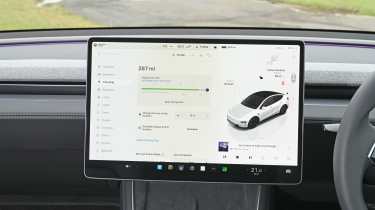
The Tesla, meanwhile, has plenty of screen real estate, but shuns the likes of Apple CarPlay and Android Auto for a native system that puts many legacy car makers’ efforts to shame. Running a super-slick processor, the Model Y’s infotainment screen operates like an iPad, with similarly quick responses and a user-friendly interface.
It’s a shame, therefore, that Tesla persists with a cabin so devoid of character it lacks basic features such as an instrument cluster showing speed and trip information. A head-up display isn’t even an option; all key stats – including speed – can be found on that main screen glued to the middle of the dash. While the cabin as a whole doesn’t feel as premium as those in the BMW, Audi or Lexus, that central touchscreen is rock solid, without any of the creaking you can get from the Alpine’s display.
Alpine A390
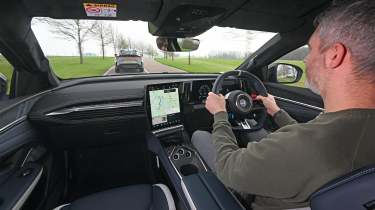
The A390’s infotainment is worthy of mention, though. Running the same Google-powered software as its Renault cousins, the sporty halo brand has done seemingly little to reskin the menus and overall layout. While that’s no bad thing in isolation, we’ve mentioned previously that a little extra sophistication would go a long way to justifying this car’s £60k-plus price tag. The information is clear and the menus are easy to operate, while Google Maps makes it simple to input a route, divert to avoid jams and benefit from EV route planning with optimal recharging stops.
By and large though, the A390 does feel like a step up from its Renault stablemates. Quality up front is good enough to give it a whiff of premium, although things drop off a little in the rear. The design itself is perhaps a little less universal than the more conservative Audi, but the overuse of black and blue materials – plus the lack of a glass roof – means it feels quite dark and dingy inside.
Lexus RZ550e
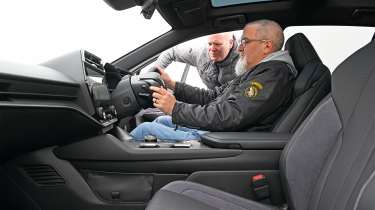
Moving to the Lexus, and ignoring the large yoke-shaped elephant in the cabin, you’re met with a high-quality model that largely justifies its near-£70,000 price tag. The seats are sumptuous and all the controls – bar that steering wheel – operate with a weight and tactility that elevate the RZ over and above the Toyota bZ4X on which it’s based.
The screen is bright and clear, with separate dials for the climate control. You can trigger the parking cameras at the touch of a button, and there are no fewer than three USB-C ports ahead of the wireless charging tray. The Alpine, Audi and BMW have two USB ports up front; the Tesla just one.
BMW iX3
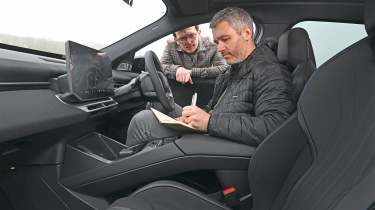
But here’s where things get interesting. Climbing into the iX3 feels like stepping into a car from the future, not something you can go out and buy today. BMW’s Panoramic Vision iDrive system is a game changer, with novelty factor backed up by genuine usability gains versus a conventional instrument cluster or head-up display (which remains an optional extra).
Running the entire width of the windscreen, the Panoramic Vision display is split into two sections with things such as speed, gear selection and battery range ever present right in front of the driver. Its positioning almost directly in your line of sight means your eyes require less time to refocus, and in practice it works brilliantly. The entire left-hand side is dedicated to a series of customisable widgets, showing info like the date, time and weather – plus the car’s AI personal assistant.
It can feel a bit overwhelming at first, especially with the angled central screen containing so much additional info and settings – all of which can be edited to fit the driver’s every whim. But once you’ve set a profile and gone through the various menus – plus downloaded the excellent MyBMW app – it feels remarkably user-friendly.
The one area inside where the BMW doesn’t quite hit the mark is perceived quality. At face value, all is fine, but digging a little deeper we worry about the durability of this new interior.
On our car, the door pulls were showing a series of finger-nail scratches after less than 2,000 miles. You expect more from a £60k car.
Voice-control test
As touchscreens become more complex, car makers have adopted cleverer voice-control systems. To test the five set-ups here, we adjusted the climate control, set the nav and more.
- Alpine: You’d expect a Google-based system to work well, and the Alpine didn’t disappoint. Bringing up opening times as well as the route when we asked for directions to the British Motor Museum was a nice touch, and it even gave us a full verbal weather forecast for the day.
- Audi: Audi’s system was reasonable, without being the cleverest here, but we had a connectivity glitch that stopped the car from looking at the weather forecast, or switching the radio station. Plus the info that came with finding the nearest charger wasn’t as in-depth as others.
- BMW: Not for the first time in this test, the BMW was the most impressive. As well as completing all our tasks without fault and chatting about what else it can do, the iX3 ended by telling a joke. And if you want to know what cars put on their toast, the answer is traffic jam!
- Lexus: The Lexus is the only one here relying on outdated scripted commands rather than conversation. It struggled more than any of the others to understand commands, and couldn’t give a weather forecast. This is definitely an area where Lexus needs to improve.
- Tesla: Tesla has two systems; a longer press of the button takes you from the car’s own system to Elon Musk’s AI set-up, Grok. The first deals with car functions efficiently, and while AI can’t do things like switch the heated seats on, it helps with wider questions.
Infotainment screen test
Each manufacturer has a different approach with its touchscreens, but what are the highlights?
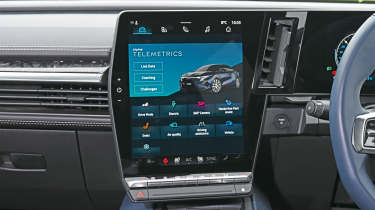
- Alpine: The Google-based system is clean and simple to use, while also offering all the functionality expected. Every model gets a 12.3-inch driver’s display with a range of easily configurable options, along with a 12.0-inch central display that highlights the A390’s sporting pretensions with the likes of lap time telemetry and real-time displays of what the torque system is up to.
- Audi: The 14.9-inch curved screen looks like a piece of theatre, and it’s complemented by one of the best dash displays around, with the Virtual Cockpit system feeling informative and user-friendly. The main screen is slick and logically laid out, but the optional third screen in front of the passenger seems like a gimmick; we’re not exactly sure what you’d use it for.
- BMW: The biggest in-car tech development since the head-up display, BMW’s new car-wide Panoramic Vision display is revolutionary and has lots of configurable function behind the form. The 17.8-inch oblong main screen replaces most of the controls, but does so in a usable way. Its responsiveness, speed and high-quality graphics are really impressive.
- Lexus: The 14-inch infotainment screen is angled slightly towards the driver, and there’s the bonus of dedicated climate controls away from the touchscreen. The yoke steering wheel has a huge number of functions on it, and once you’re over feeling like a pilot thanks to the wheel’s look and buttons, it’s handy to have so many controls within reach without delving into sub-menus.
- Tesla: The cleanest of cabins means almost everything goes through the 16-inch touchscreen, which can be quite an intimidating thing for newcomers when even the forward and reverse drive select are in the corner of the main display. It’s all slick enough, but not having buttons for simple functions means an extra layer of thought until you get used to it all.
Boot space and practicality
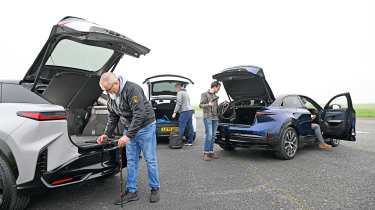
Any SUV worth its salt needs to double as practical family transport – no matter how much power, tech or range lurks within. Thankfully, with the invention of electric-specific platforms, many models now offer more interior space than their predecessors – even if continued new-car bloat means that most mainstream models struggle to fit in your average parking space.
BMW iX3
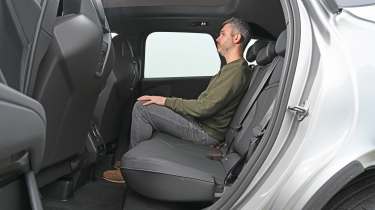
Speaking of bloat: at 4,782mm long and 1,895mm wide, the latest BMW iX3 is longer (to the tune of 115mm) and fractionally wider than an original X5. It feels big, too – arguably the largest of the lot in this company – especially alongside the relatively svelte Alpine and lower Lexus.
But with 520 litres of boot space, the iX3 also has more room for shopping and suitcases than that first X5. The seats fold 40:20:40 to reveal a 1,750-litre load area, and while the parcel shelf is a bit chunky, there’s space beneath the boot floor and a reasonable-size front boot, complete with an over-damped lid to prevent it slamming shut.
Inside, there’s loads of room for odds and ends, with a generous cubby between the front seats and an open area under the centre console. One bugbear is the sporty-looking bucket seats found on M Sport Pro cars; the fixed headrests sit quite low and not all passengers will find them completely comfortable. Yet space in the rear is very generous indeed, and more than a match for any SUV in this area of the market.
Tesla Model Y
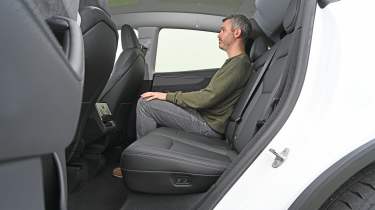
Despite its lower price point, the Model Y straddles segments by offering a huge and usable cabin that elevates it among the family-EV elite. The sloping roofline conceals a generous cargo area, and while Tesla’s figures aren’t completely comparable with those of the other models tested here, there’s no avoiding the usefulness of its deep, wide load bay in terms of pure practicality. A huge under-floor storage area and equally handy storage well beneath the bonnet allow it to keep pace with the BMW, even if some of the materials used feel a lot like fabric-wrapped MDF.
The roomy back seats and novelty rear touchscreen give the Tesla a useful USP, allowing rear passengers to adjust everything from air flow to the heated outer seats. Thankfully, it’ll be just out of reach for smaller children, so they’ll not be able to turn up the K-Pop Demon Hunters soundtrack without your say so. Every car here, including the Model Y, features a pair of USB-C ports in the back to keep phones topped up.
Audi SQ6
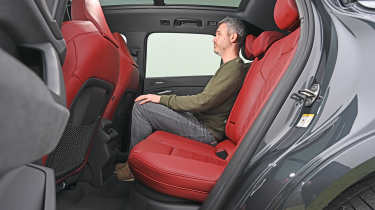
Next up is the Audi SQ6, which at 4,771mm long and 1,939mm wide is almost exactly the same size as the iX3. Inside, it doesn’t feel quite as roomy – be that due to the extra screens, taller dashboard or higher centre console, you certainly feel more cocooned sitting in the Audi. There’s loads of room in the back, though, while the EV-only platform provides a totally flat floor, meaning it’s no chore to sit three across the rear bench.
As in the BMW and Tesla, the rear seatbacks fold 40:20:40 (514 litres quickly and easily becomes 1,517 litres) and this can be done via levers in the boot area – clever, even if you have to walk round and raise them manually unlike in the Model Y. There’s a decent amount of space under the Audi’s boot floor, although part of it was taken up by the subwoofer in our test model. A big storage area under the bonnet gives you somewhere simple to store the car’s charge cables, too.
Lexus RZ550e
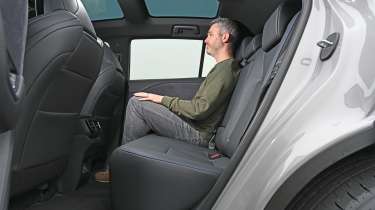
Perhaps surprisingly, given its coupé-like profile, the Lexus feels big in the back. The rear seats fold in a less useful 60:40 configuration, but the foldable parcel shelf is much less bulky than the BMW’s – which means you can store it alongside your luggage at a pinch. Including the generous space under the boot floor, there’s 522 litres to play with – two litres more than you’ll find in the iX3 – but just 1,451 litres with the rear seats folded flat. Yet while there’s space under the boot floor, there’s no room for anything under the bonnet.
Alpine A390
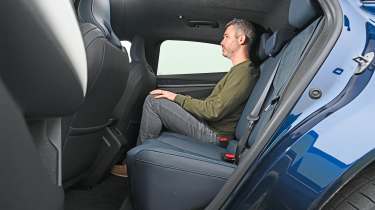
The same is true of the Alpine, which is the runt of this litter when it comes to practicality. You’d probably have guessed that from its shape, but the shortage of space inside is even more pronounced than you might expect, with the dark trim and black headlining making it feel quite claustrophobic at times. The A390’s back seats are the tightest of our quintet; headroom is fine, but legroom is at a premium. There’s no fold-down centre armrest, and the flat seat bases mean you’ll be sitting with your knees around your ears, as well.
The less-than-glowing scorecard continues when it comes to cabin storage, with a frustratingly small lidded cubby between the front seats and a single tiny cup-holder – one more than you’ll find in the smaller A290, at least. There is a 12-volt socket in that storage space, plus a wireless charging pad just below the main screen.
As in the Lexus, the Alpine’s rear seats fold 60:40, but drop them down and it’s the only car here with a step in the floor. The deep 532-litre boot is competitive, but the coupé-like profile and sloping roofline will hamper outright versatility – the 1,643-litre maximum is perhaps more flattering on paper than it is in the real world. At least loading it to the rafters won’t do much to adversely affect rearward visibility; the A390 is a car that would very much benefit from a digital rear-view mirror.
Efficiency and running costs
Not that long ago, a 200-mile real-world range was considered the holy grail – one that even premium EVs from Audi, BMW and Mercedes would have struggled to hit in winter.
But the rate of change has seen expectations shift, and what was 200 miles quickly became 300 – anything with less than that these days is considered a compromised city runaround.
Whether you agree with that or not, at this price point buyers want to have their cake and eat it. So a near-£70,000 Lexus with an official, WLTP-tested range of up to 287 miles immediately falls short – and the reality is a whole lot worse.
Over our controlled test route, where our cars took in a variety of urban and rural roads, plus some dual carriageway just after the morning rush hour, the RZ550e returned only 2.7 miles per kilowatt-hour. Factor in the relatively small 77kWh (72kWh usable) battery and you’re looking at a measly 194 miles of realistic range. At a steady 70mph, it was doing just 1.9mi/kWh, meaning 137 miles of range.
Bigger batteries ensure the others fared better. The BMW equalled the Lexus’s 2.7mi/kWh – nearly 300 miles on a charge. That’s miles off BMW’s 492-mile claim, but the longest usable range of any car here, beating the Tesla to top spot by 10 miles or so.
Crucially, the Model Y was much more efficient. It managed significantly more miles per kilowatt-hour than any of its test rivals; the 3.5mi/kWh average should give 284 miles from a full charge. But Tesla’s refusal to disclose usable battery capacities makes it hard to corroborate this information. For context, the trip readout on our Long Range All-Wheel Drive car model claimed 326 miles at 100 per cent.
Both the Audi and Alpine returned 2.8mi/kWh, but the SQ6’s bigger usable battery (94.9kWh) means it’ll cover slightly more miles before it needs plugging in. By our calculations, the A390 would do 249 miles, with the Audi maxing out at 266 miles.
Bizarrely, on our motorway test the BMW beat all but the Tesla with 3.6mi/kWh, suggesting it’d do 391 miles at a steady 70mph. The Model Y’s 4.5mi/kWh average is little short of witchcraft; if it sustained this rate, the Premium Long Range All-Wheel Drive would come within seven per cent of its certified WLTP range – closer than any of the cars here.
Charging speeds
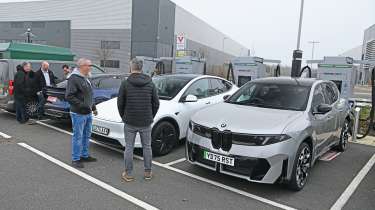
Then comes the small matter of charging, and the cars here couldn’t represent a broader palette of pros and cons. The Audi and BMW both use an 800-volt architecture, promising far faster charging speeds, while the Tesla benefits from unrestricted access to the brand’s brilliant Supercharger network.
The BMW has a claimed peak charge speed of 400kW and is officially the fastest-charging car currently on sale in the UK. The maker says if you can find a punchy enough charger, it’ll replenish 231 miles in just 10 minutes. Officially, a 10 to 80 per cent top-up takes 21 minutes: good going considering the huge, 113.4kWh battery. We saw a sustained 190kW-plus during our time with the iX3; the fastest chargers in the UK are currently capped at 350kW, but the infrastructure is improving.
The Audi, meanwhile, tops out at 270kW. Thanks to the fact the battery is a bit smaller, it too will manage the benchmark 80 per cent charge in 21 minutes – after which you’ll be sent on your way with a theoretical range of more than 200 miles.
The Model Y can charge at up to 250kW, but the true reason to recommend a Tesla is the associated Supercharger network. No longer restricted only to the brand’s own EVs, its integration within the car’s infotainment interface elevates it above almost any EV on the market. Not only will it recommend stops en-route, it pre-conditions the battery for optimum charge speeds (although rivals have caught up on this) and even bills you automatically, without the need to faff with cards or apps. Charging to 80 per cent should take less than 30 minutes.
The Alpine comes fourth, with a published maximum rate of 190kW. Not that long ago that would have put it well in the mix among premium SUVs like these, but now it’s little more than mediocre. Still, Alpine claims that’s fast enough for a 15 to 80 per cent (it doesn’t quote 10 to 80 per cent like the others) top up in around 25 minutes.
The Lexus is last, but after pre-conditioning the battery, easy via the central screen, and plugging in with just nine per cent remaining, we saw it instantly hit its posted 150kW peak. It held this speed for a sustained period and was at 80 per cent within 30 minutes – exactly as claimed.
Reliability and safety
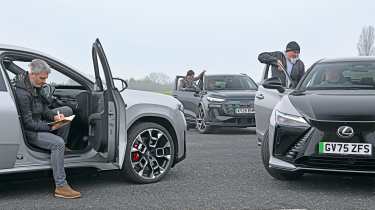
To gauge reliability and safety we crunched Euro NCAP crash-test data and analysed our annual Driver Power owners’ survey, which measures customer satisfaction.
Lexus RZ550e
The brand with the best result in our 2025 Driver Power owner satisfaction poll is Lexus, finishing third out of 31 makers. Our readers rated their cars highly for value, quality and reliability, and sung their praises in the infotainment and interior categories. But the RZ didn’t feature in the top-50 cars rundown.
It’s a few years old now, so the RZ’s five-star Euro NCAP rating must be taken with a small pinch of salt. That’s not to say it’s an unsafe car – far from it – but the assessments are continually changing, with the independent body making it harder and harder to score full marks. Still, 87 per cent in the adult and child occupant categories and 81 per cent in the safety assist section are very good indeed.
The RZ is backed up by one of the best warranties in the business, too. While the basic three-year, 60,000-mile cover is nothing special, the maker will extend it by 12 months (up to 10 years or 100k miles) every time the car is serviced at a franchised dealer.
Alpine A390
Despite only just being launched, the Alpine has already been subjected to NCAP’s latest crash tests. Scoring a respectable four stars, it was awarded 74 per cent in the adult occupant category, 85 per cent for child occupancy protection, and 77 per cent in the safety-assist section. It’s worth noting that like models from parent company Renault, the Alpine features a single button that with a quick double click, can disable some of the most intrusive safety systems – as configured by the driver.
Alpine’s fleet is too small to register in Driver Power but Renault, which shares Alpine software and quality practices, has worked hard to eradicate legacy quality and reliability concerns – owners love the Google-powered infotainment systems, the safety features and the value for money the models offer. But practicality doesn’t score so well; one of our biggest issues with the A390, thanks to that coupé-like sloping roofline and chunky battery pack.
BMW iX3
BMW finished eighth in Driver Power, which is good for a German premium brand. Expectations are naturally high, so the firm will be pleased to see so many satisfied customers. Top-10 finishes for safety, practicality, interior and infotainment all tally well with our view on the latest iX3, although we’re surprised so many owners are dissatisfied with their cars’ powertrains. A three-year, unlimited-mileage warranty is nothing to write home about these days.
It’s too early for any NCAP data on the iX3, but BMW’s history in this area is all but faultless. The latest petrol and hybrid-powered X3 – although unrelated to the electric iX3 – scored the full five stars when it was tested in 2025.
Tesla Model Y
Likewise, Tesla builds some of the safest cars on the planet. A five-star Euro NCAP rating was achieved through strong scores across the board: 91 and 93 per cent respectively in the adult and child-occupancy categories, 86 per cent for vulnerable road users and 92 per cent for the car’s safety-assist features. An 11th-place finish in Driver Power isn’t to be sniffed at, but the four-year, 50,000-mile warranty could be better.
Audi SQ6
Audi has work to do to improve on its lowly 19th place in the most recent Driver Power poll. A number of the brand’s ICE models were in the top-50 car rundown, but none finished higher than 22nd; the outgoing A5 was praised for its value and low running costs, but hammered for its reliability, where it finished 50th. That’s not ideal when buyers only get a three-year, 60k-mile warranty as standard. Still, the Q6 e-tron’s five-star NCAP score should fill family-car buyers with confidence that their car is very safe.
Verdict
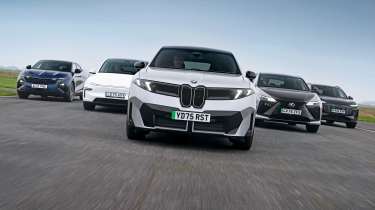
The wooden spoon goes to the Lexus RZ550e. It’s hampered by its small battery and poor efficiency, while its USP, the yoke-style steering system, stands out for the wrong reasons.
By a fine margin, the Alpine A390 GT is the sharpest car to drive. Yet in almost all respects the bigger, bulkier BMW shows it can keep pace for driver appeal. The Tesla, meanwhile, scores with its efficiency and practicality, but the iX3’s strong real-world range and 400kW charging make it just as easy to live with day-to-day.
Then there’s the Audi, which to our eyes has one of the most user-friendly and carefully crafted interiors this side of £100k. Yet the BMW’s game-changing Panoramic Vision iDrive system is both intuitive and experience- enhancing, and instantly relegates the Q6’s cabin down the pecking order.
So let’s cut to the chase: the BMW iX3 stands head and shoulders above its rivals here. Only a couple of minor quality concerns and a firm ride mark the new electric SUV down; in nearly every other category it reigns supreme.
Throw in a price that makes the Q6 look bad value – plus competitive lease deals through the Auto Express Buy A Car service right now – and you’d be mad to overlook the BMW if you’re considering a new premium electric SUV. Because the iX3 isn’t just the ‘Neue Klasse’, it’s best-in-Klasse – and the finest electric SUV you can buy right now.
Which car has the best buying and leasing deals?
In an era where there are very few actively bad cars, and certainly at the premium end of the market, you’d be forgiven for making a decision based on the best deal as much as the best car or your favourite brand. A quick look at our Auto Express Buy a Car service revealed huge disparity in what sort of discount you could hunt down when buying outright, or differences in leasing cost.
The bargain champ is undoubtedly the Audi. While there’s not a lot to be had off the price of the SQ6 we tested, there’s as much as £13,000 off other specs of Q6, taking it below £50,000. At the time of writing, the Lexus RZ was runner-up in the deal stakes at almost £5,000 off the top-spec car tested here, or £3,500 on others, while the Alpine and BMW’s brand-new status meant for now it’s hard to find a deal better than about £600 off the list price. The Tesla Model Y was only available at full list price.
The Tesla was the cheapest to lease, ahead of the Lexus, Audi, BMW and Alpine respectively. The A390 came out at almost double the best we could find for a Model Y’s monthly rate, but that will likely close when it’s more established in the marketplace.
Final rankings
The final places in our premium electric SUV supertest
1. BMW iX3
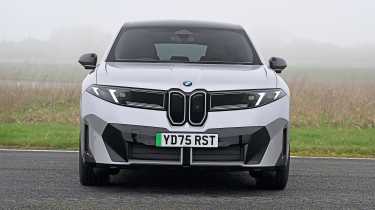
The iX3 beats all-comers in our megatest. It’s practical, great to drive, loaded with tech and decent value in this company. It’s the best mid-sized premium SUV on sale.
2. Tesla Model Y
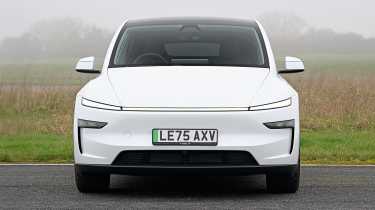
It’s easy to see why the Model Y is so popular. It’s roomy, efficient and loaded with features. It’s a great all- rounder, and a bit of a bargain alongside costlier rivals.
3. Audi SQ6
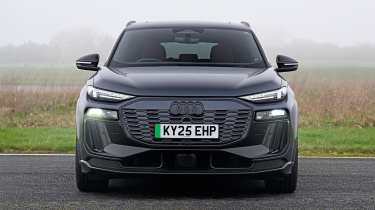
Be careful how you spec the Q6 and Audi’s EV is a great family SUV. It’s quiet, comfy and beautifully built, while the roomy interior and fast charging are big attractions.
4. Alpine A390
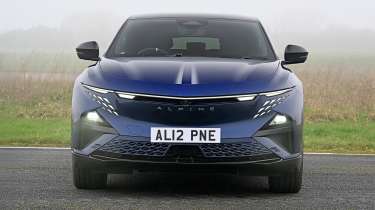
The A390 is an intriguing outlier, and it’s not without its appeal. In many ways it’s quite special, but it feels cramped and compromised alongside traditional SUVs.
5. Lexus RZ550e
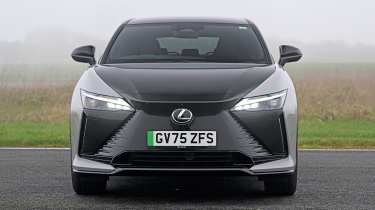
Despite a series of big updates, the RZ is feeling its age. The Lexus can’t compete when it comes to range or charging, and is lacking in other areas, too.
Specifications
| Model tested | BMW iX3 xDrive50 M Sport Pro | Tesla Model Y Premium Long Range AWD | Audi SQ6 e-tron Black Edition | Alpine A390 GT | Lexus RZ550e F Sport Takumi |
| Price as tested | £62,755 | £51,990 | £87,650 | £69,995 | £61,390 |
| Powertrain and performance | |||||
| Powertrain | 2x electric motors | 2x electric motors | 2x electric motors | 3x electric motors | 2x electric motors |
| Power/torque | 463bhp/645Nm | 370bhp (est)/N/A | 483bhp (510bhp overboost)/855Nm | 395bhp/661Nm | 402bhp/269Nm |
| Transmission | Single-speed/4WD | Single-speed/4WD | Single-speed/4WD | Single-speed/4WD | Single-speed/4WD |
| 0-62mph/top speed | 4.9 seconds/130mph | 4.8 seconds/125mph | 4.3 seconds/142mph | 4.8 seconds/124mph | 4.4 seconds/112mph |
| Interior noise at 30/70mph | 84/94dB | 88/93dB | 84/94dB | 83/92dB | 91/97dB |
| Battery capacity/usable | 113/108.7kWh | 84.7/84.7kWh (est) | 100/94.9kWh | 89/89kWh | 77/71kWh |
| Official range/test efficiency | 492 miles/2.7mi/kWh | 391 miles/3.5mi/kWh | 365 miles/2.8mi/kWh | 345 miles/2.8mi/kWh | 280 miles/2.7mi/kWh |
| Maximum charging | 400kW (10-80% in 21 mins) | 250kW (10-80% time N/A) | 270kW (10-80% in 21 mins) | 150kW (15-80% in 25 mins) | 150kW (0-80% in 30 mins) |
| Dimensions | |||||
| Length/wheelbase/width/height | 4,782/2,897/1,895/1,635mm | 4,790/2,890/1,982/1,624mm | 4,771/2,899/1,939mm/1,702mm | 4,615/2,708/1,885/1,525mm | 4,805/2,850/1,895/1,635mm |
| Front door opening (H/W) | 1,035/710mm | 1,050/765mm | 1,055/695mm | 1,030/760mm | 1,010/660mm |
| Rear door opening (H/W) | 1,035/740mm | 1,070/715mm | 1,055/740mm | 980/880mm | 1,145/815mm |
| Rear kneeroom/headroom/elbow room | 565-825mm/965/1,465mm | 645-895mm/970/1,475mm | 600-841mm/945/1,530mm | 560-810mm/915/1,385mm | 695-945mm/885/1,460mm |
| Boot space (front/seats up/down) | N/A/520/1,750 litres | 117/854/2,138 litres | 64/514/1,517 litres | N/A/532/1,643 litres | N/A/522/1,451 litres |
| Boot opening (H/W) | 795/1,075mm | 1,160/1,100mm | 870/1,050mm | 860/1,010mm | 1,045/875mm |
| Boot length/width | 995/1,100mm | 1,075/945mm | 975/1,035mm | 985/975mm | 955/995mm |
| Sill height/boot lip height | N/A/740mm | 429/655mm | 460/675mm (access height) | 420/720mmm | 445/740mm |
| Kerbweight/payload/towing weight | 2,285/540/2,000kg | 1,997/510/1,600kg | 2,350/615/2,400kg | 2,124/481kg/N/A | 2,135/505kg/N/A |
| Turning circle | 12.1 metres | 12.1 metres | 12.1 metres | 11.0 metres | 12.0 metres |
| Costs/ownership | |||||
| Residuals (after 3yrs/36k miles) | £36,774/58.60% | £33,534/64.50% | £41,371/47.20% | N/A | £26,528/37.90% |
| Depreciation | £21,981 | £8,456 | £19,944 | N/A | £21,837 |
| Insurance group/AA.com quote/VED | 44/£1,593/£620 | 43/£1,700/£620 | 50/N/A/£620 | 44/N/A/£620 | 45/£1,819/£620 |
| Three-year service cost | £650 (5yrs) | £0 | £960 (4yrs) | £0 | £0 |
| Annual tax liability standard/higher rate | £376/£752 | £312/£623 | £521/£1,042 | £368/£736 | £420/£839 |
| Fuel cost (10k miles) | £915 | £706 | £882 | £882 | £915 |
| Basic warranty (miles)/recovery | 3yrs (unlimited miles)/3yrs | 4yrs (unlimited miles)/4yrs | 3yrs (60,000 miles)/3yrs | 3yrs (60,000 miles)/3yrs | 3yrs (60,000 miles)/3yrs |
| Driver Power manufacturer position (2025) | 8th | 11th | 19th | N/A | 3rd |
| NCAP Adult/child/ped./assist/stars | Not yet tested | 91/93/86/92/5_ (2025) | 91/92/81/80/5_ (2024) | 74/85/80/77/4_ (2025) | 87/87/84/81/5_ (2023) |
Looking for your next car? You can now search our nationwide dealer network for a choice of great cars on offer right now with new, used and leasing deals to choose from...