Alpine A390 review
Although the new Alpine A390 electric SUV is a treat from behind the wheel, it's far from perfect

Our opinion on the Alpine A390
The Alpine A390 is not your typical premium electric SUV. In the areas you wouldn’t expect a car like this to be good, it shines - it’s engaging to drive, performance is exhilarating, and the design stands out in the sea of identikit rivals. It is, however, lacking in practicality and the all-important premium feel demanded at this price point.
Keen drivers will happily accept the compromise and have a brilliant car to enjoy. More family-focused buyers tempted by the Alpine’s ability and exclusivity may find it a little harder to justify. Regardless, the fact Alpine has created a two-tonne SUV running on electric power that shows obvious connections to its A110 lightweight sports car is to be commended.
About the Alpine A390
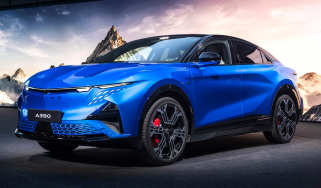
The A390 might be Alpine's first electric SUV but it’s very much an Alpine in terms of its design. This is an all-electric, 4.6-metre-long, five-seat car that’s packing a high-performance electric powertrain, but the body shape is somewhere between an SUV, a coupe, and a four-door fastback. Alpine has dreamed up the term ‘sports fastback’ to try to explain it.
The car’s technical starting point doesn’t make good reading for fans of the high-performance French brand. Unlike the A110 sports car, which features a bespoke all-aluminium structure and platform, the A390 shares more with the Renault Scenic and Nissan Ariya.
Used - available now

2022 Mercedes
GLB
67,262 milesAutomaticPetrol1.3L
Cash £18,250
2014 Audi
A1 Sportback
49,600 milesManualPetrol1.2L
Cash £8,990
2021 Audi
SQ7
92,169 milesAutomaticDiesel4.0L
Cash £35,695
2024 Volkswagen
Golf GTI
38,547 milesAutomaticPetrol2.0L
Cash £22,394However, Alpine has a fine record of taking relatively mundane Renault platforms and producing cars that are a far more interesting proposition to enthusiastic drivers – just look at what it did with the Renault 5-based A290 hot hatch. The A390 is no rebadge job; under the skin, Alpine’s engineers have made the platform their own.
Its electric motors are bespoke, and have been developed in-house to give the A390 the only tri-motor layout in any electric car under £100,000. Its 89kWh battery is also unique to this model and big enough to give it competitive range. There are major changes to the chassis, including a whole new rear section and aluminium suspension components to save weight.
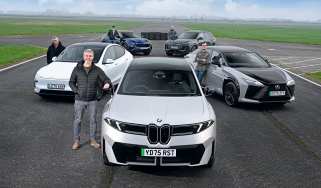
So far, we’ve tested the A390 extensively in GT and GTS forms, and included the A390 in our premium electric SUV supertest.
Alpine A390 prices and latest deals
You might be able to spot a running theme of the three versions of the Alpine A390:
- Alpine A390 GT - from £61,390
- Alpine A390 GT Premiere Edition - from £65,390
- Alpine A390 GTS - from £69,390
This price level firmly pushed Alpine’s Renault and Nissan derived technology into the premium mid-size SUV class. This amounts to the car’s biggest challenge, can Alpine’s special sauce persuade enough buyers that the A390 is a worthy alternative?
Performance & driving experience
Pros |
|
Cons |
|
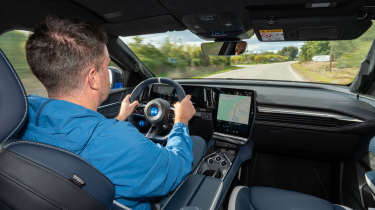
Along with the tri-motor layout and the suspension with its hydraulic bump stops, you get five driving modes: Save (what would be called Eco on less performance-focused cars), Normal, Sport, Perso – where you can choose your personal settings – and Track. They’re selected via a button on the Alpine’s large, thick-rimmed steering wheel, where you’ll also find a tempting red switch marked ‘OV’. This is the overtake boost mode, and it acts a bit like a secondary, thumb-operated accelerator. Hold it down, and you get a boost of acceleration for up to 10 seconds in addition to whatever you’re asking for with the traditional foot pedal, followed by a 30-second recharge time.
Alpine refers to the A390 as a “racing car in a suit”, and on the road it has the substance to largely back that up. The A390 feels light-footed and nimble in a way a Porsche Macan Electric doesn’t, and it seemed to revel in attacking the challenging European roads of our test routes, showing all the class and competency of its sporty Alpine range-mates. It all gives confidence that the A390 has been set up by genuine experts, just like the A110 – it just happens to be a very different package.
Performance, 0-60mph acceleration and top speed
| Model | Power | 0-62mph | Top speed |
| Alpine A390 GT | 395bhp | 4.8s | 124mph |
| Alpine A390 GTS | 464bhp | 3.9s | 137mph |
By having two separate electric motors mounted on the rear axle, the Alpine isn’t just able to double the relative power, it can also divide torque between the wheels independently (no matter which version you go for).
Combined with the front motor, this gives the A390 GTS a maximum 464bhp and the GT models 395bhp. The power figure isn’t exactly groundbreaking in itself, but the way the Alpine can deliver that power together with the torque that’s rated at 650Nm in the GT cars or an extraordinarily high 808Nm in the GTS makes the performance something special.
Some EVs have a torque-vectoring differential on the rear axle to elicit a similar effect. Both the Macan Turbo Electric and the Polestar 3 offer those systems on a dual-motor setup, but the Alpine’s tri-motor layout feels altogether sharper and more responsive. Alpine quotes a 0-62mph time of 4.8 seconds in the GT and 3.9 seconds for the GTS, and we have no reason to question either claim having tested both cars. The GTS seems to be every bit as fast as its on-paper figures suggest, and we found it can put its power down in the wet very effectively, too.
Town driving, visibility and parking
The ride is certainly on the firm side but there’s lots of suspension travel, something that’s not always a given in EVs. The hydraulic bumpstops allow the engineers to make full use of that travel without worrying about bottoming out, and this gives the whole car excellent composure, with the ability to shake off ruts, potholes and speed bumps without getting crashy, even on the 21-inch wheels of the GTS.
At low speeds on rough surfaces, there’s some background jiggle from the suspension in the A390 that becomes more obvious through the seat and steering wheel than you’ll find in less focused and comfier riding alternatives. The A390’s light steering and silent powertrain make it easy to drive in traffic, as does the ‘one-pedal’ driving mode that brings the car to a complete stop.
The brakes could do with a bit more bite; the intuitive and easily adjustable regeneration system does a lot of heavy lifting in everyday driving, but the brake pedal can feel a bit dead when you really stand on it.
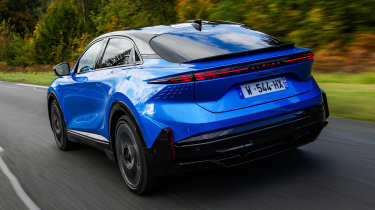
The long bonnet and tail that come as part and parcel of the A390’s coupe-on-stilts styling do make parking a little trickier than it would be in a more traditionally proportioned SUV. We’re told that the rear screen is modelled on a crash helmet visor, and it looks about the size of one when you glance in the mirror or look over your shoulder. At least there is a 360-degree parking camera system to save the day on all models, and the GTS has automatic parking functionality.
Country road driving and handling
This is where the A390 really came into its own, and in our group test against the BMW iX3 and several other rivals, we found the Alpine to be the most fun to drive. The steering is direct, linear and light, feeling perfectly in tune with the overall driving experience. It could have a little more feedback around the straight ahead, but you can feel the road surface and can anticipate the levels of available grip from the front end – not unlike in the A110.
The A390 obviously doesn’t match the A110’s extraordinary fluidity, which is facilitated by that car’s ultra-lightweight body. Instead, the SUV’s firm suspension is primarily focused on the crucial task of controlling the mass – something you can feel as you drive down broken back roads. It does so very well, resisting lean in faster corners but without feeling so rigid that you lose the feeling of connection and fun.
Motorway driving and long-distance comfort
Alpine didn’t want to create an engine noise for the A390 that mimics an internal combustion engine, so what you get when you accelerate hard is a gathering howl, like a hurricane coming down a drainpipe at you. It’s louder at lighter throttle levels in Sport mode, but completely disappears when cruising. You’re left with a very quiet cabin when driving on a motorway, with a little road roar and not a lot else. The ride at speed is pretty slick with the clever suspension more than a match for undulations.
“Accelerate hard out of a corner and you can feel the A390 lean into its outer rear wheel. This helps with traction and creates really enjoyable pointy and almost oversteery feel. It’s not unlike a Mitsubishi Lancer Evo from the late 2000s, which used this type of augmented torque delivery to improve traction and reduce understeer.” - Jordan Katsianis, senior staff writer.
Range, charging & running costs
Pros |
|
Cons |
|
The A390’s 89kWh battery and 400-volt architecture doesn’t match the best in the class for range or charging speeds. You get a heat pump as standard on all models to help you achieve maximum efficiency in colder weather, though.
Electric range, battery life and charge time
On our test drive of the GT model through the hills around Malaga in southern Spain, we did 104 miles on 50% of a full battery charge, which is an average efficiency of 3.75mi/kWh. On the fast, twisty mountain roads, efficiency dropped to around 2mi/kWh, but around town and on slow-moving motorways, we were getting close to 4mi/kWh without trying too hard, and that would exceed the 345-mile WLTP range.
Back in the UK and still in the GT version, we achieved efficiency of 2.8mi/kWh, resulting in a range of 249 miles. In our premium electric SUV group test, the Alpine was way off the BMW iX3’s real-world 391 miles but just behind the Audi Q6 e-tron and Tesla Model Y.
Like the range and efficiency, the Alpine’s charging times are fine but unexceptional. A peak charging speed of 190kW in the GTS means you can expect to replenish the battery from 15 to 80 per cent in 25 minutes or so. The GT has the same size battery but with a different chemistry and offers up to 150kW. Utilise a typical 7.4kW home wallbox charger, and it’s likely to take just over 14 hours to fully recharge an A390.
Charging speeds may not have a huge impact on most owners’ day-to-day life with the car - most will likely charge at home, taking advantage of cheaper overnight electricity rates, and when rapid charging, you’re more likely to be limited by the speed of the charger itself. That said, every rival mentioned above demolishes the Alpine’s 190kW maximum figure, despite their bigger batteries. At least there’s V2L bi-directional charging to power devices and V2G (Vehicle to Grid) capability to help reduce your home electricity bills.
| Model | Battery size | Range | Insurance group |
| Alpine A390 GT | 89kWh | 345 miles | n/a |
| Alpine A390 GTS | 89kWh | 322 miles | n/a |
Insurance groups
The car insurance groups for the A390 have yet to be announced but the performance and price mean it isn’t likely to be a cheap car to insure. The Porsche Macan Electric opens in group 44, and even a Skoda Elroq vRS is in group 37.
Tax
You no longer avoid Vehicle Excise Duty (VED) road tax by buying an EV, and from 2028 there will be eVED pay-per-mile road tax to contend with. The A390 costs only £10 to tax in the first year, and then it’s £200 annually from then on. On top of the standard annual rate of VED, there’s also the luxury car tax on cars costing over the £50,000 threshold. You’re looking at £640 per annum between years two and six to cover that one.
At least company car drivers will enjoy a Benefit-in-Kind (BiK) company car tax rate of just four per cent in the 2026/27 tax year.
Depreciation
Our experts predict the A390 will retain 49 per cent of its value after three years and 36,000 miles. That’s around the same as you get from entry-level versions of the Tesla Model Y and Audi Q6 e-tron, but higher-spec variants of those cars retain their value better - as does the latest BMW iX3, which is predicted to retain 56 per cent of its value on average.
To get an accurate valuation on a specific Alpine A390, check out our free car valuation tool...
Interior, design & technology
Pros |
|
Cons |
|
The Alpine A390 comes with a good haul of equipment as standard, and this isn’t a car where you’re going to have to blow a fortune on options to get it to a respectable specification. Our preferred GT model includes:
- 20-inch diamond-cut alloy wheels
- Heated electric sports seats
- Nappa leather heated steering wheel
- A 360-degree camera system
- 13-speaker Devialet stereo
- 12” vertical infotainment touchscreen
- 12.3” driver’s display
Mid-range GT Premiere Edition models add Sabelt bucket seats, 20-inch matte black alloy wheels, and Alpine ‘Driving Pack’ with hands-free parking, and a 22kW charger for bi-directional charging
Go for the range-topping GTS, and you get all of the above plus 21” forged wheels with Michelin Pilot Sport 4S tyres, Nappa leather bucket front seats with heating and massage functions, a premium Devialet XtremeSound stereo, an Alpine Telematics Expert system, and the Driving and Parking Pack.
The 21” wheels, with their bespoke tyres made by Michelin for the car, and the leather bucket seats are available as options on the GT. There’s also a carbon pack for the interior.
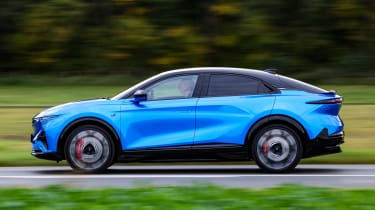
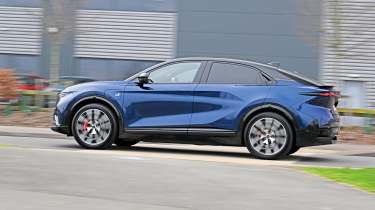
The A390 isn’t a big car. It certainly doesn’t feel as chunky as other premium options, and while the 21-inch wheels and high floor do shout ‘electric SUV’, the body doesn’t. Alpine would like us to refer to its creation as a ‘sports fastback’ rather than an SUV and is keen to point out that it’s a single centimetre taller than the A290 hot hatch.
What you have is like a four-door coupe on stilts with a pronounced bonnet and stretched tail. The high point on the roof just behind the driver’s head and by design or not, this is also a trait found in the mid-engined A110.
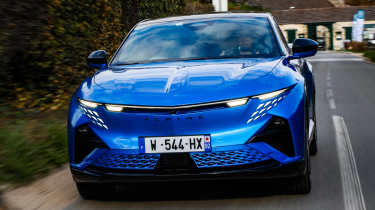
Alpine’s designers have given the nose some concept car-like lighting treatments, with a complex arrangement of four small daytime running-light nubs that reference the quad lights of the A110. These are joined by a lightbar that stretches between them, and there’s also a collection of smaller LED light points below for the full effect; the actual headlights are cleverly hidden in the lower air intakes.
The side is also quite complicated, with some aggressive creases and lines that aim to hide some of the body’s bulk. But to give the A390 strong haunches, Alpine has had to narrow the cabin, reducing interior space. The rear door handles are hidden, while the back end is finished off with yet another light bar, plus a wraparound glass screen that’s better to look at than out of.
Interior and dashboard design
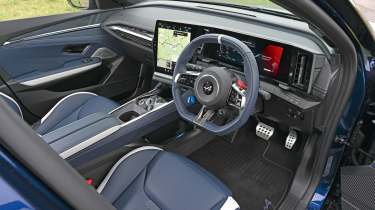
Ultimately, the A390’s cabin lacks the appeal it needs to stand out at this price point. The materials are good, and the leather bucket seats are superb with their wide design offering plenty of side support. Lifting the entire dashboard layout from the Renault Scenic takes away from this car’s individuality, however. It’s not that the screens aren’t good, it just feels like Alpine could’ve done something more special here to make the A390 feel unique.
Materials and build quality
The leather, aluminium and carbon fibre used extensively inside the A390 definitely give the car a premium air. It’s all pretty tasteful and harder plastics only creep in lower down around the door pockets and glovebox. Build quality seemed well up to scratch on our test cars, too.
Infotainment, sat-nav and stereo
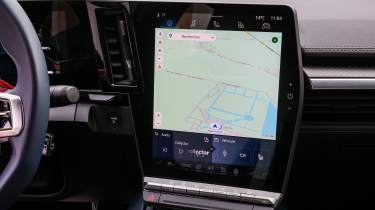
The Google-based software in the Alpine A390 is very easy to use, and there are plenty of toys within, including lap-time telemetry, G-force metres and a real-time view of how the torque vectoring system is distributing the power. The beauty of the set-up is that it keeps the key controls for climate in view along with shortcut buttons for all the main menus. With a bit of familiarisation, it’s very easy to use, and the Google Maps navigation is also top class and is made all the more easy to use thanks to its Google-based voice control system.
We also enjoyed the variety of different options presented by the digital driver’s display. From clear oval dials in the traditional style to mapping screens and tip information, there’s a great range of information in well considered display formats. It all adds to the user experience.
“In the metal, the A390’s design gives it a more dainty look than its rivals. Consider it a gymnast with chunky thighs compared with the Porsche Macan EV’s sumo-wrestler bulk” - Jordan Katsianis, senior staff writer.
Boot space & practicality
Pros |
|
Cons |
|
Space is something of an issue in the Alpine. The rear seats aren’t the most spacious and the boot is only average for the class. Up front there’s a lack of storage for small items, with only one cupholder and a wireless phone charging shelf on the top of the centre console.
There are larger spaces in a surprisingly deep cubby under the central arm rest and below on the centre console’s second tier, but both are dark and not really suitable for small items. It’s the same story with the door pockets, which are deep but a bit narrow, so it’s difficult to get your hand in to retrieve little items that have slipped down inside.
Dimensions and size
The Alpine A390 is not one of the larger mid-size SUVs out there, and its coupe-like body doesn’t make the best use of its footprint. There’s a lot of real estate taken up by the bonnet, tail and side haunches, and this has the knock-on effect of making the cabin feel a little pinched. SUVs with more traditional and boxy proportions, like the Porsche Macan, liberate more cabin space.
| Dimensions comparison | |||
| Model | Alpine A390 | Porsche Macan Electric | Audi Q6 e-tron |
| Length | 4,615mm | 4,784mm | 4,771mm |
| Width | 1,885mm | 1,938mm | 1,939mm |
| Height | 1,532mm | 1,622mm | 1,685mm |
| Wheelbase | 2,708mm | 2,890mm | 2,900mm |
| Boot space | 532 litres | 540 litres | 526 litres |
Seats & passenger space
The front seats are very comfortable but feel a little enclosed by the chunky centre console. It’s possible to get a really good driving position with the amount of adjustment in the seat and steering wheel, but it’s a shame that the seat can’t go a little lower to make things even better.
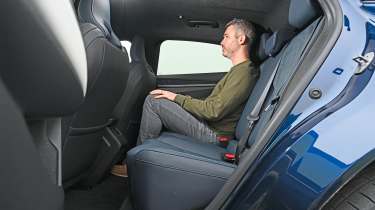
In the rear, things are even more tight by the standards of the class, with compromised head and shoulder room thanks to the sloping roof and narrowing cabin. It’s just about possible for someone of about six feet in height to sit behind their own driving position, but it’s a squeeze.
There isn’t a lot of foot room under the seat, your knees are bunched up by the high floor and pushed into the back of the front seat, while your head is pressed into the roof lining. Kids and smaller adults will have a better time. The A390 is certainly better thought of as a four-seater despite the centre rear seating position having a seatbelt, because the middle berth is very narrow. It’s also quite dark in the back, with the sombre trim, small windows and no glazed-roof option contributing to a gloomy ambience.
Boot space
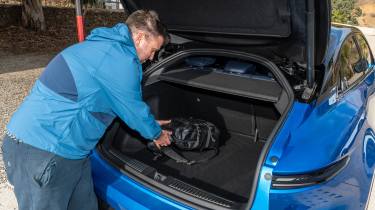
The boot space is less of an issue. It has 530 litres of space, which is about what you’d expect considering the exterior dimensions, and the rear bench does fold to create a bigger load area. There’s a lot of floor space in the boot, making it good for shopping bags, but not that much height for getting boxier items inside. There’s a double floor boot arrangement that can be specified from the options list
While I’m a fan of the prominent gear selector buttons on the centre stack and the tactile steering wheel, these features don’t do enough to make a cabin lifted from the Renault Scenic feel premium enough for a £70,000 car. - Jordan Katsianis, senior staff writer.
Reliability & safety
Pros |
|
Cons |
|
It’s a sad indictment of where we’ve come to with driver assistance systems in modern cars that a key selling point is always how easy they are to turn off. Alpine scores big points here with the My Safety button down to the right of the steering wheel that lets you select your preferred settings with one press. It’s so much more civilised than wading through infotainment screen menus.
The A390 was awarded four stars out of five by Euro NCAP in 2025, which is one star behind key rivals such as the Audi Q6 e-tron, Porsche Macan Electric, and Tesla Model Y. According to Euro NCAP, it was penalised because a door opened during the side impact test, and it lost out on points because some of its warning systems to safeguard vulnerable road users are not on by default. It does come with a comprehensive suite of driver aids to hopefully prevent you from getting into a collision in the first place, though. It’s also too new to have appeared in our Driver Power customer satisfaction survey.
| Euro NCAP safety ratings | |
| Euro NCAP safety rating | Four-stars (2025, Euro NCAP) |
| Adult occupant protection | 74% |
| Child occupant protection | 85% |
| Vulnerable road user protection | 80% |
| Safety assist | 77% |
Buying and owning
Best buy: Alpine A390 GT
The GTS model certainly has strong appeal with its searing performance and faster charging, but you can save around £7,000 by choosing the GT, which will be quick enough for most and be more efficient. It can also be ordered with the excellent bucket seats of the GTS and the 21” wheels with their bespoke Michelin Pilot Sport 4S tyres. That feels like the sweet spot.
Alpine A390 alternatives
The obvious alternative to Alpine’s performance SUV is the Porsche Macan Electric, and you can get one for the same kind of money Alpine wants for the A390 GTS. The Audi Q6 e-tron is very close in terms of price and has a more luxurious cabin, but it can’t match the Alpine’s driving experience. In fact, the A390 is probably the driver’s choice in the electric SUV sector as a whole. The Tesla Model Y Performance is also similar money and ludicrously fast, but not as engaging. The Skoda Enyaq vRS would be a cheaper and more practical option, but it would lack the premium image of the Alpine.
Did you know you can sell your car through Auto Express? We’ll help you get a great price and find a great deal on a new car, too.
Alpine A390 pictures
Key updates of the Alpine A390 review
- 16 December 2025: update to include the 2025 Euro NCAP crash test safety data.