New Alfa Romeo Tonale 2026 review: fashionable but fundamentally flawed
The Alfa Romeo Tonale has style, but that isn't enough to save it from irrelevance in a crowded market.


Verdict
Outpaced both technologically and dynamically, poorly built and quite expensive, the Alfa Romeo Tonale may have some style but that’s not enough to save it from irrelevance in a crowded part of the market. Times are tough for legacy brands such as Alfa Romeo, and that will continue to be the case if it keeps building cars like the Tonale. A replacement can’t come soon enough.
The Alfa Romeo Tonale is a mid-size C-segment SUV that straddles the line between premium and mainstream in much the same space that the Italian manufacturer has operated in since the eighties.
Yet a potentially wide customer base also means fierce competition from all corners of the market, as it rivals cars such as the BMW X1 and Volvo XC40 at the premium end, cheap new Chinese options and the evergreen Volkswagen Tiguan somewhere in the middle.
We first saw the Tonale back in 2022, launched with a pair of hybridised powertrains packaged into a stylish body. However, its technology and inconsistent build quality were immediately considered to be behind the curve. Alfa is hoping this mild mid-life update will address some of the shortcomings, while adding a few new features to sweeten the deal. Prices range from £37,765 for the entry-level mild-hybrid, to just under £50,000 for the Veloce plug-in we’re driving here.
Used - available now

2025 Alfa Romeo
Tonale
25,866 milesAutomaticPetrol1.3L
Cash £20,849
2025 Alfa Romeo
Tonale
6,000 milesAutomaticPetrol1.3L
Cash £25,995
2025 Alfa Romeo
Tonale
12,479 milesAutomaticPetrol1.5L
Cash £22,305
2022 Alfa Romeo
Tonale
9,884 milesAutomaticPetrol1.3L
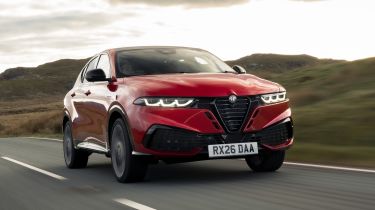
Cash £22,990The first bit of good news is that it has retained its sense of style, as the Italianate design makes its somewhat awkward proportions look good, with scowling headlights and taut bodywork.
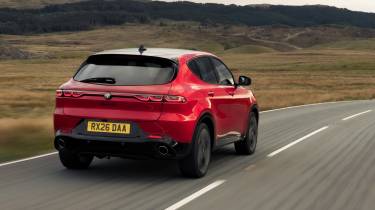
The facelift is subtle but effective, as many of the finer details have been inspired by the brand’s limited-edition, million-pound 33 Stradale, including the new grille and reshaped front bumper. There’s also a new 20-inch tri-spoke wheel design, expressive colour options and optional red leather, all of which give the Tonale more visual impact than many of its more sensible rivals.
However, the limited nature of the car’s mechanical changes means there are still some fundamental issues at play here, and with the capability of its plug-in hybrid rivals skyrocketing in recent years, this part of the SUV market is much tougher now than it was in 2022.
A key protagonist in this class is the Volkswagen Tiguan. This popular SUV has gone up in size, price and sophistication in its latest generation, but is now more appealing than ever thanks to its high-end tech, decent electric range and plenty of space inside. The Tonale, in comparison, offers its buyers very little in the way of advances over the sort of cars being sold 10 years ago.
The plug-in hybrid system of our test car instantly comes under pressure, with a 36-mile EV range that’s way behind the class best, with many rivals offering more than double that figure. Performance is lacking, too; although there is a combined 266bhp from its 1.3-litre four-cylinder petrol engine and two electric motors, unless all three elements are in sync, it can feel quite slow and lethargic.
We’ve also now progressed from a time where asking for acceleration from a PHEV would result in a sea of jolts and noises. Unfortunately, the Tonale hasn’t. Rather than power the wheels, the electric motors seem to drag power off the weedy and rough petrol engine to keep that battery charged. If you switch the powertrain to its dynamic mode and lock the transmission into manual, the Tonale finally does feel just about worthy of its 6.6-second 0 to 62mph time. It’s also handy that you can switch the adaptive dampers back to their softer setting; it’s here that the Tonale feels most complete.
We found it only relatively efficient at low speeds, and with a full battery we did around 60mpg over 120 miles of mixed city and motorway driving. It used half the battery charge in the process for context, but once depleted, a real-world figure between 30 to 35mpg is what you can realistically expect. Compared to the 75-mile EV range of the VW and its capability to easily pull out triple-figure fuel-economy figures with a charged battery in most driving circumstances, the Tonale is just too far behind.
This might be just about acceptable if the driving experience was anything like as entertaining or engaging as its larger Stelvio sibling. But it’s not. It’s not even close. You can literally feel the Tonale’s convoluted development from the moment you turn the wheel. It might look like an Alfa Romeo steering wheel and feature delicious aluminium paddles behind, but turn into a corner and it says Jeep, which is not surprising since this model was built from a mish-mash of Stellantis underpinnings, including the old Cherokee.

Turn into a bend and the body will lean, with the wheels crashing into whatever surface indentation they come across. There’s little composure or sophistication to the ride and paired to the terrible powertrain, there’s no joy to the driving experience. Refinement is also pretty poor, as when the engine’s running, it’s a rattly unit that reverberates through the cabin.
From a practicality perspective, the rear seats are a little narrow and cramped compared to rivals, and the bootspace is tiny, with a 385-litre capacity. There is some storage space under the boot floor for charging cables, but it’s so limited that they won’t easily fit unless they are tightly wrapped together.
The cabin quality is inconsistent, with some fairly low-rent plastics matched to nice leather seats and odd wetsuit-like materials across the dashboard and doors. A poorly placed wireless phone charger takes up a huge proportion of the available storage space, leaving little room for other items such as keys and wallets. The centre cup-holders are fine, but lack variability, and while there is a centre console bin under the armrest, it’s small and awkward to access.
In-car tech is also pretty average in this day and age. The main 10.25-inch screen is bright and has good screen resolution, but it’s not particularly intuitive, as many functions are scattered around the messy interface. It is configurable, though, so with some set-up time this might not be a big issue. We like the design of the digital dial pack, but there’s a latency to it that accentuates just how off the pace this entire car feels.
However, one advantage of this car’s relative age is the cabin’s general usability. We love the dash-mounted switchgear for the climate functions and the DNA drive-mode control, plus those paddle shifters behind the wheel add some Italian supercar flare to an otherwise fairly anodyne segment. But these elements aren’t enough to keep the Tonale from sinking against rivals.
The notion sounds simple, really. To compete in the European mass market, all manufacturers should probably have a C-segment SUV in the range, ideally with some form of hybrid drivetrain. Build this car, make it look nice, and you should have a licence to print money, right?
Not in Alfa Romeo’s case, as the Tonale is an example of what can happen when poor decisions are made at the very start of a new model’s development. With the influx of Chinese brands and a need to diversify between ICE, hybrid and electric, there’s simply no room left in the UK market for mediocrity, let alone outright incompetence.
Did you know you can sell your car through Auto Express? We’ll help you get a great price and find a great deal on a new car, too.
| Model: | Alfa Romeo Tonale Veloce PHEV |
| Price: | £49,460 |
| Powertrain: | 1.3-litre four-cylinder petrol, PHEV, 2x e-motors |
| Power/torque: | 266bhp/470Nm |
| Transmission: | Six-speed automatic, four-wheel drive |
| 0-62mph/top speed: | 6.6 seconds/128mph |
| MPG - CO2: | 98.4mpg - 80g/km |
| Electric Range: | 36 miles |
| Size (L/W/H): | 4,522/1,937/1,614 mm |
| On sale: | Now |