Alpine A290 vs Peugeot E-208 GTi: En garde! A French EV hot hatch duel
We find out whether the new EV hot hatches from Peugeot and Alpine can evoke the same thrills as their legendary predecessors

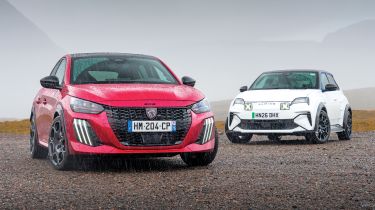
When you have the best roads in the UK at your disposal, you want to pick the right car for the job. But can an electric hot hatch really scratch the itch of the performance car enthusiast? From behind the wheel, the Peugeot E-208 GTi is certainly trying its hardest to be entertaining.
With 277bhp going to the front wheels and a 0-62mph time of 5.5 seconds, it has more than enough firepower at its disposal. Meanwhile, the low-slung bodywork and wheels that are pushed out to each corner mean this model looks more purposeful than a standard 208.
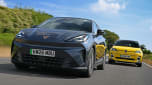
In a straight line, the E-208 GTi is a veritable rocket. With a flex of your right foot, speed builds in an instant, and there’s enough mid-range urge to get you past slower vehicles in the blink of an eye. It’s quite addictive, and is helped on its way by a standard-fit Torsen limited-slip diff. Yes there’s some wheelspin off the line, but the car doesn’t deviate far from the straight ahead in a torque-steering mess, courtesy of its mechanical assistant.
Even when rolling on the throttle from 30-50mph and beyond, you can feel the transmission spool up as it sends power to the front wheels. Thankfully the traction-control light doesn’t flash up quite as readily as it does at lower speeds.
Used - available now

2019 Vauxhall
Grandland X
64,724 milesManualPetrol1.2L
Cash £7,000
2022 MG
HS
45,707 milesAutomaticPetrol1.5L
Cash £13,000
2019 Volkswagen
Touran
33,000 milesAutomaticDiesel1.6L
Cash £15,000
2023 Jaguar
E-PACE
31,459 milesAutomaticDiesel2.0L
Cash £21,420The E-208 GTi is a bit of a hooligan in a straight line, and it makes the rival Alpine A290 feel demure in comparison. That’s not to say that the A290 is slow, though, because a 0-62mph time of 6.4 seconds is still pretty sprightly for a hot supermini. However, its lower 217bhp output means it can deal with its performance in a more controlled manner than the wild GTi. Alpine sticks with electronic torque control instead of adding a limited-slip diff, but in a straight line there’s only a hint of slip from the front wheels, as the tyres hunt for grip and the steering wheel gently writhes in your hands.
Peugeot proudly boasts that the E-208 GTi has the best power-to-weight ratio of any car in its class – we can only assume that’s the wider supermini sector, because 182bhp per tonne doesn’t really push the envelope for a hot hatch. Either way, it delivers stronger electrical punch than the Alpine.
Did you know you can sell your car through Auto Express? We’ll help you get a great price and find a great deal on a new car, too.
208 GTi: Squeezing hot hatch thrills from an EV
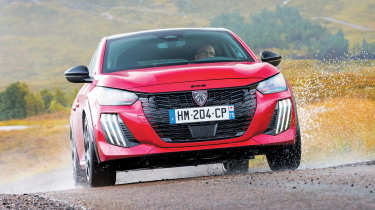
Of course, a hot hatch has to be about more than straight-line speed, as the 205 GTi proved with its sweet handling that helped it earn classic status. However, in the modern world of electrification, most manufacturers – with a couple of notable exceptions – are still searching for the Holy Grail of a fun-handling electric car.
Peugeot Sport took the basic E-208 and stripped it back to create a bespoke set-up for the GTi that would help to extract the most from a chassis which is no longer at the cutting edge of the class. There’s a 25mm-lower ride height than in the standard model, the front and rear tracks have been widened by 56mm and 28mm respectively, and there’s a unique geometry set-up, too. Completing the configuration at each corner are distinctive 18-inch wheels that are shod with grippy Michelin Pilot Sport 4S tyres.
There’s also a new steering rack that’s connected to the familiar polarising steering wheel that’s part of the 208’s i-Cockpit layout. This complete package creates a car that offers a lot of grip and an agile chassis, but which lacks the delicacy of an old-school hot hatch mainly because of the inherent weight of the drive battery.
Tipping the scales at roughly 350kg, or about a third of the weight of a 205 GTi, it’s a significant mass to carry around. On top of that, you have all the mod cons and safety kit that a premium supermini is expected to come with, meaning the 208 GTi ultimately weighs 1,535kg, or the equivalent of three 205 GTis. That’s a lot of mass for the car’s suspension to deal with.
Thankfully it handles the weight well, with a ride that is surprisingly pliant for a performance machine. The low stance and battery location combine to deliver flat and stable cornering, and there are absolutely no worries about grip from those excellent Michelin tyres.
It’s the steering that takes some getting used to, however, with the small size of the wheel being the first thing you need to get your head around.
The compact rim feels sporty in your hands, yet the system’s weighting is inconsistent. It is heavy around the centre, but in the middle of a fast bend the rack is quick to react and responds well, allowing you to adjust your line with ease. Excellent traction on the exit of corners sees the Peugeot fire down the straights with the minimum of fuss.
A290’s weight and power penalty shrugged-off
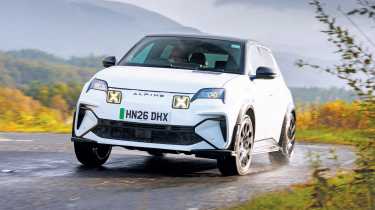
In comparison, the Alpine A290, with its relative shortage of power, feels more measured and precise on a flowing road. There isn’t the overtaking surge that is so useful in the GTi, but then the tyres (in this instance even higher-spec Michelin Pilot Sport 5S rubber) never feel overwhelmed by the power on offer.
As with Peugeot, Alpine has re-engineered the basic model – in this case the Renault 5 E-Tech – and added suspension that is designed to deliver a sharper drive. The makeover isn’t quite as radical as its competitor’s, but then the R5 is a pretty fun machine to drive in the first place. The A290 adds a new front subframe and revised geometry, while the car’s track is 60mm wider both front and rear.
When attacking a particularly twisty, undulating B-road we could place the Alpine with confidence, and the larger steering wheel offered more information about what the front tyres were doing.
Weight is a slightly bigger issue for the Alpine than it is the Peugeot, with 1,554kg to haul and less power to move it. But as with the E-208, the A290 hides its mass well, and the car’s torque-vectoring electronics do a good job of keeping the nose tucked into a corner.
The grippy tyres help the front end deliver plenty of bite, too, allowing you to push that little bit harder in the knowledge that the rear will stay in line unless heavily provoked. As with the E-208 GTi, the sheer amount of grip lets you push quite hard, but it also means both cars lack the delicate and playful balance that made past masters such as their 205 GTi and Renault 5 GT Turbo ancestors so popular.
A hot hatch without a gearbox?
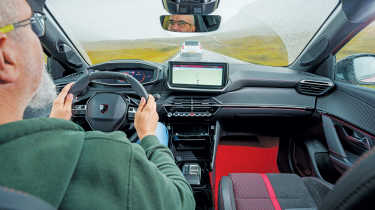
While these electric hot hatches undeniably deliver enjoyable handling, there’s one element that continues to hold them back in terms of hot-hatch entertainment, and that’s the lack of a gearbox. Whether it’s a traditional manual or a twin-clutch semi-auto, any petrol-powered performance model gives you a sense of involvement that an EV simply can’t match. Other manufacturers of performance EVs, including Hyundai and Kia, have dabbled with virtual gearchanges to boost engagement, but there isn’t any such innovation here.
Instead, there are drive modes that sharpen or soften the throttle response, with the Peugeot offering Eco, Normal and Sport modes.
We wonder how often you’ll be switching between the settings, though, because the only obvious change is the snappiness of the throttle response, while the predicted range goes up or down by 10 miles, depending on which setting you choose.
The sound of science
Fake engine noises are designed to give back some involvement, although the results won’t be to all tastes. To compensate for the lack of gearchange, Peugeot has created a soundtrack that adds layers of tone as you accelerate with a mix of a bassy rumble and an electronic element, although how enjoyable this will be is down to personal opinion.
Indeed, we’re so used to EVs delivering rapid acceleration in near silence that we’re not convinced it really adds anything. Having said that, both cars weren’t completely silent with their sound generators deactivated, producing an electrical whine reminiscent of the noise made by Ford fuel-injection systems in the eighties.
While B-road performance isn’t quite as lithe and assured as in an older hot hatch, the E-208 GTi and A290 deliver a greater breadth of ability that’s a benefit of their respective EV powertrains. With maximum torque available from a standstill, both offer a flexible response at all speeds as well as the kind of effortless and capable cruising that’s usually only available in far larger machines.
The Peugeot wears 18-inch wheels wrapped in low-profile 40-section tyres, but hydraulic bump stops within the suspension mean they have less of an impact on the car’s ride than you might expect. Although some past hot hatches have been so hard that they necessitate a visit to the chiropractor, the 208 GTi is firm yet compliant, with only the biggest bumps causing upset. Tyre roar is evident on rough surfaces, though, which spoils cruising ability.
In comparison, the Alpine is better still, despite its even bigger 19-inch wheels. It, too, has the hydraulic bump-stop solution, and there’s also superior noise insulation, while strong mid-range torque helps it to feel just as flexible as the Peugeot.
How far will they go?
Perhaps the biggest elephant in the room with any electric performance car is driving range. Here at Auto Express, we have become accustomed to recommending a mid-specification model with a big battery, because this is often the car with the longest range. However, that’s not possible with the GTi, because it’s the only version of the E-208 that uses this particular powertrain. The existing electric supermini offers a relatively short range when compared with its contemporaries, while Peugeot claims a total of 219 miles for the GTi.
You can increase this to 234 miles by swapping to less extreme Hankook Ventus S1 Evo 3 rubber at no extra cost, but that feels like it defeats the object of buying this hot model.
There’s a 225-mile range for the A290 in GTS guise but, surprisingly, choosing the lower-powered 175bhp model unlocks only a couple more miles of range at best. Of course, these official figures are on the WLTP test cycle that favours conservative driving. As soon as you tap into either car’s full performance potential, the range estimates are going to head south pretty quickly.
During our time with the Peugeot and Alpine, which involved a relatively small amount of hard driving – certainly a lot less than we would undertake if we were conducting a test of petrol hot hatches – we saw figures around the 3.3 mi/kWh mark, which means a range of less than 175 miles.
And that simply highlights one of the issues that still marks out the conundrum of the electric performance car. Yes, instant torque and snappy acceleration are great, but when you’re seeing a modest 200 miles from a charge (or much less if you’re driving hard), range anxiety is likely to be a distraction that will play on your mind when you are trying to enjoy the drive.
There are now more public chargepoints than ever across the UK, but when the country’s most enjoyable roads are in remote locations, you probably don’t want to waste time parked up, waiting to get out of there so you can carry on having fun. Factor in that these two models have a maximum DC charging speed of only 100kW, and you’ll be spending a while waiting between drives.
Nods to the hot hatch gods
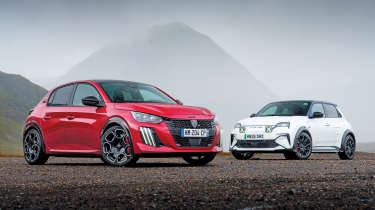
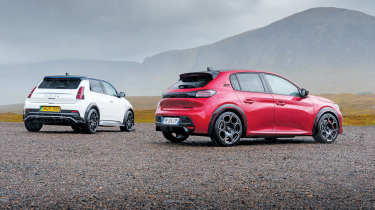
The 208 GTi offers a very different driving experience to its predecessors, but Peugeot has at least tried to inject some nostalgia for its past models into the car’s looks. Those ‘phone-dial’ alloy wheels take inspiration from the rims fitted to the original 205 GTi 1.9, while the gloss-black wheelarches feature red pinstripes in lieu of the fact there are no rubbing strips on the doors to add GTi-style stripes to. There’s more red detailing for the badge on the nose, the grille and within the headlamps, and Peugeot’s trademark three-claw daytime running lights and a redesigned lower bumper enhance the look.
The manufacturer has missed a trick at the back of the car, where there is E-208 GTi lettering on the C-pillars, but it doesn’t match the style of the 205 GTi’s badging. Overall, aside from the lowered stance and wider track, the E-208 GTi doesn’t look different enough to mark it out from top-spec versions of the standard E-208.
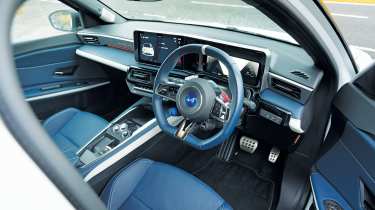
It’s inside where there are more radical changes, starting with distinctive bright-red carpets and floor mats that hark back to the original GTi. Red seatbelts and unique asymmetric upholstery styling with red details are also included, while the sports seats feature a more figure-hugging design than the standard chairs.
But this contributes to one of the biggest compromises of the E-208 GTi; the i-Cockpit cabin layout. The small steering wheel is designed so you can see the dials above the rim, but it also means you might not be able to set your ideal driving position without having to move the wheel every time you get in or out of the car.
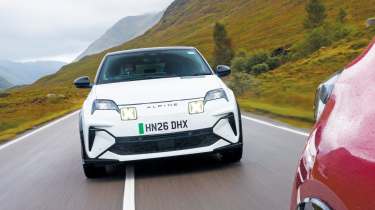
While the Alpine’s silhouette is the same as the normal Renault 5’s, plenty of racy touches have been added. The foglight-style daytime running lights are appealing, while the car’s wider track is covered by extended wheelarches that blend into deep door sills.
The cabin layout is far more conventional than the E-208’s, and there are a few cues that are carried over from the Renault 5, albeit with an Alpine theme. All models come with a multifunction steering wheel with a Formula 1-style rotary control that selects different levels of energy recovery, while a bright-red overtake button also features.
These elements are part of a modern cabin that edges ahead of the E-208’s dated one. The Google-sourced software is more intuitive than Peugeot’s set-up, while sharper displays and easily configurable safety systems are welcome, too.
At just under £35,000, the Peugeot E-208 GTi is good value when compared with the top-spec A290 GTS at £38,000. However, Alpine’s three-model line-up offers scope to make savings by doing without some of the top model’s premium kit.
Verdict
After all that there had to be a winner…
Winner: Alpine A290 GTS
| Model: | Alpine A290 |
| Price (before Electric Car Grant): | £37,995 |
| Powertrain: | 52kWh battery, 1x e-motor, 217bhp |
| 0-62mph: | 6.4 seconds |
| Test efficiency: | 3.3 miles/kWh |
| Official range: | 225 miles |
| Annual VED: | £200 |
Both of these contenders highlight the potential of an electric powertrain in a hot supermini, but it’s the Alpine A290 GTS that takes victory here. It feels better resolved than the Peugeot E-208 GTi, and its relative lack of power doesn’t handicap its ability to put a smile on your face. Just don’t expect to be travelling a long distance to get your driving thrills.
Runner-up: Peugeot E-208 GTi
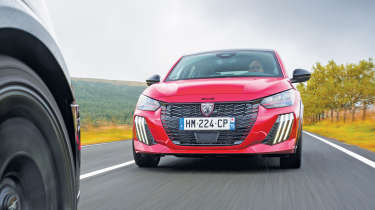
| Model: | Peugeot E-208 GTi |
| Price (before Electric Car Grant): | £34,995 |
| Powertrain: | 54kWh battery, 1x e-motor, 277bhp |
| 0-62mph: | 5.5 seconds |
| Test efficiency: | 3.4 miles/kWh |
| Official range: | 219 miles |
| Annual VED: | £200 |
Does the Peugeot E-208 GTi carry the spirit of the 205 GTi in its DNA? In a word, no. It’s too heavy to emulate its ancestor for handling finesse – but what it does deliver is reassuring grip, sharp handling and impressive straight-line speed. As with the Alpine A290 GTS in this test, driving range will be an issue if you try to make the most of the 208’s performance.
Prices and specs
| Model tested | Peugeot E-208 GTi | Alpine A290 GTS |
| Price from/as tested (before ECG) | £34,995/£35,945 | £37,995/£38,175 |
| Powertrain and performance | ||
| Powertrain | 1x electric motor | 1x electric motor |
| Power | 277bhp | 217bhp |
| Torque | 345Nm | 300Nm |
| Transmission | Single-speed/FWD | Single-speed/FWD |
| 0-62mph/top speed | 5.5 seconds/112mph | 6.4 seconds/106mph |
| Battery capacity/usable | 54/51kWh | 52/52kWh |
| Official range | 219 miles | 225 miles |
| Test efficiency/range | 3.4mi/kWh/173 miles | 3.3mi/kWh/172 miles |
| Maximum DC charging | 100kW (20-80% in 27 mins) | 100kW (15-80% in 30 mins) |
| Dimensions | ||
| Length/wheelbase | 4,100/2,556mm | 3,997/2,534mm |
| Width/height | 1,765/1,405mm | 1,823/1,512mm |
| Front door opening width/height/sill height | 660/910/405mm | 490/955/465mm |
| Rear door opening width/height | 655/910mm | 765/850/500-750mm |
| Rear knee room/headroom/elbow room | 490-730/905/1,355mm | 500-750/875/1,365mm |
| Boot opening width/height | 895/740mm | 980/710mm |
| Boot space (front/seats up/down) | NA/342/1,118 litres | NA/300/1,106 litres |
| Kerbweight/payload/towing weight | 1,535/452kg/N/A | 1,554/471/500kg |
| Turning circle | 10.3 metres | 10.2 metres |
| Costs/ownership | ||
| Residual value (after 3yrs/36,000 miles) | £12,257/34.1% | £17,942/47.0% |
| Depreciation | £23,688 | £20,053 |
| Insurance group/quote/VED | 37/£593/£200 | 29/£521/£200 |
| Three-year service cost | £0 | £504 |
| Annual tax liability std/higher rate | £279/£559 | £303/£607 |
| Annual fuel cost (10k miles) | £768 | £791 |
| Basic warranty/recovery | 3yrs (60,000 miles)/1yr | 3yrs (60,000 miles)/3yrs |
| Driver Power manufacturer position | 7th | N/A |
| NCAP Adult/child/ped./assist/stars | 91/86/56/71/4 _ (2019*) | 80/80/76/68/4_ (2024) |
| Equipment | ||
| Metallic paint/wheel size | £750-£950/18 inches | £700-£1,100/19 inches |
| Parking sensors/camera | Front, rear & side/360-degree | Front, rear & side/rear |
| Spare wheel/Isofix points | Repair kit/two | Repair kit/three |
| Keyless entry & go/powered tailgate | Yes/no | Yes/no |
| Seat upholstery/leather | Mix/no | Nappa leather/yes |
| Heated seats/steering wheel | Yes/yes | Yes/yes |
| Screen size/digital dashboard | 10.0 inches/10.0 inches | 10.1 inches/10.3 inches |
| Climate control/panoramic sunroof | Yes/yes | Yes/no |
| USBs/wireless charging | Four/yes | Two/yes |
| Wireless Apple CarPlay/Android Auto | Yes/yes | Yes/yes |
| Blind-spot warning/head-up display | Yes/no | £300 pack/no |
| Adaptive cruise/steering assist | Yes/yes | Yes/yes |
Get the latest and best car news and reviews, first! Follow Auto Express on Google today