Range Rover Electric review
The electric-powered addition to the Range Rover line-up accentuates the SUV’s core qualities and forces precious few compromises


Our opinion on the Range Rover Electric
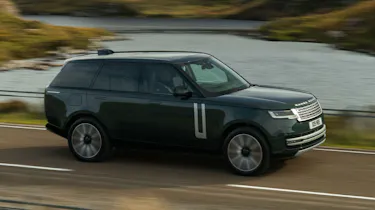
Electric power is not the answer to everything, but adding it to the Range Rover genuinely enhances the car’s unique skillset. This new version is like the model launched back in 2022 but quieter, more composed, more capable off road and cheaper to run. The 330-mile real-world range might curtail the long-distance ambitions of some customers, but the Range Rover Electric will be the pick of the line-up for the majority of buyers, and it’s a line-up that no luxury SUV rival can match.
About the Range Rover Electric
The electric Range Rover was a long time coming but four years after the launch of the fifth-generation car it has arrived to complete the powertrain line-up. The Range Rover Electric is offered only in mid-range Autobiography, plush First Edition and sporty SV trims but it’s priced from £154,000, which is £13,000 more than the equivalent plug-in hybrid.
On paper the Range Rover Electric makes a powerful case for itself. This is a powertrain designed, engineered and built in-house at Jaguar Land Rover, in the UK. Technically, it underpins this EV Range Rover, the Range Rover Sport Electric and even the Jaguar Type 01, but in reality significant changes have been to give it a unique character in each car. In almost all other respects, though, the Range Rover Electric is very like any other Range Rover, which is very far from a bad thing.
Performance & driving experience
Pros |
|
Cons |
|
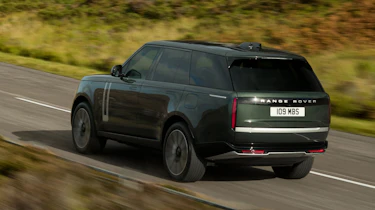
In the Range Rover Electric the addition of the battery below the floor significantly increases the stiffness of the chassis. This allowed engineers to create a special twin-chamber air suspension system that’s fitted in place of the single-chamber set-up in petrol and diesel models. With the extra rigidity improving the car’s balance on the road, the unique tuning for the electric model’s suspension could be focused on reducing the front-to-rear pitching that can affect the soft-riding Range Rover.
Used - available now

2021 Land Rover
Range Rover
6,729 milesAutomaticDiesel3.0L
Cash £61,692
2027 Land Rover
Range Rover
36,672 milesAutomaticDiesel3.0L
Cash £74,119
2027 Land Rover
Range Rover
28,684 milesAutomaticPetrol3.0L
Cash £96,000
2017 Land Rover
Range Rover
95,000 milesAutomaticDiesel3.0L
Cash £18,500The twin motors Jaguar Land Rover has created are configured specially to deliver the instant, powerful torque that’s so useful for off-road driving. To help deploy all that thrust on the most treacherous of surfaces, the slip control system is said to respond 100 times faster than that of a standard car. The Range Rover Electric’s brakes, meanwhile, have also been honed to provide extra reassurance, balancing out the eye-opening capabilities of the motors with bigger, stronger stopping power.
Does any of it work? Well, let’s just say that if the core strengths of electric powertrains were going to suit any car, they would suit the Range Rover. The famous ‘waft’ has long defined what these cars feel like on the road and the effortless, surging performance from the motors gels beautifully with that cushioned, isolated, sometimes floaty, experience at the wheel.
Performance, 0-60mph acceleration and top speed
The twin-motor EV powertrain in the Range Rover Electric draws power from the 118.5kWh battery and turns it into a maximum of 542bhp with torque of 850Nm. The car weighs 2,810kg but there’s still enough under the right pedal for 0-62mph in 4.5s and a top speed of 124mph.
As usual in Range Rover products, the Terrain Response system makes configuring this complex car on the fly simplicity itself, but the EV powertrain opens up new scope for adapting to what’s under the wheels. The on-road driving modes determine not only the set-up of the air-suspension system, but also the amount of power that flows forth from the motors and where it’s apportioned. Dynamic mode provides the full 542bhp, with a switch to Comfort delivering the same power in a much more gradual way. Eco mode reduces the amount of power ultimately available but you hardly feel like you’re missing out in normal driving.
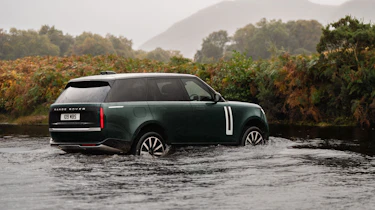
Off road, the Electric is as capable as any other Range Rover - except perhaps for the fact that if you run out of power halfway up a Scottish mountain, recharging may be trickier than locating a drop of diesel to get home. The power on call negates the need for a low-range gearbox, or any gearbox for that matter, and the wading depth of 900mm is the same as the diesel car’s.
Town driving, visibility and parking
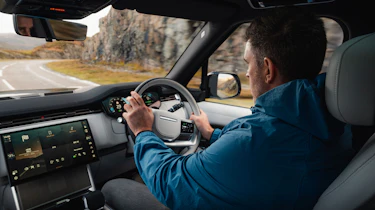
Don't underestimate the commanding driving position. You really do sit so much higher in a Range Rover than in other luxury SUVs and it contributes to making a very big car feel much more manageable in town - as does the surprisingly tight 10.95-metre turning circle aided by the rear-wheel steering. Of course, there’s no getting around the fact that this is a massive SUV at over five-metres long.
From your perch, visibility through the large glass area really is very good, though it’s still a struggle to focus properly on the digital rear view mirror. We found it best to flip the camera-fed screen to normal mirror mode, unless passengers or luggage restrict your view out the back.
There’s a one-pedal driving mode accessed through the gear shifter and it’s effective at taking the legwork out of driving in heavy urban traffic. What Range Rover refers to as the ‘chauffeur stop’ sees it ease the bulky EV to a standstill with supreme delicacy, like Jeeves has just returned from a driver training course.
Country road driving and handling
On the open road the Range Rover Electric never feels anything less than extremely solid over the full range of surfaces, wet or dry. It inspires confidence but this emphatically isn’t a car that hails from the sporty end of the luxury SUV segment. The Range Rover Sport and Porsche Cayenne Electric feel far more planted and dynamically capable when driven hard. The Range Rover is adept when it encounters a corner but eclipses all rivals with its ride and refinement.
You’ve really got to clatter into a big pothole to detect any trace of harshness through the suspension. Otherwise, the bumps are just obliterated by the air cushion. The knock-on effect of this beautiful smoothness is the trademark Range Rover floaty feel on undulating roads. Dropping it into Dynamic mode improves matters and makes everything feel more tied down, but the ride remains superbly comfortable and you can still sense the body moving in a more pronounced way than best-handling cars in the class.
The steering isn’t particularly sharp or responsive but it also suits the car’s set-up. The braking, tuned to match the sharp torque of the motors with stronger initial stopping power, feels well capable of keeping the weight in check.
Motorway driving and long-distance comfort
Higher-speed open roads see the Range Rover Electric in its element; this is an epic motorway car. The EV powertrain brings a new dimension in refinement to an SUV that was pretty hushed to begin with. There is an artificial engine noise, or ‘sound design’, system but even in its loudest setting there’s hardly a whisper in the cabin. You have to give the throttle a prolonged stomp for the deep bassy howl through the speakers to disturb the peace.
| Model | Power | 0-62mph | Top speed |
| Range Rover Electric | 542bhp | 4.5s | 124mph |
Range, charging & running costs
Pros |
|
Cons |
|
Nobody’s buying a Range Rover expecting the last word in fuel-sipping efficiency and the same goes for this electric version. The 118.5kWh battery contributes significantly to a 2,810kg kerb weight, the same as the equivalent plug-in hybrid models.
All Range Rover Electrics are in insurance group 50, the highest of the lot, but residual values tend to be very strong, which will have a bigger impact on running costs in the positive direction.
Electric range, battery life and charge time
The official WLTP tests reveal a combined efficiency figure of up to 2.8 miles per kilowatt hour and that’s enough for an official range around the 370-mile mark. This figure is competitive for a full-size SUV, with the Mercedes G-Class Electric only managing 291 miles and the Porsche Cayenne Electric offering 399 miles.
On our test drive through the Scottish Highlands, the range seemed to hold up well and the ‘real-world’ maximum of around 330 miles quoted by Land Rover engineers appeared perfectly possible. For anyone who thinks that might not be enough, it’s about what you could expect to get from a full tank in a petrol Range Rover with the 4.4-litre V8 engine.
The car will charge at up to 350kW at the right charger and that means a charge time of 22 minutes to get from 10 to 80 per cent. At a more realistic 150kW, the same charge will take 38 minutes. Topping up at home on a 7kW charger, it’ll take 19 hours to get to 80 per cent.
| Model | Battery size | Range | Insurance group |
| Range Rover Electric Autobiography | 118.5kWh | 372 miles | 50 |
Interior, design & technology
Pros |
|
Cons |
|
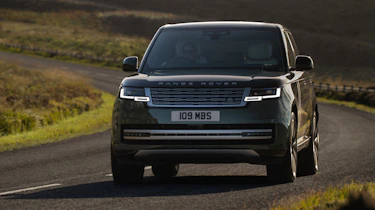
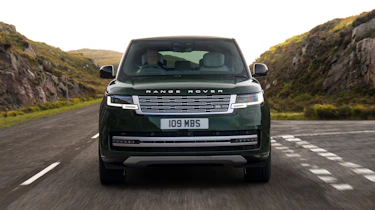
The electric Range Rover looks almost exactly like any other version from the outside, but why change a winning formula? The shape is instantly recognisable with serious presence on the road, yet still manages to stop short of being too ostentatious or gaudy.
The headlights, the grille, the smooth flanks with their hidden door handles, all the details sit flush with the body to accentuate those classic lines. Even the exhausts on the combustion cars are tucked away so you have to peer underneath to verify you’re looking at the EV. The only other telltale signs are the blanked-off grille and special aero wheels with EV branding on the centre caps.
With Autobiography trim being the bottom rung for the Range Rover Electric, all models get high-end kit including LED headlights, a full-length sliding panoramic roof, a Meridian stereo, 24-way adjustable heated and cooled seats, four-zone climate control and an ��Ambient Fragrance Diffuser’. You can load the latter up with three JLR-created scents and choose which one to distribute through the ventilation system as the mood takes you.
Interior and dashboard
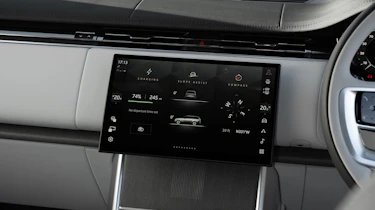
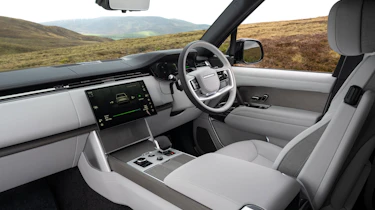
Minimalism is the height of fashion in car interior design circles at the moment but the Range Rover has been at it for years. Happily, this is minimalism of an earlier and more luxurious vintage. Indeed, the dashboard makes a refreshing change from the giant, sweeping screens you’re confronted by in some rivals.
The steering wheel retains physical controls for key functions, plus there’s a knob for the array of driving modes, a volume control and a stubby drive mode shifter on the centre console. It’s interesting that rear-seat passengers get lovely tactile rotary knobs for their heating and ventilation controls, while in the front, those functions are bundled into the screen.
Materials and build quality
There’s nothing minimalist about the materials employed inside the Range Rover Electric. The interior of this car is a match for pretty much anything else out there in terms of perceived quality. The metallic door pulls and electric seat controls are a particular highlight but so are the quality of the leather and the general solidity around the cabin. There are one or two harder plastics but the general ambience is tasteful and classy.
Infotainment, sat-nav and stereo
If this was a newer car rather than one launched in 2022, you can bet there’d be a bigger expanse of screen spanning the dash. As it is, the Range Rover serves up a more traditional arrangement of a digital instrument binnacle ahead of the driver and a separate 13.1-inch touchscreen in the centre. It’s not particularly well integrated into the dash, sitting proud like a glued-on tablet.
Land Rover’s Pivi Pro software takes some getting used to. It divides the screen into three sections, which gets more onto the screen, but some basic functions are more presses and swipes away than we would ideally like. If you’d rather avoid it, Apple CarPlay and Android Auto are standard fit.
Boot space & practicality
Pros |
|
Cons |
|
Not only is the Range Rover Electric a luxurious car, it’s a practical one too. Climbing up into it can be a bit of a chore for smaller people but the cabin and the boot are roomy for the class. The exact level of practicality depends a lot on how much you pay, with the long-wheelbase models, as well as enhancements to the rear seats and boot areas, all optional. You just can’t get a seven seater because the rear motor would eat into the third row’s legroom.
Storage space in the cabin is decent with two gloveboxes, large door pockets and a refrigerated bin under the central armrest. There are two cup-holders, and a phone charging pad in a cubby under the central screen.
Dimensions and size
The Range Rover Electric is 5,052mm long in standard-wheelbase form, with the long-wheelbase version adding a further 200mm. Both this and the width of 2,047mm are fairly standard for the luxury SUV class but the height of the Range Rover is not. At 1,867mm tall, it’s a very tall car, towering over even the Porsche Cayenne Electric by some 193mm.
Dimensions comparison | |||
| Model | Range Rover Electric | Porsche Cayenne Electric | Lotus Eletre |
| Length | 5,052mm | 4,985mm | 5,103mm |
| Width | 2,047mm | 1,980mm | 2,019mm |
| Height | 1,867mm | 1,674mm | 1,636mm |
| Wheelbase | 2,997mm | 3,023mm | 3,019mm |
| Boot space | 733 litres | 781 litres | 688 litres |
Seats & passenger space
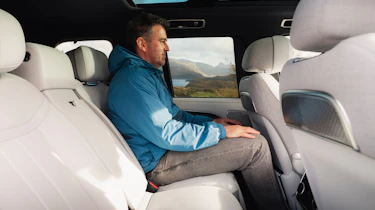
The Range Rover’s exceptional height defines its passenger accommodation to a great extent. In all seats, the base is so far off the cabin floor that you sit very upright and get top notch under thigh support. There’s a good amount of adjustment in the front seat but there’s not much reach adjustment on the steering wheel.
Although rear legroom in the short-wheelbase car is not spectacular, it is very comfortable even for a six-foot-tall passenger sitting behind a driver of similar size. Headroom isn’t as generous as you might expect given the car’s height, but it’s still fine for a six-footer. There’s not a lot of reach adjustment on the steering wheel but the 24-way adjustable front seats make up for that.
Boot space
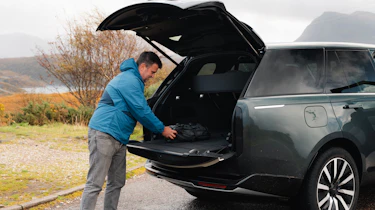
The boot is unusual in that there’s a split tailgate with one section that lifts up in the usual fashion and another that drops down. It’s a little awkward when you just want to load items inside quickly as you have to open each separately and the loading lip is also high.
On the flip side, there are lots of useful features. The drop-down portion of the tailgate can double as a seat and there’s a section that flips up out of the boot floor to form a seat back - or a barrier to hold luggage in place. There are elasticated straps and a net to keep items secure but the bag hooks that fold out of the sides of the boot area seem disappointingly flimsy. With 733 litres available, not including the space under the boot floor, the amount of room can’t be faulted.
Towing
The Range Rover Electric can tow a 2,500kg braked trailer. That’s not bad but the plug-in hybrid manages 3,000kg and the good old diesel version can pull 3,500kg, a figure that is matched by the Porsche Cayenne Electric. For just over £1,500, Range Rover’s Towing Pack includes a powered towbar that retracts under the rear bumper when not in use.
Reliability & safety
Pros |
|
Cons |
|
The electric Range Rover’s arrival four years after the latest-generation Range Rover first saw the light of day means that it is likely to inherit a five-star Euro NCAP safety rating that was dished out in 2022. The tests have become considerably more stringent in the years since, but customers can be reassured by a predictably generous complement of safety kit.
All models have blind-spot monitoring, lane-keeping assist and adaptive cruise control that will help steer the car to keep it in its lane on the motorway. For lower-speed manoeuvres, a rear traffic monitor, parking assist and Land Rover’s 3D surround camera instill confidence. There are off-road modes for the camera system that can give a comprehensive view of obstacles around the car and even the depth of the water the Range Rover is wading through, so supermarket car parks really should be a breeze.
The traffic sign-recognition tech has an adaptive speed limiter that can automatically keep the car under the speed limit throughout your journey and the speed limit warning chimes - which are fairly loud and intrusive - can be disabled with one press of a button on the steering wheel.
| Euro NCAP safety ratings | |
| Euro NCAP safety rating | 5-stars (Euro NCAP, 2022) |
| Adult occupant protection | 84% |
| Child occupant protection | 87% |
| Vulnerable road user protection | 72% |
| Safety assist | 82% |
Buying, prices and deals
- Best buy: Range Rover Electric Autobiography
Range Rover Electric buyers choose between the standard and long-wheelbase bodystyles. Autobiography trim opens proceedings at £154,000, then come the First Edition cars for £30,000 more and finally you have the SV for another £6,500 or thereabouts. The SV can also come in SV Black form for a further £13,000, if you like the fully blacked-out Range Rover aesthetic, and there’s a flagship SV Ultra, too.
Given that all Range Rover Electric models share the same powertrain, whether you want the sporty SV variants really comes down to how much you like the more aggressive look. The First Edition cars are absolutely loaded with kit, but the spec is reflected in the price. Base Autobiography trim hardly feels ‘stripped back’ in comparison and that’s the one we’d choose, while recognising that it’s largely a matter of personal taste and budget in this car.
Unlike petrol Range Rovers, the Electric doesn’t offer a seven-seat option with the long-wheelbase body, which commands a £17,000 premium over the equivalent standard car in SV trim. Options such as the rear-seat entertainment system (£3,700) and ‘Executive Class Comfort Plus rear seats’ with hot stone massage function (£6,150) will bump up the price, but turn the Range Rover into true VIP transport.
Range Rover Electric alternatives
The Range Rover has always occupied a profitable niche between luxury SUVs such as Porsche’s Cayenne or the BMW X5, and more rarefied super-luxury options from the likes of Bentley and Rolls-Royce. This gives it a broad collection of potential rivals and we shouldn’t just think in terms of SUVs; buyers of luxury saloons and top-end four-door coupes will also be casting a glance at Land Rover’s finest.
Direct alternatives to the Range Rover Electric come from the much smaller group of luxury electric SUVs. The Mercedes G-Class Electric offers a similarly iconic design and status, while the Porsche Cayenne Electric and Lotus Eletre take a more dynamic approach that is more closely aligned with the Range Rover Sport Electric. The Volvo EX90 is a big, comfortable and cheaper option that could be an alternative to the Range Rover in its higher-spec forms. Finally, buyers in this space will also soon have the BMW iX5 and the Bentley Torcal to consider.