Used Range Rover (Mk4, L405, 2012-2021) review and buyer's guide
A full used buyer’s guide on the Range Rover covering the Range Rover Mk4 (2012-2021)

Verdict
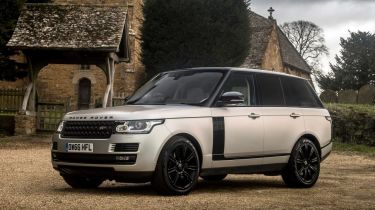
The Range Rover has always been a car for those with deep pockets and that’s very much the case with the Mk4, which sits in the top insurance categories, costs plenty to maintain, uses lots of fuel and will shed thousands in the coming years. You could buy a car that’s already lost most of its value, but then repair costs are likely to be high because it will already be quite old, with plenty of miles on the clock. If you go into Range Rover ownership with your eyes open, you’ll love the effortless off-roading and towing (it’ll pull 3,500kg), the peerless on-road luxury and the sense of occasion that comes with every drive. Just don’t try to run a Range Rover on a tight budget, because it simply can’t be done.
Debate rages over whether the original Range Rover was the first luxury SUV. When it arrived in 1970, the Jeep Wagoneer had already been on sale for seven years, and this was undoubtedly more luxurious than the original Range Rover, which was actually rather utilitarian.
What is a certainty, though, is that when the original Rangie bowed out in 1994 it had set the standard for the luxury SUV, and the all-new Range Rover Mk2 was plusher than ever. With each subsequent Range Rover generation, the bar was raised still further in terms of luxury, sophistication and comfort. However, Land Rover never watered down the off-roading abilities of this large SUV. Under the sheen of opulence, it remained as tough and rugged as ever.
Used - available now

2023 Land Rover
Range Rover
46,731 milesAutomaticPetrol3.0L
Cash £66,013
2023 Land Rover
Range Rover
46,473 milesAutomaticPetrol4.4L
Cash £84,844
2021 Land Rover
Range Rover
19,555 milesAutomaticDiesel3.0L
Cash £45,776
2024 Land Rover
Range Rover
24,602 milesAutomaticPetrol3.0L
Cash £70,860When this fourth-generation Range Rover arrived in 2013, it was the most capable, sophisticated and luxurious edition yet.
Models covered
- • Range Rover Mk4 (2012-2021) - It’s not cheap to buy or run, but this luxurious SUV is in a class of its own.
History
The Range Rover Mk4 went on sale in September 2012 priced from £71,295, and first deliveries took place in January 2013.
Buyers could have 254bhp 3.0 TDV6 or 334bhp 4.4 SDV8 diesels, or a 503bhp supercharged 5.0-litre V8 petrol engine. By August 2013 there was also a diesel-electric hybrid, and in March 2014 a long-wheelbase edition was introduced, with an extra 186mm of rear legroom. At first this came only with a 5.0 V8 engine, but there was a diesel-electric hybrid option within a month.
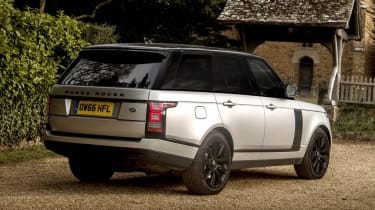
Revisions late that year brought better off-roading tech, a 302bhp 3.0 SDV6 and new colours, and in late 2016 a supercharged 335bhp petrol V6 arrived. In November 2017, the SVAutobiography and P400e hybrid followed, while an interior redesign introduced the new dual-screen infotainment system.
A number of trims and special editions have been released throughout the Mk4 Range Rover’s production, with Vogue, Vogue SE, Autobiography, SVAutobiography Dynamic and SVAutobiography LWB being the core selection – SV stands for ‘Special Vehicle’. The fifth generation Range Rover arrived in 2022 to replace the Mk4 version.
Which one should I buy?
Land Rover’s Supercharged 5.0-litre V8 petrol engine is magnificent, but its running costs can be crippling. Theoretically, the P400e is the cheapest to run, but it costs a lot to buy and may be out of reach, so the diesel-electric hybrid might make more sense. However, it’s not a plug-in, which means we’d stick with a regular TDV6, SDV6 or TDV8 diesel.
Even the entry-level Vogue gets a fixed glass roof, metallic paint, power-fold door mirrors, xenon headlights and 20-inch alloys. It also has leather trim, all-round parking sensors, a reversing camera and heated, 16-way electrically-adjustable front seats.
Vogue SE adds an upgraded hi-fi, posher seating and extra safety kit, while Autobiography brings 21-inch wheels, a 360-degree camera and quad-zone climate control. Options were plentiful when buying these cars new, so look out for extra luxuries, as a number of used models will be uniquely-specced.
Alternatives
There’s so much room in a long-wheelbase Range Rover that it has very few rivals, other than the more costly Rolls-Royce Cullinan and saloons such as the Bentley Mulsanne EWB, Rolls-Royce Ghost EWB and Mercedes-Maybach S 650.
Still, there are other luxury SUVs out there, most notably the Bentley Bentayga, which is the closest rival to the standard Range Rover. Cars like the Audi Q7, BMW X5, Volvo XC90 and Mercedes GLS compete in terms of size but don’t feel quite as special, although they do seat seven, which the Rangie doesn’t.
What to look for
Gearbox
Every version of the Range Rover comes with an eight-speed automatic transmission, and no manual gearbox is offered.
Oil
Juddering at low speeds is often due to dirty oil in the transfer box. It’s worth replacing every 30,000 miles, and asking questions if it hasn’t been.
Electrics
Electronic faults are common, so take the time to check that everything works: multimedia, windows, seats, switchgear – the whole lot.
Vibrations
If you can feel any vibrations at high speeds, they may be costly to fix. Failing rear differentials and buckled wheels are not unknown.
Interior
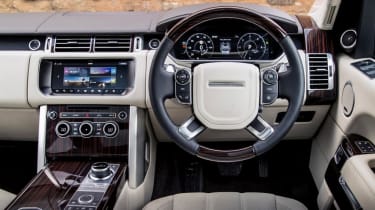
This is one of the key reasons for the Range Rover being so easy to love; its spacious cabin is incredibly luxurious because it’s full of premium materials and cutting-edge tech. Up to motorway speeds and beyond, refinement is excellent, too. There’s plenty of rear seat space, especially in long-wheelbase models, and boot space is impressive, at 909 litres – or 2,030 litres with the rear seats folded.
Running costs
All models need a service every 12 months or 16,000 miles. It costs from £425 on a 3.0 TDV6, but the 10th service can be over £1,600. The 4.4 TDV8, 3.0 V6 and 5.0 V8 are dearer, and hybrid models cost from £448.
After three years, fixed-cost services are available at a reduced rate. Only the 3.0 TDV6 has a cambelt, and this needs replacing every seven years/112,000 miles, this can be undertaken as part of a major service at an extra cost.
Recalls
The Mk4 Range Rover has had 26 recalls, and problems include sub-standard wheel nuts letting wheels work loose, and doors unlatching and opening while the car is moving. Other issues centred on the electrics, seatbelt pre-tensioners, brake servos, airbags, AEB systems, instrument clusters and fuel leaks, and the engine cutting out and/or failing to start.
Driver Power owner satisfaction
The Range Rover didn’t feature in our Driver Power 2021 new car survey, but Land Rover finished 22nd out of the 30 brands, which is disappointing for a premium manufacturer. High running costs and poor reliability are the key bugbears with owners, but almost every other aspect of the company’s cars, including the interiors, drivetrains and handling, came in for praise.
Range Rover (2012-2021) review: What we said
Extracts from our 2020 in-depth review of the Range Rover Mk4
Nothing is quite like a Range Rover. It has long been the luxury SUV benchmark, and even rivals luxury limousines for upmarket style, grace and refinement. Its regal image, exquisite interior, powerful engines and unrivalled off-road ability make it the go-to vehicle for those who want a luxury car that can do it all.
There’s lots of hi-tech kit on board, including adjustable driving modes that help with varying terrain. But, the car’s real trick is to tackle all sorts of off-road terrain while surrounding you with a sumptuous, leather-lined interior and luxury car comfort.
There's virtually no rival that can match the Range Rover’s multi-tasking ability, as the big British 4x4 combines its posh, upmarket image and imposing looks with incredible all-road capability.
About the Range Rover Mk4
The Range Rover was first introduced in 1970 as a barely more luxurious alternative to the agricultural Land Rover, with the new model inspired at least in part by the efforts of US manufacturers developing road-focused 4x4s such as the Jeep Wagoneer and Ford Bronco.
However, the Range Rover’s performance was clearly a cut-above any other 4x4 available at the time, and in more than 50 years of production the British off-roader evolved from its relatively humble roots - early versions had utilitarian hose-down interiors - to the luxury icon it has become today.
Rivals such as the Jeep Grand Cherokee launched in 1992 and the Mercedes M-Class launched in 1997 made some inroads, but the Range Rover stayed strong while other British automotive brands faltered. Continued improvements across successive generations have led us to this, the tail-end of the fourth generation Range Rover’s life. An all-new model is due on sale in 2022, and by 2023/4 a fully-electric version is expected to help shape the next phase of the Range Rover legend.
Not that there’s much wrong with the current car, you might reasonably think, even though it arrived on the scene way back in 2012. That was shortly after Range Rover had released the wildly popular Evoque, and eight years after the brand had introduced its first Range Rover spin-off, in the shape of the similarly sought-after Sport model. The 2017 Velar gave Range Rover a four car line-up, all of which are some of the best and most desirable SUVs in their segments.
The Range Rover itself comes in standard and long wheelbases (LWB), although the LWB is only available on higher-specification cars. The trim range starts with Vogue, then goes through Vogue SE, Autobiography, SVAutobiography Dynamic and SVAutobiography LWB trims. However, the SV - for Special Vehicles - versions are significantly more expensive than an Autobiography model with the same engine and offer more in-depth personalisation options. More recently, Land Rover has added the Range Rover Fifty anniversary edition, along with the Westminster, Westminster Black and the SVAutobiography Dynamic Black versions.
The most powerful cars come with Jaguar Land Rover's 5.0-litre supercharged V8 petrol engine. In SVAutobiography cars, it's the most powerful version that's shared with the Jaguar F-Type R and Range Rover Sport SVR, although thanks to the car's sheer size, Land Rover quotes the same acceleration figures as the regular 5.0-litre. Permanent four-wheel drive and an eight-speed automatic transmission are standard across the model range.
The Range Rover is JLR’s flagship vehicle and as such offers the most luxury and equipment possible for a high starting price. It sits at the top of a four-model Range Rover line-up, above the Evoque, Velar and Sport models, although the latter isn't far from the Range Rover in terms of size, quality or price.
Engines, performance and drive
Land Rover has ensured that the Range Rover can keep up with its German rivals in terms of luxury and refinement, but what really sets it apart from them is its mega off-road ability and huge towing power.
An aluminium shell means that the latest Range Rover is 420kg lighter than the last car, and ensures that this version is very agile. However, no amount of dieting can disguise the fact that it's both slower and heavier than its German competitors, and the Bentley Bentayga.
However, the Range Rover makes up for this by being supremely quiet and refined inside no matter which engine you choose, while the smooth eight-speed automatic gearbox contributes to a relaxed driving experience.
The car's standard adaptive damping and air-suspension deliver an impressively composed ride, which is only upset when the large wheels thump into a badly repaired pothole. If comfort is a priority, the Long Wheelbase car is even more cosseting.
The SVAutobiography Dynamic is designed to offer a bit more agility, without ever feeling as light on its feet as a Range Rover Sport SVR - and in that respect, it’s a total triumph. The throttle modulation on the 557bhp V8 is nicely judged, and it keeps enough full-fat Range Rover refinement, even when you’re pushing on.
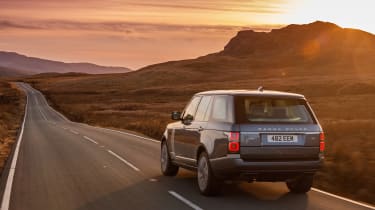
The Range Rover is at its best, in fact, as a rapid cross-country cruiser, because it’s as peerless as ever on fast motorways, and a little more tied together on wide A- and B-roads. There’s no disguising the car’s bulk in narrower sections, but its sheer size will be the issue there, rather than any problem with the handling. If you do spend a lot of time driving around town, it's worth considering the P400e plug-in hybrid version, as the silent progress allowed by the electric motors perfectly suits the car's luxurious character.
Engines, 0-60 acceleration and top speed
Range Rover buyers can choose from two diesel engines and two supercharged petrols, alongside plug-in and mild-hybrid versions.
The 3.0-litre V6 diesel D300 delivers 296bhp, making it more than capable of dealing with the two-tonne-plus bulk of the Range Rover. It does 0-62mph in a wholly acceptable 7.4 seconds, going on to hit a top speed of 130mph. Stepping up to the D350 version shaves 0.3 seconds from the sprint time, while increasing the maximum speed to 140mph.
For those that err towards petrol power, there's the 394bhp P400 which manages an impressive 6.3 second dash to 62mph. But, if you want a Range Rover with a green tinge, the plug-in hybrid P400e model is the most efficient in the line-up. It combines a four-cylinder 2.0-litre engine with an electric motor to give an output of 398bhp and 640Nm of torque, while the battery will allow for up to 25 miles driving with zero tailpipe emissions on a full charge. It's a car that will make most sense to people who do most of their driving around town, where they can run on electric power for the majority of the time. On longer journeys, though, it's less impressive, as the petrol engine is harsh and raucous, and very much at odds with the otherwise refined nature of the car.
The 5.0-litre supercharged V8 is an epic powerplant, but one that is extremely poor on fuel. In its ‘lesser’ P525 form, it delivers 518bhp from 6,000rpm and 625Nm from 2,500rpm. However, in the SVAutobiography Dynamic SWB and SVAutobiography LWB models those numbers swell to 557bhp at 6,000rpm and 700Nm from 3,500rpm, the same stats as the Range Rover Sport SVR.
Land Rover claims identical 0-62mph times and top speeds for both supercharged V8s, those numbers being 5.4 seconds and 155mph, which is an impressive turn of pace for such a big car, although the Bentley Bentayga is even faster still.
MPG, CO2 and running costs
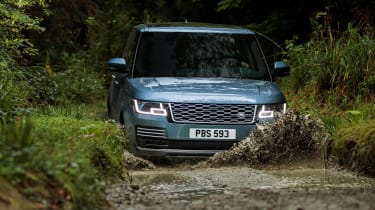
The Range Rover is a big, heavy car and is thirsty even with the smallest 3.0-litre V6 diesel. But Land Rover has put considerable effort into making the latest model considerably cleaner and more efficient than its predecessor – a car that was known for its poor fuel economy.
As a result of its considerable weight reduction, the 296bhp 3.0-litre diesel engine officially manages a combined 32.5mpg (measured on the latest WLTP test) with CO2 emissions from 228g/km, both of which are not bad for a two-tonne luxury SUV.
On paper, the most economical model in the range is the plug-in hybrid P400e. Thanks to its battery-powered electric motor, it's claimed to be able to do up to 25 miles on electric power alone. But you'll need to keep within the city limits and regularly top up the battery if you are to have any hope of getting near the car's claimed fuel economy of 82.3mpg. CO2 emissions are quoted at 77g/km.
At the other end of the scale, if you want the fastest and thirstiest Range Rover, you can opt for the 557bhp Supercharged SVAutobiography Dynamic. It uses the engine from the Range Rover Sport SVR, and returns a miserly 18.6mpg, with a CO2 figure of 342g/km.
Interior, design and technology
With its gargantuan size and good looks, the Range Rover smacks of luxury and makes quite the statement. While the Range Rover's sheer size is what first grabs you, it's what's under the skin that makes it more than just a 21st Century style icon.
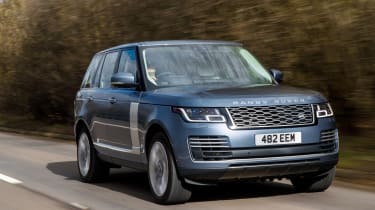
The Range Rover gets sleek gills on the front doors and the wraparound tail-lights help disguise its sheer bulk. What's more, the designers at Land Rover have cleverly managed to create a contemporary-looking SUV without abandoning the classic Range Rover design cues – the clamshell bonnet, ‘floating’ roof and split tailgate are all present and correct.
However, the swept-back headlights and sharply angled front grille and windscreen take their cues from the smaller, fashionable Range Rover Evoque crossover.
Given the regular Range Rover's huge presence, many buyers will prefer less ostentatious German saloons, such as the Mercedes-Benz S-Class, Audi A8 and BMW 7 Series. Either way, there’s no denying the Range Rover’s kerb appeal.
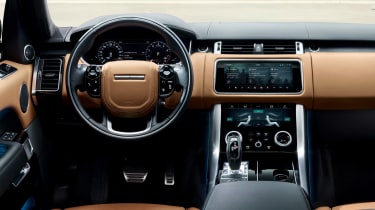
The crisp, clean and uncluttered interior is also a plus point. As expected, the 'entry-level' Range Rover Vogue is very well equipped, and as standard, Land Rover decks it out with 20-inch alloys, digital TV and radio, sat-nav, and an automatically opening tailgate and self-parking system. The Range Rover Vogue SE is the next version up, and gets a dual-view TFT screen (so passengers can watch TV and the driver can keep nav info on the same screen) and soft door-closing as standard.
Westminster-spec cars build on the Vogue equipment level with 21-inch alloys and a sliding panoramic roof, while the Black versions add bigger wheels and a styling pack.
The Autobiography model features a panoramic roof, heated steering wheel and a beautifully designed dash, while the SVAutobiography Dynamic and SVAutobiography Long Wheelbase models are almost worth considering as separate models, being twice the price of the TDV6 Vogue at the other end of the line-up.
They are the pinnacle of luxury, though, with almost every conceivable toy - including massaging, 24-way adjustable heated and cooled front seats, four-zone climate control, ebony-quilted perforated semi-aniline leather upholstery and cabin pre-conditioning with a remote function.
Sat-nav, stereo and infotainment
Jaguar Land Rover has recently updated its infotainment system to InControl Touch, which is a big improvement on the old-fashioned software its cars had before. InControl Touch is not quite as slick as BMW’s iDrive, but it is fine to use and has better control interfaces than before, making it more intuitive and less frustrating to use.
Premium HDD navigation is standard on all Range Rovers and it’s an excellent system, while there’s a range of high-end sound packages to appeal to owners. All cars get DAB and MP3 compatibility, and Meridian provides the audio set-ups.
The Vogue’s is an 13-speaker plus subwoofer 380W affair, while the Vogue SE and Autobiography are upgraded to 19 speakers plus subwoofer and 825W. They also benefit from the dual-view front screen, including one set of WhiteFire headphones for the front-seat passenger.
Finally, the SVAutobiography Dynamic gets a supremely powerful 1,700W Meridian Signature Reference Audio System and the Touch Pro Duo infotainment system with 10” touchscreen and voice control.
Practicality, comfort and boot space
While its looks have evolved, the Range Rover's principles of rugged usability and practicality have remained, and this is what gives it an advantage over more traditional luxury car rivals.
With the extra height the Range Rover has over its rivals, it feels truly massive in the back and gives a fantastic view. One downside of its sheer size, though, is that it’s still quite a climb up into the car, but recent updates now mean you can lower the air suspension to ‘access’ height at the touch of a button to make getting in and out easier. Even so, it's not quite as easy to do so as in a BMW 7 Series or Audi A8.
The Range Rover also gets a space-saver spare wheel as standard, with a full-size replacement only available for the SVAutobiography Dynamic version. What's more, the electronically deployable tow-bar is also an extra.
Size
While the current model debuted much sleeker styling than its predecessor, it remains a physically huge vehicle. It is just 1mm short of the full five metres in length and more than 2.2 metres wide, with the door mirrors in place.
It is also 1,835mm tall, comfortably higher than most crossovers that purport to have SUV-like driving positions. Sitting behind the steering wheel of the Range Rover is a very commanding place to be – you are higher than pretty much everything else on the road, save the largest vans, buses and lorries. This gives a great view out and a safe, secure feeling when you’re out on the road.
Leg room, head room & passenger space
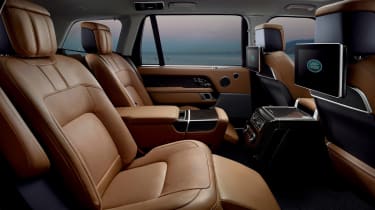
In the standard-wheelbase Range Rover, space in the rear is fine. There's more room than you’ll find in a Bentley Bentayga, with plenty of width, and a flat floor that leaves enough foot space for three people to sit alongside each other in comfort. If that's still not enough, the long-wheelbase model gets 200mm extra length.
If the front passenger is willing to edge their seat forward a bit, a six-foot passenger can pretty much stretch their legs out in the Long Wheelbase Range Rover, especially if they make use of the leg rest and recline the rear seat.
Boot
With all its seats in place, the Range Rover can hold 900 litres of luggage – 390 litres more than either the Audi A8 or Mercedes S-Class – but folding those seats down (which can be done at the touch of a button) frees up a vast 1,943 litres. Interestingly, the Long Wheelbase car doesn’t offer any more boot space – all the extra inches are given over to the rear-seat passengers.
The classic Range Rover split tailgate allows you to open one or both parts as needed: leaving the bottom half in place makes it easy to pop smaller items straight into the boot, while lowering it gives you a useful temporary seating area.
Towing
Similar to the Ranger Rover Sport the Range Rover has a good range of towing capacities, starting at 2,500kg for plug-in hybrid version and going all the way to 3,500kg for other versions.
Did you know you can sell your car through Auto Express? We’ll help you get a great price and find a great deal on a new car, too.