New Peugeot 208 GTi 2026 review: electric hot hatch is huge fun
The new all-electric Peugeot 208 GTi hot hatch looks great is guaranteed to make you smile


Verdict
The Peugeot 208 GTi has punchy power, a sharp chassis and racy looks, while overall it feels like a grown-up sports car. We maintain that the i-Cockpit layout is something you must try to see if it suits you, but if you can get on with it, this Peugeot will easily put a grin on your face. Just keep an eye on the car’s range if you’re taking it for a back-road blast.
Think of car companies that have used the GTi badge to great effect and Peugeot is likely to spring to mind almost as quickly as Volkswagen. But while the GTI has remained ever-present in the German firm’s line-up over the past 50 years, Peugeot hasn’t maintained the same consistency. The last GTi disappeared when the first-generation 208 was replaced by the Mk2 in 2019, but now it’s back in electrified form as the E-208 GTi.
The 208 supermini has been around for a while now, but Peugeot has pulled out all the stops to make the GTi version a compelling performance EV. It’s been developed by Peugeot’s Sport division, and it has been given a series of updates to help it stand apart from the rest of the line-up.
Used - available now

2023 Hyundai
Tucson
23,074 milesAutomaticPetrol1.6L
Cash £23,080
2021 Mercedes
A-Class
14,270 milesManualPetrol1.3L
Cash £17,340
2024 BMW
1 Series
21,113 milesAutomaticPetrol1.5L
Cash £18,830
2022 Nissan
Qashqai
12,745 milesAutomaticPetrol1.5L
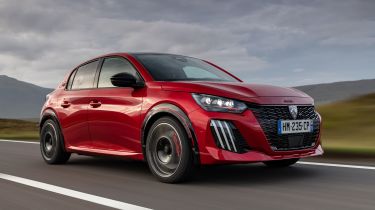
Cash £20,700The most obvious visual tweaks are at the four corners, where new 18-inch telephone dial alloys, inspired by the wheels on the 205 GTi 1.9, and gloss-black wheelarch cladding with red pinstripes are fitted. There are more red highlights up front, with flecks of colour on the grille, badge and in the headlight bezels, while a sharper front bumper, rear spoiler and diffuser have been added. There is GTi badging on the C-pillars, too, although it’s not quite the same as on the original.
Step inside, and the first thing that you’ll notice is the bright red carpeting, which is another homage to the 205 GTi. Large sports seats are also added, with thick side bolsters that hold you in place, but aren’t narrow enough to cause discomfort. They are trimmed in a mix of artificial leather and suede and fabric, while the asymmetric design is unique to the GTi. There’s red stitching on the dashboard and doors, red seatbelts and red cabin lighting, although this can be changed to other colours, while the touchscreen has a red-themed appearance with additional dials on offer showing vital information.
As well as new wheels, there’s a revised suspension system, too. The GTi has been lowered by 25mm when compared with the standard E-208, while the front and rear tracks have been widened by 56mm and 28mm respectively, further enhancing the GTi’s stance. A rear anti-roll bar has been added to boost cornering stability even further, while a mechanical limited-slip diff boosts traction out of corners.
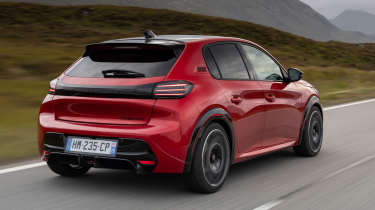
And it’s needed, because the E-208’s electric powertrain has been boosted to make 277bhp and 345Nm of torque. A power to weight ratio of 182bhp per tonne is quoted, too, which Peugeot claims is a best-in-class figure. Power is still sent to the front wheels, and as well as using a mechanical diff, the GTi is fitted with low-profile, 40-section Michelin Pilot Sport 4S tyres. There’s a 0-62mph time of 5.5 seconds, while accelerating from 50-80mph can take as little as 3.2 seconds.
Helping to bring the E-208 GTi to a halt are a pair of 355mm front brake discs with bright red four-piston calipers. At the rear, the GTi retains the standard car’s brakes, with additional braking assistance provided by the car’s energy recovery system.
While power has increased, the E-208 GTi uses the same 54kWh battery as high-spec versions of the standard car, because that’s the biggest battery that the chassis can accommodate. It means the GTi has an official WLTP-tested range of 219 miles as standard, although if you swap the Michelins for Hankook Ventus S1 Evo3 tyres at no extra cost, this extends the car’s range to 233 miles.
As ever with the 208, the first issue you encounter could occur before you’ve even turned a wheel. The i-Cockpit layout is a ‘try before you buy’ feature, and if you’re tall, you might find it tricky to find a comfortable driving position that also allows you to get in and out easily. In certain positions it can be difficult to slide your legs out from under the wheel, and it’s made a little harder with the GTi’s bigger seat bolsters.
Once in place, the GTi starts just like the standard E-208, and when you take things easy, you’ll find that the ride is surprisingly pliant for a car with lowered suspension and low-profile tyres that’s designed to deliver entertaining handling. There are no adaptive dampers, but general comfort is good, with the only criticism being the way the big wheels thump into the largest potholes. The stiff chassis follows the undulations of the road, but not to the point of discomfort.
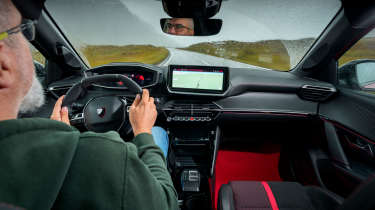
There are three drive modes, Sport, Normal and Eco, and they adjust the level of throttle response. Apply full power, and the E-208 GTi rockets forward, and in the slippery, wet conditions of our test route in Scotland, the car did a good job of getting that power to the road. While the front axle shudders as it gets the power down, there’s none of the torque steer that you might expect from a powerful front-wheel-drive machine, although the traction control does cut in to help rein in the power.
Mid-range acceleration is impressive, too. In Sport mode especially, a snappy response means power can be added in an instant, helping you to execute quick overtaking manoeuvres.
Cornering grip is good, helped by the low centre of gravity afforded by the position of the drive battery, while body roll is kept well in check, too. The small steering wheel adds to the sensation of sportiness, and feels direct as you apply more lock. The brakes lack some initial bite, but they are strong when you apply more pressure, while there’s extra assistance via the ‘B’ button on the dashboard, which boosts energy recuperation.
Unlike some rival performance EVs, the E-208 GTi doesn’t have paddleshifters behind the steering wheel to either adjust the amount of energy recovery or deliver simulated shifts. We think Peugeot has missed a trick here. What the company has added is a synthesised engine note to boost the car’s sporty appeal, although you can turn it off if you’re not keen.
Use the E-208 GTi’s full performance, and you’ll struggle to match Peugeot’s claimed economy figures. However, on a wet test route with plenty of country road driving, we managed a return of 3.4 miles per kWh, which is pretty decent for a performance-focused machine.
At a fiver under £35,000, the Peugeot E-208 GTi is in a similar price bracket as the Alpine A290, while their performance and range figures are similar. It’s also a close match for the Vauxhall Corsa GSE, although that won’t come as a surprise because the two cars use the same running gear. The Corsa is around £500 cheaper than the 208, though, and if you can’t get along with the Peugeot’s i-Cockpit layout, then that could be enough to see you pick the Brit over its French sibling. Some would argue the GSE brand will likely never have the same draw as the GTi badge, though.
Did you know you can sell your car through Auto Express? We’ll help you get a great price and find a great deal on a new car, too.
| Model: | Peugeot E-208 GTi |
| Price: | £34,995 |
| Powertrain: | 54kWh battery, 1x e-motor |
| Power/torque: | 277bhp/345Nm |
| Transmission: | Single-speed automatic, front-wheel drive |
| 0-62mph: | 5.5 seconds |
| Top speed: | 112mph |
| Range: | 219 miles |
| Max charging: | 100kW (20-80% in 27min) |
| Size (L/W/H): | 4,100/1,765/1,405mm |
| On sale: | Now |