Radical Renault Filante Record 2025 manages 1,000km on a single charge, all at high speeds
The incredibly sculptural design is inspired by record-breaking cars from Renault’s past
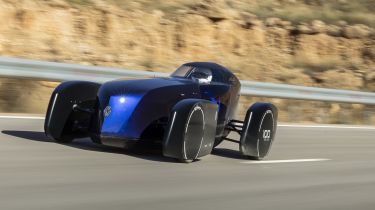
Renault has achieved the Herculean goal of covering 1,000km (621 miles) at motorway speeds in an electric car on a single charge with its radical Filante Record 2025, which set a new EV efficiency record in the process.
The single-seat “laboratory on wheels” was unveiled at the start of 2025 and is inspired by Renault’s land speed record-breaking cars from the 1920s and 1950s. But it was created specifically to push the limits of aerodynamics and electric car technology, and establish new records in the process, much like the Mercedes EQXX.
Importantly, Renault’s goal was not to simply go the furthest in an electric car, which it could have done by fitting the car with a huge battery or driving it in eco mode at 30 km/h on average.” Instead, the Filante Record 2025 was fitted with an 87kWh battery – the same size as the Renault Scenic SUV’s – and the drivers were told to maintain an average speed of over 68mph.

The objective was to cover more than 1,000 km in less than 10 hours, including technical stops and driver changes. Not only did Renault manage this, after the Filante Record 2025 had finished, there was 11 per cent battery capacity remaining – enough to allow the team to cover an additional 75 miles at speeds over 60mph.
That means Renault managed to achieve an average of 8.0 miles per kWh, which is twice as efficient as the new Mercedes CLA and Tesla Model 3 were in our recent twin test.
”This project was born from an obsession: achieving record-breaking efficiency,” said Olivier Blanche, Renault’s concept car project manager. “We battled the weather and aerodynamics, but what stands out most for me is the human adventure: an incredibly motivating collective challenge, driven by the dedication of the Renault teams and all our partners”.
As you probably guessed, the Filante Record 2025 won’t ever go into production, and we seriously doubt its extravagant design is going to influence future road cars. However, some of the technology featured onboard plus any learnings from the team will apparently inform the development of new EVs, enabling them to achieve ever higher levels of efficiency including in demanding conditions, such as high-speed motorway driving.
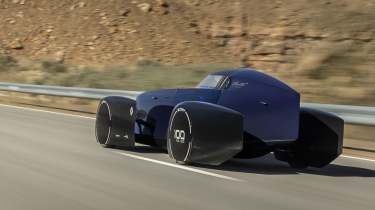
Renault Filante Record 2025 design
The designers of the Renault Filante Record 2025 took their inspiration from the hundred-year-old Renault 40CV ‘des Records’, which set speed and endurance records in 1925.
The new car’s flowing, streamlined silhouette is supposed to look like it was sculpted by the air itself. “It reflects both performance and timeless elegance,” says Sandeep Bhambra, director of advanced design for Renault. “Every inch of the surface was crafted to capture the light and showcase the body lines, which appear to melt into the air.”
Like the Filante Record 2025, the Renault 40CV ‘des Records’ was a single-seater with an enormous, elongated bonnet, housing a thunderous 9.1-litre engine. This also pushed the cockpit back as far as possible, with the design influenced by fighter planes of the time.
The wheels on the 2025 car are separated from the body, as they were on the 40 CV des Records and the later Nervasportdes Records from 1934 that also served as inspiration. Originally, the fairings resembled those from the turbine-powered Etoile Filante from 1956, but following wind tunnel testing, the designers reshaped and simplified them, and mounted them directly onto the wheels, which improved airflow.
Underneath those curvaceous fairings are specially designed 19-inch Michelin tyres that create around 40 per cent less rolling resistance than ordinary car tyres. While Renault hasn’t confirmed the Filante Record 2025’s drag coefficient (how easily it cuts through the air), we expect it to be similar to the 0.17 of the Mercedes EQXX, which is a very streamlined car.
Like the unique round headlights, the Ultraviolet Blue colour is a nod to the Filante Record 2025’s ancestors, and it appears either blue or violet depending the light conditions and how you’re looking at the car. Meanwhile, the interior draws from the world of aviation, Formula One and even space travel, and is designed so that every control is easily within the driver’s reach.
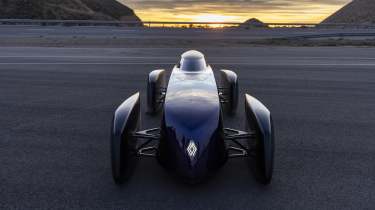
New technology onboard
The Filante Record 2025 uses steer-by-wire and brake-by-wire that, as their names suggest, do without mechanical connections from the steering wheel to the front wheels, or for the brakes. This reduces the number of mechanical components required, which in turn frees up more space under the metal and reduces weight.
Another benefit of a steer-by-wire system is that the steering wheel and other components can be fitted wherever Renault needs, which allows its engineers to overcome platform-related constraints. Additionally, the relative freedom created by brake and steer-by-wire systems means that the controls can be placed on the steering wheel, making driving the car more accessible and easier for people with limited mobility.
The 87kWh battery in Filante Record 2025 also uses new cell-to-pack technology to maximise efficiency, reduce weight and make the most of the available space, which was limited, despite the car measuring 5.12 metres long – about the same as a Mercedes S-Class. That’s because the single-seater is only 1.71 metres wide, meaning it’s narrower than a Renault Clio supermini. It also only weighs 1,000kg – with 600kg of this being the battery pack.
Click here for our list of the fastest electric cars in the world...