Peugeot 308 review
With striking good looks, the Peugeot 308 is a desirable hatchback, but it sacrifices practicality and isn’t great to drive
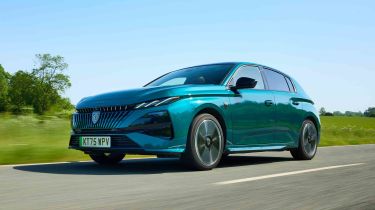

Our opinion on the Peugeot 308
Buyers looking for an eye-catching family hatchback that offers a little more character and (dare we say it) Gallic flair than other mainstream rivals could find the Peugeot 308 an interesting option. The French family car is bestowed with an air of quality that means it will have other premium hatches from the likes of Audi and BMW well in its sights.
But the 308 isn’t quite the complete package; its cramped rear seats won’t win favour from passengers, while its insipid handling and imprecise automatic gearbox will disappoint keener drivers. Improved onboard technology and decent levels of refinement are plus points that help to make the 308 a desirable choice, but other, admittedly less handsome, hatchbacks offer better value for money.
About the Peugeot 308
Peugeot knows a thing or two about making a good-looking hatchback. From the iconic 205 and 306 of the ‘80s and ‘90s, to the sharp styling of the current Peugeot 208 supermini, the French car maker has often prioritised cars that draw in buyers with a real sense of desirability.
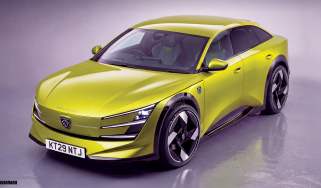
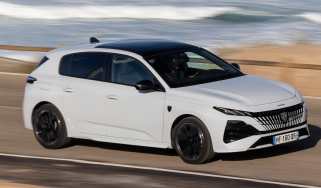
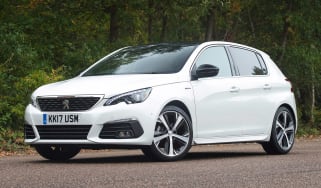
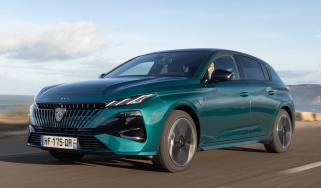
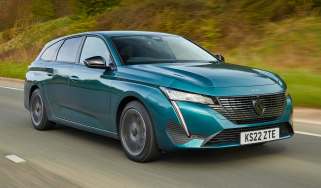
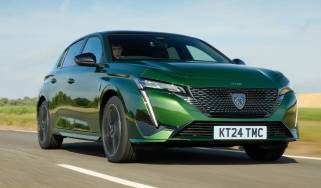
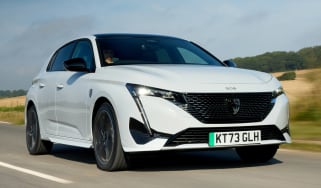
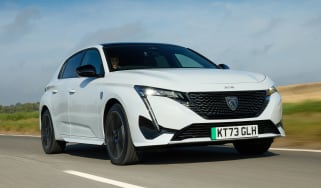
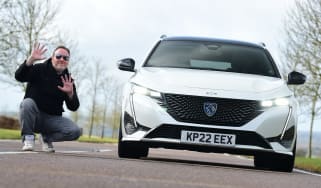
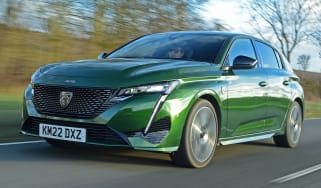
It's clear from a quick glance at the 308’s rakish looks that the manufacturer wants buyers to sit up and take notice. Its distinctive style makes some rivals feel a bit ordinary and definitely helps the 308 stand out in a crowded hatchback market.
Used - available now


The front-wheel-drive 308 offers a range of powertrains, all attached to automatic gearboxes. Interestingly, the 308 is one of dwindling number of family hatchbacks to still have a diesel option, with the rest of the line up using some form of hybrid technology to reduce fuel consumption. Or you could forgo burning fossil fuels altogether by choosing the all-electric version.
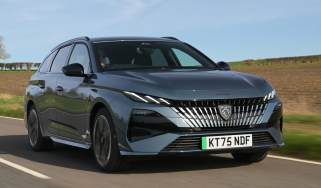
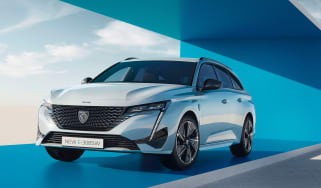
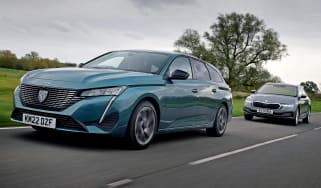
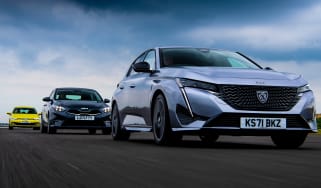
We’ve tested many versions of the 308, and even put an early pre-facelift 1.2 PureTech Allure Premium Peuegot 308 against the Volkswagen Golf and Kia Ceed in a triple test. We also tested the more practical Peugeot 308 SW against the Skoda Octavia Estate, and our web producer, Pete Baiden, ran a Peugeot 308 SW plug-in hybrid as part of our long term test fleet.
Performance & driving experience
Pros |
|
Cons |
|
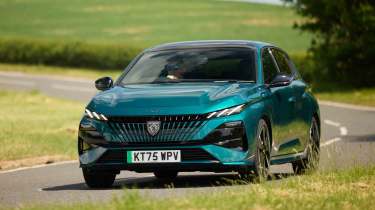
Thinking back to the great Peugeot hot hatchbacks of the past, you might be forgiven for expecting the latest 308 model to be a driver’s delight. Unfortunately, it isn’t, and the first signs are evident as soon as you slip into the driver’s seat, because trying to find a comfortable driving position can be a bit of a chore.
Forward visibility isn’t great because you sit quite low in the car; if you’re on the short side, you’ll need to raise the seat and position the steering wheel low just to be able to get a decent view of the i-Cockpit digital dials, which all feels a little odd.
The 308 is fairly nimble in and around town, however, with its quick steering providing good feel and precision, although the small, stylish-looking wheel won’t be to everyone’s tastes. Both the driver and passengers will find the ride perfectly comfortable, with the 308’s suspension set-up adequately able to smooth out any bumps in the road.
One big gripe we have is with the French hatchback’s eight-speed automatic transmission. It’s standard on the diesel (the hybrids get a dual-clutch unit) with no manual option available, which is a shame because it feels quite awkward at times – not quick enough to pick up when attempting to pull away from a junction and taking time to engage at the end of a low-speed coast. You’ll find bringing the 308 to a chauffeur-smooth standstill a bit of an onerous task, because the stop-start system is a little unsure of itself.
Performance, 0-60mph acceleration and top speed
If you’re looking for extra pace, then the plug-in hybrid model is the one to go for. Peugeot slimmed down the options so there’s only one variant now, its engine and electric motor combo putting out 193bhp and 360Nm of torque, for a 7.9-second 0-62mph time and 140mph top speed (it’ll do 84mph on electricity alone).
The old 1.2-litre PureTech petrol car is no more, which leaves the 129bhp 1.5-litre BlueHDi diesel (with 300 Nm of torque) as the only purely combustion variant. Its 10.5-second 0-62mph time won’t wow anyone, but the useful torque figure means it’s got good real-world urge. The Hybrid 145 is still quicker though, covering 0-62mph in 9.3 seconds and adding a single mile per hour to the diesel’s 129mph maximum.
| Model | Power | 0-62mph | Top speed |
| 308 1.5 BlueHDi 130 EAT8 | 129bhp | 10.5 sec | 129mph |
| 308 Hybrid 145 e-DSC6 | 145bhp | 9.3 sec | 130mph |
| 308 Plug-in Hybrid 195 e-DSC7 | 193bhp | 7.9 sec | 140mph |
| E-308 55kWh 156 | 154bhp | 9.8 sec | 106mph |
MPG & running costs
Pros |
|
Cons |
|
There’s no petrol-only 308 anymore, but there’s still a diesel, which has a claimed 59.6mpg. Next up is the hybrid, which Peugeot claims to manage 62.6mpg thanks to its electrical assistance. You’re unlikely to get the extraordinary 148.1mpg fuel economy figure from the plug-in hybrid version, but our experience of PHEVs suggests that it should get close to the figure of the diesel in real-world driving and potentially slightly better economy with regular charging.
| Model | MPG | CO2 | Insurance group |
| 308 1.5 BlueHDi 130 EAT8 | 59.6mpg | 124 | 22E-23E |
| 308 Hybrid 145 e-DSC6 | 62.6mpg | 102 | 22E-23E |
| 308 Plug-in Hybrid 195 e-DSC7 | 148.1mpg | 43 | 28E-30E |
Electric range, battery life and charge time
The 308 plug-in hybrid models offer wider appeal, firstly with the ability to run on electric power alone for up to 59 miles and also by producing far lower CO2 levels (43-60g/km). This means BiK rates start from just 10 per cent. It’s important to remember that the PHEV versions are significantly more expensive to buy than the diesel or conventional hybrid.
After covering over 6,000 miles in our pre-facelift plug-in hybrid Peugeot 308 Allure Premium long-term test car, we struggled to achieve over 20 miles of EV range. However, it did return well over 70mpg.
Recharging the plug-in hybrid will take around 4.5 hours from a 7.4kWh home wallbox - there’s no DC rapid charging available like you’ll find in the Volkswagen Golf.
Driving range has improved for the E-308, up from 267 miles between charges to 287 miles after the facelift. The maximum charging speed for the electric E-308 is only 100kW, which isn’t all that quick compared with rivals. That means it’ll take around 33 minutes to perform a 10 to 80 per cent top-up. An overnight recharge at home will take around 9 hours.
| Model | Battery size | Range | Insurance group |
| E-308 Electric 55kWh 156 | 55kWh | 279 miles | 26E-27E |
Insurance
The 1.5 BlueHDi diesel and Hybrid 145 have identical insurance groups, in a range between group 22E and 23E depending on trim level and body style, so should end up being similar to insure - though those groups are by no means low for the class, given even a BMW 1 Series starts in group 21. The electric model is next up at groups 26E-27E, while the plug-in hybrid, the most powerful model in the range, is up in groups 28E-30E. Again, even a BMW M135 xDrive with 294bhp only tops out at group 29, so don’t expect especially low rates for the 308.
Tax
The relatively low CO2 of 124g/km of the diesel still doesn’t make it the best choice for company car drivers thanks to a benefit-in-kind (BiK) figure of 30 per cent for that model. It may still catch the eye of private buyers with a first year bill of £455 followed by an annual VED rate of £200.
You could save yourself £50 by choosing the 1.2 Hybrid. Thanks to its lower 102g/km CO2 figure, its BiK rate is 26 per cent for the 2026-2027 tax year, and its first-year VED bill is £405, and then £200 per year in VED thereafter. The plug-in hybrid is even better, with an initial fee of £115 and then £200 per annum thereafter, while BiK is charged at 10 per cent.
Naturally, the E-308 will be the company car choice. Due to its 0g/km CO2 figure and plenty of all-electric range, it sits in the bottom four per cent BIK band, and attracts a first-year tax amounting to a crisp ten-pound note. After that, you’ll need to pay the same £200 annual VED fee as a regular petrol, diesel or hybrid car.
One other thing to point out is that electric and plug-in hybrid cars will be subject to a pay-per-mile eVED fee from April 2028, and that eVED rate is set to increase from April 2029 onwards.
Depreciation
Residual values were not a strong point for the previous-generation 308. After a typical three-year/36,000-mile ownership period, buyers could only expect to see a return of around 39 per cent of their car’s original value come trade-in time.
The latest 308 range fares much better, retaining 47-49 per cent of the initial price after 36 months of driving. There’s little difference between the petrol, diesel and plug-in hybrid versions, although the SW estate fares slightly better than the hatchback. This version holds on to up to 50 per cent of its initial value.
To get an accurate valuation on a specific model check out our free car valuation tool...
Interior, design & technology
Pros |
|
Cons |
|
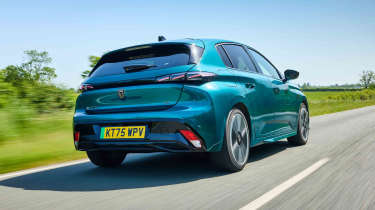
From the outside, Peugeot’s five-door hatchback certainly catches the eye. It’s not only the company logo that’s had an overhaul, so has the 308’s styling, with a rakish front design and sharp creases along the shoulder line leading to a good-looking rear. It’s definitely a bit of a head turner, particularly if you go for one of the more distinctive body colours: we’d recommend either the Olivine Green, Elixir Red or Vertigo Blue paint options.
Interior and dashboard design
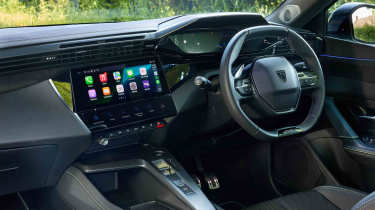
Peugeot’s i-Cockpit system is standard on all models, but takes a bit of getting used to. It incorporates a 10-inch media touchscreen and a digital driver’s display of the same size, which work well enough, but the small steering wheel design means you have to peer over the top to be able to see the dials, rather than looking straight through. It’s an unusual arrangement, and we’d advise having a decent test drive to see whether it feels right for you.
Materials and build quality
It’s noticeable how much focus Peugeot has applied to improving overall quality. It feels like a genuine challenger to premium models such as the Audi A3, and easily outclasses the Mk8 Volkswagen Golf, which wouldn’t have even been thought of just a few years ago.
Infotainment, sat-nav and stereo
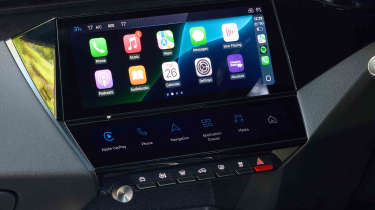
The 308 was the first Peugeot to benefit from a newly updated user interface for its infotainment set-up. While it’s a huge improvement over the systems in previous models, it’s still not without its flaws.
On the plus side, the resolution of the screen is very high, which means that the graphics are crisp and clear, and the rear-view camera looks as detailed as the best systems on the market. Beneath the main display sits a bank of touch-sensitive shortcut keys, which can be customised to show the controls you use the most. Loading times are excellent, too.
However, Peugeot has chosen to stick with the same climate-control arrangement, so all functions are selected via the touchscreen, including temperature controls that take up space on either side of the screen in some menus. Other brands have found a better touchscreen solution, but we would prefer physical controls. Other brands also offer wireless smartphone charging as standard, so charging £100 for it as an option on all trims seems a bit mean.
Boot space & practicality
Pros |
|
Cons |
|
Peugeot has crammed in a lot of standard kit to help make the 308 cabin a comfortable place to be. The steering wheel adjusts for reach and rake, there’s a front armrest and a centre console housing two cup holders, while the driver will appreciate the automatic function for the headlights and wipers, along with voice recognition for the phone and sat-nav systems.
Cruise control and rear parking sensors add to the 308’s practicality, as does the 60:40 split-folding rear seat configuration, which is convenient if you need to transport bulkier items but still need space for passengers.
Dimensions and size
Measuring 4,367mm from head to tail, the 308 sits between the Volkswagen Golf (4,282mm) and Honda Civic (4,560mm) in terms of overall length. The French hatchback is the widest of the three, at 1,852mm (without mirrors) and is lower than the Golf, but not as sleek as the longer and lower Civic, and can’t match the Honda’s passenger-space-enhancing long wheelbase either.
| Dimensions comparison | |||
| Model | Peugeot 308 | Volkswagen Golf | Honda Civic |
| Length | 4,367mm | 4,282mm | 4,560mm |
| Width | 1,852mm | 1,789mm | 1,802mm |
| Height | 1,454mm | 1,483mm | 1,408mm |
| Wheelbase | 2,675mm | 2,620mm | 2,734mm |
| Boot space | 412 litres (PHEV 314, EV 361) | 381 litres (PHEV 273) | 410 litres |
Seats & passenger space
The 308 has a lower roofline than you’ll find in a VW Golf, and it tapers away even more towards the rear of the car. While this design trait helps the 308 look suitably sporty, it hampers interior space for rear passengers, and taller occupants may find it a little uncomfortable.
We also found the wide C-pillars and small rear windows made it feel a little claustrophobic in the back, so if you’re going to be regularly ferrying passengers around, you may wish to consider an alternative five-door hatchback.
Boot space
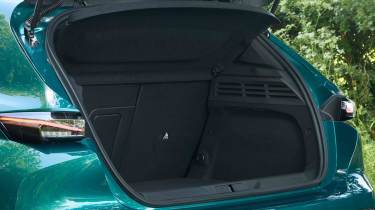
The 308 makes up for its compromised rear passenger space with a decent-sized boot. At 412 litres, its luggage capacity betters that of the Golf and is even slightly ahead of the much longer Civic. That’s only if you opt for the diesel or 1.2 Hybrid, however. Boot space in the electric variant shrinks to 361 litres, and in the plug-in hybrid it’s a pretty disappointing 314 litres - even the Skoda Fabia from the class below has a 380-litre boot.
Reliability & safety
Pros |
|
Cons |
|
The 308 includes a raft of standard active safety kit with lane-keep assist, a speed limit recognition function, a driver attention warning, adaptive cruise control and an Active Safety Brake system all included.
Peugeot’s Drive Assist Pack is available for £680 as part of the 360 Vision and Drive Assist Pack on Allure and GT trims (standard on GT Premium), and adds rear cross traffic alert (providing a warning if approaching cars are detected as you’re reversing), lane positioning assistance, and a long-range Blind Spot Detection system. If you’re adding these to an SW estate in GT trim, then it’ll cost £1,000 because an electric tailgate is bundled in that pack as well.
Industry safety body, Euro NCAP, tested the 308 in May 2022 and awarded it a four-star rating out of five. Adult and child occupant protection scores were good at 76 per cent and 84 per cent respectively, but the vulnerable road users (68 per cent) and safety assist (65 per cent) categories didn’t fare so well.
Specifically, Euro NCAP highlighted the poor areas of protection offered by the 308’s bonnet to the head of a struck pedestrian in the event of a collision, and also rated Peugeot’s autonomous emergency braking system as marginal in terms of how it responded to other cars on the road.
Peugeot’s been slowly moving up the manufacturer order in the Driver Power survey, ranking 7th out of 30 manufacturers in our 2026 best brands list. Owners scored their cars highly for the styling and low running costs. They would like a better mix of physical and touchsensitive controls, though.
The current generation of 308, albeit in pre-facelift form, achieved 18th place from 50 cars in the 2026 survey, with some impressive scores too: first place for handling, exterior, and both exterior and interior styling. Ride quality was second place too, but less admirable scores for rear seat space, infotainment and value.
| Euro NCAP safety ratings | |
| Euro NCAP safety rating | 4 stars (2022) |
| Adult occupant protection | 76% |
| Child occupant protection | 84% |
| Vulnerable road user protection | 68% |
| Safety assist | 65% |
Buying, prices and deals
Best buy: Peugeot 308 GT Hybrid 145
Pricing for the 308 starts at around £28,500 for the 1.2 Hybrid Allure, rising to £29,000 for the 1.5 BlueHDI Allure diesel or £33,500 for the 1.6 plug-in hybrid (also in Allure trim).
The Peugeot E-308 is among a growing number of EVs that qualify for the Government's Electric Car Grant (ECG) announced in July 2025. The E-308 is eligible for a £1,500 discount, which is applied automatically when you buy. Pricing starts at around £31,000 in Allure trim (before the ECG discount), going up to around £34,500 for the GT Premium trim.
While company car drivers will gravitate to the low BIK rates of the E-308 (and possibly the plug-in hybrid), for private buyers it’s the regular Hybrid 145 that makes the most sense. It’s cheaper than the diesel and gets better fuel economy, plus it has a more sophisticated dual-clutch automatic. It also retains its boot capacity compared with the plug-in hybrid or electric versions.
Mid-range GT trim doesn’t add too much to the price compared with Allure, but comes loaded with handy features like front parking sensors, sat-nav, adaptive LED headlights, and the customisable i-toggles that help make the infotainment system a little easier to use.
Peugeot 308 alternatives
Competition is fierce in the 308’s segment though also fragmented, with previous favourites either disappearing (like the Ford Focus, Hyundai i30, and Kia Ceed) or going all-electric (such as the Renault Megane). The Vauxhall Astra is still around and, as another brand under the Stellantis umbrella, is very similar to the Peugeot under the skin.
The Toyota Corolla and Mazda 3 are worth considering too, while the hybrid-only Honda Civic is excellent, if expensive. Premium brands still populate the segment too, with the Audi A3, BMW 1 Series and Mercedes A-Class all still present and correct - with the BMW being the predictable driver’s choice among them. And don’t ignore the Volkswagen Golf, which has slowly improved in its latest generation and remains one of the family hatchbacks to beat.
Key updates of the Peugeot 308 review
27 July 2026: Updated with 2026 Driver Power customer satisfaction survey results and 308 facelift impressions
Frequently Asked Questions
The 308 is covered by a three-year or 60,000-mile warranty, which is par for the course. The electric E-308 can get up to eight years or 100,000 miles of warranty coverage if you (and subsequent owners) keep taking the car back to a Peugeot retailer for routine servicing.
Deals on the Peugeot 308 and alternatives