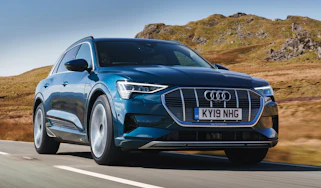
Audi Q8 e-tron (2022-2025) review
As Audi’s flagship electric SUV, the Q8 e-tron offers superb performance, comfort and refinement

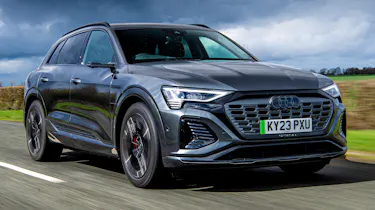

In the name switch from Audi e-tron to Audi Q8 e-tron the car also gained a substantial range boost thanks to larger batteries and more power. However, the new Q8 e-tron moniker doesn’t change the car’s core characteristics; it’s still quiet, comfortable and beautifully built, plus it comes laden with all the latest tech.
The Q8 e-tron is practical, too, with loads of space for the family and all their luggage, albeit without a seven-seat option and oddly less boot space than the pre-facelift model. But despite the on-paper improvements, Audi’s luxury electric SUV can’t match the range of key rivals like the BMW iX, nor is it particularly efficient in the real world.
About the Audi Q8 e-tron
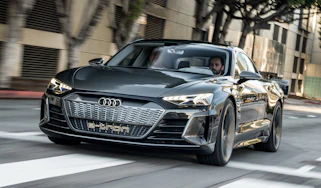
The e-tron was Audi’s very first all-electric production car and one of the first electric SUVs on the market, albeit trailing the Tesla Model X and Jaguar I-Pace into UK showrooms. But things have come a long way since 2019, with the flagship electric SUV renamed as the Q8 e-tron, which is now just one of a rapidly growing range of electric Audis that includes the impressive e-tron GT saloon, and the Q4 e-tron and Q4 e-tron Sportback family SUVs. A larger Q6 e-tron SUV, A6 e-tron saloon and A6 Avant e-tron estate are also coming soon.
Used - available now

2023 Hyundai
Tucson
23,745 milesManualPetrol1.6L
Cash £16,976
2021 Tesla
Model 3
89,000 milesAutomaticElectric
Cash £15,500
2021 Hyundai
Ioniq electric
66,000 milesAutomaticElectric
Cash £9,500
2023 Peugeot
308 SW
62,477 milesAutomaticPetrol1.2L
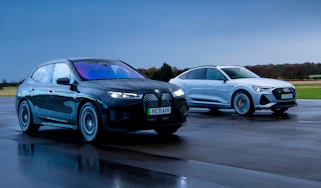
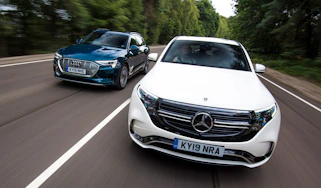
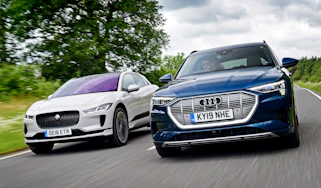
Cash £13,197The choice of luxurious electric SUVs has also grown in recent years, with the Q8 e-tron’s closest rivals being the aforementioned Jaguar I-Pace and Tesla Model X, the BMW iX, Mercedes EQC and newer EQE SUV. There are plenty more on the horizon though, namely the Lotus Eletre, Volvo EX90 and Polestar 3.
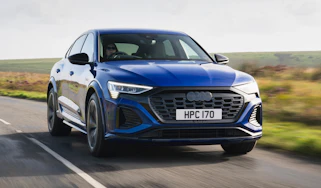
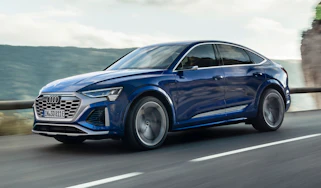
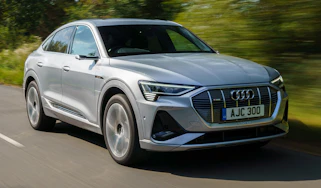
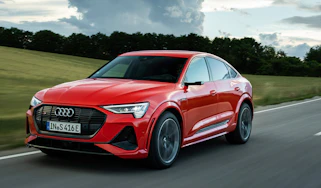
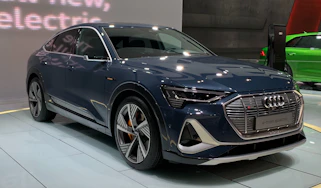
The Q8 e-tron slots in between the Q5 and Q7 in terms of size and interior space, and while its styling is fairly conservative, it’s instantly recognisable as a member of the Audi SUV family. Of course, if you don’t mind losing a bit of boot space, then the Q8 e-tron Sportback (formerly the e-tron Sportback) is offered with the same trim levels and powertrains as the regular SUV, but gets a slightly higher range thanks to its trendy coupe-esque sloping roofline being slightly more aerodynamic.
Speaking of the big electric Audi’s running gear, as well as its new name, the Q8 e-tron got more power and a larger capacity battery pack as part of its facelift. There are three powertrains to choose from, starting with the entry-level Q8 e-tron 50, which gets a pair of electric motors for quattro all-wheel drive and a 95kWh (89kWh usable) battery.
The mid-range Q8 e-tron 55 gets a power boost and an even larger 114kWh battery (106kWh of which is usable). The maximum charging speed for this version also jumps from 150kW to 170kW, so despite the bigger battery, a 10 to 80 per cent top-up still takes about half an hour.
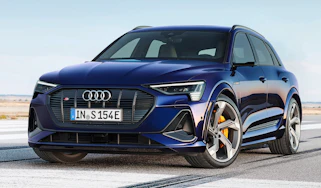
Finally, serving as the replacement for the e-tron S is the SQ8 e-tron, available in both SUV and Sportback forms. This uses three electric motors (just like a Tesla Model X Plaid) to produce 496bhp and 973Nm of torque, and is powered by the same battery as the Q8 e-tron 55. Being the high-performance version with the emphasis on power rather than efficiency, the electric range is unsurprisingly reduced.
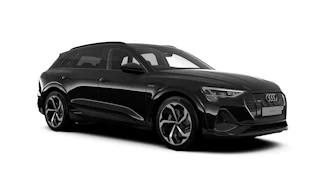
Five trim levels are available for the Q8 e-tron – Sport, S line, Black Edition, Vorsprung, and SQ8 e-tron – with prices starting from around £67,000 for the regular SUV, while the equivalent Sportback coupe-SUV will cost about £2,500 more. Every model comes with 20-inch (or larger) alloy wheels, Matrix LED lights, a power-operated tailgate and adaptive air suspension, plus dual-zone climate control, Audi’s Virtual Cockpit digital instrument display and the firm’s MMI infotainment system with Apple CarPlay and Android Auto connectivity.
Electric motor, drive and performance
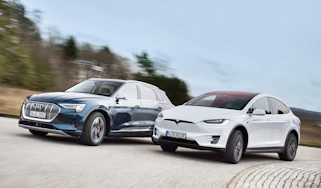
Electric cars are famed for their instant acceleration and scintillating straight-line performance – and with 664Nm of torque in even the base model, the Audi Q8 e-tron is no different. While it may not be as fast as a Tesla Model X from a standstill – and Audi’s softer throttle calibration makes it feel less hyperactive than the Tesla – the Q8 e-tron still offers plenty of shove and more than enough punch for most motorists.
The traction of the standard quattro all-wheel drive system combined with the immediate thrust of its electric motors makes light work of getting the Q8 e-tron off the line and performing swift overtakes. It can also nip into gaps in traffic that you might not have otherwise had the confidence to go for in the equivalent Audi Q8 diesel, because the auto gearbox on that car dithers about when you want to make a smart getaway.
On the open road, the Q8 e-tron impresses with incredible refinement. In some EVs, the lack of any engine drone makes wind and road noise even more conspicuous, but not so the Audi. It’s incredibly hushed – especially when fitted with the optional acoustic side windows – making a 70mph cruise feel more like 50mph. That being said, the wide tyres fitted to the SQ8 e-tron (which look big enough to roll a cricket green with) can kick up a bit of a din over rougher road surfaces.
The Q8 e-tron is comfortable, thanks in part to the standard air suspension system, which can cycle through various settings and levels of suppleness. Even over twisty, bumpy roads, it manages to glide over some pretty sizable potholes and drain covers that many other cars would thump across. Both 20- and 21-inch rims are available, and both deliver similarly impressive levels of comfort. The SQ8 e-tron has different suspension settings to go along with its monster 22-inch wheels, with the end result providing a firm, yet exceptionally controlled ride that puts us in mind of a well-sorted BMW M car.
However, the Q8 e-tron is a heavy car and struggles to disguise its bulk on twistier roads. Weighing in around 2.5 tonnes (2,650kg in SQ8 e-tron form), it is more than 350kg heavier than a Jaguar I-Pace, and even weighs more than a seven-seat Model X. This harms the agility of the standard Q8 e-tron, and can make it feel quite cumbersome through tighter bends.
The high-performance SQ8 e-tron is the exception, though. Due to some clever programming of the two electric motors it has for the rear axle, it can alter the amount of power each rear wheel gets. The full effect of this torque vectoring system is felt in Sport driving mode, where it can aggressively overpower an outside rear wheel to help tighten the car’s cornering line. It works so well in our view that you can almost kid yourself you're driving something much smaller.
Grip levels and stability for all versions are good thanks to the relatively low centre of gravity, but this isn’t a car you’ll particularly relish hustling along your favourite B-road; it’s a similar drive experience to the Mercedes EQC, but both the BMW iX and Jaguar I-Pace are more accomplished in this regard.
But accept that the Q8 e-tron isn’t a sports car and you’ll find the driving experience can satisfy in plenty of other ways. The regenerative braking system is particularly intuitive to use, and while it isn’t as aggressive as the set-up you’ll find in a Model X, it can sufficiently slow the car on approach to junctions or roundabouts. The system also works when you depress the brake pedal; only reverting to the mechanical brakes under particularly heavy loads, which helps to recoup more battery charge.
0-62mph acceleration and top speed
Whichever way you look at it, the Audi Q8 e-tron is a quick car. Even the entry-level Q8 e-tron 50 produces 335bhp from its two electric motors and is capable of sprinting from 0-62mph in six seconds flat. While that may not be as quick as the less expensive Tesla Model Y (0-62mph in 4.8s) it still offers all the torque, power and performance you expect from an electric car. The Q8 e-tron 50 gets a top speed of 124mph.
The Q8 e-tron 55 gets even more power, pumping out 402bhp and 664Nm of torque; enough for 0-62mph in 5.6 seconds. This set-up certainly isn’t sluggish and provides plenty of shove from rest, although it doesn’t feel rocket-ship fast like a Tesla Model X.
The 496bhp tri-motor SQ8 e-tron is the fastest of the bunch and is able to dispatch the 0-62mph benchmark in 4.5 seconds, before going on to a top speed of 130mph.
Range, charging and running costs
Before it was facelifted and became the Q8 e-tron, Audi’s flagship electric SUV was available with either a 71kWh or 95kWh battery, and offered between 198 and 254 miles of range. That was no match for the 292-mile Jaguar I-Pace or the 380-mile xDrive50 version of BMW iX.
Thankfully, the Audi Q8 e-tron gets significantly larger batteries than the pre-facelift model. The Q8 e-tron 50 uses a 89kWh usable battery and offers up to 281 miles of range (up to 290 miles for the Sportback), which is on par with the entry-level xDrive40 version of the BMW iX, as well as the Jaguar I-Pace and Genesis Electrified GV70.
Meanwhile, the Q8 e-tron 55 offers up to 330 miles and 342 miles of range, respectively, in SUV and Sportback coupe forms, thanks to a whopping 114kWh battery (106kWh of which is usable). This is the version we’ve driven most at this point and we’re yet to be convinced by the Q8 e-tron’s efficiency. You’ll do well to get more than 2.5 miles per kWh of energy, so you can lop 75 miles off the quoted range straight away, which equates to a real-world range of about 265 miles from this, the longest-range Q8 e-tron variant. In cold weather, or after more enthusiastic driving, don’t be surprised to see even less distance from a full charge.
Finally, sitting at the top of the Q8 e-tron range are the tri-motor SQ8 variants that use the same 106kWh usable battery, now feeding three electric motors rather than just two. This being the high-performance model, the official range drops to about 290 miles, with the Sportback model going slightly further on paper once again. However, when driven in the manner it was designed for, we saw the efficiency drop as low as 1.9 miles per kWh.
The downside of batteries of this size is they can take ages to charge. You’ll need approximately 14 hours to fully replenish the Q8 e-tron 50 using a standard 7.4kW home EV charger, or nearly 17 hours if you get a Q8 e-tron 55 or SQ8 e-tron. All cars get an 11kW on-board charger as standard, and a 22kW charger is extra, but not all home wallboxes can supply that amount of power because you need a three-phase energy supply to power them.
But as well as larger batteries, every version of Q8 e-tron has a higher maximum charging speed. The base Q8 e-tron 50 maxes out at 150kW, while the Q8 e-tron 55 gets up to 170kW. Either way, find a suitably fast ultra-rapid charging point and a 10 to 80 per cent top-up will take about half an hour.
Like all electric cars, the Q8 e-tron is exempt from road tax (VED) and escapes the London Congestion Charge until 2025. It also attracts a mere 2 per cent Benefit-in-Kind (BiK) for the next few years, compared to the 37 per cent company car drivers would pay for a less expensive diesel-powered Audi Q5.
Insurance groups
This being a luxurious electric SUV, the Q8 e-tron lands in very high insurance groups, starting in group 48 out of 50 for the most basic Q8 e-tron 50 in Sport trim. Upgrading to S Line spec or the Q8 e-tron 55 powertrain sees the insurance rating jump to group 49, with the rest of line-up landing in insurance group 50. It’s a similar story for the Q8 e-tron Sportback range, too.
Check any car's MoT history in a few easy clicks with our MoT checker tool...
Depreciation
Residuals for the Q8 e-tron after three years or 36,000 miles have settled between 44 per cent of retained resale value for the Q8 e-tron 55 Sportback in Sport trim, up to 51 per cent for the Q8 e-tron 55 Black Edition. That’s broadly on par with the BMW iX, Mercedes EQE SUV, and Jaguar I-Pace over the same time period.
The few similar cars that do better include the Volvo EX90, which is expected to retain 54 per cent of its value and the left-hand-drive-only Tesla Model X. In Plaid form, it should still be worth 62 per cent of its value, according to our experts. Prices are holding firm because Tesla has stopped selling new right-hand-drive versions of the Model X in the UK.
To get an accurate valuation on a specific model check out our free car valuation tool...
Interior, design and technology
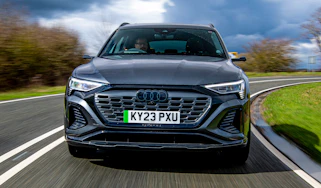
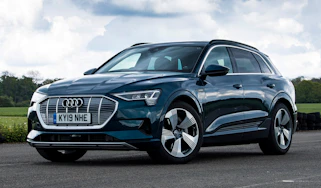
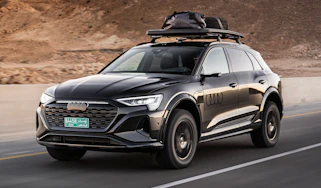
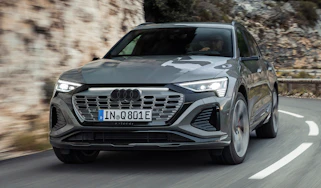
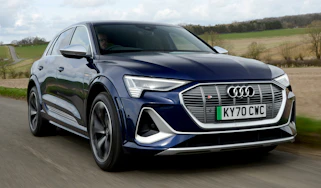
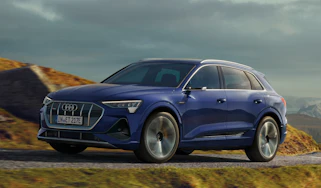
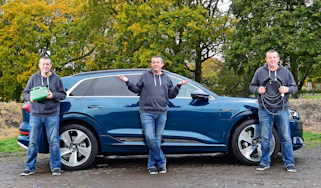
Audi played it safe with the Q8 e-tron’s styling. It’s instantly recognisable as one of the firm’s family SUVs – slotting in somewhere between the Q5 and Q7 in terms of size. It uses a similarly sculpted front grille, revised when the model gained the Q8 tag with a wider grille surround and a light-up element behind the four rings, as well as an LED rear light bar lifted from the current A7. Its dimensions aren’t too vast, either, so despite weighing around 2.5 tonnes, it doesn’t look like a huge car on the road.
Inside, the Q8 e-tron feels as beautifully built as any modern Audi, with quality materials covering every surface. There are swathes of leather, polished plastic and high-grade metal trim; the fully digital cockpit gives it a high-tech edge in the SUV class, too.
On Vorsprung cars, that fully digital dashboard is flanked on either side by a pair of swish virtual door mirrors. The tech replaces the conventional mirrors with two hi-resolution cameras, which feed images to a set of small screens in the doors. It’s also available as a cost option (£1,750) on standard models, but in our experience, the tech just isn't quite there yet. The main issue is with the placement of the displays, which are much lower than you’d normally look into conventional mirrors, while the displays are quite small too – though you can touch the screen to adjust them, which is a neat feature. The aerodynamic benefit they bring is said to eke out a little extra range, but we don’t think it’s worth that amount of money when it makes it harder to see what’s alongside you.
Sat-nav, stereo and infotainment
Following the transformation of the e-tron into the Q8 e-tron, there was no significant update for the infotainment tech. However, there was no real need to change much anyway; despite its age, the MMI Navigation Plus set-up remains slick, looks good and is easy to use.
The 10.1-inch central touchscreen seems fairly modest in size compared with that of its rivals from BMW, Mercedes and Genesis, but a second display just below is used for controlling the climate and other secondary features. It’s a neat system because, unlike other touchscreen-based systems, the on-screen keys are large and a permanent fixture. Haptic features give the feel of pressing a real key, but thanks to that lack of genuine feedback, we often find ourselves prodding the screen harder than necessary.
Every Q8 e-tron also comes with Audi's familiar Virtual Cockpit digital dials that are large, clear and easy to read. You can customise it to prioritise the more traditional dials or shrink them to display a larger map for navigation, if you prefer.
A three-year subscription to Audi Connect online infotainment services, DAB radio, Bluetooth and wireless mobile phone charging is standard too, along with Audi Smartphone Interface with Apple CarPlay and Android Auto connectivity. The mapping software comes installed with available charging points, so it’s possible to plan journeys around necessary stops.
The top-of-the-range Vorsprung trim is loaded with even more kit, including a head-up display, Audi's Virtual Cockpit Plus system and a Bang & Olufsen audio system, which are all available as part of the optional Technology pack on the rest of the Q8 e-tron line-up.
Practicality, comfort and boot space
By avoiding a seven-seat option, Audi has maximised the available space inside the Q8 e-tron’s cabin; despite the fact the Audi’s wheelbase is shorter than both the Jaguar I-Pace and Tesla Model X’s, there is plenty of room for adults to get comfortable.
Interior storage is good, with a big central cubby between the front seats. However, while this bin is a decent size, things can fall out and down the sides of the seats, which could prove frustrating over time. The door bins in the front and rear are substantial, and can handle storing drink bottles as well as your other odds and ends. There are three ISOFIX points in the cabin: one on the front passenger seat and two in the rear, which are very easy to access behind their removable plastic covers.
The big boot may have shrunk slightly when the large electric SUV was facelifted, but there’s still loads of space for luggage, and you get a 60-litre storage space or ‘frunk’ under the bonnet that’s ideal for charging cables, as well as any other bits and bobs.
Dimensions and size
At 4,915mm long, the Audi Q8 e-tron is 233mm longer than a Jaguar I-Pace, but 121mm shorter than a Tesla Model X. However, it is narrower than both, which should make it slightly easier to park on congested city streets. The Q8 e-tron Sportback is identical in length, but its swooping 1,619mm high roof line is 14mm lower than the non-Sportback.
For comparison, those dimensions make it longer than an Audi Q5 (4,663mm) but shorter than a Q7 (5,052mm). The Q8 e-tron’s ride height is adjustable by up to 76mm, making it easy to get in and out of and giving it some mild off-road ability.
Leg room, head room & passenger space
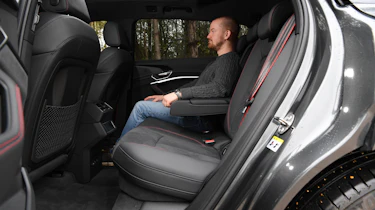
The Audi Q8 e-tron is a spacious family SUV. By avoiding the temptation to fit an extra pair of seats in the boot, the engineers and designers have managed to maximise space in the second row to ensure even tall adults can get comfortable.
There’s loads of head and legroom in the rear, and you can fit three across the back for short journeys. Of course, there’s more than enough adjustment in the seats for both driver and passenger, with decent visibility for all.
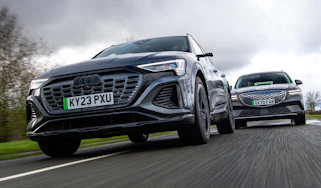
When we tested the Q8 e-tron back-to-back with the Genesis GV70 Electrified, we took our own measurements of both cars, showing that the Audi offers significantly more head room (from the seat base to the ceiling) and elbow room (from door to door) in the back seats. knee room is similar, however.
| Rear seat space comparison | |||
| Knee room (min - max) | Head room | Elbow room | |
| Audi Q8 e-tron | 636 - 864mm | 998mm | 1,561mm |
| Genesis GV70 Electrified | 616 - 863mm | 960mm | 1,358mm |
Boot space
Before it was facelifted, the Audi e-tron offered an extremely generous 660 litres of boot space. However, that’s shrunk down to 569 litres for the Q8 e-tron, but don’t let that put you off. The Q8 e-tron (in standard form) boasts more cargo space than the mere 500 litres you get in the BMW iX or the 557 litres in the Jaguar I-Pace. Fold the rear seats down, and the Q8 e-tron gives you a whopping 1,637 litres to play with, which is substantially more than you can cram into a Jaguar I-Pace.
If practicality isn’t your top priority, the more coupe-like Audi Q8 e-tron Sportback gets 528 litres of boot space with the rear seats in place and 1,567 litres if you fold the back seats down.
Our own measurements of the Q8 e-tron boot space compared to the Genesis GV70 Electrified show the Audi narrowly winning on boot length and width but with a slightly higher loading lip.
| Boot space comparison | |||
| Length | Width | Lip height | |
| Audi Q8 e-tron | 1,072mm | 1,045mm | 796mm |
| Genesis GV70 Electrified | 956mm | 1,025mm | 754mm |
Towing
The Audi Q8 e-tron has a maximum towing weight of 1,800kg, which is fairly impressive in isolation. However, it can’t compete with rivals like the Tesla Model X or BMW iX that can haul well over 2,000kg, while a diesel Audi Q5’s 2,500kg towing capacity trumps the lot.
Reliability and safety
Regarding safety, the Q8 e-tron should prove a tough family car. The pre-facelift model achieved the maximum five-star crash safety rating from industry experts Euro NCAP in 2019, and every model is fitted with Audi Pre-sense Front and Basic, lane departure warning, cruise control with a speed limiter, camera-based traffic sign recognition, a reversing camera, parking sensors all round and a host of airbags.
Top-of-the-range cars also come with adaptive cruise, swerve assist and cross-traffic alert, among additional safety kit, that are included in the optional Tour Pack and the City Assist Pack.
The Audi brand has slipped down the Driver Power rankings, coming in a woeful 30th place out of 32 manufacturers in the 2023 survey. That puts it behind Mercedes, BMW, Jaguar, and even upstart Tesla.
Warranty
As with any new Audi, the Q8 e-tron comes with a three-year/60,000-mile manufacturer warranty. Extended warranties are available for both the Q8 e-tron and the Q8 e-tron Sportback, priced at £635 for the four-year/75,000-mile warranty, and £1,670 for five years/90,000 miles of coverage.
Q8 e-tron owners also benefit from an eight-year/100,000-mile battery warranty, which matches Jaguar I-Pace’s powerpack coverage. Teslas get an eight-year/unlimited mileage battery warranty, however.
Servicing
The Audi Q8 e-tron only needs to be serviced once every two years or 18,000 miles, whichever comes first. To make life easier, Audi has three service plans available for the Q8 e-tron, offering different levels of attention according to how far owners are likely to travel.
A basic ‘Level 1’ package with a single service costs £399 up front or £33.25 per month over twelve months, while a two-service Level 2 is £785 or £32.71 per month, and Level 3, which also includes two MOTs for the third and fourth years of ownership, is £880 or £36.67 per month.