Audi R8 v Porsche 911 v AM V8 Vantage v Jaguar XKR Coupe: 2007 group test
Does Audi's R8 have the performance to match its looks and upset top-flight models from Porsche, Aston Martin and Jaguar?

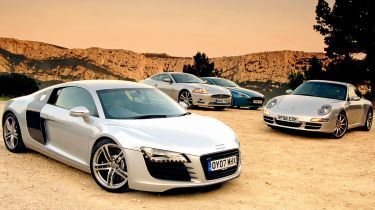
The R8 is here! It’s not as if we weren’t given plenty of warning about its impending arrival, though – Audi has been threatening to build a top-flight supercar for years.
Remember the stunning Avus concept? A mid-engined, four-wheel-drive, aluminium-bodied two-seater, it pointed the way for a high-performance model when it was unveiled at the Tokyo Motor Show back in 1991.
That’s 16 years ago – eons in automotive terms – yet since then Audi has pulled the wraps off two more prototypes that shared the same basic architecture: the Rosemeyer (2000) and RSQ (2004). It’s even been four years since the Le Mans Quattro Concept, the R8’s direct predecessor, was first seen at the Geneva expo.
But although Audi has dragged its heels, the R8 has now reached production reality, and despite the delays, it’s still a very exciting prospect. Audi owns Lamborghini, so it’s little surprise that the R8 has a certain amount in common with the Gallardo, while the mighty V8 from the RS4 promises penetrating performance, and its name is shared with the brand’s all-conquering five-time Le Mans winner.
But Audi’s sporting flagship isn’t the only car in this class to claim motorsport influence in its design. Few marques have a richer racing history than Porsche, and the current 911 is the result of more than 40 years of development. It’s one of our favourite sports cars.
Used - available now

2022 Volkswagen
ID.4
21,522 milesAutomaticElectric
Cash £18,050
2026 BMW
X1
14,865 milesAutomaticDiesel2.0L
Cash £28,200
2022 Mercedes
A-Class
38,205 milesAutomaticPetrol1.3L
Cash £15,300
2024 Audi
A3 Sportback
54,077 milesAutomaticPetrol1.4L
Cash £16,040And there are two British firms that can hold their heads up high, not only in the racing arena, but also in the supercoupé class. Not many cars are more desirable or handsome than the Aston Martin V8 Vantage, while the Jaguar XKR has proved that the Coventry company can build a world-class sports GT. So here we pitch the R8 against the cream of the crop to find out which firm offers the ultimate ‘everyday’ supercar.
Verdict
Unfortunately for the Brits, neither can challenge the German dominance of this sector. The Jaguar XKR doesn’t move the game on far enough from the XK to become a top-level sporting machine – it’s simply too comfortable and quiet. The Aston Martin is more convincing. It’s expensive, but its exclusivity, air of controlled aggression and balanced chassis make it a tempting option.
Yet it’s not as well finished as the German pair – either in terms of cabin trim or suspension tuning. The Porsche is the polar opposite of the Jag – it’s firm and feisty, yet it remains the easiest to live with on a daily basis. But its plain cabin, costly pricing and sheer familiarity undermine the vivid driving experience, allowing the Audi R8 to nip through and claim victory. Brilliant to drive, stunning to look at and wonderful to own, Audi’s first supercar is a masterpiece. The only question that remains is why it took the firm so long to build it in the first place.
First place: Audi R8
It’s amazing that we actually managed to drive the R8 at all. That’s got nothing to do with any reliability issues or the logistics of doing a photoshoot in France – more the fact that whenever we stopped, people swarmed over the Audi like bees around a honeypot. We can’t remember driving another performance machine that attracted so much attention.
The Audi is an exhibitionist’s car – and a good-looking one to boot. The designers have managed to make a feature of the cooling vents by placing them directly under the front and rear lights, while the Side Blades double as intakes for the V8 engine. Although unique, they’re arguably the least successful detail on the car, as they cut through the R8’s flowing lines.
Largely hand-built at Audi’s Neckarsulm plant in Germany, the R8 isn’t a big car – it’s nearly the same length as the 911, although significantly wider and lower. This should help its handling, but it doesn’t do practicality or ease of use any favours.
The newcomer’s packaging will force you to compromise: the nose boot totals only 100 litres, and although Audi claims that two golf bags can fit behind the seats, inserting them would block off what little rear visibility there is.
In contrast, both occupants have plenty of space, and get to enjoy a cockpit that is even better than the Aston’s for its sense of occasion. We’re not convinced by the centre console design that curves around the back of the instrument binnacle, nor the fact you sit a touch high. But in every other regard, the R8 is stunning. There’s no faulting the seats, material quality and assembly, flat-bottomed steering wheel, the dash layout, or the fact it simply makes you feel so special.
That impression doesn’t diminish when you fire up the engine. The normally aspirated 4.2-litre V8 roars into life, and once on the move delivers impressive performance from 2,000rpm. At the far end of the rev counter, a red line of 8,250rpm means astonishing acceleration, accompanied by an addictive bellow. It’s a proper performance engine, every bit as convincing here as it is in the RS4.
But there’s one thing that will affect your enjoyment of the powerplant, and the whole car – selecting the right gearbox. As we reported in last week’s first drive, the R Tronic paddleshift system is OK, but it distances you slightly from the driving experience. The same can’t be said of the superb six-speed manual, while the brakes are progressive, strong and reassuring.
That’s true of the handling, too. The R8 is enormously capable and user-friendly, with scarcely believable amounts of grip. None of its rivals, not even the 911, could keep pace on tight, twisting roads. However, it doesn’t have quite the same involvement of the scalpel-sharp 911, and its responses are slightly numb in comparison.
This is a small price to pay for a car with such awesome body control and delightful steering, while the ride quality is little short of astonishing, thanks to the £1,350 Magnetic Ride dampers. These are a must-have for any R8 owner, as they deliver comfort that’s close to matching the Jaguar’s. In fact, the only downside to the driving experience is the limited view out and wide 11.8-metre turning circle.
Oh, and the fact that Audi seems to have adopted Porsche’s pricing policy, by charging extra for everything. The firm’s A3 SE has cruise control as standard – the R8 doesn’t. It’s no wonder most buyers are spending more than £10,000 on options – this penny-pinching approach doesn’t do the otherwise awesome R8 any favours.
Details
Price: £76,825
Model tested: Audi R8
Chart position: 1
Why: The R8 promises a driving experience to match its looks, but also claims to be easy to live with.
Economy: The R8 proved to have by far the longest range – but it does boast the biggest tank. Overall economy of 18.1mpg is fair; just don’t expect to be able to top 20mpg very often.
Residuals: All of these cars measure running costs in pounds rather than pence. But at nearly £2 per mile, the R8 is by far the most expensive, despite strong predicted used values.
Servicing: According to our Driver Power 2007 survey, Audi dealers aren’t as good as Jaguar’s or Porsche’s; its network was voted 16th out of 32. R8 owners will expect much better.
Tax: Few company drivers are likely to run a supercar, but it’s anticipated that many R8s will be purchased via contract hire – these customers face a monthly bill of £1,633.
Second place: Porsche 911 Carrera S Powerkit
After the drama and excitement of the extravagant R8, the 911 seems conservative and restrained. But as ever with Porsche, it’s engineering rather than design that sets this car apart.
The classic profile has been honed over decades of development and has proved successful, to the extent that the 911 is the runaway sales leader in this sector. But even though our car wore smart 19-inch Carrera Sport wheels, it was nowhere when it came to attracting attention on the roads.
A victim of its own success? Or perhaps it’s too versatile for its own good. Comparatively tall and narrow, it has a large glass area and slender, upright A-pillars. All-round visibility is the best here, and the 911 gains points because it has a light and airy cabin and a tight 10.9-metre turning circle.
A decent 135-litre front boot gives it an instant advantage over the R8, plus the 911 actually has rear seats – although admittedly these are best folded flat and treated as an extra stowage area. Unlike both British cars, there’s no tailgate access to this load area, but that doesn’t prevent the Porsche being the easiest car to live with day to day.
That’s not only down to its flexibility, but the fact it’s simple to get in and out of, plus the controls, switches, instruments and dials are logically laid out and operate precisely. Other useful touches, such as the cubbies in the door armrests and pop-out cup-holders, reinforce the impression that the 911 was designed to be used regularly.
But in the designers’ quest to make the 911 user-friendly, they seem to have forgotten to make it stylish. The cockpit doesn’t have the same sense of occasion as any of its rivals – chiefly because it has so much in common with the Boxster that costs half the price. And while the driving position is beyond criticism, the sports seats fitted to our test car are a £1,680 option – the normal chairs have less support.
Nor is the engine of our test car in standard trim. Fitted with the optional Powerkit, which features a modified cylinder head, new intake and exhaust manifolds, an uprated engine management system, carbon fibre air filter housing and a sports exhaust, it boasts an extra 26bhp. However, Porsche sees fit to charge £8,241 for this modest increase.
It’s a waste of money, since the 911’s 3.8-litre flat-six is so good in the first place. It must be said, though, that not even the R8 could match the Powerkit Porsche’s engine note, which develops from a bassy chatter to a high-rev wail.
Power outputs are nearly identical to the Aston’s, but due to the Porsche’s light weight and slippery shape, it proved as quick as the more potent Audi in most of our acceleration tests. Yet around bends it couldn’t keep pace. It suffered from a touch of understeer, but even so, we don’t think a four-wheel-drive version would have proved any faster.
Speed isn’t everything, though, and ultimately the 911 remained the most rewarding and enjoyable car to drive. The front end does move around over bumps and the steering twitches occasionally, but that’s just the car keeping you informed of what’s going on. It’s extremely positive to drive, with honed steering, stiff suspension and a very rigid structure.
Nevertheless, the dampers manage to absorb an enormous amount of punishment, although there’s no escaping the fact that the comparatively unrefined 911 is a noisy cruiser. Not to mention the fact it’s very poorly kitted out in standard trim.
Details
Price: £76,101
Model tested: Porsche 911 Carrera S P’kit
Chart position: 2
Why: Tested here with the optional Powerkit, the 911 isn’t ready to relinquish its crown just yet.
Economy: Unlike the Audi and Jaguar, the Porsche isn’t built from aluminium. But it’s still the lightest car of our quartet, which helps it return 20.2mpg – the best figure on test.
Residuals: The Powerkit adds around 15p per mile to the price of 911 ownership, taking it to nearly £1.80 a mile. Yet even without it, this isn’t a cheap car to run, despite strong residuals.
Servicing: Porsche only provides a miserly two-year warranty, but you can cover 20,000 miles between services. That’s just as well, as the first three come to nearly £1,500.
Tax: A major part of contract hire calculations is depreciation – a 911 strength. Yet the Porsche is still more costly than the Jag. At least the £1,490 total takes in servicing.
Third place: Aston Martin V8 Vantage
Audi claims the R8 is mostly built by hand, but for real craftsmanship, look no further than the Aston Martin V8 Vantage. Assembled by a dedicated team at the firm’s factory in Gaydon, Warwickshire, it oozes class and sophistication.
It’s less ostentatious than the Audi, but remains a stunning car to look at. As with its rival, the British coupé uses LED running lights and feels small on the road. That’s not a misleading impression – it’s shorter than the Porsche and not much taller than the Audi. And to improve weight distribution, Aston has mounted the powerplant as far back in the frame as possible – giving it a front mid-engined layout.
This format does limit cabin space. The V8 Vantage is a strict two-seater with little stowage in the cockpit. However, as with the Jag, it has an accessible 300-litre boot and an additional shelf behind the seats. This traditional GT layout serves the Aston well – as does the interior design.
With swathes of leather, a neat Alcantara roof lining and a bold, sweeping dash design, it looks a million dollars. But the finishing lets it down. The buttons on the centre console are fiddly, there’s too much Ford and Volvo switchgear on display and build quality isn’t a match for the Jaguar, let alone the Porsche or Audi.
All this distracts attention from what is possibly the best seat and driving position combination of these four cars, offering a near-perfect blend of comfort and support. This further increases the Aston’s feelgood factor, helping to keep it in contention with the Audi.
But the British car’s 4.3-litre V8 simply can’t match the firepower of the Audi engine, and only just equals the outputs of the Porsche’s unit, which is half a litre smaller. Nevertheless, 380bhp is not to be sniffed at – nor is the fact that 75 per cent of the 410Nm torque figure is available from 1,500rpm.
The trouble is, it doesn’t feel especially potent at low revs, only really picking up the pace once past 4,000rpm. That’s when the noise doubles and the exhaust note hardens, giving the V8 Vantage an aural tone to rival either German.
And according to the stopwatch, when driven flat-out on the test track, it’s not much slower. But somehow the acceleration never seems to have the urgent feel of the R8 or 911. The six-speed manual gearshift isn’t as crisp or positive, and the weighty clutch is hard work in town. The Aston, does, however, have very strong brakes – second only to the 911 in terms of stopping distances.
And it drives well, too. Placing the engine a long way back in the frame and mounting the gearbox in the rear, near the driven wheels, aids weight distribution and balance. As a result of that, and the Vantage’s advanced bonded construction that enhances chassis stiffness, the British car handles very well. The steering is sharp and accurate and there’s minimal roll or weight transfer to upset things.
However, the suspension isn’t as well developed. The dampers fail to absorb bumps as well as any rival, so the Aston doesn’t fully instil confidence and the ride occasionally becomes jittery.
Put simply, the Vantage’s driving experience lacks the last bit of polish that would make it truly great, and also help to justify the high price tag. Nor are equipment levels particularly impressive – you have to pay extra for xenon lights and cruise control, for instance.
Put simply, the Vantage’s driving experience lacks the last bit of polish that would make it truly great, and also help to justify the high
Details
Price: £82,800
Model tested: Aston Martin V8 Vantage
Chart position: 3
Why: Audi’s drive upmarket takes it straight into the world of Aston Martin’s hand-built exclusivity.
Economy: The V8 in the Aston requires 15 litres more tank capacity to travel the same distance as the 911. As a result, it has the highest fuel costs in this test, with a 16.2mpg average.
Residuals: Our experts can’t calculate accurate running costs for the Aston due to its exclusivity and low production and sales figures. But it’s safe to say it will be pricier to own than the XKR.
Servicing: Wow! While we expected the Aston’s servicing to be pricey, an average of nearly £1,000 per visit is excessive. That’s the highest figure we have ever been quoted.
Tax: HSBC was unable to supply us with a contract hire price for the Aston, so you will have to shop around if you want to buy that way. Expect monthly figures similar to the R8’s.
Fourth place: Jaguar XKR Coupe
Compared with the financial stability of the German marques, the British sports car industry often seems to be in a state of flux. Ford’s ownership of Aston Martin recently came to an end, and rumour has it that the US giant is looking to offload Jaguar, too.
But despite this uncertainty, the firm still manages to turn out cars as good looking as the XK. Fair enough, it doesn’t have the visual drama of the R8, nor such taut lines as the Aston, but there’s no denying it’s extremely elegant and well proportioned. But we’re not sure the R additions sit that well on the refined body – the bonnet slats are OK, but the mesh grille and intakes look like an afterthought.
The trouble is that Jaguar needed to add extra impact to a body that’s more GT than sports car, and the results don’t blend in effortlessly. Especially on such a large frame – the XKR is significantly taller and more than a foot longer than any rival.
This doesn’t mean it’s unwieldy to drive, though. All-round visibility is good, and the relaxing cabin ensures it’s an enjoyable place to spend time in. The materials used in its construction aren’t as tactile as the Aston’s, and as a result it doesn’t have the same air of quality. But the layout is good, cubby space is reasonable and the touch-screen on the centre console is easy to operate.
There are even some rear seats – although they don’t seem to have been designed with adults in mind. The boot is better, though. It has the same quoted capacity as the Aston’s, but offers more usable space. From a practical point of view, the Jag is very easy to get on with.
Accessing the performance is equally simple. The 4.2-litre V8 is the only unit here to employ a forced induction system, and the supercharger provides effortless torque and rapid response from below 2,000rpm. But although it delivers surging acceleration, you don’t feel as involved in the process. The automatic gearbox is partially to blame, but it’s worth pointing out that the six-speed set-up does have an excellent manual paddleshift function that delivers crisp, fast and smooth changes.
However, it’s only those outside the car who get the full benefit of the growling exhaust note. From inside, the soundtrack is dominated by the supercharger’s whine, which is nowhere near as exciting. The XKR is simply too well insulated, and this level of refinement takes the edge off the Jag’s sporting credentials.
These take a further knock courtesy of the brakes. Four emergency stops from 70mph had them smoking, and they lack power and feedback compared to rivals, so are the least reassuring here. True, they have to cope with more weight, but thanks to aluminium construction, 1,665kg isn’t bad for a car of this size and power.
Yet the XKR still comes across as heavy in such talented company. The steering is lighter and less informative, while a higher centre of gravity makes the Jag feel slightly ponderous. Press on, and the tyres soon start to squeal. Considering this is supposed to be the high-performance R model, we expected it to be firmer and more agile.
Instead, the XKR excels as a cruiser. The ride on the adaptive dampers is beautifully controlled and soothing, it only pulls 2,000rpm at 70mph and the noise levels were by far the lowest here. It’s also the cheapest and the best equipped as standard – the Jaguar’s options list fits on a single page; the Porsche’s is 39 pages long.
Details
Price: £67,585
Model tested: Jaguar XKR Coupé
Chart position: 4
Why: The supercharged Jag offers effortless performance and peerless long-distance ability.
Economy: We’ve never found Jaguar’s V8 all that efficient, despite claims of 22.9mpg on the combined cycle. It topped 18mpg on the motorway, but often dropped below 14mpg.
Residuals: While the Jag has strong residuals and relatively cheap servicing, its big fuel bills, plus insurance and tax, mean drivers will pay more than £1.50 for every mile.
Servicing: Choose the XKR rather than the 911, and service costs are nearly halved to £759. However, you’ll also be visiting the main dealer’s workshop twice as often.
Tax: The XKR is nearly £10,000 cheaper than any rival in this test, which is reflected in the contract hire bill. But even then, a monthly outlay of £1,278 is still pretty hefty.