Citroen 2CV to return: a £13k EV city car honouring the iconic original
Citroen has finally confirmed the long-rumoured revival of its famous 2CV and our exclusive images show what it could look like
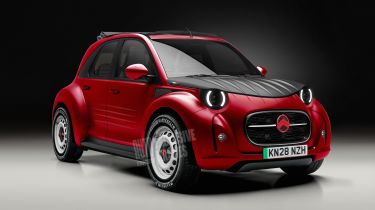
It’s official: the Citroen 2CV will return in 2028 as an all-electric city car that could cost as little as £13,000. Just a single shadowy teaser has been shared so far, but our exclusive images reveal what the reborn 1940s icon could look like.
Speaking at Stellantis's 2026 investor presentation, Citroen brand CEO Xavier Chardon said: "Icons create emotion. Icons reconnect brands with people, and today one icon is about to return. Yes, the 2CV is back." Those words drew a round of applause from those in attendance, a sign of the huge affection the comeback could trigger.

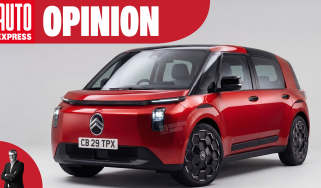
In case anyone feared the 2CV would be returning in name only, the image Citroen showed at the conference revealed the new model would be honouring the original’s form. The flared wheelarches, protruding round headlights and tall, horseshoe-shaped rear are all there, plain as day.
Meanwhile, the high roof will make for a great deal of space in a small package. The 2CV will probably measure less than four metres long, meaning it will be smaller than the Citroen C3, but similar in size to the reborn Renault Twingo arriving in the UK next year and the new Kia EV1 that’s landing in 2028.
Citroen says the new 2CV will revive the spirit of the original and embody the same values of “affordability, lightweight design, practicality, versatility and a distinctive character unlike anything else on the road.”
The original Citroen 2CV put France on wheels after World War II, as Chardon reminded us during his keynote. "In 1948 the 2CV gave freedom of mobility to millions, and 80 years later the new 2CV will democratize electric mobility,” the CEO promised. “100 per cent electric, made in Europe [and with a starting price] below €15,000. A true people's car designed for real life."

As long reported by Auto Express, the new budget Citroen will be shown as a concept at October's Paris Motor Show. Stellantis has confirmed the electric city car will be assembled at the Pomigliano d’Arco plant in Italy, which currently builds the Fiat Panda.
The new Citroen 2CV is part of parent company Stellantis's highly ambitious 60billion Euro FaSTLAne strategy that will see its army of brands, including Vauxhall, Peugeot, Fiat, Alfa Romeo, Jeep and others, launch dozens of new cars within the next few years.
One part of that plan is the 'E-Car' project, which includes the new 2CV and Fiat’s own cut-price entry-level EV that’s likely to serve as the replacement for the Fiat 500e.
"For me, the future of mobility will not be won by the most complex cars, but by the simplest and the most intuitive ones," concluded Chardon. "What truly matters is to be simply relevant. With the return of the 2CV, Citroen is back to the future."
What will the new Citroen 2CV look like?
Citroen’s design team, under the experienced Pierre Leclercq, has been hard at work on the Paris show car. The success of the reborn Renault 5, which has flown past the 120,000-order mark and been Europe’s top-selling retail electric car at times, illustrates the power of a well executed retromodernist design – or ‘neo-retro’ to use Leclercq’s term.
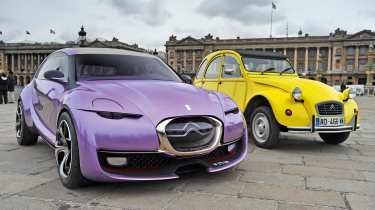
“We’ve all had a shot at recreating the 2CV,” he told us in December 2025, referencing the 2009 Revolte concept conceived under former Citroen design boss Jean-Pierre Ploué. “It was a modern interpretation of a 2CV and it was super cool. You cannot say it’s something you won’t try, the same way we tried little H-types or things like that. We tried those projects.”
The Revolte was a plug-in hybrid based on a shortened Citroen DS3, which nodded to the 2CV with its ‘eye’ headlamps, grille and exaggerated fenders. But it wasn’t a parody of the original and that’s the approach being championed by Leclercq, who will take the 2CV’s ethos of affordability, spaciousness, comfort and fuel efficiency in a modern direction.
“If you think of a 2CV, a cheap car for villages, it’s so important to keep the philosophy and values. If you can reinterpret it in a car today, then let’s do it,” Leclercq added.
And speaking to Chardon in April 2025, drilled home that the future city car wouldn’t be an unashamed retro reboot of the 2CV: “Nostalgia for nostalgia is not a silver bullet,” he told us. “For me, what is more important is to understand the purpose of the car at that time.
“The purpose of the [2CV] was to bring mobility to the masses after World War II. It was carrying four farmers under one roof and being able to carry 50kg of potatoes. In the next years maybe I could replace the farmer with a nurse.”
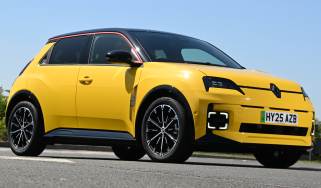
But while the new Renault 5 is the commercial lodestar, the concept will be closer in size and price to Renault’s forthcoming, £17,000 3.8m-long Twingo.
Stellantis announced a new global vehicle architecture, STLA One, as part of its investor day presentation. But the Citroen – and its Fiat sibling – will sit on a bespoke, low-cost 'E-Car' architecture. It's sufficiently different from the ‘Smart Car’ platform, underpinning the new C3, C3 Aircross and Fiat Grande Panda and packing combustion and electric power, to get an all-new architecture designation. It's certain to use lower cost LFP (lithium iron phosphate) batteries, and Stellantis's Chinese joint-venture partner Leapmotor will be feeding into the programme to keep costs down. The replacement for its T03 electric city car is likely to come from the E-car project.
What sort of range and power can we expect?
Renault’s Twingo benchmark has a 27.5kWh lithium iron phosphate (LFP) battery, mustering 163 miles of range, and a detuned electric motor with 80bhp and 175Nm of torque. It will also underpin Dacia’s forthcoming A-segment EV and a Nissan sibling.
The ‘neo-retro’ 2CV will need to conform with the European Commission’s nascent ‘M1E’ category. The regulation is still being hammered out, but cars must measure less than 4.2 metres and be assembled within the EU. Individual countries will be given leeway to financially support battery production within the economic block, and Stellantis has already announced a 4.1billion Euro (£3.5billion) Spanish joint venture with Chinese battery maker CATL, with their Zaragoza gigafactory due to be producing packs by the end of 2026.
The Commission wants to fast-track the supply of homegrown, affordable EVs – filling the EV void beneath 25k Euros – the equivalent of £21,500 – before subsidies.
Citroen’s effort will fall comfortably within these parameters, with Chardon saying: “We are still missing three-million people [since the Covid pandemic] buying new cars each year in Europe.
“And most of it, I would say 60 per cent of it, is driven by the simple fact that you don't have any cars anymore below €15,000 or £15,000. I think what is important for the brand is to offer a solution where we will be able to offer an electric car below €15,000. I can confirm that we are working on this.”
Assuming the EU ruling is issued by the end of this year, Citroen will be on track to have its electric 2CV EV in production in 2028.
Buy a car with Auto Express. Our nationwide dealer network has some fantastic cars on offer right now with new, used and leasing deals to choose from...