Citroen C3 Picasso vs Ford B-MAX: 2013 twin test
Is the revised Citroen C3 Picasso a master of the MPV art? We find out

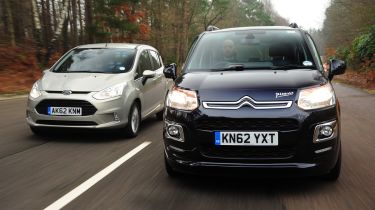
The innovative Citroen C3 Picasso is a forgotten star of the supermini-MPV class. A mix of oddball styling and great interior space took it straight to the top of the class when it was launched in 2009. However, a raft of new, more sophisticated rivals has overtaken the small people carrier since then.
To help revive the Picasso’s fortunes, Citroen has refreshed its styling and upgraded the engine line-up. There’s also new upholstery inspired by the company’s luxurious DS models. Factor in great-value pricing, and the C3 could reclaim its place at the top.
Standing in the way is our current class leader, the Ford B-MAX. With its party trick of pillarless sliding doors, it’s one of the most flexible small MPVs, despite its compact size. Better still, Fiesta underpinnings give a superb driving experience, while the smooth diesel engine promises low running costs.
So, which of our distinctive and practical contenders will win this family space race?
Verdict
These two supermini-MPVs seem to cater for very different audiences, but they also have a lot to offer over more fashionable small crossover models. The result of this test was much closer than we expected, even though the cars have different approaches to delivering big practicality in a small package.
Used - available now

2023 MG
ZS
34,364 milesAutomaticPetrol1.0L
Cash £12,300
2018 Volkswagen
Tiguan
47,600 milesAutomaticPetrol2.0L
Cash £19,995
2015 Volkswagen
Golf
74,456 milesManualPetrol1.4L
Cash £6,495
2009 Land Rover
RANGE ROVER SPORT ESTATE
122,191 milesAutomaticDiesel2.7L
Cash £1,950The Citroen seems a little dated inside, but the versatile cabin is impressively practical and the revised exterior is distinctive and bold. The car is also easy to drive and, if you can afford the higher tax bills, the 1.6-litre HDi engine offers better performance than the Ford’s diesel. However, the B-MAX’s unique pillarless doors provide unrivalled access to the rear seats, and the Ford feels like a higher-quality product, too.
For small families with child seats, the Ford is a better bet, while the Citroen will suit those with older kids. Still, the B-MAX is cleaner and nicer to drive, and if you don’t cover very high mileage every year, the lighter and faster 1.0-litre EcoBoost petrol version is worth looking at.
Modern engine technology and superior safety equipment push the Ford over the finish line in first place here – but the margin of victory is very narrow and the C3 Picasso remains a fine choice for good-value family motoring.
First place: Ford B-MAX 1.6 TDCI Titanium
The B-MAX isn’t perfect, but pillarless doors give it a unique selling point that will appeal to young families. A high-quality interior and delightful chassis make it easier to live with and more fun to drive than the Citroen, while an efficient engine range means it’ll be cheap to run. It’s pricey to buy, however, so make sure you haggle for a discount.
The new Ford B-MAX made such a splash when it arrived that we pitted it against not one but three rivals in a previous road test. Even though it narrowly lost out to the bigger Renault Scenic, we were won over by its clever design and very entertaining driving experience. So how does it shape up against the Citroen C3 Picasso?
This pair certainly look different. The Ford’s sleeker styling is a direct nod to its supermini origins and it sits lower down than the boxy Citroen. Even though they’re almost the same overall length, the C3 has a longer wheelbase, and some buyers will prefer its daring styling cues to the B-MAX’s more conservative looks.
Still, the Titanium model comes with smart 16-inch alloys and neatly integrated foglights. Plus, its interior feels slightly more upmarket than the Citroen’s. The classy Sony stereo and metallic climate controls bring a touch of quality that the cheaper rival lacks, while gadgets like DAB digital radio and Ford’s SYNC Bluetooth come as standard.
Sliding doors allow excellent access to the rear, so fitting child seats is easy, even though the B-MAX lacks the C3’s sliding and reclining rear seats. Folding the rear seats is simple, however, and the 1,386-litre boot is flat and well shaped. Plus, the front passenger seat folds down to accommodate longer items and the lack of a sunroof means taller passengers have more headroom, too.
There’s not much to choose between the two for practicality, then, but there was a clear winner on track. The B-MAX is less powerful than the C3 Picasso and its five-speed box is tailored for fuel economy, so our low-mileage car felt sluggish in our acceleration tests. It took 13.2 seconds to go from 0-60mph, while in-gear times were also unimpressive – at 6.6 seconds, the Ford was over two seconds slower than the Citroen from 30-50mph in third.
Yet these figures don’t tell the whole story, as the B-MAX is brilliant on the public road. Precise and well weighted steering combines with a smooth ride to make it a pleasant drive around town, while better sound insulation gives greater refinement on the motorway.All owners will prefer the Ford’s perfectly weighted controls, while keen drivers will appreciate the extra involvement. And family buyers will like the extra airbags, which helped the car earn a five-star crash safety rating.
However, the B-MAX is pricier than the top-spec C3, and while it should be cheaper to run, we returned a disappointing 41.7mpg. So can the superior dynamics, upmarket interior and clever sliding doors give it the edge here?
Second place: Citroen C3 Picasso Exclusive 1.6 HDi
Bags of character and style have given the C3 Picasso a new lease of life, and this diesel model is a genuine contender for top honours. The refined 1.6 HDi engine feels quick, even when the car is fully loaded, while keen pricing and generous kit boost the C3’s appeal. A disappointing safety rating and numb steering mean it’s just edged by the B-MAX, though.
After impressing greatly when it arrived four years ago, the Citroen C3 Picasso has since found itself being left behind by a wave of talented new rivals. So can a mid-life refresh help it get back to the top of the mini-MPV class?
The car’s styling is as distinctive now as it was when it made its debut, so Citroen has made only mild tweaks. At the front, the most obvious changes are some LED running lights (standard on VTR+ models and above) plus a new bumper and the latest interpretation of the brand’s double chevron badge, which stretches across the entire front grille.
New colour shades such as the Ink Blue metallic hue of our test car allow buyers even more scope to express themselves. Our top-spec Exclusive model was also fitted with the £210 Black Pack, which adds gloss-black trim surrounds for the foglight clusters and classy 17-inch Clover alloys to boost visual appeal. The overall effect is fun yet sensible: a tall profile and intricately designed lights mean the Citroen definitely draws more admiring glances than the sleek but bland Ford B-MAX.
And this high-sided design has practical advantages, too: the C3 Picasso feels bright and airy inside, while an optional panoramic sunroof (£550) lets even more light in. The upright driving position and glass A-pillars mean the view out is superb. They combine with short overhang to make the Citroen a doddle to park in the tightest spaces.
The lounge-like cabin is almost identical to the outgoing model’s, so the centrally mounted digital dials and button-heavy console are both starting to show their age, but there have been some minor tweaks.
New Mixou cloth seat trim is standard on VTR+ spec cars and above, while full black leather upholstery is now available as an optional extra (£955) for the first time. However, plush material like that seems at odds with the Picasso’s robust, practical image, so we’d rather stick with the standard cloth seats.
There’s plenty of space up front, but niggles like a high clutch pedal, cramped glovebox and hard-to-reach stereo controls have not been fixed as part of the refresh. The C3 Picasso also trails the B-MAX when it comes to build quality, yet it features some practical touches that help even the score Flip-down picnic tables fitted to the seat backs come with individual reading lights and, unlike in the Ford, the rear seats slide and recline to free up more legroom or boot space as required. Move the seats all the way forward, and the capacity increases from 385 litres to a considerable 500 litres, while folding them flat gives you 1,506 litres.
The Ford can’t match this impressive capacity, but the C3’s panaromic glass roof eats into headroom and the narrow opening of the rear doors makes access a bit tricky.
The Citroen’s 1.6-litre HDi diesel engine has been fettled to produce 5bhp more than before, taking the total output to 113bhp. That doesn’t make a huge difference to on-track performance, but short gearing means the Picasso felt livelier than its rival. Yet despite this punchy character, the diesel always remains smooth and refined.
The C3’s light steering and soft ride are typical MPV traits, but it lacks the Ford’s dynamic sparkle. There’s not much steering feedback, the ride occasionally feels crashy over big bumps and the bluff shape means there’s more wind noise on the motorway.
Still, a tall sixth gear let the Citroen match the Ford’s economy on this test, recording a reasonable 41.2mpg. Slightly weaker residual values and a pricier tax disc mean it’ll cost more to run, but this is offset by the fact it’s priced over £1,200 less than the B-MAX.
Overall, the C3 Picasso remains a very well rounded family car and subtle changes have cemented its appeal – but can it overcome the innovative and entertaining Ford?
Facts and figures
| Citroen C3 Picasso 1.6 Hdi Exclusive | Ford B-MAX 1.6 TDCi Titanium | |
| On the road price/total as tested | £17,655/£20,425 | £18,895/£19,815 |
| Residual value (after 3yrs/36,000) | £7,009/39.7% | £7,577/40.1% |
| Depreciation | £10,646 | £11,318 |
| Annual tax liability std/higher rate | £662/£1,324 | £528/£1,055 |
| Annual fuel cost (12k/20k miles) | £1,856/£3,093 | £1,831/£3,052 |
| Ins. group/quote/road tax band/cost | 15/£383/D/£100 | 11/£386/B/£20 |
| Cost of 1st/2nd/3rd service | £449 (3yrs/35k) | £785 (3yrs) |
| Length/wheelbase | 4,078/2,540mm | 4,077/2,489mm |
| Height/width | 1,631/1,766mm | 1,604/1,751mm |
| Engine | 4cyl in-line/1,560cc | 4cyl in-line/1,560cc |
| Peak power/revs | 113/3,600 bhp/rpm | 94/3,800 bhp/rpm |
| Peak torque/revs | 270/1,750 Nm/rpm | 215/1,750 Nm/rpm |
| Transmission | 6-spd man/fwd | 5-spd man/fwd |
| Fuel tank capacity/spare wheel | 50 litres/sealant | 47 litres/sealant |
| Boot capacity (seats up/down) | 385/1,506 litres | 318/1,386 litres |
| Kerbweight/payload/towing weight | 1,436/371/1,200kg | 1,310/470/575kg |
| Turning circle/drag coefficient | 10.6 metres/0.31Cd | 10.4 metres/N/A |
| Basic warranty/recovery | 3yrs (60,000)/1yr | 3yrs (60,000)/1yr |
| Service intervals/UK dealers | 12,500 (1yr)/196 | 12,500 (1yr)/781 |
| Driver Power manufacturer/dealer pos. | 22nd/24th | 25th/26th |
| Euro NCAP: Adult/child/ped./stars | 81/76/43/4 | 92/84/67/5 |
| 0-60/30-70mph | 11.0/12.4 secs | 13.2/13.0 secs |
| 30-50mph in 3rd/4th | 4.4/5.6 secs | 6.6/9.2 secs |
| 50-70mph in 5th/6th | 8.3/10.7 secs | 15.2 secs/N/A |
| Top speed/rpm at 70mph | 114mph/2,000rpm | 108mph/2,100rpm |
| Braking 70-0/60-0/30-0mph | 51.4/34.9/9.1m | 53.9/33.9/9.5m |
| Noise outside/idle/30/70mph | 65/46/63/71dB | 72/48/63/71dB |
| Auto Express econ (mpg/mpl)/range | 41.2/9.2/453 miles | 41.7/9.3/431 miles |
| Govt urban/extra-urban/combined | 46.3/68.9/58.8mpg | 60.1/78.5/70.6mpg |
| Govt urban/extra-urban/combined | 10.2/15.2/12.9mpl | 13.2/17.3/15.5mpl |
| Actual/claimed CO2/tax bracket | 184/125g/km/19% | 182/104g/km/14% |
| Airbags/Isofix/rear parking sensors | Six/yes/yes | Seven/yes/£200 |
| Automatic box/stability/cruise control | No/yes/yes | No/yes/yes |
| Climate control/leather/heated seats | Yes/£955/no | Yes/£600^/£175 |
| Metallic paint/xenon lights/keyless go | £495/no/no | £495/no/£250 |
| Sat-nav/USB connection/Bluetooth | £750/yes/yes | No/yes/yes |