Cars vs water: the vital truth about driving in floods
Over a third of our roads are at risk of flooding. How many cars get sunk by standing water – and are you insured? We reveal all

More than a third of British roads are at risk of flooding every year. And things could soon get worse, because an incoming El Niño will bring “more extreme storms in the UK” this winter, predicts the Department for Environment, Food and Rural Affairs.
Recovery service the AA told Auto Express that, in the past 18 months, it dealt with more than 1,500 water fording and flood-related breakdowns. And that toll is no surprise, with a Government survey revealing that only one in four motorists would consider changing their route to avoid driving through a flooded road.
"One of the quickest ways to damage a car's engine is for significant amounts of water to enter it,” explains the AA’s head of roads policy, Jack Cousens. “Drivers should err on the side of caution when it comes to driving through floods and significant standing water.”
The motoring association and breakdown provider points out that water can not only mess with a car’s electrics, but just an egg cup’s worth is enough to destroy an engine. Water that has ingressed into the engine block can cause hydrolock, when the pistons try to compress liquid instead of air, causing thousands of pounds worth of damage. That’s not to mention things like ruined upholstery and potential mould because certain areas of the vehicle take longer to dry out.
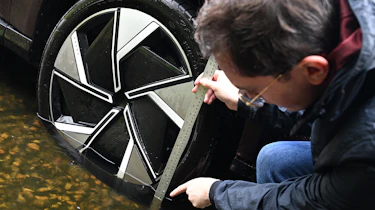
Wading depths may save your bacon
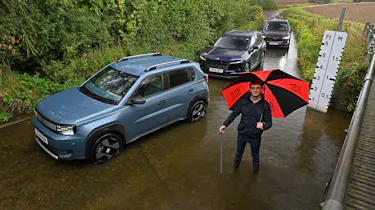
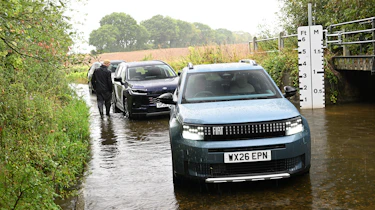
With wellies and a measuring stick from a big DIY chain (kit you could consider keeping in your car’s boot), we took three cars – a small petrol supermini, a hybrid family SUV and a large electric car – to cross an Essex ford, one of the nation’s 2,000 recorded water crossings. Given the blistering summer, the typical depth was around 140mm – not much but beyond the average car’s recommended maximum – but locals say the water level can top one metre.
The Fiat Grande Panda is the smallest of our trio and the latest model from a line of small-yet-rugged cars to bear that name. While this latest version trades on SUV looks – its plastic body cladding and boxy shape feel much brawnier than your run-of-the-mill hatchback – Fiat says its maximum wading depth is 150mm. It’s well worth researching this figure so you can ford your car with confidence.
The secret to driving through standing water? It’s all about maintaining momentum at around 4 or 5mph, to create a bow wave that keeps water out of the engine bay at greater depths. This Grande Panda is front-wheel drive (a new 4x4 is coming) and packs a 109bhp three-cylinder mild-hybrid engine; although it’s tuned for efficiency rather than low-end torque, it calmly pushes through this level of water. The Grande Panda’s 163mm ride height keeps the waterline below the door.
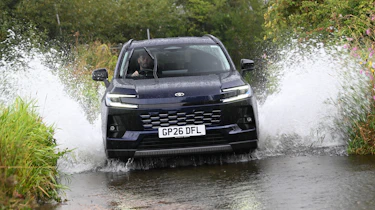
Next up is the Toyota RAV4, which isn’t offered in tough TRD Pro off-roader form in the UK; our test car is a family-oriented Excel model. It’s also front-wheel drive, like the Grande Panda, although four-wheel drive versions are offered with ‘Trail’ and ‘Snow’ modes, which would have been handy here, because we can feel the front wheels slip a touch as we enter the water.
Venturing deeper, the RAV4’s 213mm ride height keeps the body well clear of the brook. The power of the Toyota’s 2.5-litre plug-in hybrid powertrain gives us plenty of confidence as the water gets deeper. Anything more precarious than this, though, and you’ll need more off-roading capability.
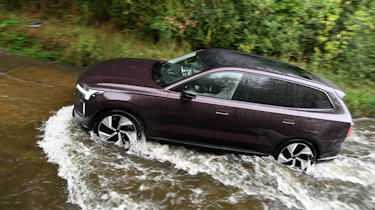
With 22-inch diamond-cut alloys and low-profile tyres, the Volvo EX90 is not as capable off the beaten track as something like a Land Rover Defender. However, with the EX90 in ‘Off-Road’ mode, its air suspension can be raised to give the electric SUV a surprisingly handy wading depth of 450mm – more than enough to clear the majority of fords in the UK.
The torque from the electric motors provides serene progress and the 360-degree camera system is handy to watch for obstacles as we surge through the silt and grime of the overflowed stream – which, thankfully, is kept well clear of the EX90’s light-coloured interior.
All of that said, fords such as this one can often fill up further by several orders of magnitude after heavy rain, meaning most SUVs – aside from the most capable of off-roaders – will literally be out of their depth. With this in mind, the Volvo is the only one of the three cars we’d feel comfortable driving into deeper water – and even then, preferably on winter or all-season tyres.
Wading depths for popular SUVs
Go big, or go home with wet feet, if you head for deeper water! Here’s the wading depths for some popular SUVs.
| Make and model | Wading depth (millimetres) |
| Average family car | 100mm (recommended) |
| Fiat Grande Panda | 100mm |
| Toyota RAV4 | 100mm |
| Volvo EX90 | 450mm |
| Toyota Land Cruiser | 700mm |
| Ford Ranger | 800mm |
| Ineo Grenadier | 800mm |
| Mercedes G-Class Electric | 850mm |
| Range Rover Electric | 900mm |
| Land Rover Defender Octa | 1,000mm |
Wait, an electric car driving in water?
The days of people worrying about taking an electric car through a car wash are almost universally over, despite the safety mantra that electricity and water don’t mix. Indeed, there are some pretty hardcore electric off-roaders already on the market, and the design of EV powertrains can make them even more adept at tackling fords, standing water and off-road tracks than combustion 4x4s.
The full-electric Mercedes G-Class’s maximum wading depth is 150mm greater than the petrol V8’s; a snorkel can solve this problem for the ICE car, of course. It’s a similar story with the full-size Range Rover Electric, because its near-unbeatable 900mm maximum fording depth is identical to the off-road kingpin that is the internal-combustion version.
Chief engineer for Range Rover, Lynfel Owen, tells Auto Express that “retaining Range Rover's 900mm wading capability was a core requirement for Range Rover Electric from day one. Every component below the wade line is engineered to be submersible, supported by intelligent high-voltage safety systems.
“Electric propulsion enhances the all-terrain capability our clients expect from a Range Rover,” Owen adds, “and boosts robustness in deep-water conditions, with precise torque control and no requirement for engine air intakes, delivering confidence and capability when wading.” Deliveries of the £154k Range Rover Electric begin towards the end of 2026.
Driving through standing water: top tips
We asked charity IAM RoadSmart and the AA for some top tips for tackling standing water…
1. Pause for thought
This might sound like a no-brainer, but try to scope the ford out before taking the plunge and perhaps even consider an alternate route. Check the depth on foot if you can – many have measuring indicators alongside – and bear weather conditions in mind: “Recent heavy rain can make it deeper than you think,” says IAM RoadSmart’s road safety manager, Shaun Cronin.
2. Don’t follow anyone too closely
While we drove in tandem for this experiment, we were very careful to keep speeds low and distances big, because tailgating a car through a ford can prove disastrous. This is because the waves and wake generated by the car in front can create much higher water that could enter your vehicle’s engine bay or other critical openings. Also bear in mind that the vehicle ahead of you may stop suddenly.
3. Check your tyres
Your car’s tyres can also have a huge influence in how it handles deep water; off-road and all-season tyres, for example, feature special grooves designed to disperse water and provide grip on slippery surfaces. A car can be swept away by 300mm of water, so ensure your tyres aren’t overinflated so as to make your vehicle dangerously buoyant.
4. Make use of any vehicle software
Many modern vehicles have specific software, such as off-road modes, wade sensing or adjustable suspension that can make them better equipped for tackling flooded roads.
“Some cars have assistance modes or software which could make driving through fords and standing water easier,” says the AA’s Jack Cousens. “It’s worth consulting the vehicle’s handbook to understand what tools are available to you before driving on."
5. Keep your speed low and consistent
The key to fording is to maintain a slow and consistent speed, ideally below six miles per hour. Maintaining momentum enables you to create a bow wave, which can redirect water away from the engine. Just make sure you don’t stop – it could end badly.
6. Avoid changing gear
On the point of not stopping, try to stick to a low gear and stay in it as you cross the ford. Otherwise you risk stalling the car – not ideal when you’re trying to maintain a steady speed – while water and grit can also seep inside and potentially cause clutch slippage.
7. Test your brakes on the other side
Finally, once you’re in the clear, we recommend gently testing your brakes – sodden pads and discs can be far less effective at creating friction and thus making it more difficult to stop.
Cousens says: “Once they’ve driven through water, drivers should first test their brakes. There may be objects hidden in the water which become trapped between the pads and the disc, so this is a vital safety check.”
Will car Insurance or warranties cover water damage from driving through floodwater?
If it goes horribly wrong in water, it’s going to cost: the average successful flood claim is £8,533. But Confused.com’s Matt Crole-Rees says drivers can’t bank on being covered by their policy.
The price comparison site’s insurance expert points out that while fords are designated crossing points, “if you cross when the water is clearly too deep and your car gets damaged, you may not be covered.
“Driving through [a ford] won’t always cancel your insurance,” he continues, “and if you have fully comprehensive cover, water damage is usually included in the policy. But it's worth checking your policy, because some don't cover water crossings at all.”
The same goes for manufacturer warranties, because damage from crossing a ford or flooded road is typically deemed as driver misuse or environmental damage – both things not covered under warranty.
That includes cars from off-road brands such as Land Rover; while the firm advertises its vehicles’ wading depths, driving into water that deep is done so at the driver’s risk – unless any prospective damage can be proven to be the result of a manufacturing defect, such as a faulty seal.
So when the rains come sweeping in this autumn, you should be better prepared to tackle the conditions. Check your insurance now, consider all-season tyres, keep an inspection kit in the boot, assess the hazard before heading in and drive calmly through it: then you should be able to cope with the rain the Great British climate throws your way.
Horses for water courses
After a long, hot, dry summer, the heavens have opened and we’re back to what Britain does best: getting wet. If the idea of traversing flood water fills you (and your car) with dread, worry no more – Horse has just revealed a fully waterproof engine.
Horse Powertrain is a company that designs and builds engines, hybrid systems and transmissions for some of the world’s biggest car makers – including Renault, Volvo, Geely and Mitsubishi. Now, it has developed the Horse B20, a low-emission, hybrid powertrain designed for “vehicles that tackle extreme off-road terrains and deep-water wading”.
The 2.0-litre turbocharged four-cylinder engine produces between 187bhp and 248bhp, plus 300-380Nm of torque depending on specification.
Horse says the engine is fully compliant with IPX8 waterproofing standards, and can be submerged at depths of up to 1,100mm. To achieve this, the unit is fully sealed and uses IPX8 components and sensors to “monitor the surrounding operating environment of the engine”.
For comparison, a Range Rover offers a wading depth of 900mm, while a Jeep Wrangler is capped at 760mm.
In both cases, however, the engines themselves aren’t entirely waterproof. When submerged, the B20’s control systems make automatic adjustments to alter throttle response or limit power based on signals from the sensors.
Don't miss the best of Auto Express on Google! Make us a preferred source. Click here...