Ford Ranger pick-up review
The Ford Ranger is as capable as it is upmarket, and you can even have it with a plug

Our opinion on the Ford Ranger
The Ford Ranger has long been one of our favourite pick-ups and is the best-seller in this market, too. The latest Ford Ranger improves on its award-winning predecessor by injecting more style and technology into the mix. Its handsome, square-jawed looks and upmarket cabin give SUVs a run for their money, while the variety of trim levels means there’s a Ranger to suit all needs. The Double Cab version in particular is a great choice for business users who want a capable workhorse that can also serve as a versatile family car when they’re off the clock.
It also has no real weaknesses these days: the plug-in hybrid powertrain offers performance and economy at least on par with diesels, but with lower fuel costs and cleaner emissions, while the ride, handling and interior functionality are all first-rate. Ford’s widespread dealer network will be appealing for plenty of customers too.
About the Ford Ranger
Where once the Mitsubishi L200 dominated the pick-up market, today it’s the Ford Ranger, which seems appropriate for a brand that regularly tops car and van sales lists. You’ll notice Rangers everywhere, working hard and being driven even harder.
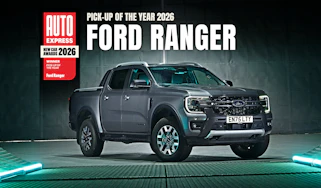
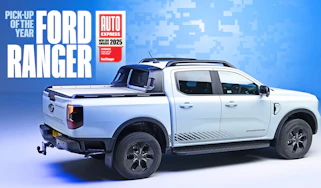
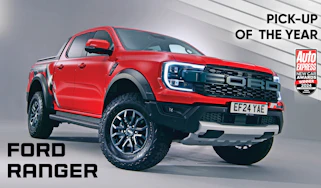
We’re big fans of the Ford Ranger at Auto Express because it's been our Pick-up of the Year for eight years running across two generations. But since the Ranger is also a best-selling pick-up truck in the UK and Europe, we’re clearly not alone in our admiration for Ford’s workhorse.
Used - available now

2024 Nissan
X-Trail
34,766 milesAutomaticPetrol1.5L
Cash £18,685
2023 Skoda
Fabia
69,626 milesManualPetrol1.0L
Cash £8,330
2025 Audi
A4
28,657 milesAutomaticPetrol2.0L
Cash £21,697
2022 BMW
X1
29,525 milesAutomaticPetrol2.0L
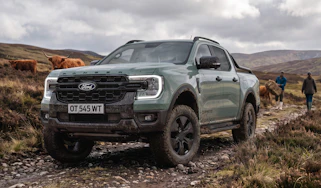
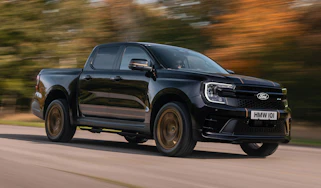
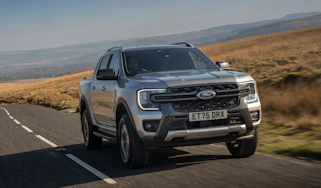
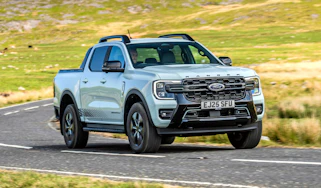
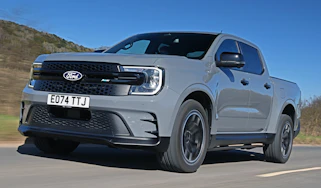
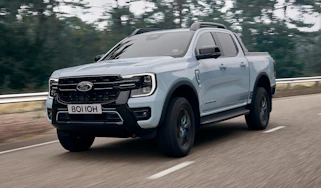
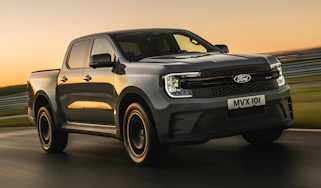
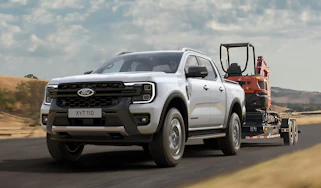
Cash £19,197The Ranger is longer and wider than before, with a bluff front end and square-jawed looks that echo the Ford F-150. Combined with the distinctive C-shaped daytime running lights and large Blue Oval emblem in the middle of the wide grille, the Ranger has a rather imposing look – not something you’d normally say about a commercial vehicle.
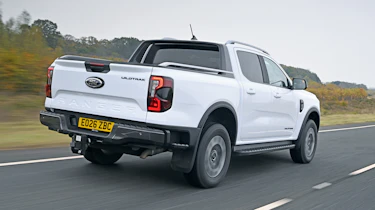
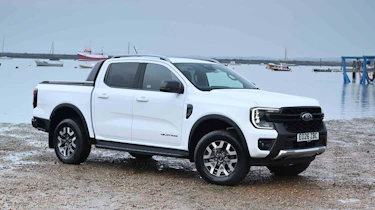
Another cue swiped from its all-American brethren is the Ranger name stamped into the tailgate, rather than the stickers seen on the old model. Ford also added a handy step to the bodywork behind the rear wheel (on higher-spec variants) after customer feedback found owners were using the rear tyre to step up to access the cargo area. The truck bed is larger, while the Ranger still satisfies the one-tonne payload requirement (apart from the high-performance Raptor version) that's needed for a pick-up to qualify as a light commercial vehicle. You can even use the tailgate as a workbench thanks to built-in holes for clamps.
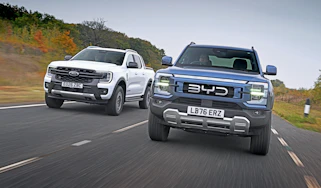
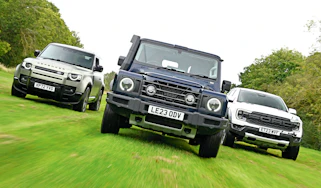
We’ve tested various versions of the Ranger over the years, including pitching the Ford Ranger Raptor against the Land Rover Defender and Ineos Grenadier in our ultimate off-road shootout. Our most recent test included the plug-in hybrid Ford Ranger against a BYD Shark.
MPG, CO2 and Running Costs
Pros |
|
Cons |
|
The 3.0-litre EcoBlue V6 soldiers on as the sole diesel option for the Ranger, and this returns a combined WLTP figure of 27.7mpg in Wildtrak trim. It’s not quite as fuel-efficient as the Isuzu D-Max, KGM Musso or mild-hybrid-equipped Toyota Hilux, but the Ford has two more cylinders than those rivals. The Ranger does at least get close to this figure in the real world, because we managed an average of 27.5mpg during our own real-world testing, which is a pretty rare occurrence.
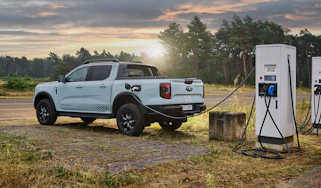
You can do better in the PHEV, though. Ford claims an official economy figure of 44.8mpg combined as a hybrid and up to 94mpg when really leaning on its 26 miles of all-electric range, although the brand’s real-world estimate of 28mpg seems pretty accurate for mixed use – we returned 33mpg overall with the battery depleted, and the big 70-litre fuel tank means it’ll comfortably cover around 430 miles on petrol power alone.
Unsurprisingly, the fiery Ranger Raptor is the least efficient of the pack. Equipped with a mad 288bhp 3.0-litre EcoBoost V6, you’ll need a very generous fuel card allowance, because it averages around 20.5mpg at best, or even worse when driven enthusiastically.
Electric range, battery life and charge time
Fully charge the truck, and you can expect around 21 miles of EV range. That’s worthwhile, but comes up short of the BYD Shark’s 55-mile EV range.
A typical 7.4kW home wall box charger should take just under 4.5 hours to fully recharge the plug-in hybrid battery, and that battery gets its own eight-year, 100,000-mile warranty.
Tax
As a pick-up, the Ford is currently subject to a standard £360 annual vehicle excise duty (VED) bill, something that applies to all its rivals. Residing in the 21 per cent Benefit-in-Kind (BiK) band, a lower-rate taxpayer can expect a bill of £2,310, or £4,461 for a higher-rate user, which is more than double the charge for a Shark.
Insurance
Passenger car group ratings don’t apply to the Ranger, which is classified as a commercial vehicle. We got a quote in excess of £1,000 for the PHEV, which was similar to the one we received for the Shark.
To get an accurate valuation on a specific model check out our free car valuation tool...
Load Space and Practicality
Pros |
|
Cons |
|
Front space
With plenty of adjustment in the seats and steering wheel, most people should be able to get comfortable in the Ranger. There’s a bit of a cockpit feel here thanks to the upright dashboard and driver-focused instrument cluster, but it’s cosy without being constricting, and the expansive forward vision enhances the feeling of space.
Passengers should have no issue with leg or headroom, and with grab handles on the A-pillars, getting in is easy too. Being able to tilt the seat bases further up at the front would be an improvement for long-distance comfort.
Rear space
The Ranger’s back row doesn’t make passengers feel like second-class citizens. There’s not quite the knee or shoulder room afforded by the Shark, but it’d have to be a combination of a tall driver and a tall rear-seat passenger before space became an issue, even for adults.
There are handy grab handles on the B-pillars to make access a little easier. The outer seats have Isofix points so fitting child seats is possible, and wide-opening doors make access relatively easy too.
Load space
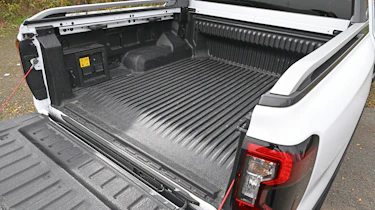
It should come as no surprise that Ford has got things right with the Ranger’s load area. The length (1,540mm), width (1,250mm between arches), and overall load volume (1,233 litres) are very competitive, and the space itself is well designed.
You get a pair of three-pin sockets in the back and several tie-down points, while our Wildtrak test car had a tough-feeling load liner to prevent damage to the metalwork underneath. Naturally there’s a huge range of accessories available to modify the Ranger, too.
The two key figures for a pick-up are payload and towing capacity. The majority of the Ranger range has a payload over one tonne (the XLT 3.0-litre diesel model able to haul the most at 1,099kg) and a towing weight of 3.5 tonnes, which are both on the money for this segment. Both figures are much stronger than those of the BYD Shark, which has a payload of 790kg and a towing capacity of 2,500kg. The only Ranger that doesn’t meet the 1,040kg threshold required for LCV classification is the Raptor, with its maximum payload of 652kg and a towing capacity of 2,500kg.
Ford offers a huge number of accessories for the Ranger. Take a gander through the options list, and you’ll find spray-in bed liners, a flexible rack system, dividers for the load bed, and hard-top canopies that essentially turn the Ranger Double Cab into a full-size SUV.
Alternatively, to create secure storage, you can add a conventional soft tonneau cover, a manual roll-top cover and even a power-opening roll-top cover. You open the latter simply by tapping a button on the key or the inside of the load bed. However, we found that the cover’s plastic housing eats up quite a bit of space towards the rear of the load bed.
Reliability and safety
Pros |
|
Cons |
|
The Ranger didn’t make an appearance in the 2026 Driver Power survey, but Ford did, finishing in 21st position – a couple of places behind Toyota, whose Hilux competes with the Ranger in this class, and further still behind BYD in 16th, which bodes well for the Shark.
That said, the Ranger is sold globally and, one or two issues in different markets aside, generally has a pretty solid reputation. So the unknown is really how the plug-in hybrid will fare longer term. The car’s eight-year battery warranty will provide some reassurance, even if the three-year/60,000-mile standard warranty is nothing special.
In terms of safety, a five-star score from Euro NCAP in 2022 means the Ranger can hold its head high. The safety body’s score is a mix of Australian ANCAP’s findings on the Ford, and Euro NCAP’s own ratings on the near-identical Volkswagen Amarok. The child occupant safety score of 90 per cent is praiseworthy for a vehicle that many people use as their daily family transport, and an 84 per cent safety-assist score suggests Ford hasn’t overlooked high-tech features.
We found the ADAS pleasingly nag-free. The speed-limit bong is relatively unintrusive, and the lane-keep assist is useful when you stray close to road markings in this large vehicle.
All Rangers come with a multitude of airbags, autonomous emergency braking, lane departure warning and keeping aid, blind spot monitoring, adaptive cruise control and a rear-view camera. A 360-degree camera set-up and speed sign recognition is available with the popular Wildtrak trim, while Ford's motorway driving assistant BlueCruise is available as an option on Limited, Wildtrak and Platinum trims.
Driving and Performance
Pros |
|
Cons |
|
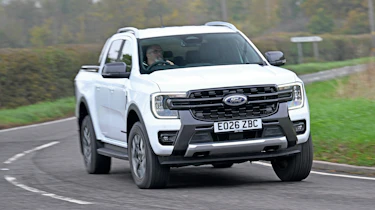
It may be a commercial vehicle at heart, but the latest Ranger is one of only a handful of pick-ups that can genuinely double up as an enjoyable everyday car. There’s no escaping its bulk, but useful tech and refined powertrains make it easier and more pleasant to drive than it looks.
The six-cylinder diesel engine remains our favourite engine despite the tax advantages of the plug-in hybrid. It produces 237bhp and 600Nm of torque, and these are good for a 0-62mph time of 9.7 seconds. The plug-in hybrid uses a 2.3-litre petrol engine working in tandem with an electric motor. This setup results in a slightly quicker 0-62mph time of 9.2 seconds, courtesy of a combined 277bhp and 697Nm of torque.
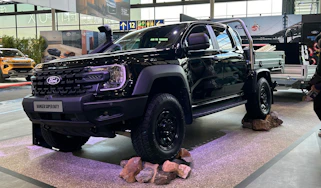
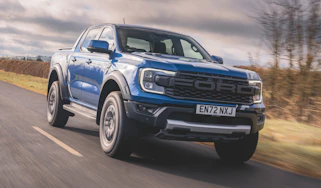
For the maddest of prospective truck owners, Ford also offers the Ranger Raptor. This is the full-fat performance model, and it comes with a 288bhp 3.0-litre V6 petrol under the bonnet. This will launch the hefty pick-up from 0-62mph in 7.9 seconds, which is just starting to creep into hot hatch territory. The key difference, though, is that this rugged four-wheel drive machine is just as much fun off the road as it is on it.
Town driving, visibility and parking
While you’re always conscious of the Ford’s size, it’s not too bad a companion when the going gets tight. The raised seating position puts you higher than most SUVs, while the squared-off sides mean vision is pretty good in all directions. There’s a decent view over the bonnet, but when parking you’re really relying on the cameras and sensors to help judge your distance to other objects, as well as the usefully large door mirrors.
The ride has some commercial-vehicle toughness to it, but the tall tyres filter out the worst that urban streets throw at you, and a relatively tight turning circle makes it easy to manoeuvre. Just bear in mind that at 5,370mm long, you’ll always stick out of parking spaces.
Country road driving and handling
You can’t expect handling that’s on par with much smaller supermini or family hatchback, but there’s definitely plenty of traditional Ford fine-handling DNA on show in the Ranger. The steering is accurate and well weighted, which makes it easy to place the car and takes the stress out of piloting something relatively wide.
There’s enough performance and response from the drivetrain that you can confidently motor along an A or B-road at the same pace you would in a regular SUV, and the brakes are strong and progressive. Nor is the ride quality an issue, with well-judged damping that keeps ladder-chassis body shimmy to a minimum even with no load in the back.
Motorway driving and long-distance comfort
The Ranger is pretty relaxing when asked to cover longer distances at higher speeds. It feels stable at the motorway limit, and the accurate steering and good visibility are again useful when changing lanes or navigating slip roads. The 10-speed automatic gearbox quickly shuffles up to the higher gears and means that at 70mph it’s still doing less than 2,000rpm, for quiet (and surprisingly economical) cruising.
Road and wind noise are both minimal, considering how much rubber is on the road and the bluff face the Ranger presents to the wind.
Cab and Interior
Pros |
|
Cons |
|
Plenty of personalisation helps bolster what is otherwise a common sight in the UK. The tech is straightforward and easy to use.
Design
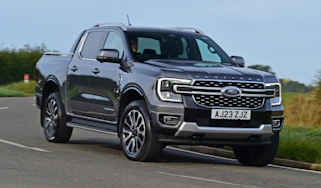
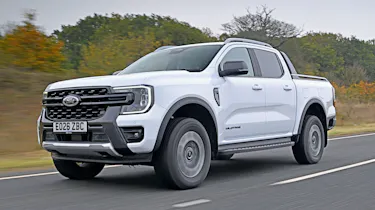
The Ranger is a familiar sight on UK roads. This has dulled its impact a little, particularly against newcomers such as the Shark, but that’s not to say the Ford’s design is without merit. In this latest iteration, it’s still a chunky, satisfying shape, with a distinctive grille that cuts into the headlights with their wraparound DRL signature.
The scalloped body sides take some visual weight out of the design too, and in off-road-biased Wildtrak trim and with a few option boxes ticked, it’s quite a desirable product.
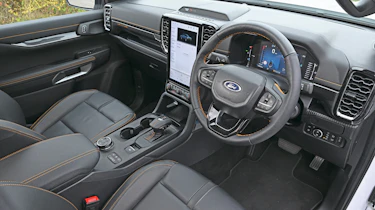
It’s not bad inside either. Your eyes will probably be drawn first to the vertical 12-inch infotainment display flanked by two ear-like vents, but the overall design has a rugged look that suits the Ranger’s character. There’s a palm-filling gear selector, a thick-rimmed steering wheel and plenty of physical controls.
Quality
It’s a commercial vehicle at heart, but the Ranger’s cabin feels about the same in terms of fit and finish as a regular Ford passenger car. Everything feels built to last too, from the satisfying squeeze-grip door handles to the thick bed liner in the load area.
Infotainment, sat-nav and stereo
Ford has kept things simple with the Ranger’s in-car tech. While it features a large 12-inch portrait-style touchscreen, the brand hasn’t gone all-in on screens, as the Ranger still provides physical controls for regularly used functions, such as the headlights and air-con.
The Ranger’s 12-inch portrait screen runs Ford’s SYNC 4 infotainment, which is pretty slick and has quick load times, but the blue font on white backgrounds can be a little distracting
There are various parking cameras provided with the Ranger Wildtrak to help when parking, although the view isn't quite as good as it could be because the display is smaller than what you’ll find in the BYD; what’s there still works well.
Most people will hop in and try to pair up their phone immediately, and hooking up an Apple iPhone for CarPlay took no more than 20 seconds. Our Wildtrak test car had a wireless charging pad too, albeit not cooled like the BYD’s.
The crisp driver's digital instrument panel provides ample information, from fuel economy to 4x4 status. The display also changes depending on the drive mode you select. However, we weren’t able to display a full map view even when using Ford’s own sat-nav; we could only provide turn-by-turn instructions. The digital driver instrument cluster in the Amarok can manage this and is generally more configurable.
Buying and owning
The Ranger comes in four trims, but Wildtrak is our favourite. We’d have it in Ignite Orange (£600), and add the £400 towing pack and the £1,275 Cargo Convenience Pack with the load-bed liner (all plus VAT).
Alternatives
While a number of pick-up rivals disappeared from our shores a few years ago, the Mitsubishi L200 has made a comeback. It sports a long list of standard equipment and a good towing ability, although it doesn't offer the Ranger's breadth of powertrain options. The KGM Musso is another pick-up that only offers diesel power, but it has excellent payload and towing numbers and remains very good value for money. Its KGM Musso EV sibling uses a different platform and can't offer the same payload or towing ratings, but it is one of the more capable electric pick-ups around and surprisingly good value thanks to a government grant.
The Isuzu D-Max and Toyota Hilux have both been refreshed and also offer separate electric alternatives: the Toyota Hilux BEV and Isuzu D-Max EV. Meanwhile, the mechanically identical Volkswagen Amarok is impressively refined, but isn't available with the same plug-in hybrid power as the Ranger. Of course, if you're after tax-busting PHEV power, the BYD Shark offers up to 55 miles of electric range in a more affordable, but ultimately less capable package.
Pick-up dimensions
| Body style | Height | Width | Length |
| Double Cab (PHEV) | 1,878mm | 2,015mm (2,207mm inc mirrors) | 5,370mm |
| Double Cab (3.0 V6 diesel) | 1,886mm | 2,015mm (2,208mm inc mirrors) | 5,370mm |
Load area dimensions
| Body style | Height | Width | Length |
| Double Cab (PHEV) | 498mm | 1,224mm (between arches) | 1,638mm (1,471mm at top of box) |
| Double Cab (3.0 V6 diesel) | 529mm | 1,224mm (between arches) | 1,638mm (1,471mm at top of box) |
Key updates of the Ford Ranger review
25 November 2026: Latest impressions, pictures and rivals based on the Ford Ranger vs BYD Shark twin-test.
12 October 2026: Updated to include the revised trim range and mentions of Ford's BlueCruise motorway driving assistant.
Frequently Asked Questions
Yes, a plug-in hybrid Ford Ranger is available, with an electric range of 26 miles.