Kia EV4 review
The Kia EV4 is a striking, spacious and supremely comfortable electric hatchback

Our opinion on the Kia EV4
The Kia EV4 is one of those cars that really hammers home the point that SUVs often provide the answer to a question that nobody asked. Here’s a model that’s truly spacious, comfortable and loaded with kit, but one that, thanks to its lower, more car-like bodystyle, manages to offer a brilliant real-world range – especially when you bear in mind that in warmer conditions our mileage would have been even better. It’s not quite perfect: it’s a little dull to drive, and the driver-assist systems are irritating, but those things aside, it’s a do-it-all family car.
About the Kia EV4
Kia’s ever-growing electric car family sees the EV4 joining its line-up – and even among a very talented bunch, it’s one of the brand’s most convincing offerings yet.
Spacious, largely comfy, and competitively priced, it ticks many of the key family-car boxes, yet, critically, pairs them with a superb real-world range. There are lots of reasons to recommend the EV4, and if you regularly take on long motorway trips, then look no further – although perhaps go for the range-topping GT-Line S with the optional energy-efficient heat pump if you do.
We’ve tested the Kia EV4 against the likes of the Renault Megane in a twin test, and we’ve also included the longer range battery version in Air trim as part of our winter EV range test.
Kia EV4 prices and latest deals
Prices for the Kia EV4 hatchback start from just under £31,000 thanks to the entry-level Air trim qualifying for the government's highest £3,750 'Band 1' electric car grant (ECG). This discount also applies to the longer-range 81.4kWh Air (just under £33,500) and Motion (just under £37,000) trims, but the rest of the EV4 line-up is ineligible since they breach the grant's upper list price limit.
Used - available now


The EV4 Fastback starts from nearly £41,000. Part of the reason is that only the hatchback is available in entry-level (but still very generously equipped) Air trim, whereas the Fastback is offered exclusively in sportier-looking GT-Line specifications.
You can now spec your ideal Kia EV4 through the Auto Express Buy A Car service and choose the best offer from dealers around the UK, with customers already able to save more than £1,000 using us.
Performance & driving experience
Pros |
|
Cons |
|
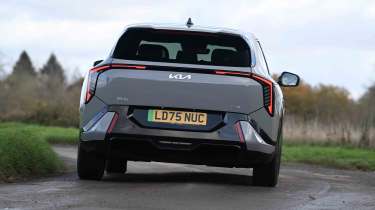
Dynamically, the EV4 doesn’t lead the class in any one area, and it isn’t very exciting to drive, but it’s easygoing, comfortable and refined for the most part.
For now, the EV4 is only available with one powertrain option. This takes the form of a single motor driving the front wheels. In an age of needlessly fast electric family hatchbacks and SUVs, its stats look fairly modest, but in reality, the performance on offer is more than good enough for a car in this class.
Electric motors, 0-60mph acceleration and top speed
All EV4’s come with a 201bhp electric motor, so the only reason for the variation in 0-62 mph times of 7.5 seconds for standard-range models and 7.9 seconds for long-range models is due to the size of the battery. There are two options to choose from: the standard-range model comes with a 58.3kWh pack, while the rest of the range gets a higher-capacity (and heavier, hence the slower 0-62 mph time) 81.4kWh battery.
The throttle is nicely judged and responsive enough to make the most of that power, but not so sharp that it’s hyperactive or overly jumpy in everyday use. A strong, consistent surge of acceleration easily takes the EV4 up to motorway speeds.
If you have a need for some more speed, a dual-motor, all-wheel drive set-up will be joining the EV4 line-up later this year. Plus, there’s a hot EV4 GT model in the works, which should be packing about 300-400bhp. We think it’ll be comfortably more than a VW Golf R, at least.
| Model | Power | 0-62mph | Top speed |
| Kia EV4 Air ‘Standard Range’ | 201bhp | 7.5 seconds | 105mph |
| Kia EV4 GT-Line ‘Long Range' | 201bhp | 7.9 seconds | 105mph |
| Kia EV4 Fastback | 201bhp | 7.9 seconds | 105mph |
Town driving, visibility and parking
At low speeds, the ride with the 19-inch wheels fitted to the GT-Line and GT-Line S trims is a little bobbly over uneven surfaces. It’s not harsh or jarring, but there’s a feeling that it never quite wants to settle down. We much prefer entry-level Air and Motion trims, which provide a much more forgiving ride, in no small part due to their smaller 17-inch wheels.
When slowing down, we’re big fans of the paddles behind the steering wheel to adjust the level of motor regeneration on the fly. However, we noticed a slight release of the brake regeneration before the mechanical brakes started to bite; the transition between the two isn’t as seamless as you’ll find in some other similarly priced rivals.
Country road driving and handling
The fidgeting that’s most prominent with the largest wheel size subsides as the speed increases, and the EV4’s ride becomes one of the softest and most forgiving in the class. The flip side is that the EV4 is always a little lifeless through turns. There’s a bit of body roll, but turn the car into a corner, and it never shows much enthusiasm about being asked to change direction. Even by the standards of some fairly weighty electric rivals, it feels a little lethargic.
Motorway driving and long-distance comfort
The soft suspension set-up comes into its own at speed, making the EV4 a very soothing car in which to cover long distances. Road noise isn’t that much of a concern with the car's smaller 17-inch wheels, but it is a little more noticeable with the larger 19-inch ones fitted to GT-Line and GT-Line S trims. Even so, tyre rumble is kept in check better than on rivals such as the Renault Megane.
That aside, comfort and refinement are great at motorway speeds, and standard-fit adaptive cruise control helps to make long journeys more relaxing.
Range, charging & running costs
Pros |
|
Cons |
|
Electric range, battery life and charge time
Officially, the EV4 can cover up to 388 miles on a single charge according to the WLTP cycle when fitted with the 81.4kWh battery and smaller 17-inch wheels, while the larger 19-inch wheels of the GT-Line and GT-Line S versions trim that figure down to 362 miles. The lower-capacity 58.3kWh standard-range battery gets 273 to a charge, which is still a very strong figure for an affordable EV.
In the less-than-ideal conditions during our twin test with a GT-Line EV4 in temperatures largely settling between 10 and 12 degrees centigrade, it averaged 3.9 miles per kWh. That translates into a real-world range of 317 miles – a little down on the official figure, but a very impressive figure for a car at this price point nevertheless.
We’ve also tried an entry-level Air with the long-range battery as part of our winter range test in even colder (between 0 and 5 degrees) weather on a long motorway drive. The efficiency was down to 3.1 miles per kWh (or 288 miles to a charge), which isn’t too surprising given the limited use of regen braking when driving at a constant speed, and the lack of an energy-efficient heat pump with Air trim helping to warm the interior without using too much battery. A heat pump is only available on the GT-Line S as a £900 option.
Both versions can charge at a maximum speed of up to 150kW. That’s competitive, if not quite class-leading; some versions of the Volkswagen ID.3 can charge at up to 185kW. Even so, a 10-80 per cent top-up in 31 minutes (or 29 minutes for the 58.3kWh model) is reasonable for those occasions where you need to top up the battery on the go. To save time, we’d advise you to use battery preconditioning while you're driving to a charger to warm the battery. That way, it can accept a higher charge rate as soon as you plug in. Preconditioning can be switched on manually using the battery screen within the infotainment system or through the native navigation system when plotting a route to a charger.
| Model | Battery size | Range | Insurance Group |
| EV4 ‘Standard Range’ Air | 58.3kWh | 273 miles | 33 |
| EV4 ‘Long Range’ Air | 81.4kWh | 388 miles | 35 |
| Kia EV4 Fastback GT-Line S | 81.4kWh | 380 miles | 38 |
Insurance groups
Insurance premiums for the Kia EV4, unfortunately, could be pricier than rivals'. The range starts in group 33, with the top-spec GT-Line S Fastback in group 38. In comparison, our class favourite, the Skoda Elroq, starts in group 22 and goes up to 37 for the hottest vRS version – quite impressive given the latter is much quicker than the EV4, putting out 335bhp and doing 0-62mph in 5.4 seconds.
Tax
All models of EV4 currently dip below the revised £50,000 luxury car tax banding for EVs, so you’ll only need to pay the standard rate of yearly Vehicle Excise Duty (VED) road tax. It is worth being aware of the plan to introduce an eVED pay-per-mile fee for EVs, which may come into force from April 2028 onwards.
Company car drivers will benefit from much lower benefit-in-kind (BiK) tax compared with a traditional petrol or diesel car, and even a plug-in hybrid. It’s currently at four per cent for the ‘26 to ’27 tax year, but it'll rise to five per cent for the ‘27 to ‘28 tax year, and seven per cent for the '28 to '29 tax year.
Depreciation
Data from residual values expert CDL suggest that the Kia EV4 will retain between 46 and 48 per cent of its original value in regular form, and 43 and 45 per cent in pricier Fastback form.
For comparison, a Renault Megane will only be worth between 36 and 38 per cent over the same period, while a Skoda Elroq will be worth 47 and 50 per cent.
To get an accurate valuation on a Kia EV4 check out our free car valuation tool...
Interior, design & technology
Pros |
|
Cons |
|
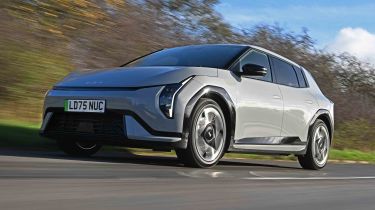
We were introduced to the Kia EV4 as a sci-fi-looking, slightly polarising concept back in 2023. However, the show-stopper only previewed the fastback saloon model. The first time we saw the hatchback was when it was revealed to the world in 2025.
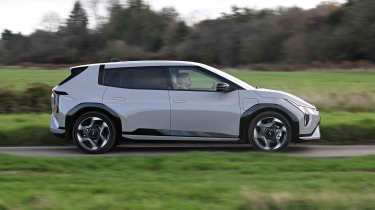
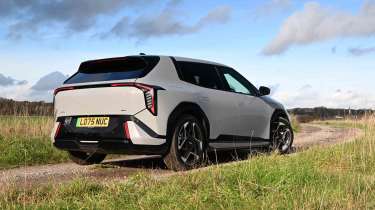
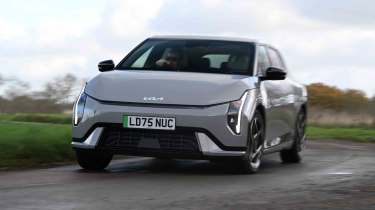
As we’ve seen with all of Kia’s latest creations, the design of the EV4 sticks very closely to the original concept. Including the ultra-slim ‘Star Map’ lighting at the front, sharply angled and relatively stubby nose and smooth surfacing contrasted by the pronounced angular wheelarches, especially at the rear.
The EV4 is well equipped throughout the range, and for that reason, the base Air models will be perfectly adequate for the majority of buyers and is our preferred version. It includes:
- 17-inch alloy wheels
- Heated front seats and steering wheel
- Climate control
- Front and rear parking sensors
- Reversing camera
Those wanting a little more kit can wander further up the range; the GT-Line brings extras including 19-inch wheels, wireless smartphone charging, a digital key, ambient lighting and two-tone artificial leather upholstery, among a range of other styling tweaks.
Next up is Motion trim, which adds an eight-speaker Harman Kardon sound system, an electrically adjustable driver’s seat, heated outer rear seats, a 360-degree exterior camera system, and a blind spot view monitor in the driver's instrument cluster. It also comes with the same 17-inch wheels as the entry-level Air trim to give you the best driving range.
The top-spec GT-Line S adds even more equipment, including uprated LED headlights with adaptive technology, ventilation for the front seat, a powered tailgate, and a head-up display.
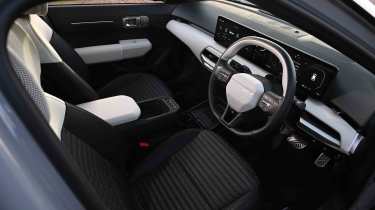
Interior and dashboard design
The contemporary dashboard design sets the EV4 apart from many of its rivals by managing to look original yet fairly well laid out. Yes, the touchscreen is responsible for a lot – and there’s a separate display just for the climate controls, which seem almost redundant when there’s a row of big, physical climate toggles just below – but there is also a row of large shortcut buttons on the dash, plus the usual selection of physical controls on the steering wheel.
The EV4 largely uses the same dashboard design as the EV3, including the trio of screens housed within a single unit and a column-mounted gear selector, which is also where you’ll find the start button. But unlike its sibling, there’s no sliding mini-table on the centre console, just a storage space which we think owners will find more useful.
Materials and build quality
There’s no hiding the fact that the EV4’s interior is mostly made from hard plastic, but Kia has dressed things up by using various finishes and textures for the different surfaces. The door panels in the base Air model, for instance, feature light grey, sofa-like fabric and plastic that looks like it’s made from crushed carbon fibre, while the GT-Line gets artificial-leather dash and seat trim.
There are also a few metal-effect elements on the dashboard to break things up, plus there are some squidgy materials dotted around, and everything in the cabin feels solid. But some rivals just feel more plush.
Sat-nav, stereo and infotainment
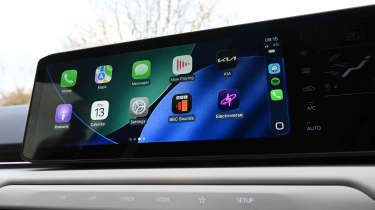
Kia’s infotainment systems were once the very best in the segment, but here the Renault shows the Korean brand that there’s room for improvement. The issue isn’t so much with the home screen – the tile-style layout is neat, leaving the navigation screen covering a big part of the display – but some of the sub-menus feel a little contrived to operate. Loading times and the screen responsiveness are fine, and the display is clear, but some rivals, including the Renault, have a sharper resolution. Wireless Apple CarPlay and Android Auto are standard if you want to bypass the car’s standard infotainment system.
The standard sound system is fine and certainly helped in the entry-level Air trim’s low levels of background noise. The upgraded eight-speaker Harman Kardon sound system is certainly a step up, but it’s only available on the range-topping GT-Line S trim. Wireless mobile phone charging is fitted to mid-range GT-Line trim and above.
“The only real issue I have with this set-up is that the climate control screen is blocked by the steering wheel. So I had to lean across to see it properly, which caused the driver monitoring system to tell me off constantly.” - Ellis Hyde, news reporter
Boot space & practicality
Pros |
|
Cons |
|
The EV4 is larger than the family hatchbacks we’re most familiar with, like the Vauxhall Astra and Volkswagen Golf. Not that’s a bad thing, though, because it means there’s lots of cabin space, including for back-seat passengers, plus a much bigger boot than your average hatchback.
Dimensions and size
The EV4 is a step on from close rivals such as the Renault Megane and VW ID.3, being longer, wider, and with a longer wheelbase. Those extra millimetres all contribute to this Kia’s generous interior space, which is welcome in a family car. In fact, the only measurement where the EV4 comes up short against those rivals is in height, but that has a lot to do with improving aerodynamic efficiency.
Meanwhile, the EV4 Fastback measures 4,730mm from nose to tail, meaning it’s almost exactly the same length as a Tesla Model 3, and just as wide.
| Dimensions comparison | |||
| Model | Kia EV4 | Volkswagen ID.3 | Renault Megane |
| Length | 4,430mm (4,450mm GT-Line & GT-Line S) | 4,264mm | 4,200mm |
| Width | 1,860mm | 1,809mm | 1,768mm (2,055mm inc mirrors) |
| Height | 1,485mm | 1,564mm | 1,505mm |
| Wheelbase | 2,820mm | 2,770mm | 2,685mm |
| Boot space | 435-1,415 litres | 385 - 1,267 litres | 440 - 1,322 litres |
Seats & passenger space
Kia’s latest interiors regularly offer a light and airy feel; this is in part due to the fairly open space around the driver thanks to the minimal lower dash and centre console, but it’s also because the overall visibility is quite generous. There’s plenty of adjustment in both the seat and the steering wheel, too. Those who want electric front seat adjustment will need to opt for the mid-range GT-Line and Motion trims, while driver’s side memory settings are reserved for the range-topping GT-Line S.
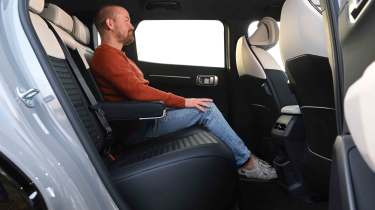
It’s certainly biggish on the outside compared with a lot of rivals, but climb into the back, and it’s clear where that length has been put to good use. Knee room is superb for a car in this class, leaving back-seat passengers with loads of space in which to stretch out. It could be better, but for the fact that the floor level is a little on the high side. This both raises the thighs of longer legs from the seat base and reduces support, but also limits foot space under the front seats. The EV4 features a flat floor, which will help when you have to squeeze three adults into the back, and the cabin is wide enough to do that.
If you’ve got a young family, there are two sets of Isofix mounting points for child seats.
As you’d probably expect, the sloped roofline of the EV4 Fastback does reduce headroom for rear passengers slightly. But there’s still enough for six-foot tall adults back there, as we can attest.
Boot space
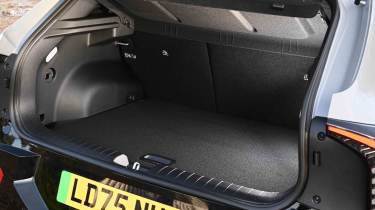
At 435 litres, the EV4’s boot capacity is good, if not outstanding. But the opening is very large, and there’s no enormous load lip to throw things over as you get in the Renault Megane, because the floor is pretty much level with the load lip, so hauling larger items on board is easy. Fold the seats down, and they drop almost completely flat, and the boot volume grows to 1,415 litres.
You don’t get a separate storage area under the bonnet to put the charging cables, but they can be hidden under the boot floor.
As well as this hatchback EV4, Kia is also offering buyers the saloon-shaped Fastback model. Its rear end grows by a full 300mm, and the boot capacity increases to 490 litres, and you can still lower the rear seats by pulling two tabs located inside the boot, revealing up to 1,650 litres of space. However, the smaller opening makes it harder to load larger items compared to the hatchback and the wheelarches intrude into the boot area, so that generous volume is less useful in reality.
"The 500kg braked towing capacity of the 58.3kWh Kia EV4 and the 1,000kg rating of the 81.4kWh model are on par with the Renault Megane, but for those who need to pull a decent-sized caravan, you'll need the Volvo EX30, because that can lug up to 1,600kg." – Max Adams, online reviews editor
Reliability & safety
Pros |
|
Cons |
|
The Kia EV4 has received a split crash-safety rating from Euro NCAP: four stars out of five for cars without the 'DriveWise ADAS' pack and a higher five-star rating for models with it. All UK models come as standard with this pack.
Every EV4 comes loaded with advanced driver-assistance systems like adaptive cruise control with stop-and-go function, safe exit warning and collision avoidance. Range-topping models get extra parking sensors, a 360-degree surround-view camera system, and blind-spot view monitoring, the latter complementing the standard blind spot warning system by showing a live camera view of what's alongside you when you indicate to change lanes.
As reassuring as it is to have all this ADAS tech on board, of the various systems we’ve sampled, Kia’s lane-keep assist tech is among the more intrusive of its type. It’s fairly common to feel the EV4 tugging away at the wheel and beeping at the driver when the car nears a set of white lines – something that is often unavoidable on narrower roads. We certainly prefer the more subtle approach. There is a button on the steering wheel for switching off the lane-keep assist, and holding the volume dial also deactivates the speed limit warning. However, everything else has to be done through the touchscreen, which requires several presses in several sub-menus.
It’s too early to say how the EV4’s ownership experience will pan out, but as a brand, Kia finished 18th (out of 31) in our latest rankings for the best car manufacturer, which is based on owners’ feedback from the Driver Power satisfaction survey. That’s rather alarming when you consider the brand finished third in the rankings last year.
| Euro NCAP safety ratings | |
| Euro NCAP safety rating | 4 stars (5 stars with safety pack) |
| Adult occupant protection | 84% |
| Child occupant protection | 85% |
| Vulnerable road user protection | 77% |
| Safety assist | 67% (78%) |
Buying and owning
Best buy: Kia EV4 Air 81.4kWh 'Long Range'
Unless you really want all the bells and whistles that come with the top-flight GT-Line S model, we recommend sticking with the entry-level Air specification. You get plenty of kit as standard, plus we think the fabric trim for the dashboard makes the cabin feel more welcoming, and it’s a little different to the artificial leather found in GT-Line trims. Air trim cars also qualify for the government's electric car grant (ECG) discount, making them even better value.
Kia isn’t a brand that offers an extensive list of optional extras, with the exterior colour being the only cost option on most versions.
Kia EV4 alternatives
Given its body style options, the Kia EV4 faces plenty of competition. The chief rivals for the hatchback are the Volkswagen ID.3, Cupra Born and Renault Megane, plus some electric SUVs like the Nissan Leaf and the excellent Skoda Elroq.
Meanwhile, the EV4 Fastback competes against electric saloons like the Tesla Model 3, BYD Seal and even the BMW i4. The newly launched MG IM5 is another rival, and its long-range model boasts up to 441 miles of range.
Key updates of the Kia EV4 review
1 June 2026: Review updated to include that Air and Motion trims qualify for the government's £3,750 'Band 1' electric car grant (ECG) discount.
20 February 2026: Updated the review with EV4 versus Megane twin-test impressions.
11 December 2025: update to discuss the latest Euro NCAP safety rating and add information about the insurance group ratings of the Kia EV4.
Deals on the Kia EV4 and alternatives
Kia EV4 pictures
Frequently Asked Questions
For a long time now, Kia has led the way with its superb warranty duration, with all new models offered with a seven-year/100,000-mile package as standard. EVs get a separate eight-year/100,000-mile warranty for their battery.