MINI JCW GP vs Renaultsport Megane Cup: 2013 group test
The new JCW GP is the fastest, most extreme MINI ever. We pitch it against the Renaultsport Megane

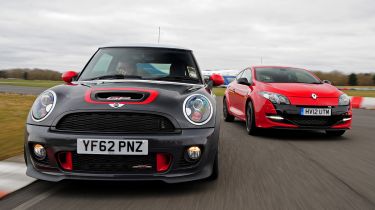
If you like your hot hatch thrills extreme and undiluted, there’s great news – the MINI John Cooper Works GP is back.
The 2006 original was the last hurrah of the Mk1 MINI. Motorsport-inspired suspension, an upgraded engine and a stripped-out interior gave it uncompromising driving dynamics, and made it a favourite of hot hatch enthusiasts.
Now, MINI has followed the same formula to create a GP version of the current JCW. Like its predecessor, it’s limited to 2,000 cars and comes with a unique paintjob, red mirrors, bold rear wing and a no-frills cabin that ditches the rear seats to save weight.
Yet it’s not the only hatch to offer hardcore thrills. The Renaultsport Megane Cup isn’t the most rounded of packages, but for driving fun it’s hard to beat. It’s also more powerful and cheaper than the MINI. So which model offers the ultimate in driver engagement?
Verdict
The MINI John Cooper Works GP delivers a masterclass in how to make a front-wheel-drive car thrilling. It provides pure driving pleasure and undiluted engagement with the road.
There are compromises that have to be made in comfort and refinement, but if you rate driving fun above all else, the GP will not disappoint. Think of it as the hot hatch version of fantastic road racers like the BMW M3 CSL and Porsche 911 GT3, and you wouldn’t be far wrong. In fact, the no-compromise performance-focused nature means it’s closer in spirit to the last-generation Megane R26.R than the current Cup version tested here.
Used - available now

2022 Toyota
C-HR
22,000 milesAutomaticPetrol1.8L
Cash £18,750
2016 Toyota
Yaris
76,100 milesAutomaticPetrol1.5L
Cash £7,994
2014 Ford
C-Max
52,900 milesManualDiesel1.6L
Cash £6,995
2018 Bentley
Bentayga
32,250 milesAutomaticPetrol6.0L
Cash £51,995But the latest Renault is still seriously capable, and has the added advantage of a five-seat cabin and great practicality. Yet even in Cup chassis specification, it doesn’t quite offer the raw fun factor of the MINI, while it still has a firm enough edge to be a little tiring as a day-to-day choice.
In this test, we’re looking for the ultimate driver’s choice – a car you’d take out just for the fun of it. And on that basis, the MINI JCW GP takes the spoils. Factor in its low emissions, strong residuals and fixed-price servicing, and you could almost suggest it appeals to the head as well as the heart.
First place: MINI JCW GP
The edgy, boisterous and feisty MINI JCW GP commands a big price premium, but its motorsport-inspired technology and exclusivity help to justify the cost. While it’s designed to perform on the track, its huge performance is accessible and enjoyable on the road. The ride is firm and it’s noisy on the motorway, yet if you want a car that exhilarates on every journey, this is the hot hatch for you.
You'd expect a hot hatch as single-minded as the MINI JCW GP to back up its performance with racy styling. And there’s certainly no missing it, with unique Thunder Grey paint set off by red edging around the bonnet vent, mirror caps and front air vents, plus slightly garish decals.
Yet it’s the aerodynamic additions – side sills, a chin spoiler and fixed rear wing – that give it menace. And they’re not just for show. In conjunction with underside panelling and an F1-style rear diffuser, the bodykit reduces lift at the rear axle by 90 per cent, while improved air flow under the engine helps suck more air from the intercooler.
The bespoke approach continues with the chassis. To allow the Kumho tyres to work harder, front camber is increased over the standard JCW, while toe-in is reduced. And for the first time in a roadgoing MINI, a fully adjustable coilover suspension set-up allows ride height to be lowered by up to 20mm.
Under the bonnet, the standard JCW’s 1.6-litre twin-scroll turbo engine is upgraded with an aluminium cylinder block, reinforced pistons and lightweight crankshafts. This tally of mechanical changes makes the GP far more than a marketing special, although the result is a rather modest 7bhp power upgrade.
Still, binning the rear seats contributes to a 55kg weight saving, making the MINI 234kg lighter than the Megane, at 1,160kg. But the bigger-capacity Renault has an extra 46bhp, and 360Nm of torque, so while the GP has a quicker in-gear response, it’s left trailing in the sprint from 0-60mph.
Not that you need to see test track figures to appreciate just how fast the MINI is. And even the shortest of drives is enough to allow you to savour the sharp throttle response, vocal exhaust and punchy power delivery. It’s a blast.
On bumpy or cambered roads there’s a price to pay for this boisterous nature. The firm suspension reacts to every imperfection, leaving the chunky-rimmed steering wheel fidgeting in your hands. Still, body control is faultless and the sense of involvement you get from the standard JCW’s razor-sharp controls has been turned up a notch in the tauter and livelier GP.
Unsurprisingly, given the motorsport engineering under the skin, the MINI’s dynamic nature is highlighted further on a track. The fast and accurate steering helps the driver to develop what feels like an intimate connection with the tarmac, and the immediacy of the chassis response means almost every press of the throttle or brake allows you to adjust the car’s balance. It’s easy to unstick the rear tyres by trailing the brake into the corner, or with a gentle lift off the throttle mid-bend – yet the communicative chassis means it’s always easy to gather it all up should you go too far.
Crucially, however, whether you’re driving on your favourite B-road or a track, the MINI is always eager and leaves the Renault feeling a little docile in comparison. So where’s the catch? Well, it’s noisy on the motorway and too firm around town, while sacrificing the rear seats limits the car’s practicality. Still, the standard JCW cabin gets GP decals and red highlights, while the Recaro seats are supportive and comfortable. Plus, as you’d expect from a car that’s all about enjoyment, the driving position is perfect.
The £28,790 price tag is steep, but MINI plans to sell just 2,000 examples. So exclusivity is guaranteed and you can expect strong residuals – in fact, you might just be buying yourself a future classic. All that counts for hot hatch fans, though, is that the John Cooper Works GP is one of the most thrilling cars money can buy; a car you’ll drive just for the hell of it.
Second place: Renaultsport Megane Cup
Fast, fun and very accomplished, the Mégane is still great in our eyes. But the Cup chassis is a little too firm to be a great day-to-day choice, and it doesn’t have the track-inspired edge to beat the MINI GP for out-and-out thrills. In isolation, it’s brilliant fun, yet in this test it’s shaded by a car that delivers an even more involving and entertaining driving experience.
Renault has faced some tough times of late, but fortunately for car fans it hasn’t been tempted to dilute its hot hatch models. There’s an all-new Renaultsport Clio coming soon, and its big brother, the Megane, is still a class benchmark, especially when fitted with the driver-focused Cup chassis.
So if you’re looking for a car to take on the fastest MINI ever made, this is it. Especially the entry-level Cup model, which forgoes luxuries and, more importantly, gets a stiffer suspension set-up and a proper mechanical limited-slip differential.
This version is also a substantial £3,545 cheaper than the MINI, at £25,245. However, while it has less kit than the standard car, the Megane Cup is still no lightweight. For instance, unlike in the MINI, you still get a rear seat and a fully enclosed boot.
As a result, it trails its rival when it comes to special kit and racy looks. Still, you’re unlikely to be disappointed by the Renault’s appearance. The rakish body is complemented by grille treatment that takes its inspiration from a Formula One front wing, while flared wheelarch extensions and a large centre exhaust finish the look.
Inside, there’s obviously a lot more space and you can squeeze three adults in the back. As in the MINI, the Recaro driver’s seat is supportive and comfortable, while material quality is reasonable throughout the cabin and the yellow seatbelts add a fun flourish.
Still, the most crucial battleground in this test is the driving experience – and the Renault doesn’t disappoint. Turn into a corner and the steering response is instant and very positive, while on the road the grip on offer is virtually unbreakable. At the track, traction isn’t quite as good as the MINI’s, but despite its weight and larger size, body control is very impressive.
Trouble is, the Megane isn’t as adjustable on the limit – and doesn’t feel as nimble or alive – as the MINI, which features hi-tech suspension and a more focused set-up. And while the Renault’s ride isn’t as unforgiving, it’s simply too firm for comfortable day-to-day use. On the plus side, the straight-line performance is superb – the 2.0-litre turbo engine produces 360Nm of torque at just 3,000rpm, so in-gear punch is as strong as the lighter MINI’s.
The engine and exhaust note aren’t quite as hard-edged as the GP’s, but the Renault still sounds great. A snappy gearshift and strong brakes wrap up an excellent dynamic package, while the standard kit tally includes cruise control, LED daytime running lights and rear parking sensors.
Even better, despite slightly higher 174g/km emissions, the Cup is a cheaper company car, on account of its lower price, and Renault’s 4+ aftersales package delivers free servicing for four years – even the MINI’s tlc pre-paid servicing deal can’t match that. Yet it’s the Cup’s talent as a driver’s car that will decide whether it wins this most focused road test.
Facts and figures
| MINI JCW GP | Megane RS 265 cup | |
| On-the-road price/total as tested | £28,790/£28,790 | £24,850/£24,850 |
| Residual value (after 3yrs/30,000) | £14,798/51.4% | £10,884/43.8% |
| Depreciation | £13,992 | £13,966 |
| Annual tax liability std/higher rate | £1,428/£2,857 | £1,275/£2,549 |
| Annual fuel cost (12,000/20,000 miles) | £3,754/£6,256 | £3,058/£5,096 |
| Ins group/quote/road tax band/cost | 35/N/A/G/£175 | 36/£615/H/£200 |
| Servicing cost | £246 (5yrs/100k) | Free (4yrs/48k) |
| Length/wheelbase | 3,730/2,467mm | 4,312/2,640mm |
| Height/width | 1,407/1,683mm | 1,423/1,804mm |
| Engine | 4cyl in-line/1,598cc | 4cyl in-line/1,998cc |
| Peak power | 215/6,000 bhp/rpm | 261/5,500 bhp/rpm |
| Peak torque | 280/2,000 Nm/rpm | 360/3,000 Nm/rpm |
| Transmission | 6-spd man/fwd | 6-spd man/fwd |
| Fuel tank capacity/spare wheel | 50 litres/run-flat | 60 litres/foam |
| Boot capacity (seats up/down) | 723 litres | 344/991 litres |
| Kerbweight/payload/towing weight | 1,160/450kg | 1,394/441kg |
| Turning circle/drag coefficient | 10.7 metres/0.36Cd | 11.4 metres/0.34Cd |
| Basic warranty (miles)/recovery | 3yrs (unltd)/3yrs | 4yrs (110k)/4yrs |
| Service intervals/UK dealers | Variable/148 | 18,000 miles/300 |
| Driver Power Manufacturer/dealer pos. | 21st/15th | 27th/23rd |
| Euro NCAP: Adult/child/ped./stars | N/A | N/A |
| 0-60/30-70mph | 6.4/5.3 secs | 6.1/5.0 secs |
| 30-50mph in 3rd/4th | 2.7/3.4 secs | 2.5/3.9 secs |
| 50-70mph in 5th/6th | 4.3/5.1 secs | 4.6/6.5 secs |
| Top speed/rpm at 70mph | 150mph/3,000rpm | 158mph/2,500rpm |
| Braking 70-0/60-0/30-0mph | 44.6/32.2/8.3m | 47.7/34.6/9.0m |
| Noise levels outside/idle/30/70mph | 69/49/67/76dB | 64/49/64/72dB |
| Auto Express econ (mpg/mpl)/range | 20.2/4.4/222 miles | 24.8/5.4/327 miles |
| Govt urban/extra-urban/combined | 29.7/49.6/39.8mpg | 34.4/43.5/25.0mpg |
| Govt urban/extra-urban/combined | 6.5/10.9/8.8mpl | 7.6/9.6/5.5mpl |
| Actual/claimed CO2/tax bracket | 323/165g/km/25% | 263/174g/km/26% |
| Airbags/alarm/xenon lights | Six/yes/yes | Six/£750/yes |
| Air-con/heated seats/metallic paint | Yes/yes/yes | Yes/no/yes |
| Parking sensors/tyre pressure monitor | No/yes | No/yes |
| Stability control/cruise control | Yes/no | Yes/yes |
| Sat-nav/USB connection/Bluetooth | DFO*/yes/yes | £500/yes/yes |