New Lepas L8 2026 review: big on space and value, short on polish
The L8 is spacious, well equipped and keenly priced, but it’s not as good to drive as its rivals


Verdict
The Lepas L8 is an impressively spacious, well appointed family SUV that has a touch of premium appeal thanks to its looks and quality, plus an impressive plug-in hybrid powertrain. It’s competitively priced as well, undercutting key competitors such as the Volkswagen Tiguan and Toyota RAV4 by a significant margin. However, those and other rivals feel far more polished on the road, whereas this newcomer has a few areas in need of improvement, particularly the somewhat floppy handling and tech onboard.
Not that long ago, nobody had heard of Omoda or Jaecoo, but they have taken the UK by storm, having sold more than 100,000 cars here since they arrived in 2024. Both are owned by Chery, which launched as a standalone brand here in 2025 and is proving similarly popular. Now, the Chinese conglomerate has brought over its more upmarket enterprise, Lepas, hoping lighting can strike a fourth time.
The brand itself is focused on design, tech and quality, while Lepas is apparently the result of slamming together the words leopard – the animal apparently inspired the styling of the company’s cars – and passion. Er okay, we’ll move on.
The Lepas L8 is the marque’s first offering in this country, a family mid-size SUV that rivals the likes of the Volkswagen Tiguan, Hyundai Tucson, Kia Sportage and Toyota RAV4, plus the similarly value-led MG HS – our Affordable Hybrid Car of the Year for 2026.
Used - available now

2023 Mercedes
CLA Shooting Brake
60,433 milesAutomaticPetrol1.3L
Cash £18,060
2023 Mercedes
EQC
26,904 milesAutomaticElectric
Cash £29,880
2022 BMW
3 Series Touring
81,131 milesAutomaticPetrol2.0L
Cash £17,920
2023 Audi
Q4 e-tron
17,172 milesAutomaticElectric
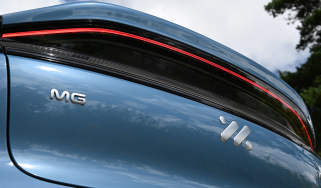
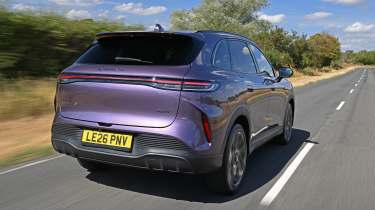
Cash £25,960With the L8, Lepas clearly hasn’t gone down the ‘Temu Range Rover’ route like sister brand Jaecoo, but has clearly taken a bit of inspiration from Audi. You can see this in the design of the grille, flanked by large air inlets, and super-slim daytime running lights. Plus, just like you get on every Audi these days, there’s a full-width lightbar at the back that’s shaped to make the car look wider.
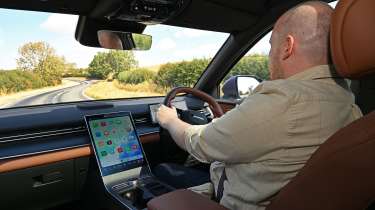
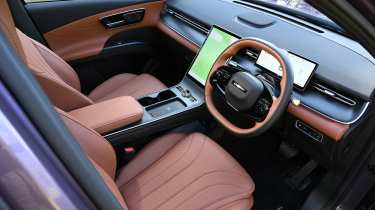
Meanwhile, the interior appears to have borrowed a few elements from Mercedes, such as the big 13.2-inch portrait touchscreen that flows down into the centre console, just like the one in the C-Class. The scent diffuser is a novelty shared with the S-Class, too.
Unsurprisingly, the quality isn’t up to Mercedes or Audi standards, but it’s decent and there are plenty of squidgy, softly padded surfaces around the cabin, with harder cheaper-feeling plastics only used for lower parts of the doors and centre console.
We appreciate that the L8 has a bank of physical climate-control buttons on the centre console, and what looks like a large volume dial but is actually a drive mode selector. However, those and all the buttons on the rather odd square steering wheel are covered in glossy black plastic that starts collecting dust, greasy fingerprints and scratches the moment you sit inside.
As in so many new Chinese cars, the L8’s infotainment system is loaded with customisation options, to the point that it’s difficult to find the setting you want because it’s buried in a maze of menus and sub-menus. All the pages load quickly at least, the touchscreen is sharp and responsive, and if you use the wireless Apple CarPlay or Android Auto, these take up the entire display.
The 10.25-inch driver’s display is similarly clear, but presents a mess of small icons and shoves your speed off to one side, while a much less helpful graphic of the car sits in the centre. The AI-powered voice assistant’s attempts at natural conversations were also irritating.
Thankfully, Lepas is working to improve its tech, including adding an easy shortcut to deactivate the L8’s ADAS systems, which should come in an over-the-air update. We would also encourage the engineers to hone the lane-keep assist some more, because the system struggled on tight and twisty country lanes.
One of this car’s redeeming qualities is the vast amount of space in the back. There is acres of legroom – enough to make six-foot-tall passengers feel small – and lots of headroom, with the panoramic sunroof adding to the spacious feel. The 507-litre boot isn’t the biggest in its class, but it’s on par with the MG HS’s, there’s storage under the floor, and most families will be catered for.
Right now, the L8 is available exclusively with a plug-in hybrid powertrain that uses a 1.5-litre four-cylinder petrol engine primarily as a generator for the e-motor and 18.4kWh battery. So it’s more like a range-extender, which can deliver a smoother driving experience because there’s none of the awkward baton-passing between engine and e-motor, plus more immediate power delivery.
It certainly felt a lot like we were driving a pure-electric car when testing the L8, because there was a decent amount of oomph when you put your foot down and we hardly noticed any noise from the engine. Mind you, that’s hardly surprising, given that Lepas has also fitted an active noise-cancellation system.
Since we drove the Lepas L8 in China in the spring, the company says it’s tuned the car’s chassis for UK roads, added new dampers and other parts, and fettled the steering. The goal was to make the car feel more ‘agile’ and ‘precise’ – basically to make it handle better on our roads – but we think there’s still room for improvement.
First off, there isn’t much body control. The L8 leans heavily through corners and can feel unsettled on undulating roads, while the steering feels vague because you get zero feedback through the wheel. The car is relatively comfortable at least, coping quite well with potholes and other imperfections, although they send an audible thud into the cabin. Wind and road noise creep in, too.
Being ‘okay to drive’ would be enough to satisfy most family SUV buyers, we reckon, but we did have slightly higher expectations given that Lepas seems to talk more about driving dynamics than the other members of the Chery family. Ultimately, though, the L8 doesn’t handle any better than its siblings.
One major bugbear for us came while trying to do a quick three-point turn or parking manoeuvre in the L8: unless you have your foot pushed very hard on the brake pedal, pulling on the gear selector sends you into neutral, rather than drive or reverse. There’s no warning bong or message, leaving you to sit like a confused lemon in the middle of the road.
Prices for the Lepas L8 start from £34,900, which is about £3,500 less than a plug-in hybrid Kia Sportage or £7,000 less than the equivalent VW Tiguan. However, the MG HS Plug-in Hybrid is available from £32,495.
Although there’s just the single powertrain, there are just two specifications to choose from: Essence and Elevate. Standard kit includes those two large displays, a panoramic sunroof, wireless smartphone charger, dual-zone climate control, keyless go, a surround-view camera system, plenty more driver-assistance tech and a seven-year/100,000-mile warranty.
Higher-spec models add 20-inch diamond-cut alloy wheels, soundproofed front windows, power-adjustable front seats with heating, ventilating and massage functions, faux-leather upholstery, an electric bootlid, eight-speaker Sony stereo, and a 540-degree surround-view camera system.
| Model: | Lepas L8 PHEV Elevate |
| Price: | £37,900 |
| Engine: | 1.5-litre four-cylinder petrol PHEV |
| Power/torque: | 275bhp/365Nm |
| Transmission: | Single-speed automatic, front-wheel drive |
| 0-62mph: | 7.9 seconds |
| Top speed: | 111mph |
| Economy: | 403.5mpg |
| CO2: | 21g/km |
| Size (L/W/H): | 4,688/1,871/1,686mm |
| On sale: | Now |