Volkswagen Caddy Maxi vs Skoda Roomster: 2008 twin test
Is Volkswagen’s new van-based Caddy Maxi the most practical no frills people carrier around? We find out as it tackles Skoda’s purpose-built Roomster MPV

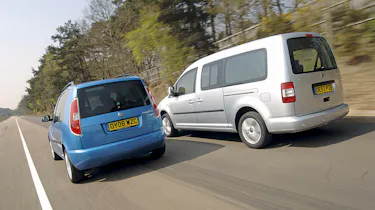
Innovation or imitation? That’s what many designers have asked themselves when dreaming up the ideal MPV. There’s nothing more practical than a van, but will buyers put up with a tweaked commercial vehicle?
Peugeot, Citroen and Fiat have successfully adapted vans into passenger cars that offer great space. Volkswagen is no stranger to this market, either. It launched a Life version of its Caddy van four years ago – although the model found few fans. Now, the German firm is back with a fresher, larger car: the Caddy Maxi.
The big news is that it’s available with seven seats and offers bags of passenger room and stowage. Bosses describe it is a practical but compact car for customers who want versatility and space. But is it as well finished and family friendly as a purpose-built MPV? To find out, we’re pitching it against the Skoda Roomster.
While it’s smaller, the interior of the Czech model is impressively flexible, and it also has the price advantage in this test. So, is it worth spending the extra and opting for the seven-seat Caddy? We put the two head-to-head...
Verdict
While the Caddy Maxi Life is a decent people carrier, we’re still not convinced that it’s a serious contender in the MPV class. Even if you can live with the frumpy looks, the interior is not as flexible or as clever as many rivals.
But perhaps the biggest stumbling block is the price tag. At nearly £18,000 for the 2.0 TDI, it’s very costly – especially when you consider an entry-level Touran will set you back only £14,295. The Golf-based compact MPV is better to drive, has a much higher-quality interior and still comes with seven seats as standard.
Many rivals can’t match the quality of the new VW, but similar commercial-based models such as the Fiat Doblo are far cheaper. Even the range-topping Italian car costs only £12,705, and it also has a third row of chairs.
That’s the real reason why the Skoda takes the victory in this test: the Caddy is simply not worth the extra cash.
In comparison, the Roomster offers great value, and has a more upmarket feel inside. Only those buyers who demand the versatility of a seven-seater will find it falling short of their family car needs.
First place: Skoda Roomster
Need proof that people carriers don’t have to be boring? Then take a look at the Roomster. The supermini-MPV is a massive departure from Skoda’s previous small cars, which have been conservative by comparison. It’s also the first model since the VW Group took control in 1991 that isn’t based on one of the parent firm’s existing platforms.
From the outside at least, we’re not convinced it’s a complete success. Although the neat nose echoes that of the Fabia, the back looks at odds with the front end; it’s like two cars in one. Still, Skoda should be applauded for trying something different, and the shape is more distinctive than most other supermini-MPVs.
Used - available now

2026 Audi
A1 Sportback
45,876 milesManualPetrol1.0L
Cash £13,326
2023 Audi
e-tron
38,608 milesAutomaticElectric
Cash £16,489
2021 SEAT
Ibiza
32,936 milesManualPetrol1.0L
Cash £11,000
2024 BMW
X3
33,318 milesAutomaticDiesel2.0L
Cash £31,595Slipping into the driver’s seat is like climbing into a Fabia with a tall roof. The stereo is easy to use, as are the high-mounted ventilation controls, and it’s more upmarket than the Caddy, with softer materials throughout. The seats are more supportive, too. Thanks to thin A-pillars, forward visibility is better than in the Caddy, even if we found stowage a little disappointing.
As both cars use VW components, it’s no surprise their controls share the same slick feel. The Roomster has a positive gearchange and a smooth clutch, which makes it easy to drive.
Despite its car-derived underpinnings, the Roomster has an advantage over the Caddy for passenger space. A shorter overall length means there’s no room for a third row of seats, but that in turn frees up more space for the rear bench. Our test car’s glass roof helped the cabin feel spacious, even if few people will want to travel on the narrow and uncomfortable centre chair.
While it doesn’t slide like the outer two, it can be flipped to double as an armrest with cup-holders. Folding the seats is straightforward, thanks to the VarioFlex system – the chairs drop with one handle and then tumble with the pull of another.
VW has yet to publish precise boot volumes for the Caddy Maxi, but it’s clearly larger inside than the Skoda. The Czech car isn’t as far behind as you think, though. Benefiting from the space gained by only having five seats, the Roomster has a 450-litre volume – more than a Ford Focus.
The ageing 1.9-litre TDI engine is a bit of a letdown. While we’ve driven plenty of different models powered by the 104bhp unit, its coarse and noisy nature still takes some getting used to. The performance makes up for this slightly. In our 0-60mph test, the lightweight Roomster recorded a time of 11.2 seconds – one-tenth faster.
On the road, the Skoda is competent and fairly agile. In fact, it’s similar to the Fabia, and far more composed than the Caddy Maxi. When cornering, the Roomster is stable, while the steering is light and precise. Firmer suspension means the Skoda isn’t as smooth over rough roads as its rival, but it’s just as good on the motorway and is less prone to cross winds.
If the Roomster doesn’t win you over on the test drive, its price will certainly grab your attention. Our test car was in top-spec 3 trim. Powered by the 1.9 TDI engine, it’s the most expensive model in the line-up at £14,220, but it undercuts the Caddy Maxi by nearly £4,000. And it comes with parking sensors, cruise control and an MP3 connection as standard. It also gets six airbags – that’s two more than the Caddy.
Details
Price: £14,220
Model tested: Roomster 3 1.9 TDI
Economy
With a lighter kerbweight and smaller engine, the Roomster was the more frugal car, returning 39.8mpg. But that’s still well short of the firm’s claimed figure of 53.3mpg.
Residuals
The styling divides opinion, but the Roomster performs well in the used market. It retains 42.5 per cent of its price new, and will still be worth £8,176 after three years.
Servicing
You will pay slightly more for servicing if you buy the Skoda, with three checks for £807. But the firm’s garages came second in our Driver Power 2008 dealer poll.
Tax
As it puts out 139g/km of CO2, the Roomster sits in the lowest 18 per cent tax band for diesels. That means business users on the lower rate of earnings pay only £563 a year.
Second place: Volkswagen Caddy Maxi
Walk into a Volkswagen showroom, and you will see five MPVs on display. As well as the new Caddy Maxi Life, buyers have the choice of the Golf Plus, Touran, Sharan and Caravelle. So, what does this boxy model add to the range?
Certainly not style. Even though it comes with alloy wheels and colour-coded bumpers, there’s no disguising the slab-sided van shape. Only the Touran-like nose appears familiar; the overall shape of the Caddy Maxi is rather dull.
With such a square profile, the VW struggles to hide its height and length, and looks quite bulky as a result. Lined up next to the Roomster, it’s clear the Czech model is far more distinctive.
The VW is 670mm longer, and that means it offers loads more room inside – enough for seven seats in fact. Passengers in the middle row will find less knee space than the Skoda, yet there’s masses of headroom, thanks to a roof that’s more than 200mm higher than its rival’s. The middle bench only splits 60/40, but it’s more comfortable with three abreast.
The real difference between these two is the extra seats in the Caddy, which offer decent space and a good view forward. It’s just a shame the third row is a fixed bench, and so is short on flexibility. While the seatback can be folded to increase the boot capacity, if you need more space, the whole chair has to be removed, which is an awkward and cumbersome procedure.
Treat the Maxi as a five-seater, and its commercial origins help it to a comfortable victory in the practicality stakes. The VW is an excellent load-lugger, with its wide and square rear opening making storing even the bulkiest objects easy. There’s no load lip, and the boot floor is wider than the Roomster’s, too.
We hoped the Caddy’s van underpinnings would be less obvious from the driver’s seat. But while the layout will be familiar to VW owners, it’s not particularly inspiring. Gone are the soft-touch materials of the Golf, with hard plastics that lack sophistication taking their place. It certainly doesn’t feel like an £18,000 vehicle.
Our test car is the 2.0 TDI with 138bhp. The Caddy is also available with the same 1.9-litre TDI as the Roomster, although in terms of refinement, the two units are evenly matched – that is, they’re both too coarse and a bit noisy.
Despite the fact the 138bhp VW has 34bhp more power than the Skoda, it trailed by one-tenth-of-a-second from 0-60mph, with a time of 11.3 seconds. It feels sluggish on the move, too, even though the Caddy has 80Nm more torque, at 320Nm, and was quicker in-gear. Only on the motorway does the Maxi edge ahead, with less noise at 70mph – at 69dB, it was 4dB quieter than its competitor, and is a comfortable cruiser.
As you’d expect, handling isn’t a strong point. While the steering is precise, the body rolls in corners, and the seven-seater feels heavy at the rear. It’s no match for the nimble Skoda.
Nor can the Caddy Maxi range compete on price – usually one of the key advantages of choosing a van-based MPV. There’s only one trim level, and with the 2.0 TDI engine it comes in at a hefty £17,995. Opting for the 1.9-litre diesel cuts the price by £2,000, but that’s still more expensive than the top-of-the-range Roomster.
Details
Price: £17,995
Model tested: Caddy Maxi Life 2.0 TDI
Economy
Our Caddy Maxi averaged 37mpg exactly – not far behind the Skoda. The larger fuel tank gave it a slightly longer 488-mile range. And we’d expect economy to improve with a higher mileage
Residuals
While our experts have yet to work out the Caddy’s residuals, VW’s excellent second-hand reputation means they are likely to be strong. The Touran, for example, retains about 45 per cent.
Servicing
While VW trades on its premium image, its garage network is failing to live up to that standard. In Auto Express’s Driver Power 2008 dealer survey, it finished a poor 23rd out of 30.
Tax
Neither of these cars is a common business choice, but the Caddy will cost more. It emits 169g/km of CO2, and lower-band owners pay £950 a year. Annual road tax is £50 more than the Skoda’s.