How to drive on ice: top tips for driving in icy and slippery road conditions
Driving on ice can pose all sorts of problems, but these top tips should help keep you out of trouble

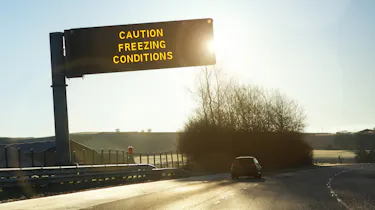
Driving in winter can be incredibly tricky. With temperatures dipping below freezing the risk of ice forming on the road increases, which can lead to some pretty treacherous conditions.
To drive on ice safely, you’ll need to adapt your driving style. Below, our in-depth guide covers everything you need to know when it comes to driving on ice and in slippery conditions, as well as looking at the precautions you should take before getting behind the wheel.
Before your journey
Before you set out, it’s important you plan ahead, weigh-up the risks and make sure your car is prepared in case you get stranded.
Don’t drive!

The first question you should ask yourself is “do I need to drive”?
Even if you're prepared and experienced in driving in icy conditions, not everybody else will be, so the potential for an accident is greatly increased.
It’s recommended that you avoid all travel during the worst cold weather conditions if possible, but if you’ve weighed up the options and driving is the only way, the following tips should help to keep you safe.
Planning and preparation
If you must venture out in the car, always plan your route before you set off. It’s best to stick to main roads, which are more likely to have been gritted. Following bus routes may be useful, as these are more likely to have been treated too.
If you’re driving to meet someone, let them know the route you’re planning to take and your estimated time of arrival. Check the weather forecast before heading out as well as a map app to see if there are any road closures or accidents on your route.
Key equipment
Besides the usual ice scraper, it’s advisable to carry a fully charged mobile phone in case of emergency, a warning triangle, a tow rope, jump leads and warm clothing.
If you're heading out into uncleared or rural roads, you should take a snow shovel and an old rug or sack to put under the wheels if you get stuck.
Before setting off
Before you get behind the wheel, you need to make sure your car is ready to go. Start it up, and turn the heating on to clear windows and mirrors before moving off. Use air-conditioning to help the car clear, as it’s more effective than just the heating alone. Make sure your lights are also clean and visible.
Top tips for driving on ice
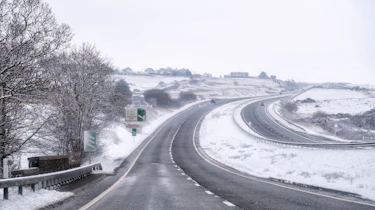
Icy patches can appear even on treated roads. The tips below should help keep you safe in slippery conditions.
Slow down
‘Slow down’ could be all the advice you need to drive safely in icy conditions. There is a lot less grip when it’s icy: stopping distances double in the wet, but can increase by a factor of 10 on ice. You may not be able to stop at all.
The risk of skidding is always present even when driving at walking pace, particularly when applying the brakes or making sharp steering inputs, or on inclines. That risk increases exponentially with speed, as do the dangers should you lose control.
Watch out for black ice
Black ice is where a thin layer of water freezes over the road surface, leaving a glossy patch of ice which is incredibly difficult to see when driving along. It looks just like a wet patch road.
When black ice forms, often during cold snaps overnight, it’s a particularly nasty challenge for early-morning drivers, and if the gritting lorries are caught off-guard too, road conditions on the commute can be a recipe for disaster.
Black ice can form any time it’s cold enough, of course, but so too can more obviously opaque icy surfaces after snow fall or heavy frosts.
Even when conditions improve and the sun comes out, patches of black ice can still remain in shaded areas, especially on country roads.
Drive gently
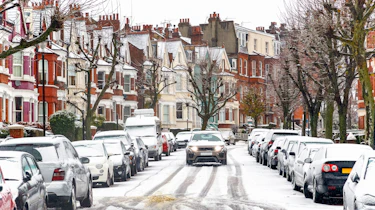
Adjust your driving style to use small, gentle movements on the accelerator and avoid the brakes when possible. If you're driving a manual or semi-automatic car, set off in second gear rather than first, so that the power of the engine doesn’t overwhelm the tyres, while reading the road ahead means you can rely on gentle engine braking to slow down.
If you’re travelling too quickly and need to slow down, don't panic and slam on the brakes: new cars come with anti-lock brakes, but ice can defeat the system if all wheels lock at once.
Modulate your brake pressure so the wheels can still turn as the car slows, retaining directional control. When travelling downhill, reduce your speed well in advance, and use lower gears to limit the need for braking and reduce the chance of skidding.
How to correct a skid on ice
In icy and wintery conditions, your car might go into a skid, so knowing how to regain control is vital.
What to do when your car understeers
Understeer is caused when the front wheels of a car slip on the road surface while the rears still have grip. It usually occurs when you carry too much speed into a corner, so when you apply steering lock, the car wants to continue straight ahead.
Turning the steering wheel further won’t help because the front tyres have lost grip. Instead, you must slow down and take some steering lock off to help the tyres regain traction.
However, when the road is icy, backing off the throttle may be the only effective way to slow down, because stepping hard on the brakes may only make matters worse.
When you’ve slowed enough, adding lock again to get around the corner should see you back on course.
What to do when your car oversteers
When cornering on an icy surface and the rear tyres lose grip, the momentum can bring the back end of the car around like a pendulum. In this case you need to steer into the skid, so if the car swings out to the left, you steer to the left to try and counteract a spin.
At any sort of speed, applying the brakes will likely make the skid worse. You must also try not to overcorrect the slide by steering too aggressively, as the back end may ‘fishtail’ in the opposite direction, forcing you to correct again by steering into multiple slides in turn.
However, be prepared to make a number of quick corrections as it’s hard to judge the correct amount of corrective steering lock to apply if you’ve not previously practised the art of skid control. This could be the moment you wish you’d invested in a skid pan training course…
What are your top tips for driving in winter weather? Let us know in the comments section below...