New Volkswagen ID. Polo prototype review: electric supermini shows VW at its best
We get an early taste of the new all-electric Volkswagen ID. Polo ahead of its official reveal

Verdict
This early taste is a sign that Volkswagen could be back to its best. The new Volkswagen ID. Polo – even as a pre-production prototype – feels like a very high-quality item. Solid, well connected, comfortable and even quite engaging to drive, the ability to build all of this into a well priced package is something we all hoped for; the surprising bit is how much of VW’s innate ‘character’ has come through.
It’s quite a bizarre experience in this job to walk into a room full of engineers, designers plus prototypes and there not be an ounce of arrogance in the room. But standing amongst the creators of Volkswagen’s all-new ID. Polo, the sense is instead one of cautious optimism.
Volkswagen knows it under-delivered on its electric cars the first time around. The initial ID models such as the ID.3 and ID.4 fell short of the quality, driving dynamics and reliability expected from a brand like VW, and that’s before we take into account its half-baked approach to tech and ergonomics. It’s not just that the strategy wasn’t quite right, but the execution wasn’t great either.
This is all about to change, though. Next year’s ID. Polo is the first of a new era for VW, says its makers, driven from a new CEO and a realistic view of who its customers are and how they interact with their cars. In 2025, there are no second chances, so how does it stack up?
How does the new ID. Polo look?
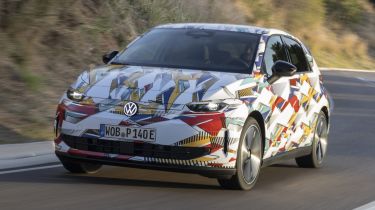
Straight away the new ID. Polo proudly displays a sense of confidence that the ID.3 could never muster. Sitting solidly on a wide stance and 19-inch wheels, it comes with a shape that undeniably says Volkswagen. We’ve still got a few months to wait to see the ID. Polo in its final form, but through the chaotic camouflage, elements such as smooth and full surfaces and clever lighting are clear. This is a Polo, but seen through a futuristic lens.
Used - available now


Of course, we do already have a very good idea of what the car will look like, thanks to the ID.2All concept that provided direct inspiration for the ID. Polo, but what’s impressive is how close the production version is, considering the B-segment mandate for affordability and practicality – it’s easy to make a supercar look like a concept, a supermini is a very different kettle of fish.
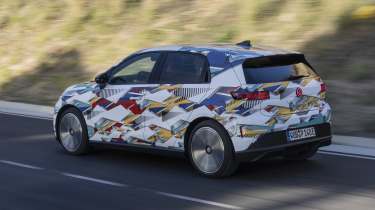
But today isn’t about deciding whether the ID. Polo looks good or not, but to get a sense of whether VW has learnt its lessons when you’re sitting behind the wheel, and initial impressions are good.
What’s the ID. Polo like to sit in?
Outward visibility is good and there’s plenty of adjustment in the seat and steering wheel to keep you from feeling perched on top of the car, rather than sat inside it. The interior architecture also feels very different to most ID products that have come before. Rather than a wide, open space lined in hard plastics, even the design-obscuring dashmat can’t hide the wide centre console that houses a small volume knob, cup-holders and a space for a couple of smart phones.
Peering beneath the exposed sections of dash, the plastics and materials seem miles ahead, not just of the ID.3, but also the combustion-engined Polo currently on sale. Just as the concept previewed, fabrics and clever recycled materials should give the cabins a much warmer feel, and highlight a sense of quality that’s synonymous with brands such VW.
What can we say about the digital interfaces?
The basic user interface was covered for our images, but in order to remain safe while driving, we lifted the lid to find a digital UI that looks familiar to VW, but cleaner, more variable and easier to navigate. Turning off some of the mandatory safety systems, such as lane-keep and speed-sign recognition is an easy process on-screen. There’s no physical control to do this, but peeking out from the camouflage is an undeniable row of buttons for the climate control – there are no sliders to be seen.
The infuriating single-row window switches are now relegated to the pages of history, with four controls, plus the same clever lever-like door handle that you’ll find on the new T-Roc. The oblong-shaped steering wheel, although a little big, is the right thickness, and the slick-looking button pads on both sides are easy to navigate and now more clearly relate to the driver’s information screen in front of you.
The right control panel controls the elements on the right side of the screen, and the left one handles the opposite side. There’s no assumed knowledge from customers here, only proof that when it comes to interior usability, Volkswagen has listened.
What’s the new ID. Polo like to drive?
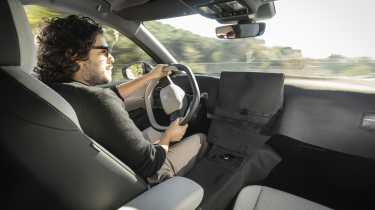
Engage drive with the same gear-selector stalk as you’ll find on other VW models and the ID. Polo moves away silently, and instantly shows off a very impressive low-speed ride. This is made more impressive considering the largest-available 19-inch wheels that are fitted to these prototypes.
In a previous presentation, we were given the technical details of the ID. Polo and, as suspected, it runs a similar set of numbers to the new Cupra Raval, which shares its MEB+ chassis. This set-up in effect switches around the previous MEB layout by mounting the electric motor ahead of the front axle, rather than on the rear.
As well as reducing cost and complexity, it also allows a simpler torsion-bar rear suspension design to be fitted, which unlocks a colossal 437-litre boot capacity – a big chunk of which sits underneath a false floor.
Two battery options are available – a base 37kWh LFP (Lithium Iron Phosphate) and higher-spec 54kWh NMC (Nickel Manganese Cobalt) – the latter of which offers ‘up to’ 279 miles from a charge, with top-up speeds of up to 130kW, going from 10-80 per cent in 23 minutes. No other figures have been released.
There will be four power options available, all from the one electric motor that’s capable of up to 207bhp. A 227bhp GTI version is coming in the future, adding a limited-slip differential and unique suspension set-up, but for the ‘standard’ models, only the one passive system is available.
This is what makes the car’s excellent ride so surprising. We were given more granular detail of how this was achieved, with the rear-axle geometry developed to give the back end more stability, but the net result of this is a car that feels and drives in a much more settled fashion than would be expected on a supermini, electrically-driven or not.
Coming to a stop, the next incredibly impressive element are the brakes, which have been totally redeveloped to give the car a consistent and easy-to-modulate feel. It is impossible to sense the switch between regenerative and friction braking, and it doesn’t just out-do the former ID models, but all of VW’s ICE-powered cars, too.
Power from our 207bhp variant is also more than enough for this type of car, backed up by 290Nm of torque that makes it feel effortless, even at motorway speeds. These are Polo GTI-like numbers, but it is worth remembering that at just under 1,500kg, it’s also a fair bit heavier than its petrol-powered hot hatch sibling.
The steering feels very well judged, with excellent weighting and just enough speed in the rack to feel agile, without becoming hyperactive. Unlike former MEB-platform products, there is no sense that you’re sitting on top of the car, which makes it both more engaging around corners and more comfortable for passengers.
A heavy dose of throttle on a tight right-hand corner produces a small amount of wheelspin from the loose surface, but the traction control very subtly nips power from the inside wheel and we just take off. It’s polished, nuanced and feels expertly calibrated – all the things the ID.3 wasn’t when it was launched.
Which leaves us with our lasting impression. This is a car that doesn't need to prove anything other than VW’s own iron-clad competency. It’s not here to change minds or extravagantly provocate change. It’s here to be a daily driver for customers who want a high-quality, well engineered and now well connected car. In this regard, Volkswagen is clearly on the right track. Now we just need to see it, and find out precisely how much it’s going to cost in the UK.
Did you know you can sell your car through Auto Express? We’ll help you get a great price and find a great deal on a new car, too.