New Ford Fiesta comeback in detail: Renault 5 and XR2i inspiration for 2028 launch
Ford’s comeback plan for Europe hinges on new models tied-up with Renault, and the Fiesta is arguably the most important

Ford is laying out its ‘Ready Set Ford’ plan that it hopes will turn around the brand’s fortunes in the European market. Core to this movement will be a brand new Ford Fiesta supermini, but it won’t be going it alone.
That’s because Ford will be introducing five all-new models between 2028 and 2029 to cover all of the biggest selling market segments in Europe, and in many cases with both hybrid and electric car powertrain options.

The full line-up has already been teased in an image showing off their front-end silhouettes and new lighting signatures, which also point to a dramatic shift in Ford’s current design language. The company won’t be developing all of these new models from scratch, though, because most will be the products of joint ventures to increase scale and thus bring their prices down to compete with the influx of products from more agile Chinese manufacturers.
However, the stakes are high. These newcomers will be charged with stopping the bleeding at Ford: its new-car registrations in Europe have slumped from just over one million in 2019 to 426,459 last year.
The plan is ambitious, but it’s one that Ford of Europe’s president, Jim Baumbick, is confident will ensure the brand has a stable future in Europe well into the future. And it will all hinge on the rebirth of the iconic Fiesta.
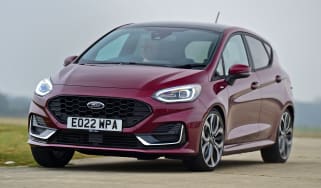
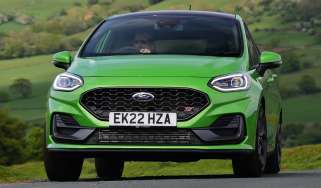
If you can’t wait for the new Ford Fiesta, check out our Buy a Car service where we have a wide selection of used Ford Fiestas for sale, with prices starting from less than £3,000.

New Ford Fiesta powertrains and range
The all-new Ford Fiesta will arrive in 2028, exclusively with an all-electric powertrain. It’ll be based on the same RG EV Small platform as the Renault 5, Alpine A290 and Nissan Micra – three cars it’ll also be in direct competition with.
However, while this platform is well known, it doesn’t necessarily mean that all the cars will share the same key specifications. Speaking with Auto Express, Ford of Europe’s president Jim Baumbick told us: “When we choose partners, we’re working on the future development of the platform. You effectively join a platform at a particular point and time. So you can imagine there will be differences from vehicle one to vehicle two, because the platform is constantly developing over time.
“I like to think of the train analogy. We’re getting on the train [at a certain point]. We’ll get a version of the platform, and then every time the platform evolves, we collectively get that benefit of the evolution. It’s not a static thing, it’s a very dynamic thing.”
So while this means that the Fiesta will retain a front-engined, front-wheel-drive layout, this could include a revised battery that’ll help keep Ford’s model right up to date against its key rivals.
For now, we can only speculate on the Ford’s specifications by looking at the current Renault 5, which is available with two battery options in the UK – 40kWh and 54kWh, with 119bhp or 148bhp respectively. A range of 250 miles at most for the larger battery will be possible, but this figure will vary depending on the final specifications.
Even with the Fiesta’s proposed arrival date of 2028, a figure of around 250 will remain competitive with most European rivals, especially now that we know the new Volkswagen ID. Polo, Cupra Raval and Skoda Epiq are all capable, at most, of around 280 miles on a charge.
What will the new Ford Fiesta look like?
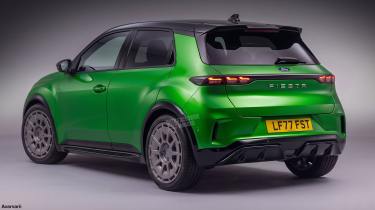
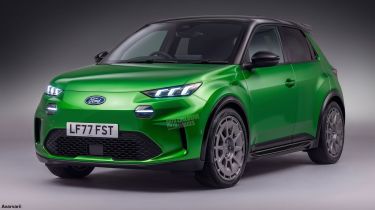
Regardless of the platform, though, Ford is adamant that its new Fiesta will still look and feel like a Ford, because it plans to instil its competition-derived heritage into all its future models. As you can see in our exclusive images, the new model will feature sporty styling elements inspired by Ford’s iconic past models, such as the XR2i, with two-element headlights, and black wheelarch surrounds.
There are very few details regarding the interior tech, because it’s not known whether Ford will employ its own infotainment system, but Baumbick said: “Our goal would be, over time, to make [all our infotainment systems] much more similar, and it gives us speed to be able to make changes and differentiate across the partners.”
This suggests that Ford might be limited to using a system from Renault with its own skin, but we’ll have to wait to be sure.
Come and join our WhatsApp channel for the latest car news and reviews...
Used Ford Fiestas for sale

2021 Ford
Fiesta
29,966 milesManualPetrol1.0L
Cash £12,600
2022 Ford
Fiesta
23,661 milesAutomaticPetrol1.0L
Cash £15,000
2023 Ford
Fiesta
19,757 milesAutomaticPetrol1.0L
Cash £16,197
2021 Ford
Fiesta
61,228 milesManualPetrol1.0L
Cash £7,910
2023 Ford
Fiesta
17,462 milesManualPetrol1.0L
Cash £11,532
2023 Ford
Fiesta
22,341 milesAutomaticPetrol1.0L
Cash £15,999
2023 Ford
Fiesta
36,760 milesAutomaticPetrol1.0L
Cash £14,292
2022 Ford
Fiesta
12,000 milesAutomaticPetrol1.0L
Cash £14,998
2023 Ford
Fiesta
17,290 milesManualPetrol1.0L
Cash £14,498