Volvo C40 Recharge Plus Twin Motor 2022 review
After a UK drive of Volvo’s C40 Recharge in top-spec, twin-motor guise, we remain a little perplexed


Verdict
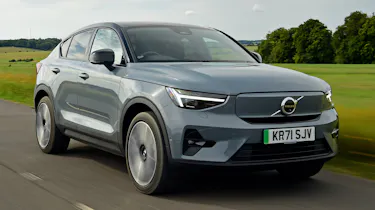
The C40 feels needlessly powerful in this twin-motor set-up, which is also wallet-bustingly expensive, and it could do with being a little softer. For those who want the performance, a Polestar 2 is a better bet, while everyone else should opt for the single-motor C40. Either way, the appeal of the C40 seems limited over the more practical and slightly cheaper XC40 Recharge.
As Volvo gave much of its range a long overdue rejuvenation under Geely ownership, one ageing model was left to solider on - the V40 family hatchback. The plug was pulled in 2019, but it wouldn’t be until 2021 that its replacement finally arrived.
Except, it wasn’t a like-for-like substitution. Partly prompted by many old V40 customers moving on to the XC40, Volvo decided to replace the conventional C-segment hatch with something in that very much in vogue sub-segment, the ‘coupe’ SUV.

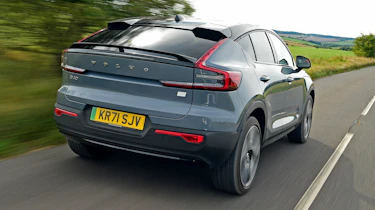
The Volvo C40 is only available as an electric vehicle, and it uses the XC40 Recharge as a base. From the front, you’d be hard-pressed to tell the difference between the two cars, but move a little further round, and you’ll spot a sloping roofline and a new, swoopier tailgate complete with a small spoiler.
Used - available now

2011 Honda
Insight
32,500 milesAutomaticPetrol1.3L
Cash £6,999
2024 Vauxhall
Grandland
15,608 milesAutomaticPetrol1.2L
Cash £15,926
2024 Vauxhall
Mokka Electric
10,093 milesAutomaticElectric
Cash £13,241
2023 Ford
Puma
44,655 milesManualPetrol1.0L
Cash £11,247Underneath, the C40 Recharge is all the same as the XC40 Recharge, which means you can have one with that car’s dual-motor set-up, which puts a unit at each end to give all-wheel drive. As with those cars, the total output is a whopping 402bhp, backed up by 660Nm of torque. It’s that version we’re testing in the UK for the first time.
The 0-62mph time is 4.7 seconds, which sounds quick enough, but if anything, the C40 feels even faster than this figure would suggest. This is partly down to the instant torque delivery of the electric motors - which isn’t softened off here, as is the case for a lot of EVs now - but also down to the performance being somewhat unexpected in a car that looks like this. For all Volvo’s attempts at making the C40 more striking than the XC40, it’s still far from an overtly sporty-looking car both inside and out.
Initially, the chassis seems a good match to the pinned-to-your-seat nature of the C40 at full throttle. It’s quite firm, which helps the body stay fairly level in corners despite the car weighing a considerable 2.1 tonnes. Chassis-wise, it’s broadly the same as the XC40 Recharge, but with very minor tweaks to account for the differences in mass.
As found with a lot of modern Volvo cars, the steering weight increases noticeably as lock is applied, giving it a strong self-centring attitude and thus a slightly ‘springy’ feel. It’s much more consistent with the firm steering option enabled on the centre console, but either way, the set-up doesn’t provide any meaningful feedback.
The C40 handles itself well enough in fast, sweeping corners, but struggles to hide its sheer weight in tighter bends, pushing on into understeer. This can’t be rectified with the throttle, as the equal outputs of the motors make for a neutral feel under power delivery. A bigger problem for the C40 on twisty UK roads is the damping - the EV is a little too firm for its own good, meaning the body struggles to settle down and produces a nervous feel on more broken-up road surfaces.
It doesn’t quite ride smoothly enough elsewhere, either - we’d happily take a bit more body roll in return for additional comfort, and some smaller wheels than the 20-inch items fitted to our car to take the edge off further. If dynamic driving is more your forte, the Polestar 2 is a better bet - the driving experience is much more satisfying in that car, despite it using many of the same bits and pieces underneath.
The Polestar also has better rear visibility. The view out of the C40’s heavily raked rear screen would be embarrassing for a sports car, let alone a supposedly practical SUV. Boot space also takes a hit relative to the XC40, dropping from 452 litres to 413, and you’ll also need to be wary that particularly bulky items won’t fit under the sloped tailgate. The opening itself is nice and wide, though. Legroom in the back, meanwhile, is generous - as is headroom, although there is a reduction of 42mm compared to the XC40.
The subtly-designed cabin feels much the same as the XC40’s, and that’s no bad thing - it’s a comfortable, premium-feeling space made mostly with stout materials. The C40 has the additional benefit of dash inserts inspired by a topographical map of the Abisko National Park in Sweden, and these stylishly light up in different shades of grey at night. It’s a neat touch.
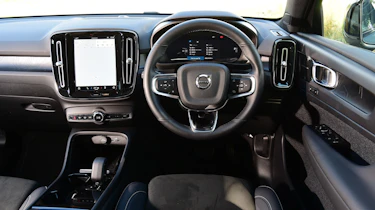
On infotainment duties is a nine-inch portrait-oriented touchscreen. It looks crisp and runs on Google’s Android operating system. This means mapping and navigation are provided via Google Maps, a real boon considering it’s slicker and easier to use than every OE set-up out there. Plus, Volvo has - at last - added Apple CarPlay connectivity, so both iPhone and Android phone users are now catered for.
It’s a shame that you have to use the screen to change climate control settings, though. Responsive though the screen might be, it’s still not as easy to use as a set of physical controls, generally requiring a longer look away from the road to change temperatures or fan speeds. This seems somewhat at odds with Volvo’s longstanding focus on safety.
The instrument cluster is fairly comprehensive in the information it displays, but as we’ve seen with other Volvo EVs and plug-in hybrids, a range figure is conspicuously absent. To display it, the Range Assistant must be selected on the bottom section of the main infotainment screen menu.
Sticking with that subject, the C40 has an official range of 273 miles according to the WLTP cycle, although on a full charge you can expect more like 230. During our test, the average efficiency figure hovered around three miles per kWh of electricity, which is decent enough, but far from spectacular.
The highly-specced ‘Pro’ trim we tested has already been discontinued. It’s broadly equivalent to the Ultimate trim on Volvo’s configurator, which at the time of writing was the only way to get a twin-motor C40. It’s yours for a considerable £61,950, nearly £15,000 more than the entry-level, single-motor C40 Recharge Core. On Volvo’s monthly subscription programme, it costs from £799 a month, for which you’re tied into a 36-month contract with an annual mileage limit of 6,000.
There aren’t any paid-for options, with the C40 Ultimate instead coming with a big standard kit list including front and rear heated seats, surround-view parking cameras, an exceptional Harman Kardon premium sound system, electric front seats and those problematic five-spoke, 20-inch diamond-cut wheels. Buyers are given a choice of eight colours plus two different colours of part faux-leather interior trims or a premium grey wool option.
| Model: | Volvo C40 Recharge Plus twin motor |
| Price: | £61,950/£799 a month |
| Engine/battery: | 2x e-motor, 78kWh (75kWh useable) |
| Power/torque: | 402bhp/660Nm |
| Transmission: | Single-speed automatic, all-wheel drive |
| 0-62mph: | 4.7 seconds |
| Top speed: | 112mph |
| Range: | 273 miles |
| Max charging: | 150kW DC (10-80% in 28 minutes) |
| On sale: | Now (in Ultimate trim) |