Best hatchbacks to buy 2026
We’ve selected the top 10 best hatchbacks so you don’t have to
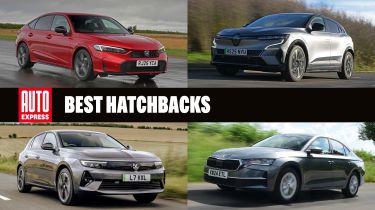
Once the go-to choice for families, the hatchback segment that has given us famous names like the Ford Focus and Volkswagen Golf has seen its popularity dwindle slightly with the rise in popularity of SUVs. However, the best hatchbacks are still some of the most tempting and popular models on today’s market.
Modern hatchbacks need to appeal to a wide range of buyers. From our own exclusive research, we know buyers prioritise reliability, value for money, running costs and comfort when searching for a hatchback.
With this in mind, our expert road testers drive and rate every new hatchback in the context of its rival models to build a full picture of how they compare. Each car is judged on practicality, efficiency, ease of driving and affordability, while also considering comfort, running costs and Euro NCAP safety ratings. You’ll find our recommendations on the best hatchbacks to buy right here.
Top 10 best hatchbacks in the UK
| Rank | Make and model | Price from | Buy |
| 1. | Skoda Octavia | £28,500 | Latest deals |
| 2. | Renault Megane | £31,300 | Latest deals |
| 3. | Kia K4 | £26,000 | Latest deals |
| 4. | Honda Civic | £32,800 | Latest deals |
| 5. | MG4 | £29,995 | Latest deals |
| 6. | Toyota Corolla | £30,800 | Latest deals |
| 7. | Audi A3 | £30,800 | Latest deals |
| 8. | Vauxhall Astra | £26,135 | Latest deals |
| 9. | Mazda 3 | £25,280 | Latest deals |
| 10. | Volkswagen Golf | £28,895 | Latest deals |
Keep reading to learn more about the very best hatchbacks you can buy right now. You can also click the individual links in our table above to go directly to a specific car..
1. Skoda Octavia
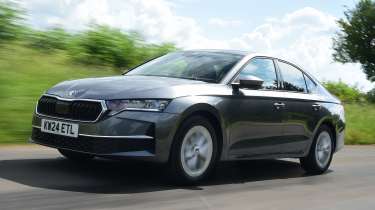
The Skoda Octavia offers an immense amount of space and value, no wonder it's been a serial winner at our New Car Awards.
- Prices from £28,500
Pros |
|
Cons |
|
It’s hard to define the true best car on sale, yet few offer so much for so little as the Skoda Octavia.
Our Auto Express Family Car of the Year for 2025, Skoda’s saloon-hatch hybrid embodies all the key qualities which the Czech firm stands for: value for money, quality and practicality, plus a great all-round ownership experience.
Since its debut in the mid-nineties, the Skoda Octavia has been one of the go-to choices for family car buyers who prioritise space and value. Over the years, it has moved upmarket in build quality, technology and price, but its core strengths remain.
With a starting price of around £28,000, nothing in the segment matches the Octavia’s sheer space. Rear passengers get more legroom than in any rival, while the 600-litre boot comfortably leads the class. Opt for the estate version and that expands to a cavernous 640 litres.
Despite being a long car at 4.7 meters, it’s easy to pilot around town with great all-round visibility. Erring on the side of comfort rather than sportiness – so long as you don’t choose the top-of-the-range vRS model – the Octavia feels refined on the move, with supple suspension, low wind noise and a range of quiet, perky engines.
It’s the Octavia’s interior which really puts the cat amongst the pigeons, however, both in the case of fit-and-finish, as well as available space. Arguably, the Octavia feels posher inside than the Volkswagen Golf with which it shares its underpinnings, with plenty of standard equipment making the cheaper Skoda look like a bargain in comparison. What we truly love, however, is all of the so-called ‘Simply Clever’ features dotted around the cabin, whether that be the hidden umbrella in the driver’s door, a parking ticket holder, or an ice scraper hidden away in the fuel filler cap.
"The Octavia is a big car for the class and most of that extra bodywork is hanging out the back, which means positioning the rear in a tight parking space requires a touch more care than in some rivals." - Alex Ingram, contributor.
- Who will like it: Those looking for a great all-round family car with plenty of luggage space.
- Who won’t like it: Some people might still have hang ups over the Skoda brand.
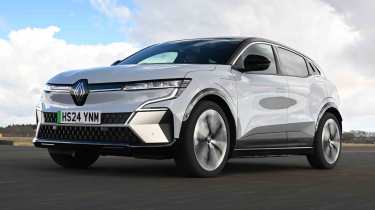
2. Renault Megane
The Renault Megane might now be a fully fledged EV, but this hatchback follows the same family-friendly ethos as generations gone by.
- Prices from £31,300
Pros |
|
Cons |
|
The Renault Megane has been around for almost three decades, and while it has adopted some SUV traits in its transition to electric power, it hasn’t strayed far from its hatchback roots.
The Renault Megane is only available with the option of a 60kWh battery, which can return up to 285 miles on a WLTP efficiency combined cycle. This should be plenty if you mainly drive in urban areas, with the occasional long distance trip. When you do need to stop and charge, you can top-up from 15-80 per cent in around 32 minutes when using a 150kw fast charger.
Step inside and you’ll be greeted with the Megane’s greatest advantages and drawbacks. Getting the bad stuff out of the way first, looking through a letterbox would probably give you more visibility than the Megane’s rear window, while the back seats are a tad tight. However we cannot understate how fantastic the Megane’s Google-based infotainment system is. The boot is generous at 440 litres and there’s a useful charging cable storage space under the floor.
“EVs haven’t really embraced towing, but the Megane E-Tech is able to haul up to 900kg.” - Alex Ingram, contributor.
- Who will like it: Family car buyers prioritising practicality, quality and value.
- Who won’t like it: Not everyone is ready to make the switch to an electric car.
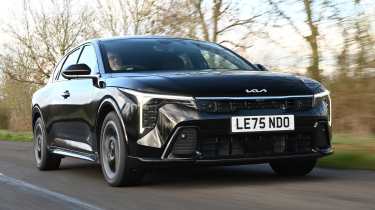
3. Kia K4
The new Kia K4 replaces the old Kia Ceed, but it still does everything a family hatchback should do.
- Prices from £26,000
Pros |
|
Cons |
|
The Kia Ceed is no more, but its replacement, the Kia K4, picks up where the old car left off. Offering spacious family transport and being a great antidote to the ubiquitous SUV.
Overall, the Kia K4 is a very competent family car. While it won’t excite you on a twisty road, the K4 just gets on with the job at hand. Unlike rivals, there’s no option of an electrified powertrain, but the two available petrol engines are reasonably efficient so shouldn’t break the bank when it comes to running costs.
Around town it is easy to drive thanks to good all-round visibility and light controls. The suspension is pretty good at absorbing bigger bumps and road noise at higher speeds is fairly hushed.
Step inside and you’ll notice how spacious the cabin is. Being slightly longer and wider than the old Ceed, the K4’s swooping silhouette doesn’t make the car feel cramped for taller passengers, and leg and head room is generous. The boot size is very respectable for the class at 438 litres, beating the likes of the Volkswagen Golf by 57 litres.
The interior fit and finish feels well put together, and as with any modern Kia, it is intuitively laid out with plenty of physical shortcut buttons which are easy to use while on the move.
“The Kia K4 is more expensive than the Ceed it replaces, but it’s a larger car than the Ceed, and you get a level of kit that’s largely in line with the Sportage for around £3,000-£4,000 less than Kia’s big-selling SUV.” - Dean Gibson, senior test editor.
- Who will like it: Buyers after a no-nonsense hatchback with SUV levels of space and kit.
- Who won’t like it: Rivals like the Volkswagen Golf have a wider selection of powertrains which might be more suitable for some.
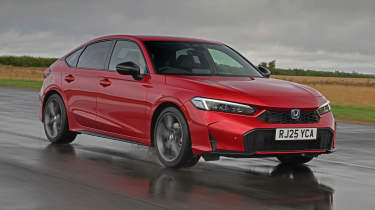
4. Honda Civic
The Honda Civic has always been a strong contender in the hatchback class, but recent tweaks make it better than ever.
- Prices from £32,800
Pros |
|
Cons |
|
The Honda Civic is a great choice if you’re looking for sporty driving manners but don’t want to compromise on efficiency. With aggressive styling that isn’t skin-deep, it’s perhaps one of the most enjoyable cars to drive in this class, with a great chassis, good grip and decent power from its 2.0-litre hybrid powertrain.
Despite having a not-insignificant 181bhp and reaching 0-62mph in less than eight seconds, Civic buyers can also expect fuel economy in excess of 50mpg, which we managed to achieve during our own real-world testing. This should help offset the car’s rather lofty starting price.
The Civic also has a stylish and spacious cabin that is perfect for everyday life, offering plenty of legroom for both adults and children. The 410-litre boot is also above average for the class, so there’s lots of space for luggage, too.
The Civic’s driver-focused and well-built cabin is another strong point. However, a recent update has made this even better with the arrival of a fully-digital cockpit for the mid-spec Sport model (previously exclusive to top-spec cars), and a cosier black roof lining.
“Fit and finish is hard to fault in the Civic. Any hard plastics that are present seem less obvious than in rivals from the Volkswagen Group, while the seats, steering wheel and switchgear all feel suitably well finished.” - Alex Ingram, contributor.
- Who will like it: If affordable running costs and keen-handling are near the top of your agenda then the Civic should be considered.
- Who won’t like it: The sloping roofline and tailgate eat into boot space, so if you regularly need to carry bulky items in the boot then rivals like the Skoda Octavia will be better equipped.
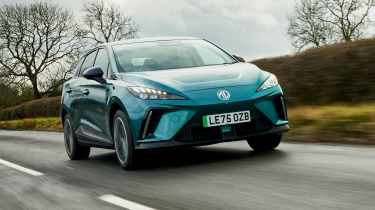
5. MG4
MG has been going from strength-to-strength since its UK return, and the popular MG4 is proof the brand is here to stick around.
- Prices from £29,995
Pros |
|
Cons |
|
The MG4’s punchy starting price made headlines when it first arrived, and this former Auto Express New Car Award winner is still great value for money.
Having just received a mid-life update, the MG4 now starts from around £30,000 which is around £3,000 more than the pre-facelift car. But when you take into consideration that the entry-level car comes with a large 64kWh battery for up to 280 miles of range, a generous amount of kit as standard, a seven-year warranty and improved interior quality, you really are getting quite a lot for your money.
The MG4 is well-suited to life in and around town. Its electric powertrain means it’s very quiet and composed, and the regenerative braking system isn’t intrusive when you let off the throttle. Forward and rear visibility is also good, and the light, direct steering makes navigating tight spaces easy. Up the speeds on twisty roads and the MG4 is an engaging car to drive.
The infotainment system has also been upgraded and is much easier and slicker to use than the software found in older MG4s. There are some handy shortcut keys running along the bottom of the touchscreen, as well as physical dials for the climate control which are a welcome addition.
Cabin materials feel suitably robust and of a much higher quality compared to older cars. The low roofline doesn’t eat into passenger headroom as much as you’d think, and the boot space is decent at 388 litres.
“The MG4 is an appealing choice for those in the market for a small electric car, especially now the interior is a much closer match to its key rivals like the VW ID.3. The price has managed to remain competitive and the range is decent" - Ellis Hyde, news reporter.
- Who will like it: Buyers looking to get a good-value small electric car with a very usable range.
- Who won’t like it: The MG4 Urban offers even greater value for money and more practicality.
6. Toyota Corolla
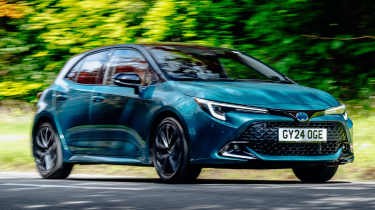
The Toyota Corolla is in its twelfth-generation now, which is a clear sign that Toyota knows how to build a great family car.
- Prices from £30,800
Pros |
|
Cons |
|
The latest Toyota Corolla received a mid-life facelift not too long ago and simply put, it’s better than ever.
You can get the Corolla with two engine configurations. A 2.0-litre hybrid which produces 174bhp or a 1.8-litre, 138bhp hybrid set-up. Both are great options in their own right, but it’s the entry-level 1.8-litre unit we’d pick as it provides a great balance between performance and economy. When we tested a 1.8-litre Corolla against a Honda Civic and Kia Ceed, we saw efficiency figures of over 54mpg.
While the Toyota Corolla is not as engaging to drive as a Volkswagen Golf or Ford Focus, it shines on long journeys, thanks to a refined ride and minimal road noise. Visibility is hampered slightly at the rear due the narrow rear window, but the reversing camera and parking sensors help when backing up into tight spaces.
The boot is only 361 litres, shrinking to 313 litres if you opt for the 2.0-litre engine as the 12V battery is located under the boot floor, so rivals like the Honda Civic, Volkswagen Golf or Vauxhall Astra would be better if you need a larger boot. If you need more space and are sold on the Corolla, it is also available as an estate car.
Inside, the Corolla doesn’t look as striking as it does outside, but everything feels suitably premium, and a mid-life update brought a new, easy-to-use infotainment system.
“The Corolla range lacks the plug-in hybrid technology offered in its rivals, but Toyota’s faithful ‘self-charging’ hybrid running gear continues to promise lower running costs compared to the traditional petrol hatchbacks” - Ellis Hyde, news reporter.
- Who will like it: Those looking for the ultimate peace of mind when it comes to reliability, as Toyota has a great 10-year/ 100,000-mile warranty.
- Who won’t like it: You can’t get the Corolla with a pure-electric or plug-in hybrid powertrain which might put some buyers off.
7. Audi A3
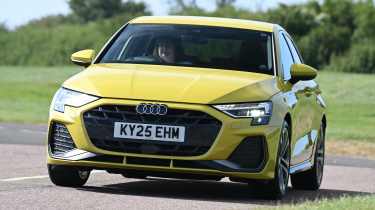
If you’re after a family hatchback with a premium touch, the Audi A3 is a difficult act to beat.
- Prices from £30,800
Pros |
|
Cons |
|
The Audi A3 is more than worthy of the four rings on its bonnet given its sophisticated driving manners, strong tech and high-quality interior, with all cars featuring Audi’s superb Virtual Cockpit digital instrument cluster which is partnered with a slick central infotainment touchscreen.
The latest A3 is a pretty common sight on the UK’s best-selling car list, so it’s clear that this blend of big car plushness and small car stature is striking a chord with buyers. Underneath the bonnet lies the choice between petrol, diesel or plug-in hybrid power, so there’s pretty much an A3 powertrain to suit every need. There’s even the hot 2.0-litre Audi S3 and 2.5-litre Audi RS 3 for those who want a hatch with a turn of speed.
We’re fans of the 1.5-litre petrol which blends performance and efficiency well and would be our pick-of-the-range for most buyers. During our long-term test of a 1.5-litre petrol Audi A3 over six months, we averaged 49.3mpg in a mix of town and motorway driving. Not bad considering this figure was only 1.3mpg short of Audi’s official WLTP figure.
If you opt for the plug-in hybrid, you will have to shave 100 litres off the A3’s 380-litre boot capacity. Fortunately, four adult passengers can get nice and comfortable in every A3 variant. If you need to tow, the diesel model can lug up to 1,600kg.
Wearing those four rings means the A3’s interior needs to truly stand out, and we’re pleased to report that it does. A mid-life facelift brought the overall quality up to an excellent standard, and there’s plenty of proper buttons to be found — unlike in the closely-related Volkswagen Golf.
“While the high-performance S3 and RS 3 deliver serious thrills, most drivers will find the lower-powered petrol, diesel, and hybrid A3 models more than competent for day-to-day driving.” - Alastair Crooks, senior news reporter.
- Who will like it: The Audi A3 is a great all-rounder with a touch of class. S3 and RS 3 versions will appeal to those who want extra performance.
- Who won’t like it: Some of the optional extras are really expensive and probably best avoided by those paying close attention to their budget.
8. Vauxhall Astra
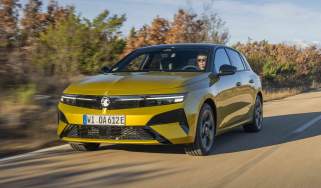
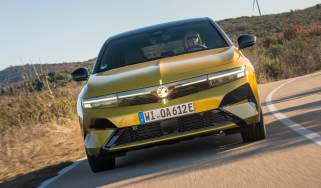
The Vauxhall Astra is one of the boldest family hatchbacks when it comes to the styling department, but it’s no one-trick-pony.

- Prices from £26,135
Pros |
|
Cons |
|
The Vauxhall Astra was never a particularly ugly thing, just a bit unexciting. This latest generation, however, changes all of that with a striking design courtesy of the brand’s signature ‘Vizor’ front end.
As with the related Peugeot 308, buyers of the Astra can choose from petrol, plug-in hybrid and fully electric powertrains. The former is the cheapest by far, and the base 1.2-litre turbo petrol engine’s 128bhp is more than plenty for nipping around town and doesn’t feel out of its depth on the motorway.
All versions of the Astra should prove to be fairly economical, too. When we had a 1.2-litre Astra on our long-term test fleet for six months and averaged 49.3mpg over 5,200 miles. Plug-in hybrid Astras officially return up to 122mpg, while the Astra Electric can go up to 260 miles WLTP.
The Astra also undercuts the Peugeot on price. Don’t expect to be short changed, either as the Astra comes with plenty of standard equipment. The sharp design continues inside, where the traditional dials have been replaced by a modern cockpit with two 10-inch digital displays.
When it comes to storage, the Astra is very generous with plenty of cubbies dotted around the cabin and the boot is big at 422 litre boot, easily outclassing the Volkswagen Golf which only has 375 litres. Things aren’t so great when it comes to rear passenger space, which can feel a touch cramped if you’re on the taller side.
“Stylish looks, impressive technology, and a wide variety of engines make the Vauxhall Astra a convincingly good family hatchback” - Ellis Hyde, news reporter.
- Who will like it: Car buyers who really want a sharp-looking and spacious car without having to step up into an SUV.
- Who won’t like it: The rear seats can feel cramped, so taller rear passengers might struggle over longer distances.
9. Mazda 3
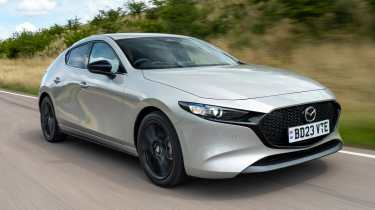
The Mazda 3 is something of a left-field choice, but it looks fantastic, drives brilliantly and feels incredibly well put together.
- Prices from £25,280
Pros |
|
Cons |
|
Stylish and dynamic in equal measure, the Mazda 3 is a great left-field choice; in true Mazda fashion, it blends a rewarding drive with unique design and impressive build quality.
Power comes from a choice of 2.0-litre petrol engines with either 120bhp or 184bhp, depending on trim. Both are responsive, while also returning decent fuel efficiency of more than 50mpg which is a good thing because there’s no option of a full hybrid, plug-in hybrid or electric powertrain. The 3 is also fun to drive, while the suspension does a pretty good job of soaking up the bumps and we love how direct and engaging the steering is.
Inside, the upmarket interior is among the best in the class, with a sleek design and solid materials. Apple CarPlay and Android Auto connectivity are standard, and the intuitive infotainment system is operated via a rotary dial, similar to BMW’s iDrive set-up which we found really straightforward to use while on the move. The sloping roofline does eat into rear headspace a little, and the boot isn’t the largest in class at only 351 litres.
“Build quality is great and the materials used are top-notch, especially on higher-spec models – there’s very little to complain about inside the 3’s cabin.” - Max Adams, online reviews editor.
- Who will like it: If keen handling is near the top of your agenda, the Mazda 3 should be on your shortlist.
- Who won’t like it: There are no diesel or hybrid options available, which might be limiting for some.
10. Volkswagen Golf
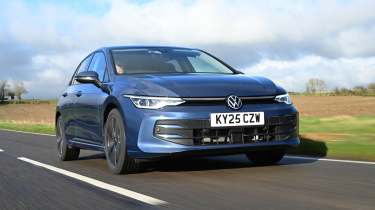
The Volkswagen Golf is a stalwart of the hatchback class, offering plenty of space, a comfortable drive. It should cope well with day-to-day life.
- Prices from £28,895
Pros |
|
Cons |
|
The Volkswagen Golf has been around for over 50 years, so Volkswagen must be doing something right with its stalwart family car to achieve staying power that other manufacturers can only dream of.
The main reason to buy the Golf is that it is quite good at everything it does. While it might not be the most exciting to drive, it is very predictable and reassuring, giving you a sense of security on the road. Suspension is supple enough and copes well with the UK’s rough stretches of Tarmac.
Running costs shouldn’t break the bank either as all engines are pretty frugal, with the petrols getting above 53mpg and the diesels achieving almost 65mpg on the WLTP combined efficiency test. The only exceptions include the hot VW Golf GTI or Golf R, which both return in the mid 30s. Insurance costs for the standard car shouldn’t be outrageous either.
Recent updates really have improved the Golf. Gone are the annoying haptic control panels and the majority of technical gremlins which hampered earlier cars have been ironed out. The materials used around the cabin feel suitably sturdy. There’s enough room for four adults, and the boot is a practical size at 381 litres. Just be aware that you can’t get the Golf as an estate anymore so you might have to look elsewhere in the class if you need more boot space.
“There are some well thought out storage areas, from the large glovebox to a dedicated smartphone slot complete with wireless charging. The latter is angled forward so your device can’t fall out of place while driving.” - Max Adams, online reviews editor.
- Who will like it: Buyers who want a jack-of-all-trades compact car.
- Who won’t like it: The Golf isn’t the most exciting car to look at, so those who want eye-catching styling might want to consider rivals like the Vauxhall Astra or Toyota Corolla.
How we choose the best hatchbacks
We don’t just take a manufacturer’s word for it when deciding what makes a great hatchback. We listen to the people who really matter. UK motorists!
Our exclusive survey of over 400 readers confirmed that buyers in the hatchback market are a demanding bunch, looking for a wider range of different capabilities than buyers in any other market sector.
- 63.5% named reliability as a priority
- 54.1% identified value for money
- 51.4% chose running costs
- 48.6% prioritised comfort
- 41% prioritised ride and handling
- Technology was the lowest priority, but 20.3% still identified it as a priority
Our expert road testers also put each car through its paces in the real world, focusing on what we know actually matters to buyers. A hatchback might look good on paper, but if it doesn’t hold up in everyday driving, it won’t make the cut.
Our dealer network has 1,000s of great value new cars in stock and available now right across the UK. Find your new car…
Frequently Asked Questions
A hatchback is a car with a rear door that opens into a luggage area connected to the cabin.
The door typically includes the back window of the car, and hinges upwards to allow for large items to be put into the luggage area. Hatchbacks differ from traditional saloons, which have a smaller, unglazed boot lid and a luggage area blocked off from the passenger space by a bulkhead or the rear seats.
Best hatchback deals