BMW 5 Series vs Mercedes E-Class: 2009 group test
Do style, image and kit suffer when you go for a ‘cheap’ prestige saloon? We drive new base models from Mercedes and BMW to find out

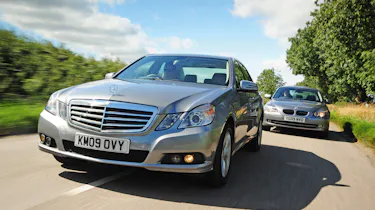
Look back through automotive history, and you’ll be hard pushed to find a rivalry fiercer than the one between Mercedes and BMW. Their E-Class and 5-Series models are just the latest in a long line of saloons that have fought tooth and nail for the executive car crown.
In the past, they have gone about their business in very different ways. If driver involvement was your priority, then the 5-Series was the obvious choice, but if you valued space and comfort, the E-Class was the one to go for.
Today, the boundaries between the two are more blurred than ever, as both ranges provide everything from comfort-spec cruisers to powerful super-saloons.
The Mercedes E220 CDI Sport was beaten in its debut test by the Jaguar XF, but in lesser SE trim it doesn’t compete with our class leader. Instead, it goes head-to-head with its BMW rival.
Does the E220 CDI SE have the space, comfort, refinement, badge appeal and economy that we’ve come to expect from the three-pointed star? Or will it be overtaken by the 520d SE in this clash of the entry executives?
Verdict
Image-conscious executive car buyers are obsessed by brand, but which of our pair is the better prestige saloon?
Used - available now

2013 BMW
5 Series
84,399 milesAutomaticDiesel2.0L
Cash £5,950
2023 BMW
5 Series
46,799 milesAutomaticDiesel3.0L
Cash £29,950
2020 BMW
5 Series
26,035 milesAutomaticDiesel3.0L
Cash £19,346
2020 BMW
5 Series
61,122 milesAutomaticPetrol3.0L
Cash £23,785It’s clear that Mercedes benchmarked its newcomer against the 5-Series, because the two are incredibly well matched.
Neither is aimed at motorists who want a performance car, though, so does that cost the sharper-handling 5-Series?
The BMW certainly provides more feedback, and offers a smooth and punchy diesel engine – but its talents run deeper than its polished dynamics.
The Mercedes has a light, spacious and airy cabin, with good ride comfort and gutsy performance. However, the easy-to-drive E220 CDI narrowly misses out here.
With so little to split this duo on paper, it comes down to the way they look, drive and feel. As a result, the more polished 520d SE gets our vote... but only just.
First place: BMW 520d SE
When it arrived in 2004, the BMW 5-Series was a revelation. It showcased the firm’s controversial new design approach and iDrive control system, and it couldn’t have been a more radical departure from the executive norm.
Its once shocking bodywork has mellowed with time, but it still looks fresh. Parked next to the E-Class, the BMW is sharp and well proportioned, even with the relatively small 17-inch alloys that come as standard.
It’s finished off with deep bumpers, side skirts and an oval tailpipe, so there’s no doubt about the car’s sporting intentions.
Dark materials mean the interior is a gloomier place in which to spend time than the Mercedes, but the 5 feels more special than its competitor.
With a driver focused dashboard, supportive and easily-adjusted seats and smaller steering wheel, finding the perfect driving position is simple. The seats provide more lateral support than those in the Mercedes, yet they’re still adequate on long journeys.
And while the more sombre cabin doesn’t feel as spacious as that of the E-Class, the 5-Series can still transport four passengers in comfort. Get familiar with the revised iDrive system, and you’ll be just as happy navigating your way around the various menus.
On the move, the BMW’s 175bhp diesel engine is refined and smooth, although it is a little noisier than the Mercedes unit. Peak torque of 350Nm is 50Nm down on its rival and it arrives 300rpm later, so you need to work the 520d a bit harder. However, the slick six-speed manual box makes this a simple task, and the engine is smooth across the rev range.
Despite being the entry-level model in the 5-Series line-up, the 520d delivers lively performance, so it doesn’t seem like a poor relation.
The more punchy Mercedes feels faster, but it was hampered by its slower-shifting five-speed auto in our tests. Where the BMW really delivers is on fast and smooth roads, as it’s more engaging and rewarding to drive.
However, on rough surfaces the firmer suspension and less forgiving run-flat tyres are more apparent. Occupants aren’t cushioned as effectively as they are in the Merc.
The difference is small, but the cars reflect the strengths of their respective brands. The E-Class has a more cosseting ride, but feels lifeless, while the BMW will appeal more to enthusiasts thanks to its greater composure and the extra feedback you get through its major controls.
In the crucial battle for company car honours, the two rivals are closely matched. For private buyers, the BMW has slightly lower resale value forecasts, although the impressive five-year pre-paid servicing package all but cancels out the E-Class’s stronger residual predictions.
In terms of finances, then, the BMW is a sensible bet – especially if you want an auto, as its emissions of 149g/km trump the Mercedes. So, does that mean the 5-Series wins this test?
Second place: Mercedes E220 CDI SE
For some drivers, there’s no beating the appeal of the three-pointed star badge. And while recent versions of the Mercedes E-Class haven’t always shone as brightly as in the past, the firm is aiming to address that with its latest model.
On the outside, you can see where the designers took their inspiration from. The newcomer looks like a larger C-Class rather than a shrunken S-Class, although it’s not as neatly proportioned as its smaller stablemate. Despite being much older, the BMW provides more visual interest and appears the younger of the two.
For existing E-Class owners, the newcomer is a logical progression, though, and its upright styling does have its benefits. Climb aboard and the cabin provides plenty of space and good visibility.
The angular dash and uninspiring switchgear echo the exterior lines, but everything is logically laid out, and SE trim comes with artificial leather upholstery. Although the light grey trim of our test car won’t suit everyone, it does make the cabin bright and airy.
While the BMW’s interior is minimalist and sleek, the Mercedes is clearly aimed at a more mature audience. Unusually for such a large car, the base of the windscreen is very close, which makes forward visibility excellent, but taller drivers will find the rear view mirror unusually close by.
Start the four-cylinder diesel, and it doesn’t sound especially refined. But our noise meter readings revealed that it was quieter at idle than the BMW inside and out, at 42dB and 61dB respectively.
On the move, both engines recorded identical figures at 30mph (57dB) and 70mph (67dB) – but it’s the E-Class’s pace that impresses.
Helped by a smooth-shifting auto, our test model proved to be a capable cruiser. Accelerate hard and the transmission’s slow upchanges are apparent, yet the Merc still sprinted from 0-60mph in 8.4 seconds – only one-tenth behind the manual BMW.
While the E220 CDI isn’t as sporty to drive as the 5-Series, its more compliant set-up is smoother and more comfortable.
However, the controls are over-light, and the steering kicks back on rough surfaces. Plus, where the BMW requires a single input to negotiate long bends, the E-Class needs constant adjustment to maintain its line.
So the Merc is more comfortable, but it’s not as rewarding to drive. And that’s the main difference between these two – as they’re closely matched on price.
The E-Class is marginally cheaper and retains more of its value, yet there’s virtually nothing between them for company buyers. If you want space, refinement and comfort with a prestige badge, the E220 CDI SE is perfect – but it plays safe by sticking to Merc’s traditional strengths.