New Nissan X-Trail 2026 review: a big step in the right direction
The reworked Nissan X-Trail hybrid is getting a fresh e-Power drivetrain and slicker styling – and is already available in the US

Verdict
Based on this drive, the next-generation Nissan X-Trail should be far more competitive and appealing than the current car. It will feature a uniquely impressive hybrid powertrain that does a shockingly good EV impersonation, along with an attractive, well made cabin with vibrant, user-friendly tech. It still won’t be particularly memorable to drive, but it’s unlikely to frustrate, and is just as practical as the current model. That said, we still don’t know if there will be a seven-seat option in the UK.
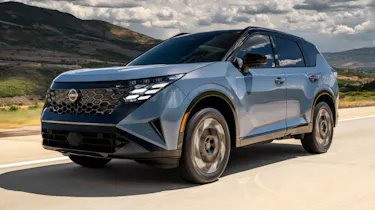
Nissan may have only just updated the X-Trail for 2026, but this all-new model will be following hot on its heels, likely in 2028. Although sharing its platform with today’s model, the new X-Trail will feature fresh styling, updated technology and Nissan’s third-generation e-Power hybrid powertrain. It’s a much better SUV – as we can confirm having driven the car in the US, ahead of its market launch there.
The previous iteration of Nissan’s unique e-Power hybrid system has been part of the X-Trail’s UK line-up since 2022, but it never made it to the American version (known as the Nissan Rogue, hence the badging on this car). With most of its competitors now offered as hybrids, Nissan USA coaxed the powers-that-be to move production of the next-generation Rogue forward by several months, with the hybrid arriving first.
Used - available now

2017 Nissan
X-Trail
115,537 milesAutomaticDiesel2.0L
Cash £8,499
2024 Nissan
X-Trail
60,912 milesAutomaticPetrol1.5L
Cash £17,299
2024 Nissan
X-Trail
25,820 milesAutomaticPetrol1.5L
Cash £20,197
2024 Nissan
X-Trail
26,245 milesAutomaticPetrol1.5L
Cash £19,699This latest e-Power system, which made its debut in the Qashqai, uses the same hybrid set-up as before; the wheels are powered by the electric motors, while the engine acts solely as a generator to power those motors and replenish the battery.
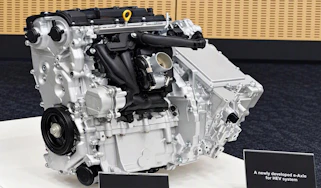
The biggest change is the petrol engine. It’s still based on Nissan’s 1.5-litre turbocharged three-cylinder, but this new version was specifically engineered for this application – it has a low red line, is optimised for thermal efficiency and promises to be both quieter and more economical. It’s most definitely quiet. There was just a distant hum under typical acceleration and it didn’t even get particularly loud when we floored the throttle. Never mind its predecessor, the new X-Trail is quieter than most other hybrids we’ve tried.
The power delivery is unique, too. The X-Trail feels like an electric car – it’s similarly smooth, torque-rich and uninterrupted by gearbox shifts, thanks to the standard-fit CVT. It also felt much quicker when accelerating onto a motorway than, for example, a Toyota RAV4. Indeed, Nissan’s estimated 0-60mph time of 6.4 seconds is impressive.
On the point of feeling like an EV, the e-Power set-up provides drivers with the option of one-pedal driving, something very few competitors do. Simply press the e-Pedal button and the car will smartly slow the car and bring it to a stop.
Efficiency also promises to be improved. Despite making little attempt to drive economically, the Rogue Hybrid we drove averaged 41mpg (almost 50mpg in UK gallons) in about 80 miles of rural two-lane roads and some traffic. The 2026 X-Trail N-Trek and its second-generation e-Power system managed 35mpg in our testing.
The rest of the car is also quiet and refined, and the steering weight is consistent. The body is well controlled, but that also comes with a ride that can be surprisingly firm over sharper bumps. There are six drive modes, including a new mix-and-match Personal option, but aside from making the throttle response a little punchier, there’s not much point in sampling Sport mode.
The American Rogue Hybrid will come exclusively with the dual-motor e-Power system that provides standard all-wheel drive and an output of 225bhp. By contrast, the UK’s current X-Trail comes with a single-motor, front-drive e-Power variant as standard that produces 201bhp. The US will also get a dual-motor option with 210bhp. European specifications will be confirmed at a later date.
The Rogue can seat up to seven, depending on how many motors are fitted; there are three rows with front-wheel drive and two rows with all-wheel drive. However, the engineers couldn’t say for certain if that would be the case on UK cars, so consider the X-Trail a two-row SUV for now.
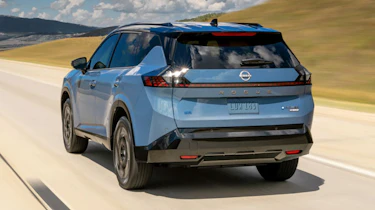
Regardless of seat count, the exterior dimensions are very similar to before. The styling has been made more memorable, though, with sharper body creases and more prominent LED lighting. It bears a passing resemblance to the Peugeot 5008 and Hyundai Tucson up front.
The interior is certainly not as avant-garde as the 5008’s, but it makes the RAV4’s look and feel like a grim den of grey plastic. Perceived quality in the Nissan is excellent – even a mid-grade trim level is slathered in padded and stitched fake leather in a distinctive dark teal. There’s high-quality switchgear too, including physical buttons and toggles for the climate control system, and a nicely textured grey plastic trim in place of scratch-prone piano black.
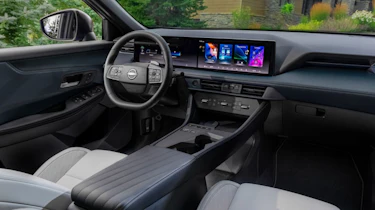
The infotainment system is all-new. The conjoined screens – either 12.3 inches each, or the 14.3-inch duo shown here – feature really vibrant graphics. The menu layout is also simple and benefits from shortcut buttons along the bottom and in the upper-left corner of the touchscreen. Pulling up driver assistance and sound-system settings is rarely easier than this.
The instrument panel isn’t as well resolved, though. Operated via perfectly logical steering-wheel controls, it nevertheless suffers from an overabundance of layout choices that frequently bombard you with less vital information. Most banish the speedometer off to the right or bury it in plain sight amid information overload.
Wireless Apple CarPlay and Android Auto are standard fit, along with wireless chargers that feature magnets to keep your phone in place and prevent overheating. The larger screens also add Google Built-in functions that include integrated Google Maps for the sat-nav and the latest Gemini AI voice assistant.
The driver-assistance features have also been given an upgrade. A new camera, radar sensor and software suite do a better job than the systems in the current X-Trail; the lane-keeping assist was impressively subtle in its corrections during our test drive and was less likely to intervene when it shouldn’t. The driver-inattention warning system also wasn’t as irksome as in the 2026 car.
The ProPilot Assist adaptive cruise control system now features automated lane changes and can operate hands-free at speeds below 31mph. Hands on, it also worked impressively at higher speeds, including the accompanying lane-centring steering assist.
Like the exterior dimensions, interior space is basically unchanged. Six-footers can still sit behind tall adults, and the boot remains usefully large for a two-row SUV, but small when compared with three-row rivals. There’s one nonsensical change, however: the back seat now features fixed headrests, which force the rear anchor straps of child seats to be arched over and pushed down upon the headrest lump.
That’s the rare head scratcher in what is otherwise a smart overhaul. The e-Power set-up could easily be the best hybrid system in the segment, and the new interior is a stand-out. Of course, it’s possible that the 2028 X-Trail will be different to its American twin in more ways than just its name. We’ll know for sure in a year or so.
Did you know you can sell your car through Auto Express? We’ll help you get a great price and find a great deal on a new car, too.
| Model: | Nissan X-Trail |
| Price: | TBC |
| Engine: | 1.5-litre 3cyl petrol hybrid |
| Power/torque: | 225bhp/450Nm |
| Transmission: | Single-speed automatic, four-wheel drive |
| 0-60mph: | 6.4 seconds (est) |
| Top speed: | TBC |
| Economy/CO2: | TBC |
| Size (L/W/H): | 4,650/1,850/1,720mm |
| On sale: | 2028 (est) |