New BMW XM Label 2026 review: heavy, loud, expensive and ridiculous
The plug-in hybrid BMW XM is compromised, fast and slightly ridiculous; for the show-boaters only


Verdict
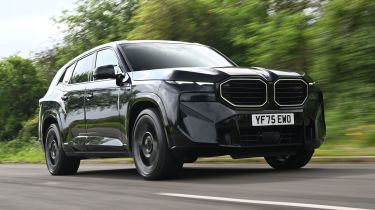
The BMW XM is an easy car to hate in many respects. It’s loud, brash, and somewhat obvious in its ploy to separate wealthy people from their money. Yet even in the context of its £150,000-plus SUV world, the XM still creates quite a statement. Looking at it purely as a car, though, this SUV has lots of space inside, extraordinary performance and the added benefits of a plug-in hybrid powertrain, but there’s a lack of cohesion here that seriously bites.
I can’t think of another BMW which has elicited such a collective gasp from onlookers as the XM, and that’s saying something from a brand that’s had its fair share of controversial models. Yet in its quest to charge more money for ever more high-end models, BMW has designed this gargantuan SUV to exist alongside the elite of the SUV market; one targeting customers who would otherwise be shopping for an Aston Martin DBX, a Lamborghini Urus or Mercedes G-Class.
This context puts a different spin on things compared to more rational car types, and it’s something that – despite a slow start in terms of sales – is now starting to click with the ultra wealthy, judging by the sales figures.
Used - available now


As of 2026, the BMW XM has now been honed and diversified since its controversial release in 2023. The formerly single variant has grown into a two-tier range structure, with a 50e opening the range joined by the fully loaded ‘Label’ sitting at the top. While the two look relatively similar they differ in relation to their powertrains, although both feature a core plug-in hybrid system.
Entry-level 50e utilises the same plug-in powertrain as the run-of-the-mill X5. This combines a turbocharged 3.0-litre straight-six petrol engine with a 192bhp electric motor and 25.7kWh battery pack. Peak combined power is 469bhp, yet is capable of a reasonable 64.2mpg, 52-mile electric range and CO2 emissions of around 100g/km. Performance is also pretty good; 5.1 seconds is the 0-62mph benchmark and it’ll top out at 155mph.
The Label, formerly known as the Label Red, is quite a different beast on account of its larger twin-turbocharged V8 petrol engine that works in combination with its PHEV system. This is a set-up we’ve since become accustomed to in the latest M5, but here it actually produces more power. The peak combined figure is a somewhat alarming 727bhp – 10bhp up on the M5. Torque is an even 1,000Nm and it’ll crack 180mph.
Performance is on another scale to the 50e, as it’ll blast to 60mph in 3.8 seconds, but its on-paper economy is in the same ballpark at 55mpg. It’ll also hit a similar 50-ish miles on a charge, but the CO2 figure has bumped up to 115g/km.
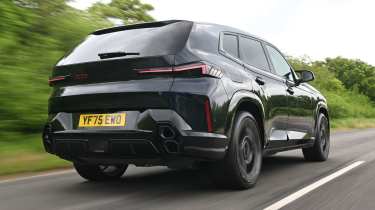
We found that in the real world, using the plug-in hybrid system at lower speeds or in built-up areas its electrical efficiency isn’t that bad, so it’ll quite happily run without turning over its petrol engine for anywhere between 25-35 miles. Dip into the petrol engine, though, and it’ll rapidly diminish the economy to more like 20mpg – or less.
There are some usability quirks of the BMW plug-in hybrid system, too, because it has something of an absolutist nature in the way it uses its electrical energy. In the default e-mode, it’ll happily run down the battery charge regardless of the conditions, and if you want to hold the battery charge, a rather ambiguous ‘eControl’ setting will do it with an almost total reliance on the petrol engine.
The middle ‘Hybrid’ setting is also somewhat crude in its operation, since it tends to use pretty much all of its battery charge with abandon. Other PHEVs use their available battery capacity more deftly in this middle mode, with a better sense of where the petrol engine can be kept switched off and where it has to be used. Setting the embedded navigation system can help to improve this, but there are plenty of plug-in hybrids that do the job better.
However, this is a £155,000 V8-powered SUV, and my guess is that hyper efficiency isn’t really a top priority of its buyers, and in the case of the Label it’s the extra performance capable from the system that’s probably the bigger sell – and on this it delivers. Even its on-paper figures don’t really prepare you for the sheer performance capable from such a massive machine.
And it – just about – seems capable of controlling it. Thanks to some heavy-duty chassis technology including rear-wheel steering and 48V active anti-roll bars, the XM drives like a car half its size and two-thirds its weight. There’s not much in the way of subtlety here, but it’s remarkable how much speed the XM can carry around corners. There’s even a half-decent amount of feel.
Compared to early XMs, many of the quirks have largely been ironed out. Its brakes, for example, are more finely tuned and have a good amount of pedal feel. There’s more consistency and less judder, although we’d suggest sustained braking inputs could cause the relatively small iron discs to overheat on a winding road.
The XM’s steering is also better than before, with a fast ratio and accurate on-centre feel.
There is a significant chink in the XM’s armour, but is one that can partially be corrected. We’d suggest avoiding the 23-inch wheel options at all costs, because they really spoil the car’s ride quality.

While never anything other than firm, XMs on the smaller 22-inch wheels still have a level of compliance over bumps and potholes that helps inspire some level of confidence that one of the wheels won’t break every time you hit a pothole. The 23s – and their 30-section profile tyres – crash far more violently, and feel as if they’re taking the full force of the car’s 2.6-tonne kerbweight. It’s not just uncomfortable, but also promotes rattles and creaks inside the cabin.
There’s also a colossal amount of suspension and road noise that’s drummed up regardless of wheels, so general refinement is actually pretty poor. It’s quite surprising, especially when compared to the Rolls-Royce like refinement and calm of the iX – BMW’s all-electric SUV.
The cheaper and less capable 50e might help bring the price point down, but it does remove one of the key high-points of the XM. Without the incredible performance, this variant feels like a brittle and unrefined SUV without any tangible benefits over the equivalent X5.
The XM’s interior has its ups and downs of its own, too. This isn’t the most contemporary of BMW models and the tech inside the cabin shows it. While we have no qualms against the iDrive system in general, newer systems in the new iX3, and 7 Series are a considerable step forward in terms of usability and functionality. Material quality is good, though, and there are plenty of styling flourishes that help lift this cabin over the equivalent X5.
Its tessellated roof pattern won’t be to everyone’s taste, though, and many might prefer a glass option to help lift the relatively dark second row. That second row is incredibly spacious, though, and by adopting the extra-long wheelbase of its X7, BMW’s been able to place the second row further back in the cabin. In fact, the second row has more than a hint of Rolls-Royce about the way its seatbacks integrate into the bodyside.
The boot capacity is generous, at 527 litres or 1,820 litres if you fold down the 40:20:40-split rear seat. There’s no load lip to bother you, but it’s worth pointing out that the opening itself is a fair way up from ground level if you’re planning to heave heavy items into place. There’s no underfloor storage either, so a chunk of the load bay will potentially be taken up by the charging cable, stored though it is in a fancy holdall designed to look like posh luggage.
We can’t help thinking that the XM is a car that’s full of too many glaring contradictions, though. Too big and heavy to be a great sports SUV, yet too noisy and uncomfortable to be a good luxury one. If making a statement is your intention, the XM certainly makes one, but as an ultra-luxury high performance SUV, there are others that do it better.
Did you know you can sell your car through Auto Express? We’ll help you get a great price and find a great deal on a new car, too.
| Model: | BMW XM Label |
| Base price: | £153,356 |
| Powertrain: | 4.4-litre V8, twin-turbocharged, 1x e-motor, 25.7kWh battery PHEV |
| Transmission: | Eight-speed automatic, all-wheel drive |
| Power/torque: | 727bhp/1,000Nm |
| 0-62mph: | 3.8 seconds |
| Top speed: | 180mph |
| MPG/C02: | 55mpg/115g/km |
| Size (L/W/H): | 5,110mm/2,005mm/1,755mm |
| On sale: | Now |