Ford Ranger vs BYD Shark: USA and China hold a feisty pick-up summit
BYD’s new plug-in hybrid Shark is aiming to take a bite out of the UK pick-up market. Will the Chinese truck sink or swim against the best-selling Ford Ranger?


Got stuff to haul? You’re probably in the market for a pick-up, and if that’s the case, then the Ford Ranger has probably come up on your radar at some point, because it’s the best-selling model in the class. With a wide range and competitive pricing, the Ford does everything buyers ask of it – but does that mean it’s the best choice?
Chinese giant BYD has another option, with the new Shark, and it looks set to give the Ranger a hard time. While customers in this class are fiercely loyal, they’re also smart enough to know when there’s a better alternative out there, and the Shark arrives with performance, economy and features that its rivals might struggle to match.
It all centres around the Shark’s plug-in hybrid powertrain, which punches well above its weight in terms of power and torque, and has a huge battery slung underneath for more than 50 miles of electric running.
To face up to the Shark, we’ve brought in Ford’s similarly fresh Ranger PHEV, to see whether the UK’s best-seller is just as strong even when it’s not powered by a diesel engine. Which pick-up truck is worth your money?
Did you know you can sell your car through Auto Express? We’ll help you get a great price and find a great deal on a new car, too.
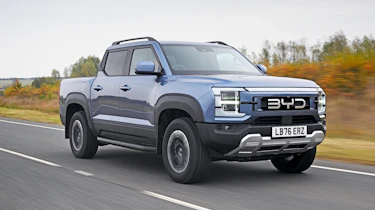
BYD Shark
| Model: | BYD Shark 1.5T DMO Design |
| Price: | £47,295 |
| Powertrain: | 1.5-litre 4cyl PHEV, 430bhp |
| 0-62mph: | 5.7 seconds |
| Test efficiency: | 80.7mpg |
| Official range: | 401 miles |
| Annual VED: | £360 |
New BYD models seem to be appearing every other month as the brand expands its portfolio, and the Shark shows it hasn’t forgotten niche markets. There’s a ladder chassis underneath the BYD, albeit with double-wishbone suspension at the rear rather than the more traditional leaf springs.
Used - available now

2023 Peugeot
5008
29,268 milesAutomaticDiesel1.5L
Cash £17,197
2020 BMW
1 Series
49,104 milesAutomaticPetrol1.5L
Cash £15,697
2023 Nissan
Juke
31,467 milesAutomaticPetrol1.0L
Cash £12,458
2022 Volvo
XC40
45,000 milesAutomaticPetrol1.5L
Cash £18,741It also arrives with much more power at its disposal than its Ranger rival and, perhaps more relevant for everyday use, more than double the electric range of the Ford in this plug-in hybrid contest.
Tester’s notes
We’re still not sure about having quite so many controls bundled into a big touchscreen, but the Shark’s display didn’t prove too difficult to get on with.
It’s worth having your BYD dealer go through some of the shortcuts and functions, because you might not figure them out yourself – such as swiping vertically or horizontally with three fingers to quickly change the temperature and fan speed, or swiping down from the top to bring up a quick menu to let you turn off some ADAS features. Some larger shortcuts for the lights and air-conditioning would be nice though.
Testing the Shark alongside the Ford Ranger, what stood out was how much more like an SUV BYD’s newcomer feels than a rugged pick-up truck.
The Ford drives very well but it ultimately feels more like a commercial vehicle, whereas the eager electric drive and tech-forward cabin design of the BYD make it seem a little more sophisticated.
Families would ultimately be better off with a regular SUV with an enclosed boot and a smaller footprint, but for those needing dual-purpose use, the Shark would be easy to get along with.
Ford Ranger
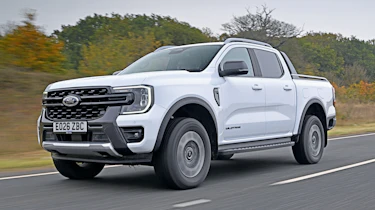
| Model: | Ford Ranger 2.3 EcoBoost PHEV Wildtrak |
| Price: | £55,424 |
| Powertrain: | 2.3-litre 4cyl PHEV, 277bhp |
| 0-62mph: | 9.2 seconds |
| Test efficiency: | 91.1mpg |
| Official range: | 508 miles |
| Annual VED: | £360 |
The Ford Ranger has long been one of our favourite pick-ups and is the best-seller in this market, too. Brand loyalty means a lot to buyers in this segment and BYD will have to overcome that with the popular Ranger. But in this plug-in hybrid form, Ford is also serious about meeting changing demands.
An all-electric range of 26 miles might hamper it slightly, but the Ranger remains competitively priced, well specified and good to drive, so the BYD certainly won’t have things easy against the market leader.
Tester’s notes
Spend any time with a Ranger and you can see why it’s become the UK’s best-selling pick-up. After several generations it has the well honed feel you also get from a Transit or one of Ford’s passenger cars – something that only really comes about when a manufacturer really understands what its buyers want from a vehicle.
For example, the retention of physical air-conditioning controls, the small load bay side steps, and the Ranger’s well damped ride quality are all simple things, but also not characteristics that many brands get right. Ford does get them right though.
It’s not something that you’d notice in isolation, but compared with the 400-plus horsepower Shark, the Ranger’s PHEV powertrain is one element that feels like it needs a little more work. Performance, responsiveness, regenerative braking and refinement all lag behind the Chinese car.
But on the flip side, the Ford is clearly fit for purpose: the Ranger PHEV will haul and tow just as much as a V6 diesel Ranger, whereas the BYD is notably deficient in those two areas next to its rivals. And to be fair to the Ford, next to the average diesel pick-up, the Ranger’s hybrid drivetrain could be from a luxury vehicle.
Head-to-head

On the road
The BYD feels more car-like, partly thanks to acceleration that the Ford can’t live with, and partly the refinement that comes with a drivetrain that primarily relies on electric power.
It also steers smoothly and rides well, albeit with occasional shudder over rough surfaces. The Ford can’t keep pace in a straight line and its engine kicks in more readily, but it has a more sophisticated feel to its precise steering and damping.
Tech highlights
Car-like also describes the Shark’s in-car tech, or at least, it’s much like other BYDs, with a 15.6-inch touchscreen handling most controls. There are some neat shortcuts and it responds well, but we’d rather the headlight controls weren’t in there.
The Ford is more conventional with more physical switches, which will suit some people better. It’s less feature-packed, but more intuitive to use.
Price and running
There’s just a few grand between the Shark and Ranger on paper, although with options the Ford is much more expensive; what you see is what you get with the Shark.
You can expect to spend less on petrol in the BYD if you use its much greater EV range. Real-world economy as a pure hybrid is similar (around 30mpg) and outright range is comparable, because the smaller-battery Ford has a larger fuel tank.
Practicality
The BYD just has the edge for interior space and its cabin feels more airy, but the Ranger fights back when doing traditional pick-up jobs.
Its 1,067kg payload beats the Shark’s 790kg, and, at 3,500kg, it can currently tow a tonne more than the BYD, although the Chinese firm’s engineers are likely to find a quick solution to that. We like the Ford’s side steps for the bed, although the BYD’s extendable step in the tailgate is clever.
Safety
Both trucks have full five-star safety ratings from Euro NCAP, but the BYD’s score is newer; it was tested in 2025 (the Ford was 2022) and is based on Australia’s ANCAP rating.
Ford scored a few per cent higher for adult and child occupant protection and both get 74 per cent for vulnerable road users, while BYD’s safety-assist score is a little higher than Ford’s. Both offer the kit you’d expect from a modern car.
Ownership
BYD’s warranty is six years/ 93,750 miles (the slightly odd amount equals 150,000km) and is the most generous. Ford’s is a more standard three years/60,000 miles, and both trucks have eight-year battery cover (100k miles for the Ford, 125k for the BYD).
Routine servicing is required every 12 months or 12,500 miles for both pick-ups. Neither brand publishes specific pricing or fixed-price service details.
Verdict
Winner: Ford Ranger
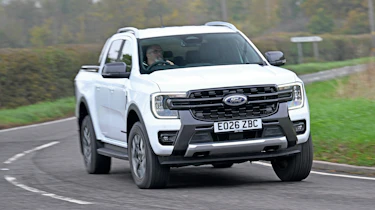
The Ranger takes the win by the narrowest of margins. Assessed as a working vehicle it has to win, with the greater load volume, higher payload, and greater tow rating – essentially, there are things the Ranger can do with ease that might rule out the BYD entirely for certain buyers, so the Ford wins on that basis.
It also has no real weaknesses these days: the plug-in hybrid powertrain offers performance and economy at least on par with diesels, but lower fuel costs and cleaner emissions, while the ride and handling and interior functionality are all first-rate. Ford’s widespread dealer network will be appealing for plenty of customers too.
Runner-up: BYD Shark
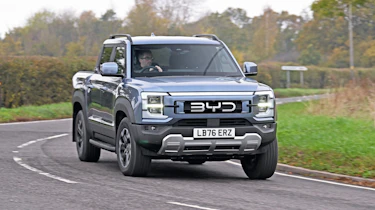
If BYD’s engineers can find the extra payload and towing capacity needed to match the Ranger’s, then it would flip this result. That’s how impressive BYD’s new challenger is. Key to its appeal is an electric range that more than doubles the Ford’s figure, so in local use it’ll drink a fraction of the fuel.
But out of town it’s also in another league for performance, while riding and steering nearly as well as the Ranger. Heavy reliance on that central touchscreen will dissuade some buyers, but the comfortable and airy cabin is another highlight. Above all, it looks pretty good too, and offers strong value for money.
Prices and specs
| Model tested | BYD Shark 1.5T DMO Design | Ford Ranger 2.3 EcoBoost PHEV Wildtrak |
| Price from/price as tested | £47,295/£47,295 (inc. VAT) | £45,584/£55,424 (inc. VAT) |
| Powertrain and performance | ||
| Engine | 4cyl in-line/1,497cc | 4cyl in-line/2,261cc |
| Power/torque | 430bhp/652Nm | 277bhp/697Nm |
| Transmission | Single-speed auto/4WD | 10-speed auto/4WD |
| 0-62mph/top speed | 5.7 seconds/111mph | 9.2 seconds/112mph |
| Fuel tank/battery capacity | 60 litres/32.2kWh | 70 litres/16.5kWh |
| MPG (on test/official)/range | 80.7/30.4/401 miles | 91.1/44.8/508 miles |
| Dimensions | ||
| Length/wheelbase | 5,457/3,260mm | 5,370/3,270mm |
| Width/height | 1,971/1,925mm | 2,015/1,878mm |
| Front door opening width/height/sill height | 735/1,100/600 mm | 690/1,110/555mm |
| Rear door opening width/height | 705/1,100mm | 675/1,125mm |
| Rear knee room | 640-890mm | 615-870mm |
| Rear headroom/elbow room | 895/1,560mm | 920/1,515mm |
| Tailgate opening width/height | 1,365/535mm | 1,280/390mm |
| Load space | 1,200 litres/1,490/1,205mm | 1,233 litres/1,550/1,250mm |
| Load length/height | 1,555/535mm | 1,540/390mm |
| Kerbweight/payload/towing weight | 2,710/790/2,500kg | 2,433/1,067/3,500kg |
| Turning circle | 13.0 metres | 12.9 metres |
| Costs/ownership | ||
| Insurance quote/VED | £1,033/£360 | £1,141/£360 |
| Three-year service cost | TBC | POA |
| Annual tax liability std/higher rate | £844/£1,688 | £2,200/£4,401 |
| Annual fuel cost (10,000 miles) | £2,557 | £2,356 |
| Basic warranty (miles)/recovery | 6yrs (93,750)/3yrs | 3yrs (60,000)/1yr |
| Extended warranty | No | Insurance based |
| Driver Power manufacturer position | 16th | 21st |
| NCAP Adult/child/ped./assist/stars | 82/86/74/87/5 _ (2025) | 84/90/74/84/5_ (2022) |
| Equipment | ||
| Metallic paint/wheel size | £1,100/18 inches | £720/18 inches |
| Parking sensors/camera | Front & rear/360-degree | Front & rear/360-degree |
| Spare wheel/Isofix points | Yes/two | Yes/two |
| Keyless entry & go/damped tailgate | Yes/yes | Yes/no |
| Seat upholstery/leather | Artificial leather/no | Artificial leather/no |
| Heated seats/steering wheel | Heat & vent/no | Yes/yes |
| Screen size/digital dashboard | 15.6 inches/10.25 inches | 12.0 inches/7.0 inches |
| Climate control/panoramic sunroof | Two-zone/no | Two-zone/no |
| USBs/wireless charging | Four/yes | Five/yes |
| Wireless CarPlay/Android Auto | Yes/yes | Yes/yes |
| Blind-spot warning/head-up display | Yes/yes | Yes/no |
| Adaptive cruise/steering assist | Yes/yes | Yes/yes |
What we would choose
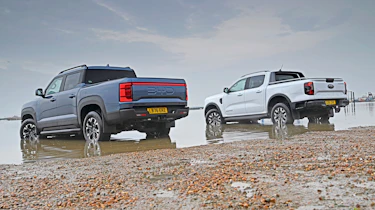
BYD Shark
You take what you get with the BYD; the Shark’s options list amounts to its exterior colour, with everything else standard, and no choice of interior finish or alternative alloy wheels. We’d have our Shark in Sunrise Orange (£1,100).
Ford Ranger
The Ranger comes in four trims, but Wildtrak is our favourite. To match the BYD we’d have Ignite Orange (£600), the £400 towing pack and the £1,275 Cargo Convenience Pack with the load- bed liner (all plus VAT).
Looking for your next car? You can now search our nationwide dealer network for a choice of great cars on offer right now with new, used and leasing deals to choose from...
Don't miss the best of Auto Express on Google! Make us a preferred source. Click here…