Chevrolet Cruze SW vs Kia Cee'd SW vs Hyundai i30 Tourer: 2012 group test
We pit the Chevrolet Cruze SW against its clever estate rivals, the Kia Cee'd Sportswagon and Hyundai i30 Tourer

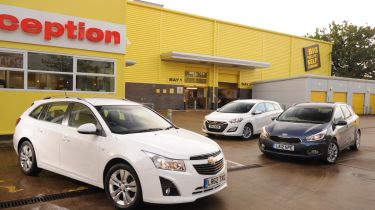
Storing a lot for a little is a piece of cake these days, as the latest generation of great-value compact estates proves. The best models will offer the maximum amount of space for the least money and will also be cheap to run and comfortable enough to carry the whole family on long driving holidays.
Chevrolet has scored hits with the seven-seat Orlando MPV and Cruze hatch. But now it’s the turn of the Cruze estate to continue the success story. The newcomer stays true to its American roots, and is badged Station Wagon, but has a practical edge with its decent boot and lots of handy extra storage. We’re testing it here in top-spec LTZ trim.
Taking on the Cruze SW are two hugely talented rivals – in the shape of the all-new Kia Cee’d Sportswagon and the excellent Hyundai i30 Tourer. In its first test, the Cee’d hatch came within a whisker of beating the VW Golf MkVI, while the i30 Tourer is our current compact estate champ. So, which of these spacious choices will come out on top?
Verdict
They're not as glamorous as crossovers, but these compact estates still make a great deal of sense. Not only are the cars in this trio cheaper to buy and run than the vast majority of soft-roading SUVs, they can also carry more passengers and luggage.
Used - available now

2023 Ford
Puma
14,937 milesAutomaticPetrol1.0L
Cash £17,910
2026 SEAT
Ateca
52,672 milesManualPetrol1.5L
Cash £13,490
2027 Volvo
XC40
40,724 milesAutomaticPetrol2.0L
Cash £23,260
2024 Audi
A3 Sportback
12,433 milesAutomaticPetrol1.4L
Cash £19,030Even in this range-topping LTZ guise, the Cruze represents great value for money, while the gutsy VCDi engine gave it the edge at the test track. However, on the road its fidgety ride and lack of refinement were badly exposed and the cheaply finished load area is not up to European standards. Add to that some low-rent plastics and the smallest boot, and the Chevrolet finishes in a disppointing third place.
Choosing between the Hyundai and Kia is harder, but for us the Cee’d Sportswagon edges this encounter thanks to its classier look, longer warranty, smarter interior design and better fuel returns. But that’s not to say the i30 Tourer isn’t a fine choice – it’s still well worth a look.
First place: Kia Cee'd Sportswagon
Clever pricing means the better equipped Kia is only £200 more than the i30, while low emissions, decent economy and that great warranty make it cheaper to run. You should look elsewhere for driving thrills, but the Cee’d SW is classy, refined and roomy enough to be the perfect family holdall.
Until recently, Kia was considered just another value brand that trailed its mainstream rivals for quality and desirability. But now, the manufacturer has become a real powerhouse. Every new model is a contender for class honours, including the latest Cee’d – so this Sportswagon estate version could be the car to beat in this closely fought contest.
Kia has already proven it can be a desirable brand with the right designs, thanks to the Sportage and Optima, and the striking Cee’d looks a lot more sophisticated than the Cruze.
The trademark tiger nose grille and swept-back headlights give the SW the same bold stance as the five-door hatch, and although there are hints of the Vauxhall Astra from the back, the overall effect is subtle and stylish.
Climb aboard, and the well appointed cabin is a revelation after the cheaply trimmed Cruze, with quality materials used throughout and an attractive centre console that’s angled towards the driver. The two-tone cloth seats are supportive and the 2-spec model we tested includes decorative chrome trim on the dials and door handles which provide a special feel.
You have to upgrade to the 3 model to get closer to matching the Cruze for equipment – it brings an excellent touchscreen sat-nav, auto lights and wipers and a reversing camera – but this adds £1,800 to the list price as well.
Perhaps more importantly for an estate, the 2 offers extra features to aid practicality. There are six hidden cubbies under the boot floor for shopping bags or keeping important items out of sight, plus pockets on the front seatbacks, a luggage net and cooled glovebox.You can fold the rear seats with one hand, and this reveals a perfectly flat luggage bay that’ll swallow a maximum 1,642 litres of luggage.
Buyers considering a caravan holiday will also welcome the fact that the Cee’d SW can tow 200kg more than the heavier Cruze. Yet the Kia trailed its rivals during our in-gear tests at the track, as it doesn’t have the Chevy’s torque. The standard Flex Steer system allows drivers to choose from three different modes, but even in Comfort it provides more weight than the Cruze. There isn’t loads of feedback, although on the road the Kia felt stable and planted and gave a much smoother ride.
The 1.6-litre engine is hushed and refined, and the start-stop system works well in traffic, with very few judders through the gearknob. Larger wheels and tyres mean the Cee’d grips harder than the i30 in corners and performed better in our braking tests as well. The trade-off for the car’s greater agility and stopping power is a firmer ride over rough surfaces.
Still, the Kia looks better than the Hyundai inside and out, and has a longer warranty. Our low-mileage Cee’d was also the most efficient car in this test, returning a superb 45.3mpg, so it looks like the complete estate package. But will the i30 Tourer be able to hold off its stylish sister car to retain its place at the top?
Second place: Hyundai i30 Tourer
If you want an efficient, practical estate, the i30 should be on your shortlist. What it lacks in desirability it makes up for with low running costs, plus an interior that should stand up to years of abuse. It’s a car for your head rather than your heart, but in this market that’s no bad thing.
Having seen off mainstream rivals from Renault and VW in our previous test, the Hyundai i30 Tourer is the car to beat here. But it starts out on the back foot, as our plain Active model isn’t as interesting to look at as the Kia.
True, the estate body is neatly integrated into the ‘fluidic sculpture’ family design language, and the well proportioned rear overhang does an excellent job of hiding the 185mm of extra length. Yet the tiny 15-inch alloys and lack of chrome detailing mean the Hyundai isn’t as attractive as the Cee’d.
Still, the i30 is better proportioned than the larger Chevrolet and standard LED lights add a premium gloss to its sensible image.
Inside, it’s slightly more spacious than the Cee’d, despite sharing the same chassis. With the seats in place, there’s 528 litres of capacity – 18 litres more than the Kia. With the rear bench folded flat, it offers an identical 1,642 litres. However, the i30’s rear seats are backed with hard plastic rather than cloth, which looks cheap but is likely to be more robust.
The Tourer is 20mm shorter and 15mm taller than the Cee’d SW, too, and although the cars’ wheelbases are identical, when we got the tape measure out the Hyundai had a slight advantage in terms of head and legroom.
Up front, the i30 uses the same quality materials as the Kia, and the fit and finish of the upright dash is miles ahead of the Cruze. The deeply cowled dials and flared air vents are smart enough, but you’ll have to stretch to reach some of the audio and ventilation controls, meaning it’s not as user-friendly as the more driver-orientated Cee’d SW.
In basic Active trim, the Hyundai is nowhere near as well equipped as the Chevrolet, either. Although essentials like Bluetooth and cruise control are here, and the multifunction steering wheel prevents the cabin from looking too basic, you’ll need to upgrade to the Style model to benefit from practical extras like a luggage net and pockets in the front seatbacks, plus luxury kit like cornering headlights and auto wipers.
Regardless of which trim level you choose, the i30 still has the same smooth and refined dynamics that set the Kia apart in this test. If anything, the small wheels make it even more comfortable, and although the 109bhp i30 has 17bhp less power than its sister car, an identical torque figure of 260Nm meant it felt just as quick at the track – it matched the Kia from 0-60mph and during our in-gear tests as well.
There was more body roll in corners and the car ran out of front grip sooner than the Cruze thanks to its eco tyres, but this isn’t something you’d notice in normal driving. The only blot on its dynamic copybook were the brakes: the i30 took 53.5 metres to stop from 70mph – several more than the others.
In this spec, the Hyundai was also cheaper to buy than its rivals, and would cost the least to insure, while its five-year warranty matches the Chevrolet’s. However, it depreciates more than the Kia over three years, and while our car had covered nearly 2,000 more miles than the Cee’d, it trailed at the pumps with 40.4mpg.
Overall, this functional, practical and discreetly styled estate car remains a very impressive choice. Can it win another test?
Third place: Chevrolet Cruze SW
If you want an efficient, practical estate, the i30 should be on your shortlist. What it lacks in desirability it makes up for with low running costs, plus an interior that should stand up to years of abuse. It’s a car for your head rather than your heart, but in this market that’s no bad thing.
Having seen off mainstream rivals from Renault and VW in our previous test, the Hyundai i30 Tourer is the car to beat here. But it starts out on the back foot, as our plain Active model isn’t as interesting to look at as the Kia.
True, the estate body is neatly integrated into the ‘fluidic sculpture’ family design language, and the well proportioned rear overhang does an excellent job of hiding the 185mm of extra length. Yet the tiny 15-inch alloys and lack of chrome detailing mean the Hyundai isn’t as attractive as the Cee’d.
Still, the i30 is better proportioned than the larger Chevrolet and standard LED lights add a premium gloss to its sensible image.
Inside, it’s slightly more spacious than the Cee’d, despite sharing the same chassis. With the seats in place, there’s 528 litres of capacity – 18 litres more than the Kia. With the rear bench folded flat, it offers an identical 1,642 litres. However, the i30’s rear seats are backed with hard plastic rather than cloth, which looks cheap but is likely to be more robust.
The Tourer is 20mm shorter and 15mm taller than the Cee’d SW, too, and although the cars’ wheelbases are identical, when we got the tape measure out the Hyundai had a slight advantage in terms of head and legroom.
Up front, the i30 uses the same quality materials as the Kia, and the fit and finish of the upright dash is miles ahead of the Cruze. The deeply cowled dials and flared air vents are smart enough, but you’ll have to stretch to reach some of the audio and ventilation controls, meaning it’s not as user-friendly as the more driver-orientated Cee’d SW.
In basic Active trim, the Hyundai is nowhere near as well equipped as the Chevrolet, either. Although essentials like Bluetooth and cruise control are here, and the multifunction steering wheel prevents the cabin from looking too basic, you’ll need to upgrade to the Style model to benefit from practical extras like a luggage net and pockets in the front seatbacks, plus luxury kit like cornering headlights and auto wipers.
Regardless of which trim level you choose, the i30 still has the same smooth and refined dynamics that set the Kia apart in this test. If anything, the small wheels make it even more comfortable, and although the 109bhp i30 has 17bhp less power than its sister car, an identical torque figure of 260Nm meant it felt just as quick at the track – it matched the Kia from 0-60mph and during our in-gear tests as well.
There was more body roll in corners and the car ran out of front grip sooner than the Cruze thanks to its eco tyres, but this isn’t something you’d notice in normal driving. The only blot on its dynamic copybook were the brakes: the i30 took 53.5 metres to stop from 70mph – several more than the others.
In this spec, the Hyundai was also cheaper to buy than its rivals, and would cost the least to insure, while its five-year warranty matches the Chevrolet’s. However, it depreciates more than the Kia over three years, and while our car had covered nearly 2,000 more miles than the Cee’d, it trailed at the pumps with 40.4mpg.
Overall, this functional, practical and discreetly styled estate car remains a very impressive choice. Can it win another test?
Facts and figures
| Chevrolet Cruze StationWagon 1.7 VCDi LTZ | Kia Cee’d Sportswagon 2 1.6 CRDi Eco | Hyundai i30 Tourer Active 1.6 CRDi | |
| On the road price/total as tested | £19,785/£19,785 | £19,295/£21,095 | £19,095/£19,095 |
| Residual value (after 3yrs/36,000) | £5,975/30.2% | £6,950/36.0% | £6,798/35.6% |
| Depreciation | £13,810 | £12,345 | £12,297 |
| Annual tax liability std/higher rate | £671/£1,342 | £654/£1,308 | £609/£1,219 |
| Annual fuel cost (12k/20k miles) | £1,931/£3,218 | £1,722/£2,870 | £1,931/£3,218 |
| Ins. group/quote/road tax band/cost | 21/£375/C/£30 | 13/£341/C/£30 | 12/£326/B/£20 |
| Servicing costs | £349 (3yrs/30,000) | £299 (3yrs/30,000) | £299 (3yrs/30,000) |
| Length/wheelbase | 4,681/2,685mm | 4,505/2,650mm | 4,485/2,650mm |
| Height/width | 1,521/1,797mm | 1,485/1,780mm | 1,500/1,780mm |
| Engine | 4cyl in-line/1,686cc | 4cyl in-line/1,582cc | 4cyl in-line/1,582cc |
| Peak power/revs | 128/4,000 bhp/rpm | 126/4,000 bhp/rpm | 109/4,000 bhp/rpm |
| Peak torque/revs | 300/2,000 Nm/rpm | 260/1,900 Nm/rpm | 260/1,900 Nm/rpm |
| Transmission | 6-spd man/fwd | 6-spd man/fwd | 6-spd man/fwd |
| Fuel tank capacity/spare wheel | 60 litres/sealant | 53 litres/space saver | 53 litres/space saver |
| Boot capacity (seats up/down) | 500/1,478 litres | 510/1,642 litres | 528/1,642 litres |
| Kerbweight/payload/towing weight | 1,475/580/1,200kg | 1,420/500/1,500kg | 1,467/453/1,500kg |
| Turning circle/drag coefficient | 10.9 metres/0.34Cd | 10.6 metres/0.31Cd | 10.6 metres/0.31Cd |
| Basic warranty (miles)/recovery | 5yrs (100,000)/1yr | 7yrs (100,000)/1yr | 5yrs (unltd)/5yrs |
| Service intervals/UK dealers | 10,000 miles (1yr)/113 | 20,000 miles (1yr)/170 | 20,000 (1yr)/162 |
| Driver Power manufacturer/dealer pos. | N/A | 12th/17th | 7th/12th |
| Euro NCAP: Adult/child/ped./stars* | 96/84/34/5 | 89/88/61/5 | 90/90/67/5 |
| 0-60/30-70mph | 9.6/10.0 secs | 10.7/11.3 secs | 10.7/11.4 secs |
| 30-50mph in 3rd/4th | 4.0/5.9 secs | 4.7/7.3 secs | 4.7/7.6 secs |
| 50-70mph in 5th/6th | 7.5/11.1 secs | 8.9/11.7 secs | 8.9/11.5 secs |
| Top speed/rpm at 70mph | 124mph/2,000rpm | 120mph/2,100rpm | 115mph/2,100rpm |
| Braking 70-0/60-0/30-0mph | 49.8/36.2/9.3 metres | 49.7/36.5/9.7 metres | 53.5/38.7/10.2m |
| Noise outside/idle/30/70mph | 65/48/63/71dB | 63/42/61/70dB | 64/43/63/71dB |
| Auto Express econ (mpg/mpl)/range | 40.4/9.0/533 miles | 45.3/10.1/528 miles | 40.4/9.0/471 miles |
| Govt urban/extra-urban/combined | 52.3/70.6/62.7mpg | 53.3/70.6/64.2mpg | 56.5/74.3/67.3mpg |
| Govt urban/extra-urban/combined | 11.6/15.7/14.0mpl | 11.8/15.7/14.3mpl | 12.4/16.5/15.0mpl |
| Actual/claimed CO2/tax bracket | 187/119g/km/17% | 167/116g/km/17% | 187/110g/km/16% |
| Airbags/Isofix/rear parking sensors | Six/yes/yes | Six/yes/yes | Six/yes/yes |
| Automatic box/stability/cruise control | No/yes/yes | £1,100/yes/yes | £805/yes/yes |
| Air-conditioning/leather/heated seats | Yes/no/no | Yes/no/no | Yes/no/no |
| Metallic paint/xenon lights/keyless go | £445/no/no | £445/no/no | £445/no/no |
| Sat-nav/USB connection/Bluetooth | Yes/no/yes | No/yes/yes | No/yes/yes |