New Dacia Jogger Hybrid 155 review: frugal family car makes tons of sense in town
Dacia's MPV goes well with hybrid power, but it can get a bit thirsty on longer trips


Verdict
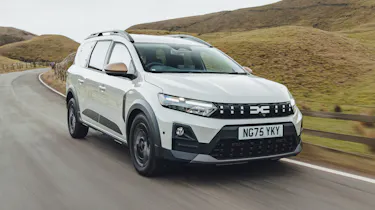
The Jogger Hybrid 155 has huge appeal when it comes to town and city driving. In these environments it’s efficient, refined and just easy to get about in. The hybrid petrol engine is a bit thirsty so those looking to use the Jogger for regular long-distance trips might be less impressed by its fuel consumption. The Hybrid 155 loses none of the Jogger’s practicality and versatility, however, which at this price is certainly its biggest strength.
The Jogger became Dacia’s first electrified model back in 2023 when it adopted the Hybrid 140 powertrain from parent firm Renault, seen in the likes of the Clio and Captur. It suited Dacia’s MPV pretty well, providing a more laid-back driving experience thanks to the automatic transmission and improved efficiency courtesy of electrical assistance for the engine.
It’s not taken long for the Jogger to reap the benefits of its Renault Group partnership once more, because now there’s a new Hybrid 155 that’s arrived with the Jogger’s mid-life facelift to replace the old Hybrid 140.
It might have a similar name, but this hybrid system is quite different. Designed by HORSE (a Renault and Geely joint venture), the Hybrid 155 has a 1.8-litre, four-cylinder petrol engine and two electric motors. A 49bhp motor can power the front wheels and a supplementary motor acts as a starter/generator, but can also recoup energy through regenerative braking. The old Hybrid 140 in contrast had a 1.6-litre petrol with a single electric motor.
Used - available now

2022 Dacia
Jogger
20,433 milesManualPetrol1.0L
Cash £12,885
2023 Dacia
Jogger
43,023 milesManualPetrol1.0L
Cash £14,995
2023 Dacia
Jogger
63,443 milesManualPetrol1.0L
Cash £10,995
2023 Dacia
Jogger
17,204 milesManualPetrol1.0L
Cash £13,678The battery is larger too, but only by 0.2kWh, taking capacity to 1.4kWh. As you might expect with such a puny battery, there’s no claimed electric-only range figure for the Jogger Hybrid 155 - but Dacia says in urban areas it will run up to 80 per cent on electric power. The Hybrid retains the same 50-litre fuel tank as the TCe so expect a very impressive maximum range well over 600 miles.
Jumping into the Jogger Hybrid 155 for our test drive, the first thing we attempt is matching that claimed figure from Dacia. Pressing the start button causes a short jingle to sound, which is just as well because the petrol engine won’t fire up immediately. In fact, the Hybrid 155 didn’t really engage its petrol engine until we got over 30mph. Around town the electric motor feels more than perky enough to keep up with traffic - especially from rolling starts.
There’s a little bar on the driver’s display that tells you the level of battery charge, though because it’s so small you can actually see it drop in real time as you drive along. On the flip side, you can see the bar topping up as the brake recuperation does its thing. Stick it into ‘B’ for extra regenerative braking and the battery charge tops up pretty quickly. The braking force is fairly smooth too, though it’s a long way off a true one-pedal system where you rarely need to use the brake.
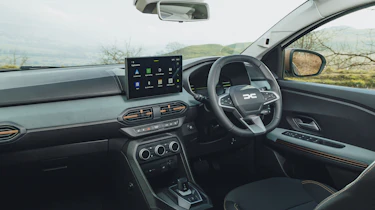
After some steady driving around town and on some country roads the Jogger Hybrid 155 rewarded us with 64.6mpg - higher than the official 61mpg and way higher than the old Hybrid 140 was meant to achieve (56.5mpg).
Despite the obvious efficiency of the system at low speeds, at higher speeds it starts to struggle. During a section of A-roads with inclines, fuel efficiency dropped to 48.5mpg - which isn’t disastrous by any stretch of the imagination but the use case for the Jogger Hybrid 155 is clearly centred on urban areas, where the car is also helped by excellent all-round visibility for the driver.
Aside from a distant hum when running purely on the battery, the Jogger is superbly refined at low speeds. Cause the petrol engine to burst into life by either mashing the throttle or going too quickly and that refinement is lost. The petrol engine’s clatter seems more intrusive than in the Hybrid 155 version of the Bigster SUV. You can even feel vibrations through the transmission tunnel and the car’s floor when you’ve got your foot down - which is often the case because the Jogger feels slower than its nine-second 0-62mph time.
The Hybrid 155 also has a new gearbox, a four-speed automatic for the petrol engine and a two-speed for the electric side of the system. Preferring to slur its gearchanges, it is smooth, and only occasionally do you feel a lurch on a downchange if you’re braking heavily.
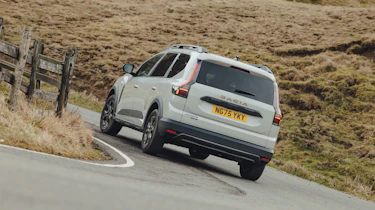
Elsewhere the Jogger Hybrid 155 doesn’t feel particularly different from other Jogger variants we’ve driven. It might be almost 180kg heavier than the pure-petrol TCe, but it still contains its mass surprisingly well in the bends and the steering is more than communicative enough. The ride doesn’t exactly isolate you from the road surface and large thuds sometimes reverberate around the massive cabin with its lining of hard plastics, but it’s far from uncomfortable overall. We think that with all seven seats on board filled, the added weight might well help the Jogger cope with rough roads and undulations even better.
In line with Dacia’s ‘you do the maths’ slogan, the Hybrid 155 really has to appeal to the head (and the calculator) more than anything. It’s a shame the powertrain isn’t offered on the base Essential trim Jogger, instead there’s the £23,330 Expression and the £24,630 Extreme model that we tested - both costing £3,035 more than their equivalents with the TCe turbo petrol.
In the unlikely event the UK’s average for petrol doesn’t move from the 142.2p per litre it is right now, on fuel costs alone you’d have to drive over 96,200 miles in the Hybrid to recoup that extra outlay. However, the Hybrid does only emit 104g/km, meaning its first year tax rate is £390 instead of the £540 imposed on the TCe. While you’re making back your money, the Hybrid will provide a more relaxed driving experience - especially around town. For many this will be a reason in itself to choose the electrified powertrain.
| Model: | Dacia Jogger Hybrid 155 Extreme |
| Price: | £24,630 |
| Powertrain: | 1.8-litre four-cylinder, 2x e-motor |
| Power/torque: | 153bhp/170Nm |
| Transmission: | Four-speed automatic |
| 0-62mph/top speed: | 9s/111mph |
| Economy/CO2: | 61mpg/104g/km |
| Size (L/W/H): | 4,550/1,784/1,630mm |
| On sale: | Now |