New Hyundai Ioniq 3 review: Korean star shines brighter than small EV rivals
The new Hyundai Ioniq 3 is hard to fault and might just be the best small electric car money can buy


Verdict
It might be up against tough competition, but the Hyundai Ioniq 3 is nothing short of a home run from the Korean brand. Underwhelming power figures and compromised rear visibility are small blots on what is an otherwise impressive scorecard: the Ioniq 3 is good to drive, full of tech, well priced and boasts a fantastic interior and real-world range considering the price. Renault 5, you may have met your match.
Hyundai appears to have taken a bit of a backseat to its sister brand, Kia, when it comes to electrification. While the EV2, EV3 and EV4 have bolstered Kia’s mainstream zero-emissions line-up, the only choices for those browsing Hyundai showrooms with a budget of around £30,000 are the ageing Kona Electric and the cutesy-yet-compromised Inster.
The arrival of the Ioniq 3, then, couldn’t have come any sooner. It plugs a gaping hole in Hyundai’s range at just the right time, with the electric supermini market gathering momentum thanks to the likes of the Volkswagen ID. Polo, Cupra Raval, Skoda Epiq and aforementioned EV2, which have arrived hot on the heels of the phenomenon that is the Renault 5.
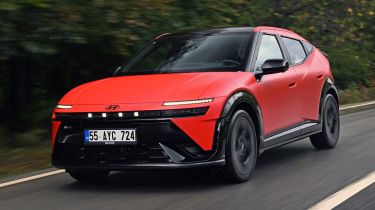
The French car has amassed hordes of adoring fans thanks to its unashamedly retro design. The Ioniq 3, on the other hand, does feature some throwback touches, but instead feels more Cyberpunk 2077 than 1977; the sleek pixel-like headlights are instantly eye-catching, for example, as is the ‘aero hatch’ silhouette.
Used - available now

2021 Renault
Arkana
47,349 milesAutomaticPetrol1.6L
Cash £13,520
2027 Toyota
Corolla Touring Sports
21,057 milesAutomaticPetrol1.8L
Cash £21,550
2023 Peugeot
5008
33,440 milesAutomaticPetrol1.2L
Cash £17,600
2023 Skoda
Fabia
19,177 milesManualPetrol1.0L
Cash £13,430Such a swooping shape is part of a package that helps remedy the limitations of the smaller Inster, in particular its limited range. A drag coefficient of just 0.26 paves the way for a class-leading official range of up to 308 miles in 61kWh Long Range specification; during our drive across a mix of urban roads and motorways at the Ioniq 3’s international launch in an uncharacteristically rainy Istanbul, we returned 4.2 miles per kWh, which equates to 260 miles.
At face value, this long-leggedness gives the Ioniq 3 real main-car appeal. However, those looking to save some cash (£2,000 to be precise) and use the Hyundai as a second vehicle might instead opt for the Standard Range model. Available solely in entry-level Advance spec, this version will do up to 213 miles before needing to be plugged in, according to the Korean firm.
Oddly, the Standard Range eclipses the Long Range’s 110kW maximum charging rate with speeds of up to 119kW, although differences in charging curves mean both can be topped up from 10-80 per cent in around half an hour.
Now if all this sounds rather familiar, that’s because the Ioniq 3 shares its underpinnings with the Kia EV2. As with that car, the 133bhp Long Range version actually produces 10bhp less than the Standard Range. At over one-and-half tonnes, you might expect such a modest output to make it feel sluggish. Thankfully, the 250Nm of torque on offer provides more peppiness than what the Ioniq 3 Long Range’s 9.6-second 0-62mph time would suggest.
Floor the throttle and there’s no chance of being pinned back in the driver’s seat, as is the case with other EVs; the Ioniq 3 has no issue getting up to motorway speeds, but rivals are far quicker off the mark.
While the EV2 can be accused of feeling a bit too floaty and out of sorts on a twisty road, Hyundai has managed to get the chassis balance just right. Body roll is kept mostly in check and although the steering is on the light side – there isn’t much in the way of feedback, either – it’s pinpoint accurate, making the Ioniq 3 enjoyable to throw around corners. Flicking the car into its Sport setting adds a welcome bit of weight to the steering wheel, and sharpens up the throttle response.
In fact, aside from brakes that lack much progression and the aforementioned lack of oomph, the Ioniq 3 has in it all the makings of a great electric hot hatch. Hyundai wouldn’t tell us whether a full-fat N version is on the way, which is a bit of a shame as more power, simulated gearshifts and a stiffer set-up could really elevate the enjoyment this car offers.
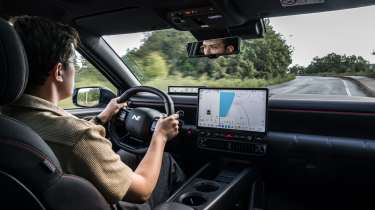
Most of the time, however, drivers will be thankful for the Ioniq 3’s more forgiving suspension; it’s not quite as comfortable as an EV2 or a Citroen e-C3, but the Hyundai deals well with broken and bumpy roads. There is some wind and tyre noise at higher speeds, but supportive seats and an easy-to-modulate regenerative braking system make the Ioniq 3 a refined, capable long-range cruiser.
The interior sees the debut of an all-new layout that’ll eventually make its way to other Hyundai models, starting with the facelifted Tucson SUV. Perceived material quality is very strong – soft-touch plastics on top of the doors and squidgy materials on the armrest are impressive at this price point – but what we’re most thankful for is the inclusion of physical buttons and switches on both the dashboard and steering wheel.
Infotainment comes courtesy of a slim 9.9-inch driver’s display on the dashboard, alongside either a 12.9 or 14.6-inch touchscreen, depending on specification. This employs Hyundai’s new Pleos Connect infotainment system, which the brand says is designed to replicate a smartphone interface. In practice, it’s very responsive to your touch and relatively easy to operate once you know where everything is. The built-in sat-nav comes courtesy of Google Maps (albeit in a Hyundai-branded skin) but you can always, of course, make use of wireless Apple CarPlay and Android Auto.
The driver’s display sits above the steering wheel, as in a Peugeot E-208, but here it’s far less awkward to get a clear view. You can customise this screen to display sat-nav directions, your current media playback or efficiency data – annoyingly, you have to dig into the touchscreen to do this – but more interesting is that it’s actually an option. Advance models take a leaf out of the Tesla Model Y’s book and instead rely solely on the speed readout on the main infotainment screen. Unfortunately, this means that such information is impossible to minimise or remove from the touchscreen, even when it’s being mirrored on the driver’s display.
Nevertheless, the level of kit is otherwise pretty decent, with 16-inch wheels, dual-zone climate control, adaptive cruise control, front-and-rear parking sensors and a reversing camera all standard fare on the Advance.

We advise, if you can, stepping a bit higher up the range; Premium adds 17-inch alloys, battery preconditioning, blind spot monitoring, a wireless phone charger and that coveted extra screen for an extra £1,700. Our pick of the line-up is the Ultimate model which adds wider 18-inch wheels and metal-effect exterior trim, a heated steering wheel and front seats, adaptive headlights (complete with jazzy start-up animations) and ambient lighting for another £2,500.
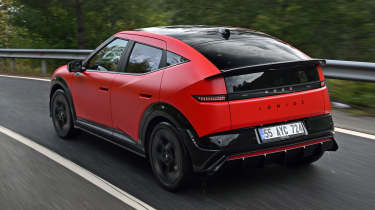
Hyundai says most UK buyers will choose the range-topping N Line EVO. Complete with a racier bodykit, 19-inch wheels and a large rear wing, this version is certainly eye-catching, but suffers a range deficit of around 40 miles due to its drag-inducing exterior flourishes. Still, N-specific upholstery, a 360-degree camera and the largest 14.6-inch touchscreen justify its £28,195 asking price.
In fact, with the base Advance Standard Range model starting from around £18,500 thanks to its eligibility for the Government’s full £3,750 Electric Car Grant, the Ioniq 3 represents fantastic value – especially considering how it trumps similarly-priced EVs for interior space. The rear seats are more than roomy enough for adults, although three abreast in the back will be a tight squeeze and headroom might be tight for tall occupants.
Hyundai claims a boot capacity of 441 litres which, at first glance, makes the Ioniq 3 seem about as practical as a petrol family hatchback. In reality, a third of this figure accounts for the ‘Megabox’ storage void underneath the adjustable boot floor. This is not to be sniffed at, though – unlike the rear visibility which is greatly impeded by the rear spoiler.
| Model: | Hyundai Ioniq 3 N Line Evo Long Range |
| Price: | £28,195 |
| Powertrain: | 61kWh battery, 1x e-motor |
| Power/torque: | 133bhp/250Nm |
| Transmission: | Single-speed automatic, front-wheel drive |
| 0-62mph: | 9.6 seconds |
| Top speed: | 102 mph |
| Range: | 265 miles |
| Max. charging: | 110kW (10-80% in 30 mins) |
| Size (L/W/H): | 4,155/1,800/1,505mm |
| On sale: | Now |