New Hyundai Ioniq Plug-in 2017 review
Hyundai's Plug-in version of the Ioniq hatchback provides an affordable route into electrified driving

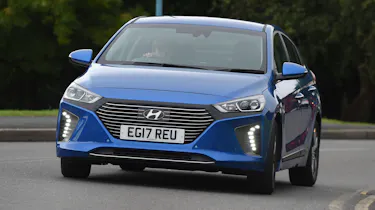

The Hyundai Ioniq Plug-in isn't quite as well resolved as its main rival, the Toyota Prius PHV – nor does it feel quite so polished inside. But this is a competent, efficient and surprisingly practical family car, and another affordable way into electrified motoring. Assuming that its price advantage over the Toyota is replicated in the monthly finance deals, it deserves consideration.
Hyundai isn't the first manufacturer to offer pure-electric and hybrid technology, but there's no denying the Korean brand is working hard to catch up. Its Ioniq range of eco-focused cars includes a hybrid and a pure-electric version - but in the middle of the pack, there's a plug-in model designed to offer the best of both worlds. We tried it in Italy back in April, but now we've had a chance to get behind the wheel of the car in the UK.
The PHEV version isn't just a carbon copy of the regular Hybrid with an extra power socket. Although the normally aspirated 1.6-litre petrol engine has the same output as in the non-plug-in car, the electric motor gets a small boost. And while the maximum combined power figure is still 139bhp, it’s ever-so-slightly faster from 0-62mph – completing the sprint two tenths faster than the standard Hybrid car.
Used - available now

2025 Audi
A4
30,816 milesAutomaticDiesel2.0L
Cash £20,807
2020 Peugeot
5008
74,517 milesManualPetrol1.2L
Cash £12,212
2017 Ford
S-Max
100,435 milesAutomaticDiesel2.0L
Cash £8,795
2023 Tesla
Model 3 Premium
63,000 milesAutomaticElectric
Cash £15,999The ability to charge the larger battery at a wall socket (it takes about two and a half hours) really helps the Ioniq's CO2 emissions, though; this car emits just 26g/km, compared with the conventional hybrid's 79g/km.
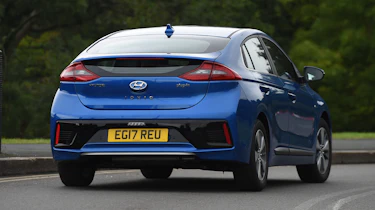
As with most other PHEVs, the Ioniq is a car that is at its best when making relaxed progress. Treat the throttle with respect and it with gather speed smoothly and with little intrusion from the petrol motor. Stamp on the right pedal and things quickly deteriorate, though; the six-speed dual-clutch transmission isn't the quickest or smoothest-shifting unit out there, and the petrol motor, while fluid enough, is pretty audible if its revs are sent rocketing.
You can run the plug-in Ioniq in a couple of modes. Most of the time will be spent in the car’s hybrid setting, where the system mixes electric and petrol power as it sees fit. It's worth noting, though, that as with the Prius and Prius Plug-in, the Ioniq PHEV is keener to stick with pure-electric motoring than its conventional hybrid stablemate. Despite this, you'll still notice the engine kicking in quite regularly – not least because it's not the most polished of transitions.
Sticking the car into EV mode forces the car to ignore the petrol engine altogether for as long as possible. In theory, at least, this would allow you to complete the bulk of a longer journey using the petrol engine, switching to silent running for the final few miles in an area where noise or emissions are more heavily controlled. In practice it works pretty well, although the 60bhp electric motor doesn't have the punchy shove that you'd get a in a pure-electric car.
Hyundai claims a pure-EV range of around 39 miles, but you'll do well to get about two thirds of that total in real-world motoring. The official fuel economy figure of around 252mpg is pretty unrealistic, too, although with regular plug-ins, this could still be a very efficient commuter car.
The overall set-up of the Ioniq is geared towards comfort, so there's a fair amount of body roll if you throw the car at a corner. You'll find that a pretty unsatisfying exercise, though, because while the steering is accurate enough, it is also desperately short on communicating what the wheels are doing. Tricky brake pedal modulation - perhaps the hardest part of a hybrid set-up to master - completes the picture, leaving you with a car that's comfortable to drive, but not in the least bit rewarding.
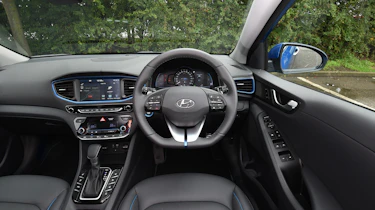
Inside, there are flashes of technology that hint at the sophisticated powertrain that lies beneath. You’ll find a funky instrument panel and an eight-inch infotainment screen that can display vehicle data - but they don't do enough to lift what is otherwise a pretty bland cabin. It feels cheap, too, with some hard, scratchy plastics never far from the eye.
There's a reasonable amount of kit, though. The plug-in is offered in the same trim levels as the pure-EV Ioniq - so Premium and Premium SE (the non-plug-in hybrid also gets the more lowly SE spec) – with all cars getting touchscreen nav, wireless phone charging and keyless go. Apple CarPlay and Android Auto are also included, while stepping up to Premium SE add driver's seat ventilation, rain-sensing wipers, a blind-spot detection system and front parking sensors.
It's spacious enough for four adults to travel in comfort, and you can get three grown-ups across the back seat for all but a really long journey. The boot capacity takes a hit because of the PHEV set-up, but even so, it's a useful 341 litres - about the same a small family hatchback.