New Kia PV7: nine seats and 350kW charging for PV5's big brother
Korean brand aims to continue its takeover of the commercial sector with massive new PV7

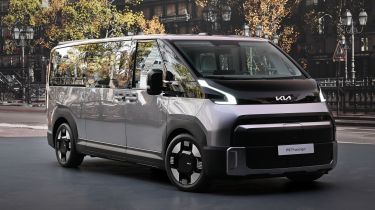
This is the new Kia PV7, big brother to the Auto Express award-winning Kia PV5 that has consistently impressed us as both a family hauler and commercial workhorse. Now the Korean brand is raising the stakes with the larger, more capable and more sophisticated PV7, which will arrive in showrooms in the second half of 2027.
The biggest difference between the PV5 and PV7 is, as you might expect, the size. In its longest current form, the PV5 is just under 4.7 metres long, whereas the PV7 is 5,350mm – over half a metre more. Compared to rivals, the Kia is midway between short and long-wheelbase Ford Transit Customs, and nearly 300mm longer than the long-wheelbase Volkswagen ID.Buzz.

Kia says its passenger model will be capable of seating up to nine occupants in four rows, but in Korean markets there will actually be the option to accommodate up to 11. This gives some idea of how efficiently the PV7 uses its admittedly large footprint – thanks in large part to its modular e-GMP.S platform.
Models fitted with three rows will have the option of sliding seats in the second and third rows, and they can be removed altogether if required. Top-spec cars also come with separate rear controls for the air-conditioning, plus the usual scattering of USB charge points as well as interior lighting for those at the back.
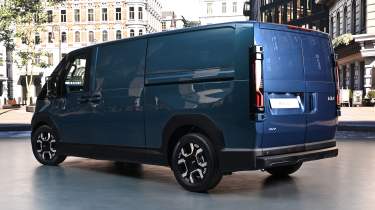
In Cargo form, the front cabin can be set up in two or three-seat layouts, leaving over six square metres of loadspace in the rear section, or up to 8.1 square metres in the forthcoming high-roof derivative. There will also be the choice of twin barn doors on the back or a traditional lifting tailgate, plus powered sliding doors and a load-through bulkhead for long items. The payload is rated to 1,165kg, which is higher than both the Volkswagen ID.Buzz and Ford’s electric Transit Custom can manage.
What range does the Kia PV7 have?
There will be two nickel manganese cobalt (NMC) battery options available: a 71.5kWh standard range pack and a 96.2kWh long range one. Key technical figures for the smaller option are yet to be released, but Kia says the long range will be able to reach up to 285 miles on a charge, which is significantly up on the Transit (201 miles), but a few miles behind the highest-range ID.Buzz models, which can get close to 300 miles.
All PV7s will produce a healthy 262bhp and 420Nm of torque from a front-mounted electric motor, but there’s no sign that a dual-motor all-wheel-drive variant for cold-weather markets will be offered in future.
One advantage the PV7 will have on both its key rivals, as well as the PV5, is a high-spec 800V electrical system that’ll support DC fast chargers of up to 350kW. When fitted with the larger battery pack, Kia claims the PV7 can be topped up from 10-80 per cent in around 25 minutes.
What does the Kia PV7 look like inside?
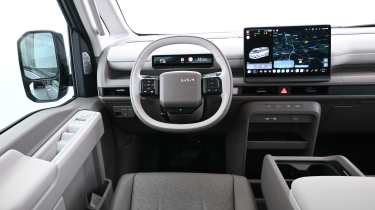
The PV7 will also include Kia’s latest Pleos Connect infotainment system accessed through either a 12.9-inch or 14.6-inch touchscreen display. These sit in a more plush cabin than that of the PV5, with an upholstered dashboard and new ambient lighting. However, practicality hasn’t been compromised, as multiple storage spaces have been carved out of the dashboard thanks to innovations such as mounting the passenger-side airbag in the roof, and clever packaging of the car’s heating and ventilation systems.
The exterior look also builds on Kia’s existing design language, but the surfacing is slightly more complex, and there are subtly flared wheelarches plus a new silhouette to the windowline. A glass roof option will also be offered, and there are fresh wheels and colours.
In time, Kia will introduce more body variants including a slightly shorter version to plug the gap to the largest PV5, as well as a dedicated cab-chassis model that can be fitted with a steel bed on the back. High-roof and conversion variants, both of which could easily be transformed into a futuristic camper, are coming, too.
The PV7 will be hoping to follow the success of the PV5, which was named Family Car of the Year in Passenger form in our 2026 New Car Awards, plus Electric Van of the Year in Cargo guise.
Did you know you can sell your car through Auto Express? We’ll help you get a great price and find a great deal on a new car, too.