Mazda MX-5 review
The world’s best-selling roadster is getting even better with age

Our opinion on the Mazda MX-5
At a time when cars are becoming heavier, larger and ever more complex, the appeal of a small, simple, lightweight sports car grows stronger with every passing year. And with the Mazda MX-5 gaining some small but significant updates during its lifetime, it’s no wonder that we’ve named it our Convertible of the Year on more than one occasion.
Not only is there just enough tech to keep things feeling fresh inside, but the most potent 2.0-litre model is better to drive than ever before. For pure driving thrills on a fairly modest budget, the MX-5 is very hard to beat.
About the Mazda MX-5
Ever since the Mk1 Mazda MX-5 launched back in 1989 as a spiritual successor to British classics like the Lotus Elan, it has always been positioned as an affordable, accessible sports car for the masses. Now in its fourth iteration (which has undergone a series of updates since its 2015 launch), this still follows the same crucial formula as the original: lots of fun at an affordable price.
One thing that has changed, though, is that you now have the choice between a standard model with a fabric roof, or an RF variant with a metal folding roof. Either way, all versions send drive to the rear wheels via a six-speed manual gearbox. Cars fitted with the larger 2.0-litre engine get other mechanical benefits beyond the extra power, too. The key stand-out feature is a limited-slip differential, which was revised as part of a mild facelift for the MX-5 range. A special cam mechanism within the differential has allowed Mazda to adjust how it behaves both off the throttle when entering a corner and when getting back on the power on corner exit to the benefit of more predictable, yet still agile, handling.
Used - available now


Back when this generation first came out, there was a burgeoning convertible market, and we tested the MX-5 against the Fiat 124. Ironically, the 124 was heavily based on the MX-5, which explains why it was a close call between the two, but the Fiat narrowly won out at the time thanks to its then lower price and superior residual values that helped lessen running costs. The 124 lasted only until 2019, leaving the MX-5 almost unchallenged as our favourite convertible car choice.
Mazda MX-5 prices and latest deals
Prices for the Mazda MX-5 start from around £28,600 for a fabric-topped car in entry-level Prime-Line trim. This trim is only available with the smaller 1.5-litre engine. If you stick with this engine and roof style, the mid-range Exclusive-Line will cost just over £30,500, rising by another £2,500 if you want the larger 2.0-litre engine. At the top of the line-up sits the Homura, which is only available with the larger engine, and is priced from £36,000.
If you need the extra security of an electrically folding metal roof, the RF model commands around a £2,000 premium over the equivalent soft-top, with an RF Prime-Line starting at £30,500.
You can chop thousands off the price when you build your dream Mazda MX-5 with the Auto Express Buy a Car service. We also have plenty of used MX-5 models that are ready to hit the road, along with a selection of MX-5 leasing deals. We can also help you to sell your car.
Performance & driving experience
Pros |
|
Cons |
|
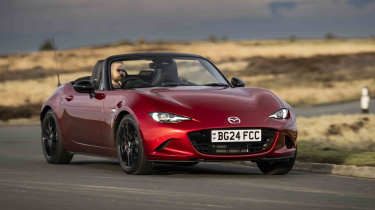
Back-to-basics driving thrills are what the Mazda MX-5 has always been about, and the latest version doesn’t disappoint. Despite its price, it’s a driver’s car that deserves to be mentioned in the same breath as much more expensive performance machines.
Whichever you go for, the two engine choices make a revvy, angry noise and just enough exhaust note enters the cabin to remind you that you’re in something sporty. The 1.5 is a little freer revving, but deciding which version has the better character will come down to personal preference.
All versions come with a fantastic six-speed manual gearbox that is precise and has a wonderfully short throw. The RF version was available with an automatic for a brief period, but its has since become manual only, just like the regular convertible.
| Model | Power | 0-62mph | Top speed |
| 1.5L SKYACTIV-G Roadster | 130bhp | 8.3 secs | 127mph |
| 1.5L SKYACTIV-G RF | 130bhp | 8.7 secs | 126mph |
| 2.0L SKYACTIV-G Roadster | 181bhp | 6.5 secs | 136mph |
| 2.0L SKYACTIV-G RF | 181bhp | 6.8 secs | 137mph |
Performance, 0-60mph acceleration and top speed
Despite a modest 130bhp (again at 7,000rpm) and 152Nm of torque at 4,500rpm, the MX-5’s light weight pays dividends here, giving better performance than you might expect. 0-62mph takes 8.3 seconds, and the top speed is 127mph. The 1.5-litre is a lively unit that needs plenty of revs to get to its best, but this is something that it is more than happy to do thanks to its 7,500rpm red line.
We’ve never craved more power in the MX-5, but with the chassis now better than ever, it’s clear that it could quite reasonably handle more than the 181bhp and 205Nm (at 7,000rpm and 4,000rpm respectively) that’s available here. A 0-62mph time of 6.5 seconds isn’t sluggish.
The hard-top RF is available with both engines, but being slightly heavier, it takes 8.7 seconds and 6.8 seconds to go from 0-62mph in 1.5- and 2.0-litre forms, respectively.
Town driving, visibility and parking
Even at low speeds, the MX-5 is a hugely pleasurable thing to drive; from the pedals to the steering to the gearbox, all of the major controls are wonderfully weighted and superbly precise. It’s a car that allows you to appreciate the basics of mechanical interaction on even a short trip to the shops.
Harsher bumps can cause small, light cars to jostle around at low speeds. It’s at these lower speeds that roof-off driving in either model results in a little flex from the chassis, which manifests itself most obviously through vibrations in the rear view mirror.
A bonnet lowered by 28mm over the previous car’s, plus thinner A-pillars moved back by 70mm, mean forward visibility has been improved significantly.
Country road driving and handling
It’s on more open roads where the MX-5 really starts to shine, though. With a kerbweight of between 975kg and 1,000kg, depending on spec, the Mk4 is over 100kg lighter than the third-generation model, and only 50kg heavier than the original launched back in 1989.
The result is a wonderful chassis, giving the driver a feeling of agility and balance that, with every passing year, becomes even easier to appreciate as so many cars grow heavier, larger, and more ponderous.
The suspension is much more supple than that of a typical hot hatchback, so the car flows over bumps and rolls through corners. This allows the driver to feel just what is going on through not only the seat of their pants, but also the electric power-steering system. Following a major update, it has become more naturally weighted than ever before. It doesn’t take too much commitment to play with the car’s limits of grip; normally by throwing it into a bend enthusiastically. Even when the front starts to slide, the mildest throttle lift and a little extra lock will see the car tighten its line further. It’s all so predictable and reassuring – and all happening at such sensible speeds that it inspires a huge amount of confidence, so you only lean on it harder.
Another upgrade that helps with this is a revised limited-slip differential. A new cam mechanism has enabled different levels of slip during acceleration and deceleration; in short, this means Mazda has tuned the diff to make the car more predictable at the limit.
As before, the differential is only available on the top 2.0-litre model. The 2.0-litre also has bigger brakes than the entry-level 1.5-litre petrol, which deliver better stopping power, plus it gets sports suspension with Bilstein dampers and a front strut brace. These reduce body roll and aid turn-in. The 2.0 car is slightly heavier than the 1.5, but only by 25kg. The added weight is in the nose, and as a result, the 2.0-litre doesn’t feel quite as quick to turn in, even though it's been given a strut brace to keep the suspension tied together.
Like the roadster, the MX-5 RF has a fairly soft overall suspension set-up, allowing the driver to flow with the road. The RF also weighs an extra 40kg over the standard car – most of which is fairly high up in the chassis. While this is noticeable when driving the two variants hard back-to-back (and the 0-62mph times are marginally slower than the lighter roadster variants), most people won’t notice too much difference. However, given the price difference and that it’s less refined in some ways, we’d opt for the soft-top instead.
Motorway driving and long-distance comfort
Perhaps more of a surprise is that, despite the extra metal that surrounds the driver, the RF is the less refined car on the move; the wind tends to catch the upright buttresses behind the driver and passenger, which at motorway speeds generates far more wind noise than the convertible’s more open design. That aside, the MX-5 is a fairly comfortable and relaxing long-distance cruiser, roof up or down.
“The steering remains one of the best aspects of the MX-5, giving just enough weight to create a sense of security on a cruise but responsive and full of feedback when you want it. The steering wheel hasn’t become thicker to give some false sense of sportiness either (we’re looking at you BMW).” - Alastair Crooks, senior news reporter.
MPG & running costs
Pros |
|
Cons |
|
Mazda claims it prefers not to focus on achieving spectacular results in the official economy charts; instead, it says it’s more interested in giving customers real-world fuel savings.
That’s why its strategy is based around high-compression naturally aspirated petrol engines rather than following the turbocharged, downsizing trend. Both the engines offered in the MX-5 use direct injection technology, but the smaller 1.5-litre SkyActiv unit delivers better on-paper economy at up to 45.6mpg with CO2 emissions from 140g/km.
The 2.0-litre comes with Mazda’s i-stop and E-Loop fuel-saving technology. According to Mazda, it emits 153g/km of CO2 and can only return 41.5mpg at best. Although this seems fairly conservative to us, as we’ve frequently seen averages closer to the mid-40s during testing. This is all the more useful when you realise that the MX-5 only comes with a 45-litre fuel tank.
| Model | MPG | CO2 | Insurance group |
| MX-5 1.5 Prime-Line | 45.6mpg | 140g/km | 27 |
| MX-5 2.0 Homura | 41.5mpg | 153g/km | 33 |
| MX-5 RF 1.5 Prime-Line | 45.6mpg | 140g/km | 24 |
Insurance groups
The hard-roofed RF has slightly lower insurance groups than the soft-top models. The lowest grouping is the base 1.5-litre Prime-Line RF, which resides in group 24 (out of 50), while the highest group is for the top-spec 2.0-litre Homura roadster comes in at group 33.
These groups are pretty similar to those of another popular drop-top, the MINI Cooper Convertible, which sits between groups 23 and 29.
Tax
The Mazda MX-5 qualifies for the standard rate of VED road tax, and steers clear of the luxury car tax surcharge for traditionally powered cars that cost over £40,000 when new..
While a roadster would be an undeniably cool choice of company car, it won’t offer any Benefit-in-Kind (BiK) tax savings. You’ll need an electric car to enjoy the lowest rates, and the MG Cyberster and Fiat 500e Convertible are two of the very few convertibles that fit the bill here.
Depreciation
Despite the UK’s love for a convertible, the MX-5 doesn’t hold its value as well as you might hope. Depending on the variant, our market data shows that it’ll maintain between 39 and 41 per cent of its original value after three years and 36,000 miles.
As convertibles go, the MG Cyberster is a much stronger performer at 59 per cent, although this is a much rarer and far more expensive car.
To get an accurate valuation for a specific model, check out our free car valuation tool...
Interior, design & technology
Pros |
|
Cons |
|
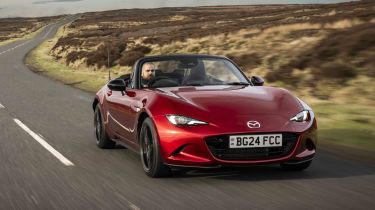
Over time, the MX-5 has received extremely subtle design changes to its exterior, with both the head and tail lights gaining revised LED lighting graphics. It’ll take the largest of anoraks to spot those differences, though. A new paint option, called Aero Grey, has also been added to the line-up, though we’re still big fans of the gorgeous Soul Red finish.
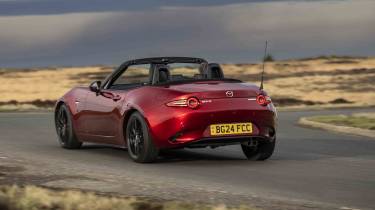
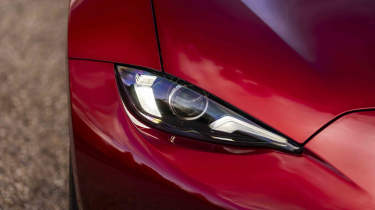
Slim LED headlights and a gaping front grille give it a slightly more menacing character than the third-generation model, while round tail lamps provide a striking light signature in the dark. Whether the roof is up or down, the MX-5 has a classic silhouette, with the cockpit located towards the rear of the car and a long bonnet stretching out in front.
By adapting the standard MX-5’s design to accommodate the hard roof on the RF, Mazda has created something really rather unique in this sector. Unlike the Mk3 MX-5 RC, the RF has buttresses that slope down from the back of the cabin and into the slightly kicked up rear wheel arches. The result is something discernibly different from its soft-top relative, despite sharing the same sharp-looking front-end design.
Interior and dashboard design
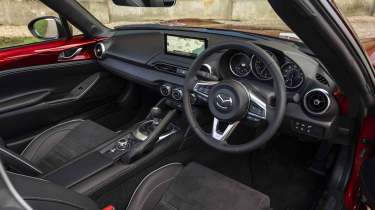
There have been changes on the inside, too, and these are easier to spot than the external revisions. One of the most obvious upgrades is the Recaro seats that are fitted to the range-topping Homura models.
Regardless of your chosen spec, though, the MX-5 contains a very driver-focused layout. While the dashboard is starting to feel its age due to its small infotainment screen and analogue dials, it’s still a pleasant sight. We’ll never complain about it having lots of proper physical dials and buttons, either.
Materials and build quality
The MX-5’s door tops are coloured to match the exterior paint, adding a flash of colour to the cabin and, according to Mazda, visually connecting the driver to what’s going on outside. They are also sculpted in such a way that airflow with the hood down is directed to keep the passengers cool while minimising buffeting to their hairstyles.
Apart from a few questionable plastics here and there, and the simplicity of its design, the MX-5’s cabin is an enjoyable place to be.
Infotainment, sat-nav and stereo
Another key MX-5 improvement was the introduction of an updated 8.8-inch touchscreen infotainment system. However, this only responds to touches when the car is parked. On the move, it’s still possible to use the same intuitive click wheel arrangement that was previously featured. The screen is larger and sharper than before, and all the better for reading the on-screen map. More up-to-date USB-C ports have been added, too.
Wireless Apple CarPlay and Android Auto are also available, and we found it easiest to pair the phone with a USB cable the first time, at which point the system remembers the device wirelessly for subsequent journeys. For the most part, it’s a logical system, but we would like a shortcut to more easily disable the slightly irritating lane departure warning system. The speed limit chime can be switched off with a physical mute button to the right of the steering wheel, just beside the traction control button.
“Some areas do look old now, but overall it’s still a pleasing environment. There’s not much room for storage, and if you place anything heavier than a laptop on the passenger seat, you’ll get some annoying beeps warning your non-existent passenger to put on their seat belt.” - Alastair Crooks, senior news reporter.
Boot space & practicality
Pros |
|
Cons |
|
While the Mazda MX-5 will never be a family car, it has definitely made the most of its limited dimensions. The lightweight fabric hood can be folded back easily from the driver’s seat with one hand. Small cubbies between the seats and on the centre console are useful for your phone or small change, while the car's 12v socket is tucked away under the dash in front of the passenger seat. However, the door bins are small, and there’s no glovebox in the MX-5, bizarrely.
The metal roof of the Mazda MX-5 RF can be raised or lowered in 13 seconds, at up to 6mph. However, the clever top reduces boot space by three litres over the standard convertible. The hard-top doesn’t dampen wind noise any more than the canvas-roofed MX-5, so the RF is still noisy. There is also some turbulence, despite a wind deflector.
Dimensions and size
The Mazda MX-5 is compact, to say the least. The latest model’s overhangs are shorter than before, and the wheelbase has also been trimmed to 2,310mm. This requires inventive packaging within, yet also provides the squared-off stance of the MX-5.
| Dimensions comparison | |||
| Model | Mazda MX-5 | MINI Cooper Convertible | MG Cyberster |
| Length | 3,915mm | 3,879mm | 4,535mm |
| Width | 1,735mm | 1,744mm | 1,913mm |
| Height | 1,225mm | 1,431mm | 1,329mm |
| Wheelbase | 2,310mm | 2,495mm | 2,690mm |
| Boot space |
130 litres (soft-top) 127 litres (RF) | 215 litres | 249 litres |
Seats & passenger space
Compared with its predecessor, the seats in the latest Mazda MX-5 have been moved closer together, with two six-foot adults on board, the driver will occasionally brush their passenger’s thigh inadvertently when changing gear. But otherwise, the MX-5 is very comfy inside for a small car.
With the roof up, headroom stands at 950mm, there’s over a metre of leg room (1,096mm), and you get 1,325mm of shoulder room and 1,320mm of hip room across the cabin. Put simply, it’s cramped in the MX-5, and the RF offers marginally less headroom than the soft-top. However, when the conditions are right, and you can take the roof off, you won’t be concerned about headroom anymore.
The Mazda MX-5 is a sports car with no space in the back for additional seating. If you’re after a drop-top car with space for four, you’ll need to look at something different, such as the BMW 4 Series Convertible.
Boot space
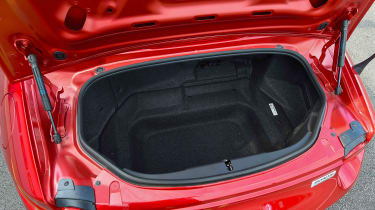
Boot space is reduced compared with the old model by 20 litres to just 130 litres overall, but the load area has been cleverly reshaped so that it can swallow two carry-on suitcases (something the old model could not achieve). The boot opening is 821mm above the ground, while the fabric hood stows away in a slot behind the rollover hoops, so it doesn’t eat into the limited luggage capacity. The hard-top RF has even less boot space at just 127 litres.
“Despite its dinky dimensions, the MX-5’s snug-looking cabin is actually surprisingly roomy. It also packs a decent amount of handy storage and some neat cup-holders.” - Alastair Crooks, senior news reporter.
Reliability & safety
Pros |
|
Cons |
|
The latest Mazda MX-5 still retains a relatively simple mechanical layout, as well as plenty of electronic kit shared with existing models, so the car should provide trouble-free motoring. It’s worth noting, however, that if you plan to drive it hard (on road or track) then perishables such as brake discs, brake pads and tyres will need replacing more frequently.
While this two-seat roadster didn't feature in our latest Driver Power best cars to own list, Mazda managed a middling 17th place finish out of 31 brands on the best manufacturer league table. This was still a better performance than rivals Fiat and MINI, though.
Safety experts Euro NCAP gave the MX-5 a four-star crash test rating in 2015. However, because the MX-5 was tested so long ago, its rating has expired. The MX-5 missed out on the full five-star score because active city stop wasn’t standard, but every model does get front and side airbags, Dynamic Stability Control and traction control. Upgrading to Exclusive-line or Homura trim adds Lane Departure Warning, Smart City Brake and a Driver Attention Alert system.
Buying and owning
- Best buy: Mazda MX-5 2.0 Homura
While we think the 1.5-litre is still a free-revving and eager enough power plant to provide plenty of thrills when combined with the MX-5’s delightful chassis, we would invest in the range-topping Homura trim in order to get the absolute best this two-seater has to offer. At the slight expense of a little more weight in the nose, the extra punch of the 2.0-litre engine makes the most of this car's highly capable chassis and is better able to keep up with other traffic.
We wouldn’t bother forking more out for the RF due to its pronounced buffeting around the rear buttresses, which makes it noisier than the roadster when the roof is down. Those buttresses impact rear visibility, too.
Mazda MX-5 alternatives
The convertible car market has been steadily shrinking for a long time. In fact, we even have a dedicated feature about the death of the convertible car. However, there are a few stubborn holdouts that are worth taking a look at.
If you’re after a sports car, the MG Cyberster is an intriguing albeit expensive alternative. This is a fully electric car, so the driving experience differs greatly from the Mazda, but it does turn plenty of heads. There’s also the more humble Fiat 500e Convertible which is also electric, and just about offers space for four people thanks to having a pair of seats in the back.
If you’d rather stick with combustion power, the Mercedes CLE Cabriolet and BMW 4 Series Convertible are two of the fancier options on the market. Perhaps the closest rival to the Mazda MX-5, though, is the MINI Cooper Convertible, because this offers pretty reasonable costs along with a fun driving experience.
Frequently Asked Questions
The Mazda MX-5 is one of the last remaining cars of its kind. Regardless of your chosen specification or trim, this lightweight, rear-wheel drive roadster provides a huge amount of traditional driver engagement and outright fun. While there’s no hope of it ever being described as practical, there’s simply nothing that can beat it for sheer affordable enjoyment.
Deals on the MX-5 and alternatives
More reviews
Car group tests