Why EVs are so expensive to insure, and how to make them cheaper
Research shows that EVs are usually 15 to 25 per cent more expensive to insure than petrol cars – the experts at Thatcham say they have the solution

Electric cars being more expensive to insure than their internal-combustion engine (ICE) equivalents could soon be a thing of the past as a new battery development blueprint aims to prevent “unnecessary” write-offs by making EVs more affordable and easy to repair.
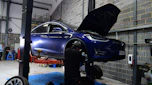
Despite their usually substantial up-front cost, EVs can offer dramatically reduced running costs for most motorists. However, one of the sticking points has long been the relatively high cost of car insurance. This has been attributed to the price of repairing or replacing an electric car’s battery pack if it fails or is damaged, which can often account for up to 40 per cent of a car’s total value.
EVs also generally have faster acceleration than equivalent ICE cars, which means they are seen as having a higher risk of being involved in an accident. With this factor and the higher repair costs combined, the reality in 2026 is that, according to salary sacrifice firm, The Electric Car Scheme, electric cars are typically anything between 15 and 25 per cent more expensive to cover than their petrol equivalents.
Insurance costs: petrol vs electric
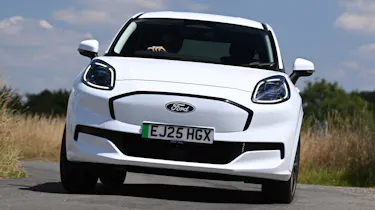
Our own research backs this up to an extent; while investigating our recent EV versus Petrol costs analysis, we found that an electric Ford Puma Gen-E was about £100 (roughly 10 per cent) per year more expensive to insure than the petrol model. A Volkswagen ID.3 Pro Match was also found to be around 20 per cent more expensive to insure than the equivalent 1.5-litre petrol Volkswagen Golf, but on the other hand the premium on a Vauxhall Corsa Electric was actually lower than that on the internal combustion car.
| Model | Insurance (Source: AA) |
| Vauxhall Corsa YES 1.2 Auto (petrol) | £1,048.21 |
| Vauxhall Corsa Electric YES 100kW (electric) | £1,033.80 |
| Ford Puma 1.0 125 ST-Line X Auto (petrol) | £2,894.88 |
| Ford Puma Gen-E Premium (electric) | £3,208.95 |
| Volkswagen Golf Match 1.5 eTSI (petrol) | £955.35 |
| Volkswagen ID.3 Pro Match (electric) | £1,161.99 |
| Skoda Karoq 1.5 DSG SE L (petrol) | £3,182.22 |
| Skoda Elroq SE L 60 (electric) | £3,536.67 |
| BMW 420i Gran Coupe M Sport (petrol) | £3,867.24 |
| BMW i4 eDrive35 M Sport (electric) | £4,700.61 |
How can EVs be made cheaper to insure?
Automotive safety and repair experts, Thatcham Research, have developed a framework which manufacturers can use to develop and manufacture EVs. The recommendations are designed to improve repairability and thus reduce the price of insurance by cutting the number of needless write-offs.

First, electrical system shut-offs must refrain from causing permanent battery damage and should be reversible, like the fuel cut-off in a petrol or diesel car. Batteries themselves should also be easy to decouple from the vehicle and not require bespoke tools or unique and complex procedures.
Once the battery is removed, the manufacturer should provide clear instructions on how to assess any potential damage that both workshops and insurance firms can follow. Thatcham recommends that high-voltage systems should also be standardised across the industry in a similar manner to on-board diagnostics systems in non-electric cars.
For basic EV repairs, Thatcham’s guidelines suggest that a battery should not require a full disassembly in order to cut down on time and complexity. If disassembly is required then it’s said that batteries should be designed with a modular construction with resealable fasteners, rather than simple adhesive.
Finally, to avoid complex repairs in the first place, critical components like charge ports should be relocated to areas of the car less susceptible to crash damage. Batteries should be encased within easy-to-access and replaceable protective casings.
Thatcham Research’s CEO, Jonathan Hewett, described how: “The eight recommendations we've outlined are entirely achievable. We already see these principles working in conventional vehicles – resettable safety systems, accessible diagnostics, serviceable components. There's no technical reason why EVs can't meet the same standards.”
Repairability and sustainability
Given that EVs are part of what is supposed to be a more sustainable approach to motoring, it’s hoped that improved repairability will also improve the lifespan of electric cars, alongside bringing down the price of insurance for drivers.
A recent report by Generational found that the average battery state-of-health of EVs aged between zero and 12 years is around 95 per cent. This is higher than expected and it indicates how many otherwise-usable EVs are being written-off as a result of minor damage by insurance companies because of how expensive their batteries are to repair.
Whether these guidelines will be adopted or not ultimately depends on cooperation between the likes of Thatcham and the industry as a collective. Hewett told Auto Express that: “The issues identified here are the remaining challenges, those that require a reassessment of what truly matters as volumes increase, and where improvements can strengthen the long‑term robustness of insurance premiums.”
“The next step is to work collaboratively with manufacturers to understand how these areas can be improved. These are challenge-led observations rather than design mandates,” Hewett continued. “This approach is intended to avoid constraining design progression at a time when vehicle architectures and technologies continue to evolve rapidly.”
Did you know you can sell your car through Auto Express? We’ll help you get a great price and find a great deal on a new car, too.