Abarth 500e review
Abarth has had a stab at recreating its iconic 500 hot hatch for the electric era – with mixed results

Our opinion on the Abarth 500e
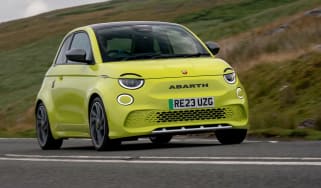
Some real charisma and personality has been injected into the all-electric Abarth 500e hot hatchback. The car is swift rather than fast, but it has impressive road manners given its upright stance and city-car proportions. Add in an excellent cabin, plus the fabulous exterior design transformation, and the 500e feels like one of the most desirable compact hot EVs on the market – even if all that comes at a price.
About the Abarth 500e
The Abarth 500 was a real success for Abarth and Fiat, selling consistently throughout its production run and cultivating an enthusiastic and loyal audience that most brands would kill for. Dropping the model for an all-electric variant was a risk, and one that hasn’t entirely paid off, not least due to a much higher price than the old petrol models.
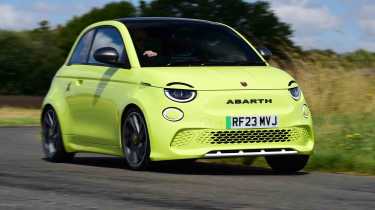
To Abarth’s credit, it’s not a half-measure car. It looks just as good as the old car, and Abarth has made the same kind of effort inside, with racy seats and quality materials. It’s a brisk performer too, and in an attempt to replicate the drama of the petrol Abarth 500s, there’s even a sound generator that doesn’t just work inside the car, but outside it too.
The 500e had the market to itself for a while, but the arrival of other sporty, small EVs means things are a little tougher now, particularly as the car’s pricing puts it into the same region as some more powerful cars like the Alpine A290 and Cupra Raval. The Abarth is entertaining to drive but, like its predecessor, is flawed enough to limit its appeal to a narrower audience than some of its rivals.
Used - available now

2025 Audi
A4
20,684 milesAutomaticPetrol2.0L
Cash £23,249
2022 Nissan
Leaf
25,941 milesAutomaticElectric
Cash £9,750
2022 Mazda
2
45,585 milesManualPetrol1.5L
Cash £11,850
2023 Kia
Picanto
5,505 milesManualPetrol1.0L
Cash £12,199Interestingly, there are signs Abarth could yet launch a petrol version of the current 500 (just as Fiat has a hybrid 500), so those who aren’t ready for the EV may still get to rekindle their love for the previous car.
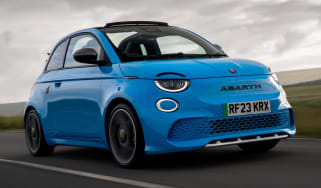
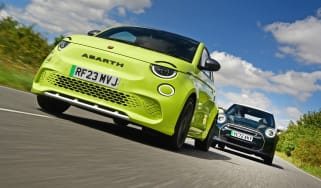
But for now, the 500e is electric only. And we’ve tested both the regular and convertible versions and pitted the Turismo Abarth 500e against the previous-generation MINI Electric.
Electric motor, performance & drive
Pros |
|
Cons |
|
Fiat did a great job of reinventing its 500 city car for the electric era. But when it comes to the sporty Abarth, with no turbocharged four-cylinder engine under the bonnet, the question of how to mimic the regular 500e’s success is a tricky one.
Noise – or rather, the lack of it – is a major part of this, so Abarth decided to tap into the model’s playful nature and simply fake it. As a result, the hot 500e features a sound generator – with one speaker inside and one out – to try to replicate the sometimes flatulent sounds of a petrol-powered Abarth.
After turning the car on, the initial response is surprise – not at the sound itself, rather its quite unruly volume. Straight away, you can tell Abarth is not taking itself too seriously, a positive point despite the potential for teeth-grinding embarrassment, depending on the driver’s circumstances. The volume isn’t variable, and at a constant speed the burble turns into a drone, which you can’t disable on the move.
Electric motors, 0-60mph acceleration and top speed
The Abarth’s motor produces 152bhp – 35bhp more than the most powerful Fiat 500e – plus 235Nm of torque. On paper, the 7.0-second 0-62mph time is good, if not great, but more interesting is its rolling acceleration. Abarth says that the car is a second faster than the old 165bhp petrol Abarth 595, but only in the oddly specific 25-37mph acceleration bracket.
We’d point out that the 216bhp version of the Alpine A290 is over half a second faster in the much more common performance metric of 0-62mph, taking 6.4 seconds, while the MINI Cooper Electric SE can crack 0-62mph in 6.7 seconds.
| Model | Power | 0-62mph | Top speed |
| Abarth 500e | 152bhp | 7.0sec | 96mph |
Town driving, visibility and parking
Being based on one of the smallest modern vehicles on the roads means the Abarth is off to a good start for town driving. It’s short, narrow, and tall, all of which is great for parking, squeezing through gaps and providing good visibility. The eager performance is welcome too, while the ride is much more pliant than its petrol predecessor.
Country road driving and handling
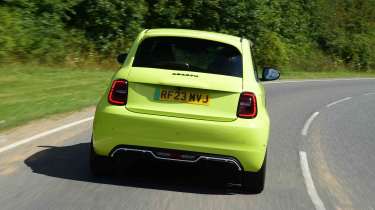
Despite a relatively high seating position, the low-set battery helps weight distribution. As such, the Abarth’s chassis feels agile and playful without suffering a bouncy or brittle ride – quite a feat on a car with a short wheelbase.
It’s hardly softly sprung, but it is compliant even on the larger 18-inch wheels fitted to our top-spec Turismo. This is backed up by responsive, weighty steering, particularly in the Scorpion driver modes. It’s in these two settings that the e-motor’s full 150bhp is available, with the main difference being the level of regenerative braking. There’s lots of front-end grip, but get greedy with the throttle, and you’ll need to manage traction.
You won’t feel bored, because the Abarth is broadly engaging and entertaining. Even the brakes, often a tricky element to get right on high-performance electric cars, have good feel and are more than powerful enough.
Motorway driving and long-distance comfort
Range rather than refinement is the main limiting factor on the motorway, as the relatively small battery conspires with a fairly blunt, upright shape (which works against efficiency) to make higher-speed driving a brief affair. At a basic level, the Abarth is fairly comfortable at motorway speeds and has more than enough performance to cope.
“It takes 2.9 seconds to sprint from 0-31mph, and this lively pace and the car’s tiny dimensions make the Abarth a fantastic city runabout.” – Alex Ingram, special contributor.
Range, charging & running costs
Pros |
|
Cons |
|
Electric range, battery life and charge time
Given the standard Fiat 500e can do up to 199 miles on a charge, you might be disappointed to learn Abarth claims 164 miles in official tests – or a little less if you go for the Turismo on its bigger wheels, or the convertible with its 156-mile range. This (again, officially) rises to 209 miles in town, if you make good use of the car’s regenerative braking system. In our most recent test of the Abarth 500, we got a real-world range of 151 miles, though not much motorway driving was involved, where you can expect less.
As with the electric Fiat 500, the Abarth 500e doesn’t have a heat pump, and it isn’t an option. This will have an impact in colder temperatures because a heat pump provides a more energy-efficient way of warming the interior and preserving the driving range. That’s a shame because both the Alpine A290 and MINI Cooper Electric both get one as standard.
Peak charging speed is as per the top-spec Fiat 500e, at 85kW, yet due to the relatively small battery, a 10-80 per cent charge takes only 25 minutes. If you do most of your charging at home – all but essential in a car like this, we’d argue – then a full recharge is likely to take 6 hours using a 7.4kWh wallbox charger.
| Model | Battery size | Range | Insurance group |
| Abarth 500e | 42kWh | 164 miles | 23-28 |
Insurance groups
The Abarth 500’s insurance group ratings are roughly where you’d expect for a small, sporty electric hatchback, with the entry-level car starting in group 23, and the top-spec model in group 28, similar to the 27-29 of the Alpine A290. The regular Fiat 500, for comparison, sits in groups 13-18.
Tax
Like other EVs under the £50,000 mark, the Abarth 500e will cost you only £10 in your first year of paying VED, which then rises to £200 per year thereafter, matching most combustion cars. There are also the same BIK benefits for company users, with rates of just four per cent in the ‘26/’27 tax year. This will climb to five per cent in ‘27/’28 tax year, seven per cent in ‘28/’29, and nine per cent in ‘29/’30.
Depreciation
In terms of residual values, the Abarth 500e could do better. Over the course of a typical ownership period of three years or 36,000 miles, our expert data from CDL suggests that the 500e will retain 40 to 42 per cent of its original value, which isn’t as good as the 47 per cent the Alpine A290 is expected to be worth, or the 46 to 54 per cent the MINI Cooper Electric is anticipated to be worth.
Design, interior & technology
Pros |
|
Cons |
|
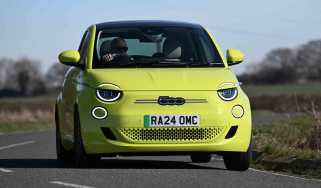
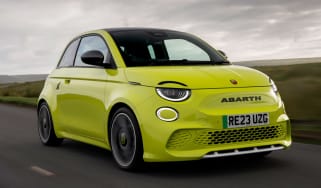
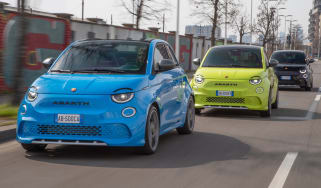
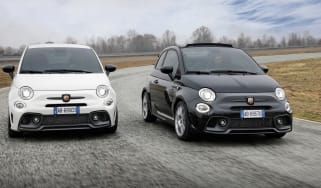
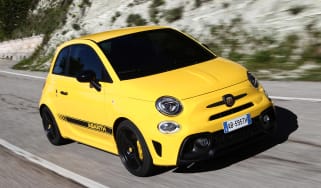
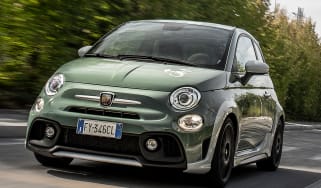
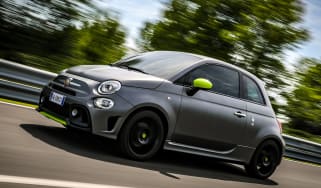
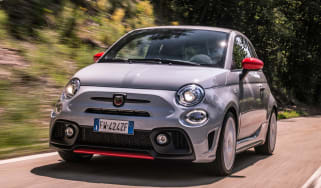
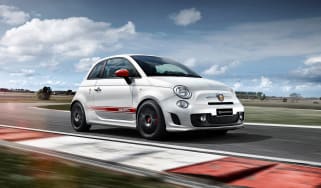
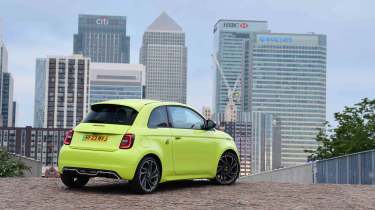
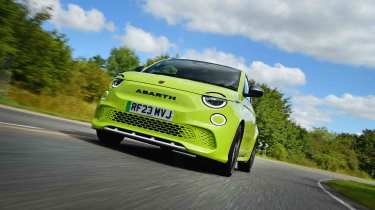
The Abarth 500e looks menacingly different to the standard Fiat 500 on the outside, with a sporty aesthetic that’s emphasised in the car’s more exuberant paint options. More subtle colours are available if you’d rather blend in.
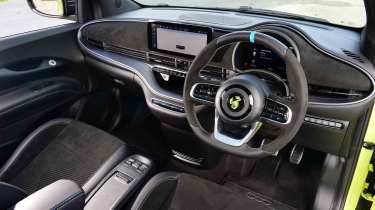
It follows the Fiat 500e by hitting the right notes inside, too, with high-quality black Alcantara trim and a novelty 12 o’clock marker on the steering wheel.
The standard 500e gets plenty of equipment in our view, including:
- 17-inch alloy wheels
- Climate control
- LED headlights
- 10.25-inch infotainment system with sat-nav and wireless Apple CarPlay and Android Auto
- A 7.0-inch digital driver’s instrument cluster
- Rear parking sensors
- Auto lights and wipers
The range-topping comes with 18-inch alloys, a fixed glass roof, heated windscreen and front seats, wireless phone charging, keyless entry and start, Alcantara seats, and a Beats audio system.
Interior and dashboard design
The old 500’s interior was packed with character and ripe for customisation (both by the factory and by owners), and some of that has been carried over to the 500e. What’s different this time is a greater sense of sophistication, and actually a little more sense of space thanks to the more horizontal dashboard format, and no protrusion for a gear lever. The three-spoke steering wheel looks and feels suitably sporty, and the simple instrument cluster ahead of you hits the right notes too, and there are just enough physical buttons and switches not to have to fiddle about in the touchscreen any more than you want to.
Materials and build quality
Much like the design, there’s a sophisticated feel to the Abarth’s materials. There’s a blissful lack of piano black plastic (some supposed premium marques would do well to take heed), and touches like the artificial suede-trimmed dash are a nice touch, and good for reducing glare as a secondary benefit. Likewise, the seats look and feel great, and most controls operate with precision – the only time things feel a little cheap is if you start peering at plastics lower down the dash and doorcards, or when shutting the door itself, which still has a slightly lightweight, tinny feel that reminds us of the old Abarth.
Infotainment, sat-nav and stereo
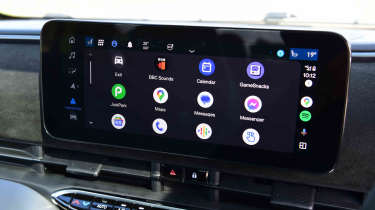
When it comes to technology, the Abarth 500e has most of what you need and little of what you don’t. So there’s no dash-spanning screen – just a simple instrument cluster and a 10.25-inch central display. While some people might expect more at this price point, we love that it allows you to just get on with what this car is about: driving.
The main display is responsive and not too complicated, with all the usual features – Bluetooth and USB connectivity, plus DAB radio and wireless Apple CarPlay and Android Auto if you prefer to use apps on the move. Wireless phone charging is only available with the Turismo trim.
There are some menus bespoke to the Abarth, including screens that show real time information on things like power and torque. These are nice to have and help separate the hot hatch from its humble origins, to justify the hefty price premium.
“The steering wheel is a three-spoke, flat-bottomed item and it feels great to hold, but the driving position itself is quite high.” – Alex Ingram, special contributor.
Boot space, comfort & practicality
Pros |
|
Cons |
|
We’ll begin by stating the obvious: The Abarth 500e is not a big car. There’s no Tardis-style trickery here either, so compromises have ultimately had to be made in terms of space, and you’ll mostly find those in the rear seats and the boot. Objectively speaking, we have to consider this one of the Abarth’s weaknesses, but subjectively, most customers will know before buying whether a car this compact will work for them. If you’re single or a couple without kids, it likely won’t be a problem.
The Abarth’s true strength in the practicality stakes is its compact footprint, which makes it manoeuvrable around town. This, matched to decent visibility, makes it simple and fun to drive on tight city streets.
Dimensions and size
| Dimensions comparison | |||
| Model | Abarth 500e | Alpine A290 | MINI Cooper Electric |
| Length | 3,632mm | 3,997mm | 3,858mm |
| Width | 1,683mm | 1,823mm | 1,756mm |
| Height | 1,527mm | 1,512mm | 1,460mm |
| Wheelbase | 2,322mm | 2,530mm | 2,559mm |
| Boot space | 185 litres | 326 litres | 360 litres |
Driving position, seats & space in the front
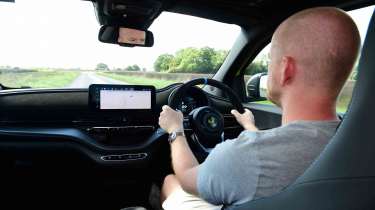
Like the old car, you sit up relatively high in the Abarth 500e - one of the concessions to squeeze a power unit, four seats and a boot into something only 3.6 metres long. The driving position is less compromised here though since there are only two pedals in the footwell, and the centre console no longer digs into your knees. The result is an unconventional but relatively comfortable driving position, and there’s a little adjustment in the wheel to refine things. Large windows provide a good view out, too.
Seats & space in the back
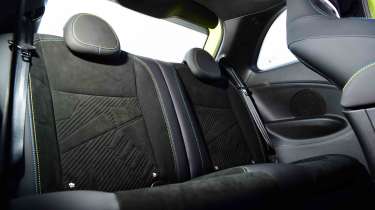
Space in the rear is marginally improved over the previous combustion-powered Abarth, but this is not a car you’ll buy if you regularly carry tall adults. In fact, it’s not a car you’ll buy if you have young children, either – fitting child seats can be a real challenge given the car’s three-door body.
Boot space
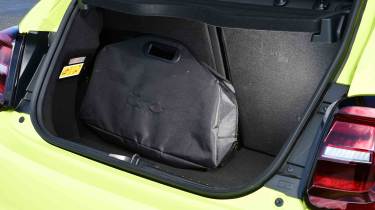
The boot is rated at 185 litres, which is identical to the older car’s. That’s smaller than a MINI Cooper and restricts what you can carry with the seats in place, though it’s worth pointing out that the MINI and the other car in our table above, the Alpine A290, are physically larger vehicles. If you’ve not got a full cohort of passengers, then the rear bench offers useful additional storage; treat the Abarth as a glorified 2+2, and you’ll not be disappointed.
“Interior storage is quite generous for a car of this size. The glove compartment is spacious, while lifting up the central armrest reveals a very deep cubby below.” – Alex Ingram, special contributor.
Safety & reliability
Pros |
|
Cons |
|
We’re a couple of years into Abarth 500e sales now, and so far there have been no major horror stories about the car’s reliability or ownership prospects. Parent company Fiat hasn’t traditionally had the best reputation, but there’s a lot to be said for the 500’s simplicity, both as a small car and being electric, which might be contributing to the ‘no news is good news’ factor.
That said, the Fiat brand has been improving over the years. As recently as 2024, Fiat finished in 31st place out of 33 brands in the Driver Power survey, but in the 2026 survey Fiat was 18th from 30 brands. While that won’t trouble the top of the table, it has placed ahead of the likes of Toyota, Skoda, and Kia, each of which would have comfortably eclipsed Fiat in the past.
In terms of safety, Euro NCAP hasn’t tested the Abarth 500e, but it did put its Fiat sibling through the wringer in 2021 – awarding it a respectable four stars. The Abarth is mechanically similar and gets much of the same kit, so we’d expect a similar score (albeit adjusted for more stringent tests) if it were assessed today.
The Abarth gets a host of airbags, autonomous emergency braking, lane-keeping assist and intelligent speed assist, plus electronic stability control and a drowsy driver detection system. Not the last word in cutting-edge tech, but certainly not as basic as you find in some small city cars.
| Euro NCAP safety ratings | |
| Euro NCAP safety rating | 4 stars (Fiat 500e, 2021) |
| Adult occupant protection | 76% |
| Child occupant protection | 80% |
| Vulnerable road user protection | 67% |
| Safety assist | 67% |
Buying, prices and deals
Best buy: Abarth 500e
While the old Abarth’s range got quite complicated, with different power outputs and trim levels, the 500e sticks to just a single motor, single battery, and two trim levels, one simply 500e and the other 500e Turismo, priced at £27,995 and £30,995, respectively.
Both of those prices have come down a lot compared to when this EV first launched, but you can now save a further £3,750 on each version thanks to the electric car grant (ECG) from the Government. The Abarth 500e is among a growing number of EVs that qualify for the maximum ‘Band 1’ discount, which is automatically applied when you purchase the car.
With only 500e and 500e Turismo models to choose from, we’d stick to the basic car. Both get the same powertrain and battery, so performance is nigh-on identical. The regular 500e has smaller wheels, so it beats the Turismo version for driving range, and the latter’s significant price isn’t justified by its additional features. Given the Abarth is already priced alongside some pretty competitive machinery, it makes sense to us to spend the least amount of money you can. That being said, it’s important you get it in a vibrant colour: Adrenaline Red and Acid Green are both available as £650 options on the standard 500e.
Check out our latest new car deals, leasing deals and used car deals for the top offers available now on Auto Express. And don't forget we can help you sell your car, too.
Alternatives
Abarth got in there early by offering an electric hot hatch, and it more or less had the market to itself. Since then, a few more options have hit the market. First there’s the MINI Cooper Electric, starting around the £27,000 mark and with 181bhp to its name, though in basic form it’s not actually as quick off the mark as the Italian car, in part thanks to being significantly heavier.
Another pseudo-retro option is the Alpine A290. This French hot hatch can’t scale the heights of the brand’s A110 sports car, but as a quicker, more entertaining take on the excellent Renault 5 supermini it’s quite appealing – though once again, despite offering 178bhp in its GT+ entry-level form, it can’t match the Abarth’s 0-62mph time. It’s a little larger and more sophisticated though, and prices start at about £33,500.
One new entrant into the market is the Cupra Raval. We’ve not compared it directly with the other hot EV hatches yet, but signs are promising. Lower-spec models don’t offer anything like the Abarth’s performance, but our experience with the top-spec car is that it’s a fun handler, and a mid-range V1 trim 133bhp car for only around £27,000 could end up being a fun alternative.
Abarth 500e pictures
Key updates of the Abarth 500e review
3 August 2026: Update to include mention of the £3,750 Band 1 electric car grant (ECG) discount
Frequently Asked Questions
All Abarth cars come with a three-year manufacturer’s warranty, with unlimited mileage in the first two years, and a maximum limit of 60,000 miles in total in the third year.
Deals on the Abarth 500e and alternatives