BMW X1 vs Audi Q3: 2012 twin test
BMW has waded in with a revised X1, but can it beat the Audi Q3? We put the pair head-to-head...

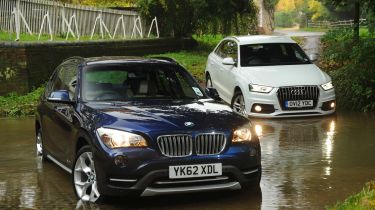
New compact SUV and crossover models have streamed on to the market over the past couple of years, leaving the BMW X1 looking a little out of date. So the company has made a series of revisions in an attempt to bring the car back into contention.
The changes aren’t exactly radical, though. There’s now the option of an eight-speed automatic gearbox in place of the old six-speeder, while two new trim levels – xLine and Sport – join the line-up. All X1s also get subtle styling alterations and a slightly revised interior.
There’s a choice of 18d, 20d and 25d diesel engines, with all but the flagship 25d offered in either two or four-wheel drive.
We test the 141bhp xDrive 18d 4x4 in xLine trim. It faces the classy and desirable Audi Q3. The 138bhp 2.0-litre TDI quattro version in flagship S line spec costs £1,110 more than the BMW. The question is whether the revised X1 can topple one of our current class favourites.
Verdict
BMW has been on a roll of late. The 1, 3 and 5 Series are our current favourites in their respective sectors, while the new 3 Series Touring recently took victory in its first test. Unfortunately, minor updates to the X1 haven’t done enough to change our opinion that it’s the weakest car in the range.
Used - available now


Its dated cabin, awkward looks and heavy steering all disappoint. The X1’s flaws are even more obvious when pitched against the Audi Q3, which is a well rounded and desirable package.
It isn’t exciting and it’s far from revolutionary, but a first-rate cabin and smart looks mean it feels just like a scaled-down Audi Q5, while the driving experience strikes a careful balance between comfort and handling. It also has a bigger boot and more passenger space than the BMW.
Still, the X1 isn’t all bad. The 18d engine is refined, punchy and clean, while taut body control and secure grip mean that, aside from the heavy steering at low speeds, the BMW is pretty good to drive.
Also, the new xLine trim is relatively well equipped and it’s cheaper to buy than the S line Q3. The pair returned identical fuel consumption, but the BMW is cleaner. Yet the Audi has better residuals, and is also easier to live with, roomier and more desirable than the X1. It’s a clear winner.
First place: Audi Q3 2.0 TDI quattro
Audi's baby off-roader is unlikely to get muddy, but it offers the raised seating position, image and looks of a large SUV in a smaller, more efficient package. The boot is 40 litres bigger than the X1’s and the cabin serves up more space, too. Optional extras are very costly and in S line trim it’s a little expensive, but strong predicted residual values are a big plus point for private buyers.
The Q3 model line-up is only a year old, but Audi’s relentless range expansion means the compact crossover is no longer the newest metal in the showroom.
Nevertheless, a close resemblance to the handsome Q5, a classy image and compact dimensions ensure it still strikes the right note. The prominent grille, rounded roofline and the trademark clamshell tailgate are all familiar Audi SUV styling cues. In order to create a rugged 4x4 look, the standard Q3 gets wheelarches and side sills that contrast with the rest of the body colour, but S line models like the one we tested here get the full body-colour treatment and a smattering of subtle, sporty details.
Climb aboard and you’ll notice the taller ride height gives the Q3 a loftier driving position than the X1. But it’s the design of the cabin that really sets the Audi apart from the BMW. The instruments and general layout are crystal-clear and modern, while the materials are a step above the X1’s.
A beautifully damped 3.5-inch screen pops up manually from the dash and Audi’s MMI control system is a breeze to use, plus the optional sat-nav is excellent. But while leather is standard in the xLine-spec BMW, it’s a costly £795 optional extra in the Q3.
The most impressive option is the £220 Audi Drive Select system, which allows you to choose from Dynamic, Auto, Efficiency and Comfort modes at the touch of a button. Dynamic makes the steering heavier and sharpens throttle response, while at the other end of the scale, Efficiency mode optmises the car’s fuel economy.
In Comfort, the steering is noticeably lighter than the X1’s, making the car easy to live with at low speeds, but the weightier response in Dynamic doesn’t offer any better feedback – here the BMW still has the edge.
The two SUVs offer similar grip, but the taller-riding Q3 doesn’t control body roll as well as the X1 – although the trade-off is a more comfortable ride in the Audi.
The Q3’s 138bhp 2.0-litre engine is a bit noisier under load than the BMW’s, and it doesn’t feel quite as punchy. Still, at the track our two contenders were closely matched on performance, and quattro all-wheel drive ensures the Audi has easily enough traction. The six-speed manual transmission also has a precise shift action, and overall the car strikes a fine balance between handling and comfort.
Add in a bigger boot and slightly more rear legroom than in the X1, and you’ll find that the Audi is the more practical of the two as well.
In S line trim, it costs £1,110 more than the xDrive X1; opt for SE trim on both and the Audi is only £360 more expensive. Either way, its has slightly higher CO2 emissions, but much stronger residual values.
It isn’t revolutionary, but a tried-and-tested formula makes the Q3 a formidable choice.
Second place: BMW X1 18d xDrive
The X1 isn’t a bad car. It’s just that it looks like the weakest link in BMW’s line-up. And the driving experience hasn’t improved. Still, the first X3 wasn’t great, yet the current one is a genuine contender. So while the revised X1 looks and feels dated, BMW fans will hope an all-new car, if and when it arrives, will rival the Q3. Until then, it remains an also-ran.
Is it a jacked-up 1 Series crossover, or a genuine premium compact SUV? That’s the identity crisis the X1 has always faced. Perhaps crisis is too strong a term, but the smallest BMW X model has never had the kudos and image of the larger X3 and X5.
Yet for some buyers, the absence of brash SUV styling is a plus point, and the latest revisions to the X1 do little to change that.
In fact, a quick glance will leave you wondering if the looks have changed at all. Study the car closely, however, and you might spot that there’s less grey plastic cladding, that the indicators have been integrated into the door mirrors and that there’s a new set of headlamps to give the front end a more contemporary look. xDrive cars get 18-inch wheels and chrome for the grille and exhaust, plus aluminium-effect roof rails and side sills.
Still, there’s no escaping the fact that the X1 is based on the previous 3 Series Touring – and this is immediately apparent once you climb aboard. There, you’ll discover that the steering wheel, gearlever and some of the switchgear are carried over from the old car.
The cabin is solidly built, but some of the plastics feel a little hard and overall the X1 isn’t as modern or upmarket as the Audi. Passengers don’t fare too badly – two adults can sit comfortably in the back – but the X1 doesn’t offer any more legroom than the average family hatch, plus its small rear doors make accessing the back seats tricky.
On the plus side, those seats fold flat to the floor without the need to tumble the bases forward, and the maximum luggage capacity is just 15 litres down on the Q3’s, at 1,350 litres. However, with the seats up, the BMW’s boot suffers more wheelarch intrusion than the Audi’s, giving only 420 litres of space as opposed to the Audi’s more generous 460 litres.
Cabin stowage is decent, especially if you go without sat-nav – then, a large bin in the centre of the dash fills the gap where the screen would be.
The X1 doesn’t have the lofty SUV-like driving position of the Q3, but the seats are comfortable and the interior wraps around you in typical BMW fashion, reflecting the company’s driver-focused values.
Unfortunately, first impressions on the move are not good, as the steering is very heavy at low speed. While rear-wheel-drive sDrive X1s get electric power-steering, 4x4 xDrives have the older hydraulically assisted set-up, which robs them of the lightness of touch that we now expect from BMWs.
Things get better once you’re up to speed, as the steering is precise and offers plenty of natural feedback, while body roll is kept in check and there’s lots of grip. With 18-inch wheels and run-flat tyres, there’s a firm edge to the ride, and the revised X1 still doesn’t hit the sweet spot between handling and comfort.
And because it’s 105kg heavier than the Q3, it never feels as agile as its small dimensions suggest. Yet despite a 60Nm torque deficit, performance is strong, helped by a sharp throttle response: the 2.0-litre 18d engine feels faster and punchier than the Audi’s.
At the test track, the X1 and Q3 are closely matched, and it’s only in the higher gears that the BMW can edge ahead against the stopwatch. The engine’s refinement makes a good impression, too. Noise is well isolated from the cabin and it’s smooth and quiet on the move. The snappy six-speed manual gearbox is great, while the standard stop-start system ensures the 18d emits only 144g/km of CO2 – placing it one tax band lower than the Audi. During our test, we averaged respectable 38.9mpg economy.
Fixed-price servicing also helps to lower running costs, but the X1 can’t match the Audi’s residuals. If that’s a marker of the BMW’s desirability, we wonder whether the updates have done enough to hand the revised crossover victory in this test?
Facts and figures
| BMW X1 18d xDrive xLine | Audi Q3 2.0 TDI S line | |
| On-the-road price/total as tested | £28,150/£31,350 | £29,260/£34,235 |
| Residual value (after 3yrs/30,000) | £12,133/43.1% | £15,332/52.4% |
| Depreciation | £16,017 | £13,928 |
| Annual tax liability std/higher rate | £1,230/£2,460 | £1,337/£2,674 |
| Annual fuel cost (12,000/20,000 miles) | £2,005/£3,342 | £2,005/£3,342 |
| Ins group/quote/road tax band/cost | 22/£406/F/£135 | 18/£374/F/£135 |
| Servicing costs | £300 (5yrs/60k) | £25pcm (3yrs) |
| Length/wheelbase | 4,477/2,760mm | 4,385/2,603mm |
| Height/width | 1,545/1,798mm | 1,608/1,831mm |
| Engine | 4cyl in-line/1,995cc | 4cyl in-line/1,968cc |
| Peak power | 141/4,000 bhp/rpm | 138/4,200 bhp/rpm |
| Peak torque | 320/1,750 Nm/rpm | 380/1,750 Nm/rpm |
| Transmission | 6-spd man/4wd | 6-spd man/4wd |
| Fuel tank capacity/spare wheel | 61 litres/run flats | 64 litres/sealant |
| Boot capacity (seats up/down) | 420/1,350 litres | 460/1,365 litres |
| Kerbweight/payload | 1,640/1,800kg | 1,535/1,800kg |
| Turning circle/drag coefficient | 11.8 metres/0.34Cd | 11.8 metres/0.32Cd |
| Basic warranty (miles)/recovery | 3yrs (unltd)/3yrs | 3yrs (60k)/3yrs |
| Service intervals/UK dealers | Variable/153 | Variable/121 |
| Driver Power manufacturer/dealer pos. | 14th/16th | 15th/18th |
| Euro NCAP: Adult/child/ped./stars | 87/86/64/5 | 94/85/52/5 |
| 0-60/30-70mph | 9.6/9.6 secs | 9.5/9.3 secs |
| 30-50mph in 3rd/4th | 4.1/5.6 secs | 3.9/5.8 secs |
| 50-70mph in 5th/6th | 7.4/9.4 secs | 7.8/10.4 secs |
| Top speed/rpm at 70mph | 121mph/2,000rpm | 122mph/2,000rpm |
| Braking 70-0/60-0/30-0mph | 51.4/37.7/9.8m | 50.6/37.5/9.3m |
| Noise levels outside/idle/30/70mph | 71/46/62/68dB | 71/46/60/68dB |
| Auto Express econ (mpg/mpl)/range | 38.9/8.6/522 miles | 38.9/8.6/548 miles |
| Govt urban/extra-urban/combined | 43.5/58.9/51.4mpg | 40.9/56.5/49.6mpg |
| Govt urban/extra-urban/combined | 9.6/13.0/11.3mpl | 9.0/12.4/10.9mpl |
| Actual/claimed CO2/tax bracket | 195/144g/km/22% | 195/149g/km/23% |
| Airbags/ISOFIX/cruise control | Six/yes/£590* | Six/yes/£225 |
| Electric/leather/heated seats | £875/yes/£265 | £765/£795/£260 |
| Hill descent/adapt dampers/met paint | Yes/no/£465 | £195/£680/£525 |
| Park sensors front/rear/rear camera | £215/yes/£310 | £250/yes/£650 |
| Sat-nav/DAB radio/Bluetooth | £1,550/£285/yes | £495/£305/yes |