Greatest 1990s hot hatchbacks
A lack of driver aids coupled with modern engine technology made 90s hot hatchbacks great. These are our favourites

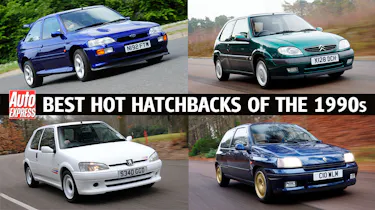
The 1990s were an unusual period for hot hatches. Manufacturers were operating right on the cutting edge, developing suspension, chassis, tyre and engine management technologies that have since become commonplace. The greatest 90s hot hatchbacks were the result of brands experimenting with a wide range of approaches to generating horsepower and then using it to the best effect.
Engine technology was developing rapidly. The under-stressed, high-displacement engines and carbureted fuel systems of the 70s and 80s were gradually being shunned in favour of high-compression, low-displacement powertrains with electronic fuel injection – some of which were paired with forms of turbocharging.
Modern engine control units were also in their infancy, tasked with providing a more reliable method of engine and spark management than a traditional distributor and coil. However, the industry couldn’t keep pace with the speed of progress, so the cars from this period often have a strange blend of old-school mechanical and modern electronic engine management.
We’ve taken a step back in time to choose our hot hatchbacks from before the turn of the millennium.
Citroen Saxo VTS
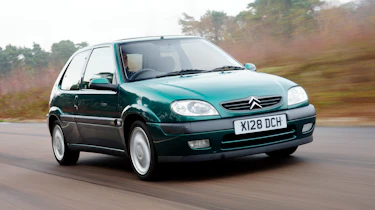
Loved by track-day enthusiasts and boy racers alike, the Citroen Saxo VTS is a sweet-handling hot hatchback with chunky retro styling. It was powered by a peppy 1.6-litre four-cylinder petrol engine which, unlike its pricier rivals from Ford and Nissan, relied on good-old-fashioned flow dynamics to generate power, rather than an enormous turbocharger.
The engine can trace its roots back to the Citroen AX, but for the Saxo VTS it was fitted with a 16-valve cylinder head and a freer flowing exhaust system. This resulted in an output of 118bhp and 145Nm of torque. Granted, this doesn’t sound like much, but combined with the Saxo’s circa 900kg kerb-weight, it was enough grunt to worry the Volkswagen Golf GTI of the day.
Ford Escort RS Cosworth
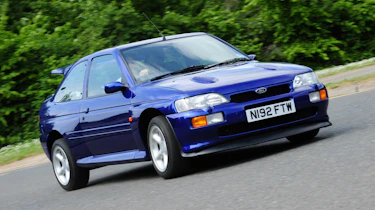
Ford designed the Escort RS Cosworth to be competitive in the Group A class of the World Rally Championship. Like the Nissan Sunny GTi-R, it’s powered by a turbocharged four-cylinder engine, which sends power to all four wheels via a notchy manual gearbox. Those wild aero appendages do more than just look good, too – the splitter and rear wing were both designed to keep the RS Cosworth stable at high speeds.
As was often the case in these experimental days of forced induction, the Escort RS Cosworth suffers from appalling turbo lag. But, once the boost kicks in at around 2,500rpm, there’s 227bhp and 304Nm of torque on offer – enough for a 0–62mph time of 6.2 seconds and a top speed of 137mph.
Nissan Sunny GTi-R
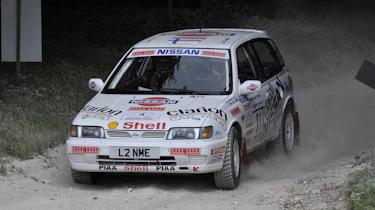
The Nissan Sunny GTi-R was another daft homologation special, built to allow the Japanese manufacturer to enter the Group A class of the 1991 World Rally Championship. To make it competitive, Nissan took the humdrum Sunny hatchback, binned all of its mechanicals and shoehorned its famously tuneable SR20DET 2.0-litre engine under the car’s bonnet.
Nissan then fitted a beefy five-speed manual gearbox, larger brakes and an all-wheel drive system, similar in design to the system found under the R32 and R33 Skyline GT-Rs. The result was 216bhp, 267Nm of torque, a 0–60mph time of around five seconds and a claimed top speed of 144mph – enough to give the modern Ford Focus RS a run for its money.
Peugeot 106 Rallye
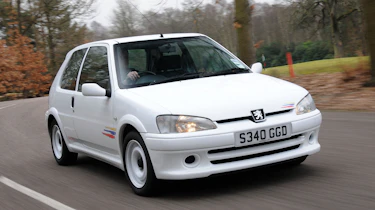
For the third time in this list, homologation rules forced a manufacturer’s hand into producing an excellent hot hatch. Back in the 1990s, the sub-1300cc class of the World Rally Championship was popular but, thankfully, Peugeot’s sporty 106 XSi didn’t comply with the rules, due to its 1.4-litre engine.
To get around the issue, Peugeot dropped a raucous 100bhp 1.3-litre four-cylinder into the 106 XSi’s engine bay and fitted a set of stiffer anti-roll bars. Then, the company’s engineers threw every scrap of superfluous equipment in the bin, giving the Rallye a kerb weight of 825kg. The effects were profound – the 106 Rallye had razor-sharp handling, vast reserves of grip and an impressive power-to-weight ratio of 121bhp per tonne.
Peugeot 306 GTI-6
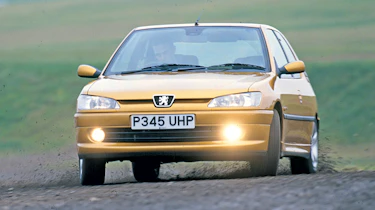
The standard 306 was a great car – it was arguably the prettiest of nineties’ hatchbacks and drove brilliantly, too, so it was the perfect base for a hot hatch.
The XSi was fun, but when the 306’s mid-life facelift arrived, so did the 306 GTI-6 with its 167bhp 2.0-litre engine and snappy, six-speed gearbox – something of a rarity at the time. That short gearing added to the excitement, with quick responses from both the throttle and steering adding to the mix. Yet it wasn’t at the expense of comfort; the 306’s legendary cushy ride may have been firmed up in the name of body control, but it was still reasonably comfy, while there was space for the family inside.
There was one major downside, though, as the larger six-speed gearbox played havoc with the steering rack, so the turning circle of the GTI-6 was ship-like. You can’t mention the GTI-6 without mentioning the slightly stripped-out Rallye version, which was even quicker.
Renault Clio Williams
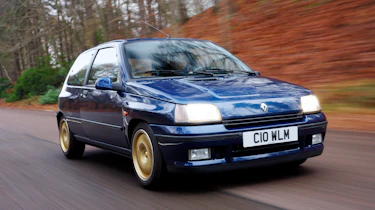
The Renault Clio Williams was the first hot hatchback to put the legendary Peugeot 205 GTi in its place. It handled like it was on rails – Renault’s engineers pinched the reinforced front subframe from the Clio Cup racer of the day; then fitted uprated springs, beefier dampers, new rear torsion arms and thicker anti-roll bars. The track was also about an inch wider than the standard car’s, to accommodate the wider Speedline alloys and fatter tyres.
The Clio’s engine was another naturally aspirated four-cylinder petrol unit, this time displacing 1.8 litres and producing 148bhp. The powertrain’s peak torque figure of 171Nm arrived low in the rev-range, too, which made the Williams feel gutsy and eager – especially when coupled with its 981kg kerb-weight.
SEAT Ibiza GTI
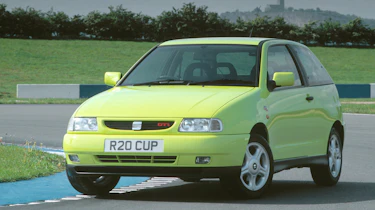
The Ibiza GTI was an early product of SEAT’s partnership with Volkswagen. It was based on a modified version of the rather lumpant Mk3 Golf’s underpinnings – but its handling was far better than its donor car’s due to its shorter wheelbase, stiffer suspension and lower kerb weight.
Thankfully, it retained the Golf’s range of powerful four-cylinder petrol engines. Buyers could opt for either a 113bhp 2.0-litre eight-valve powertrain, or a free-revving 127bhp 1.8-litre 16-valve unit – the latter of which offered a 0–62mph time of 8.6 seconds. Post-1996 Cupra Sport models were also available with a 2.0-litre 16-valve four-cylinder engine, which saw the Ibiza’s power figure soar to 148bhp and its 0–62mph time drop to 7.6 seconds.
Vauxhall Astra GSi
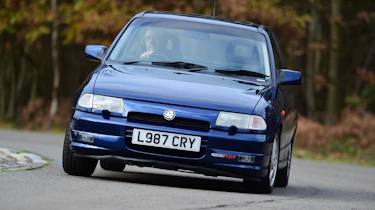
Most of the cars on this list are nimble and dainty – but not the Astra GSi. It was a heavyweight in a class of bantams, with a bulky body, poor handling, standard airbags and a suspension setup pinched from the larger Cavalier. However, all of this meant that, when it inevitably saw the wrong side of a ditch, it was considerably safer than its rivals.
It was powered by an early version of Vauxhall’s motorsport-derived “Red Top” 2.0-litre four-cylinder petrol engine, which developed 148bhp and a meaty 196Nm of torque. The twin-cam unit was built in collaboration with Cosworth and has a reputation for tunability, with later turbocharged variants developing upwards of 200bhp.
Volkswagen Polo G40
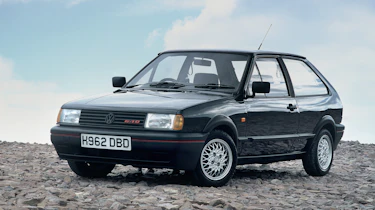
The Polo G40 was another experiment with forced induction. Unlike its rivals, the Fiat Uno Turbo and Ford Fiesta RS Turbo, the G40 was fitted with a belt-driven supercharger rather than an exhaust-driven turbocharger. As such, the G40’s boost arrived low down and climbed in a linear fashion throughout the rev range – and there was no turbo lag.
The engine to which the supercharger was bolted was a 1.3-litre four-cylinder petrol unit. With the help of forced induction, it had an output of 113bhp and 150Nm of torque. Couple that with a short ratio gearbox and a lightweight body and you’ve got a hot hatch that can keep up with modern competition. Top speed is 122mph, while 0–62mph takes around eight seconds.
Which 1990s hot hatch is your favourite? Tell us in the comments section below...