New BYD Dolphin G arrives in the UK for a huge £6k less than key rivals
The BYD Dolphin G supermini gets big-car technology, with all versions costing less than £30,000
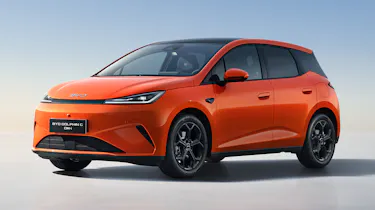
The BYD Dolphin G is the Chinese car brand's newest supermini arrival in the UK, and with prices starting from less than £24,000, it’s officially the UK’s cheapest plug-in hybrid.
On display at the 2026 Goodwood Festival of Speed, the Dolphin G comes in four versions. The £23,990 ‘Active’ and £26,990 ‘Boost’ variants get a smaller battery with less range, while the £28,490 ‘Comfort’ and the range-topping £29,490 ‘Sport’ have a larger battery that offers more EV miles.
The Dolphin G is available to order now with the first customer deliveries set to start from September. Even in Sport guise, it undercuts the next cheapest plug-in hybrid on sale in the UK, the £29,990 Geely Starray EM-i SUV, by £500.
The Dolphin G, which we drove recently for the first time, is the initial model BYD has designed in Europe for Europe, where the brand hopes to make an impact on the hugely important ‘B-segment’ of the car market, going up against the likes of the Renault Clio and Toyota Yaris. Neither of those rivals are available with plug-in hybrid technology, although they do come as full-hybrids.
The MG3 Hybrid+ also features a full-hybrid system – these are powertrains that don't need to be plugged in – and costs less than £20,000. Although you can currently save nearly £3,000 on one with the help of the Auto Express Buy A Car service.
BYD Dolphin G plug-in hybrid powertrain and performance
Unlike the all-electric Dolphin supermini that’s already on sale in the UK, the Dolphin G is powered by BYD’s ‘Super Hybrid’ DM-i system that’s also used by the brand’s Atto 2 DM-i and Seal U SUVs. It combines a 1.5-litre petrol engine with two electric motors, one of which helps drive the front wheels, while the other generates energy for the motor and the battery.
Power output and the size of the battery depends on the specification of the Dolphin G. Entry-level Active models will feature a tiny 7.42kWh battery that, according to BYD, is good for up to 25 miles of pure-electric driving, whereas Boost, Comfort and Sport versions will get a larger 18.3kWh pack that will deliver a 65-mile EV range.
BYD’s plug-in hybrid powertrain prioritises electric running to improve fuel efficiency and provide a smoother, more refined driving experience. The petrol engine and primary e-motor can work together to drive the front wheels though, such as under hard acceleration, with the car determining how the hybrid system behaves depending on the situation.
The brand claims the Dolphin G has a combined range of up to 646 miles from a full tank of petrol and a fully charged battery. The base model produces 173bhp and the rest of the line-up makes a healthier 209bhp, yet every Dolphin G does 0-62mph in 8.3 seconds and has a top speed of 112mph.
Fully recharging either battery should take a little under three hours from a typical 7kW home wallbox, but those with the larger units can also be charged at up to 39kW from a DC rapid charger. This enables a 10 to 80 per cent top-up in 26 minutes.
Interior and practicality
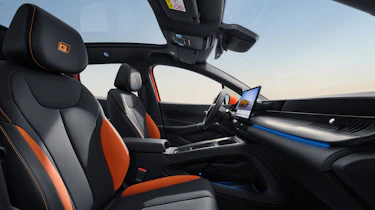
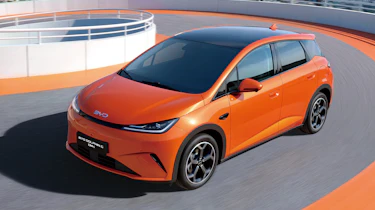
The Dolphin G measures 4,160mm long, 1,825mm wide and 1,575mm tall, making it slightly larger than a Skoda Fabia and MG3. It also has a 2,610mm wheelbase, which is claimed to deliver “best-in-class packaging”, including space for five adults and a 425-litre boot, which is bigger than a Volkswagen Golf’s.
The luggage space includes a 45-litre compartment underneath the boot floor and there’s up to 1,225 litres on offer with the 40:60-split rear bench folded down.
BYD’s newcomer will be available in four trim levels: Active, Boost, Comfort and a more distinctive Sport edition.
In terms of standard kit, the entry-level model features a 10.1-inch touchscreen plus a 8.8-inch digital instrument panel, Apple CarPlay and Android Auto connectivity, automatic air-conditioning, fabric upholstery plus a raft of driver-assistance systems, such as adaptive cruise control and blind-spot detection.
The higher-spec Boost model piles on the luxuries, with tinted windows, a vegan leather-trimmed steering wheel, heated front seats and, strangely, additional air vents. It also adds a 12.8-inch touchscreen, an eight-speaker sound system, ambient lighting, a wireless smartphone charger and two USB ports for rear passengers.
Comfort brings 18-inch alloy wheels, a mix of fabric and vegan leather upholstery inside, Google built into the infotainment system with Google Maps and Google Assistant, plus a 360-degree exterior camera.
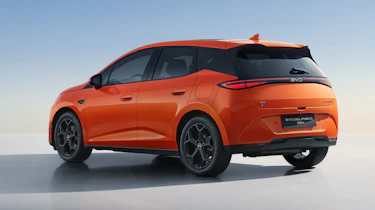
The top-of-the-range Sport version gets all the bells and whistles, plus a sharper look, unique badging, darker 18-inch rims and suede panels on the seats inside with either black or orange and blue accents – matching the two exterior paint options exclusive to the Sport.
BYD’s big plans for Europe
Earlier this year, BYD’s executive vice president Stella Li told us that “BYD is missing the biggest volume in the B-segment”, and that the Chinese colossus’s future small and mid-sized cars would be designed in Europe for Europe. She also said during this year’s Financial Times’ Future of the Car summit that “in the future, we will have more and more products based on European tastes and consumer needs, and designed locally here”.
BYD is pushing hard in the European market, putting the finishing touches to its first car factory in Hungary, its supplier base, and establishing an R&D centre in Budapest, which will work on European cars. It’s a playbook that copies Kia, whose breakthrough European car in 2006 was the European-designed and built Ceed hatchback. It will cause more headaches for Europe’s legacy car industry, with the Chinese brands continuing to take market share.
Pre G, BYDs were designed primarily for Chinese market needs, but Li said the divergence of the two markets required regionalised products, although with shared componentry. “We see a bigger gap now to China,” she explained. “The competition is pushing everybody to make cars bigger and bigger, and the chassis wider and wider, and it’s become crazy. You cannot have a bigger car running in Paris, Rome and London. People there still prefer a smaller-sized car.”
BYD will split its product development for the B and C-segments, with cars less than 4.3m-long – about the size of a Volkswagen Golf – optimised for Europe. Designs will be fine-tuned more for European tastes too, with Li telling us: “I saw the next three years’ cars: their look is based more on European design, no longer Chinese.”
Did you know you can sell your car through Auto Express? We’ll help you get a great price and find a great deal on a new car, too.