New BYD Dolphin G 2026 review: PHEV power helps mask its flaws
Chinese manufacturer BYD’s ultra-rapid product expansion continues into the supermini segment with the plug-in-hybrid Dolphin G DM-i

Verdict
BYD enters the hotly contested B-segment supermini marketplace for the first time with the BYD Dolphin G – with the ‘G’ apparently standing for ‘genius’. That might be pushing things a tad, but this is a perfectly proficient little runaround that promises terrific value and a genuine USP in this segment: a plug-in hybrid powertrain. If that sort of arrangement appeals, then there’s plenty on offer to help you overlook its flaws.
BYD’s almost-frantic desire to conquest every sector of the European car market continues apace with its first non-EV supermini – the Dolphin G DM-i.
Hot on the heels of the recently released Atto 2 DM-i crossover, the Dolphin G represents the only plug-in hybrid (PHEV) small hatchback currently on sale. It uses BYD’s latest ‘5.0’ DM-i (dual-mode, intelligent) PHEV set-up, which aims to provide an EV-like driving experience but with a petrol motor for longer trips.
Ostensibly, the 94bhp 1.5-litre four-cylinder engine is rarely directly driving the front wheels through the electronic continuously variable transmission (e-CVT). Instead, it acts almost like a generator for the large ‘Blade’ lithium-ion battery pack installed in the Dolphin G’s chassis, allowing the 161bhp electric motor to undertake the brunt of the propulsion work.
Used - available now

2023 Tesla
Model 3 Performance
29,560 milesAutomaticElectric
Cash £29,197
2023 Peugeot
208
16,100 milesAutomaticPetrol1.2L
Cash £13,995
2024 Vauxhall
Grandland
7,264 milesManualPetrol1.2L
Cash £15,799
2023 Hyundai
Kona Hybrid
18,785 milesAutomaticPetrol1.6L
Cash £16,799Precisely which Blade battery and associated powertrain you get is linked to four specifications confirmed for the UK market. The base-grade Active car peaks at 174bhp and is fitted with a meagre 7.4kWh unit, providing just 25 miles of all-electric range.
Due to its smaller battery, it is lighter than the other Dolphin G models, so it makes more of the fuel in its 42-litre tank to summon up a 633-mile combined range. It’s also no slower to accelerate, either, achieving the 0-62mph sprint in 8.3 seconds. It has the same top speed as its siblings, too: 112mph.
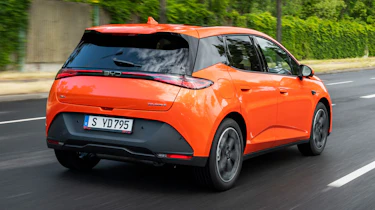
Nevertheless, we reckon most people are going to opt for one of the Boost, Comfort or Sport models, as these come with a significantly enlarged 18.3kWh battery. That ups the zero-emission running to an eye-catching 65 miles, even if the combined powertrain range is not much better than the Active at 646 miles – due mostly to the inflated kerb weight of 1,555kg. It does cut the CO2 emissions to just 32g/km, however – down from 60g/km in the base car.
There’s another benefit to opting for the 18.3kWh Dolphin G variants, which is faster recharging times courtesy of a DC connection. The Active is limited to a paltry 3.3kW AC peak rate, which would see a 15 to 100 per cent top-up of the battery taking almost three hours.
When fitted with the bigger battery, the BYD hatch takes a slight bit longer (around six minutes) to perform the same task on an AC outlet – despite the ability to run at up to 6.6kW. But 39kW DC hook-up is also possible, which would take the Dolphin G’s battery from 10-80 per cent in just 26 minutes on the right connection.
It can also be specified with vehicle-to-load (V2L) capability, allowing owners to plug electrical devices – such as cool boxes or coffee machines – into the BYD and use it as a big, mobile power bank.
In terms of trim levels, even Active cars come with a healthy smattering of kit, including adaptive cruise control, but Boost cars really load in the necessities. Items like the larger 12.8-inch infotainment system, heated seats and steering wheel, an uprated eight-speaker sound system and 15-watt wireless smartphone charging come into play here.
Those wanting such luxuries as 18-inch alloys, Google tech for the control systems and a head-up display for the driver will need at least a Comfort, like our test car.
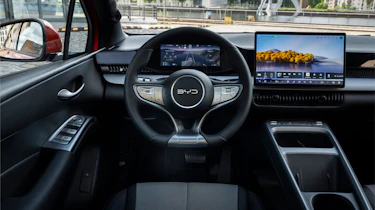
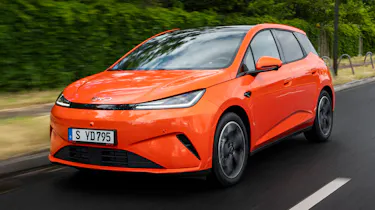
Sport mainly adds styling frivolities and black rims, with the former including a two-tone interior option of either black and orange, or black and blue depending on the chosen exterior body colour. While it won’t set Milan’s fashion runways on fire, we reckon the Dolphin G is a reasonably handsome small car – especially in the Orange Sunset paint of our test model.
Inside, material quality is largely OK for this class of car, although the plastic clothing the upper surface of the dash and the top of the doors is notably cheap in feel. In our car, there were also some deep, unsightly scratches already visible on the driver’s door.
Otherwise, though, no other materials are particularly nasty and, despite running everything through the 12.8-inch touchscreen at the exclusion of almost all physical buttons, the tech and systems seem to work well.
There are some annoying ADAS functions you’ll want to switch off, however, and some of the menu layouts in the screen aren’t the most helpful in facilitating that process. But both graphical sharpness and responsiveness are fine.
Space in the back is a little cramped, mind. Although there’s a completely flat floor, the narrowness of the Dolphin G’s body, coupled with only mediocre amounts of leg and headroom, ensure that this is not the most capacious supermini on sale.
It does, though, have a good boot – often a failing of Chinese family cars. The cargo area in the BYD measures 425 litres with all seats in use, and 1,225 litres with the 60:40 split-folding rear bench dropped down. There’s even dedicated underfloor storage space for the charging cables.
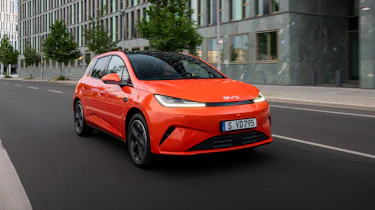
To drive, the BYD Dolphin G is proficient but unspectacular, and its dynamic display is marred by a couple of significant drawbacks which might be enough to put some potential punters off.
Chief offender is an overly busy and far too gritty low-speed ride, exacerbated by the larger 18-inch alloys of our test vehicle. The BYD can really amplify what are only modest lumps in the road surface into quite sharp-edged experiences below 30mph, although it does get better and more composed as speeds rise and tarmac conditions improve.
Another bugbear is the sheer slovenliness of throttle response, in terms of waking the engine up to deliver full power and torque to the wheels. It can take entire seconds for the engine to cough into life and join the electric motor in pushing the car forward at its swiftest pace, and when you do press the engine into action it makes a strained, unpleasant din as the e-CVT gearbox permits it to rev out for prolonged periods.
Also, while the steering is by no means the worst we’ve encountered, there’s still a lack of meaningful feel to it and an odd sensation of stickiness just off dead-centre, all overlaid by an over-zealous self-centring mechanism.
Nonetheless, driven much more sedately, the DM-i proves to be a functionally capable and undemanding vehicle; precisely what target buyers in this sector crave.
And its PHEV-specific features are hard to ignore. It does try to run in all-electric mode as much as possible below 50mph, while a reasonably untaxing test route elicited overall economy of 49.6mpg – just off the claimed combined figure of 62.8mpg, but not by enough to ring alarm bells about the BYD’s long-term efficiency.
Did you know you can sell your car through Auto Express? We’ll help you get a great price and find a great deal on a new car, too.
| Model: | BYD Dolphin G DM-i Comfort |
| Price: | £26,000 (est) |
| Powertrain: | 1.5-litre 4cyl petrol PHEV |
| Power/torque: | 209bhp/210Nm |
| Transmission: | E-CVT automatic, front-wheel drive |
| 0-62mph: | 8.3 seconds |
| Top speed: | 112mph |
| Economy: | 62.8mpg |
| CO2: | 32g/km |
| Size (L/W/H): | 4,160/1,825/1,575mm |
| On sale: | Summer |