Volkswagen Golf R32 vs Alfa Romeo 147 GTA: retro V6 hot hatch battle
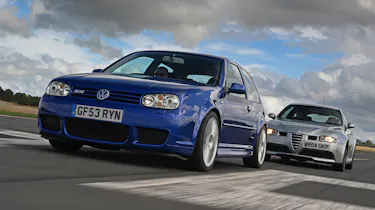
The Volkswagen Golf R32 and Alfa Romeo 147 GTA each took a different approach to the big-engined hot-hatch formula. But which is king – Teutonic titan or Italian stallion?

Here at Auto Express, we like to think that we’re pretty forward thinking. We embrace new technologies, approach new manufacturers with an open mind, and most of all, we try our best to not get all rose-tinted and suggest that cars used to be better in the old days.
But for all the progress in safety, technology and efficiency in modern cars, there are definitely areas where we’d admit that the market isn’t what it was a couple of decades ago. And for the petrolheads we all are, one of the places where it hits home the hardest is in the hot hatch market.
Move back to the early 2000s, and we were undoubtedly at a high point for the segment – in sheer quantity every bit as much as quality. From small, affordable yet brilliantly exciting superminis like the Citroen Saxo VTS, through more powerful contenders like the Renault Clio 172/182, MINI Cooper S and Honda Civic Type R, the keen driver was catered for at many levels.
Then there were the models that proved the engineers had the backing of the board behind them. The hot hatches that tried their darndest to shoehorn the biggest engine possible under their bonnets. Six cylinders In a family hatch? Bonkers, but brilliant.
Used - available now

2018 Vauxhall
Zafira Tourer
67,078 milesAutomaticPetrol1.4L
Cash £8,620
2013 FORD
TRANSIT
30,470 milesManualDiesel2.2L
Cash £10,495
2025 BMW
iX
18,721 milesAutomaticElectric
Cash £32,579
2024 Volvo
XC60
15,720 milesAutomaticPetrol2.0L
Cash £31,543Two of the finest examples of the breed first appeared in 2002: the Volkswagen Golf R32 went on to spawn the R brand, which has continued to this day with huge success. It was spun-off from the Golf V6 4MOTION, which used the 2.8-litre V6 from the outgoing Golf Mk3, with a Haldex clutch-driven four-wheel drive system, but was never especially sharp to drive.
Here, the R32 is squaring up against another six-cylinder stunner. The Alfa Romeo 147 GTA offered the same hatchback bodystyle as the Golf, an engine that matched its rival’s 3.2-litre capacity and even had an identical top speed. But while the pair’s basic formula looks similar, the outcome is a couple of cars with unique, yet utterly wonderful, characters of their own.
Did you know you can sell your car through Auto Express? We’ll help you get a great price and find a great deal on a new car, too.
Volkswagen Golf R32
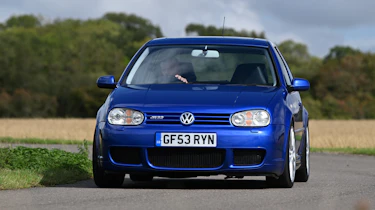
| Model: | Volkswagen Golf R32 |
| Price (new): | £22,340 |
| Powertrain: | 3.2-litre V6, 238bhp |
| 0-62mph: | 6.6 seconds |
| Top speed: | 153mph |
| Official economy: | 24.4mpg |
| Annual VED: | £430 |
Back in 2002, the R32 was priced at £22,340 in three-door form. Adjusted for inflation, that would set its 2025 price at £41,657 - almost exactly the same as today’s Golf GTI. It’s worth noting that, at the time of its release, another of this car’s closest rivals was much cheaper; the Ford Focus RS might have had two fewer cylinders than this pair, but it did offer a turbo by way of compensation. Starting from £19,995, it looked like something of a bargain in comparison.
Replacement
In 2005, a replacement for the R32 was revealed. This time based on the Mk5 model, it remained at the top of the Golf family, but now had a much more talented car sitting below it. Unlike the Mk4 GTI, the Mk5 was a brilliant car, which made the need to stretch to the R32 a little harder to justify. Still, the lure of the 3.2-litre six-cylinder engine under the bonnet was the main reason to take the plunge. It gained 10bhp through better breathing, while UK buyers could spec it with a DSG gearbox for the first time, too.
What we said
We reviewed the R32 back in August 2002, and were delighted that it unlocked potential in the Mk4 Golf that the GTI had failed to do. We declared it “a very complete car and far more enjoyable to drive than any previous Golf”, even if we felt it could have been even better had another 100kg or so been trimmed from the kerbweight. “Fine roadholding, a smooth, powerful V6 and a firm chassis” won us over, as did the fact that it was a “subtler proposition” than the similarly priced and “raw” Subaru Impreza and Ford Focus RS.
Alfa Romeo 147 GTA
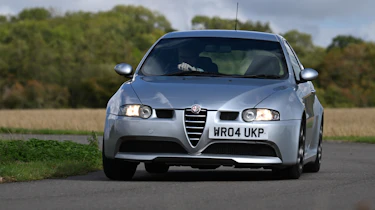
| Model: | Alfa Romeo 147 GTA |
| Price (new): | £22,450 |
| Powertrain: | 3.2-litre V6, 247bhp |
| 0-62mph: | 6.3 seconds |
| Top speed: | 153mph |
| Official economy: | 23.3mpg |
| Annual VED: | £430 |
The 147 GTA was the third Alfa Romeo to wear the famous GTA lettering. First came the Giulia Sprint GTA in 1965, then the 156 GTA arrived just before the 147 in 2001.
Mechanically, it shares a lot with the 156 GTA, including its platform, front suspension and engine. When it was new, it would set you back £22,450 – just a small premium over the Golf. It was cheaper than another upmarket rival, though; the Audi S3, with a much less characterful four-cylinder turbo, cost £24,820.
Selespeed
Browse the used markets, and every once in a while an automatic ‘Selespeed’ option can crop up. All of the 147 GTA Selespeeds in the UK have been imported, most of them from Japan. Although it shares its name with the slightly sluggish, unreliable automated manual (the clutch and gears are hydraulically actuated and electronically controlled) used in lesser 147 models, the GTA’s system is Maserati’s ‘Cambiocorsa’ set-up of the same era. Shifts are quicker than with other Selespeed systems, and with proper maintenance it’s a lot more robust, too.
What we said
Our first experience of the 147 GTA came on the international launch in October 2002. We were excited by the prospect of what was the fastest hot hatch of its era, and adored the noise, describing how the “playful burble at tickover soon becomes a tuneful symphony.” We noted that the front wheels were prone to torque steer, and that keen drivers would appreciate the “slightly unsettled rear end and nose-biased braking system.” We concluded by saying: “Fast, fruity and with real Latin flair, it is great fun to drive.”
Head-to-head
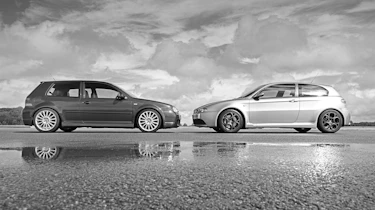
On the road
Both cars are a joy to drive. The Alfa Romeo’s engine is divine: a rich, complex growl that’s so good we wish we could hear more of it from the cabin. The Golf’s engine isn’t quite as sonorous, but it’s a touch more audible. The VW feels more sophisticated in other areas; it’s more agile through the corners, while its gearshift, clutch and pedal placement are way better than those of the Alfa Romeo.
Tech highlights
The big-engine, small-car format is still one that excites, and here are two of the best examples of the breed. Both have 3.2-litre, six-cylinder engines and six-speed manual gearboxes. The main difference is that the Alfa sends its torque through the front wheels, while VW fitted the R32 with its Haldex four-wheel drive system, which sends power to the rear when the front breaks traction.
Price and running
V6-powered hot hatches from the early noughties are unlikely to be bought for their fuel-sipping qualities, and it’s safe to say that the mpg figure for both cars is likely to be in the twenties if driven keenly. Values of both are on the up; GTAs start from around the £10,000-mark, with leggy versions of the Golf starting at around £2,000 or so less. Tidy examples of both cost significantly more.
Practicality
Hot hatches aren’t just about performance – they need to be easy to live with, too. That means space for at least four is just as important as in a standard family car. Both cars easily pass this test. The Golf’s cabin offers a little more elbow room in the back, but the Alfa just edges it in terms of knee room. Both have superbly comfortable back seats, and reasonable boot space, too.
Safety
Both of these cars emerged as Euro NCAP really began to establish itself, so safety standards started to progress. Both have front, side and curtain airbags, plus driver aids like ABS and electronic stability programmes. At the time, NCAP awarded the Golf four stars (by this point, just one car, the Renault Laguna, had scored the full five), and the Alfa was given three stars.
Ownership
Volkswagen sold roughly 2,300 examples of the R32 Mk4 and DVLA data shows that there are just under 900 still registered, with another 850 or so listed as SORN. The Alfa is significantly rarer. The same source shows just 157 registered, taxed and road legal at the end of Q2 2025 (the latest data available), with a similar number of GTAs declared SORN.
Verdict
Winner: Volkswagen Golf R32
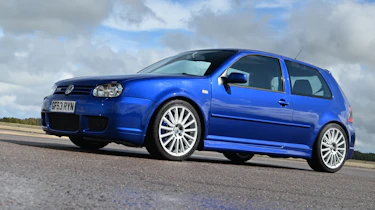
When Volkswagen nails a hot hatch, it goes down among the very greatest, and revisiting the Golf R32 here confirms that it deserves to be given the highest praise. Contrary to many hot VWs that came before, it’s agile and playful to drive – all the more surprising considering the huge engine up front. The 3.2-litre unit sounds great, while all of this is wrapped up in a package that includes all of the things that made the Mk4 Golf such a hit with buyers in any form: a spacious cabin, impressive refinement and superb build quality.
Runner-up: Alfa Romeo 147 GTA
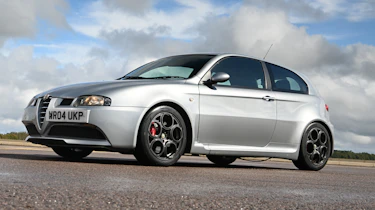
It may come second here, but drive these two cars back-to-back, and you’d be hard pressed not to succumb to the 147 GTA’s immense charm. Absolutely gorgeous to look at, rapid in a straight line, and of course blessed with one of the finest engines ever fitted to a production car, it’s like a baby Italian supercar wrapped up in a hatchback body. Yes, the Volkswagen is a little more agile, more refined and better built, but we doubt any of those things will matter in the slightest if you’ve already fallen for the GTA’s personality.
Prices and specs
| Our choice | Volkswagen Golf R32 | Alfa Romeo 147 GTA |
| Price new/inflation-adjusted to 2025 | £22,340/£41,657 | £22,450/£41,863 |
| Petrol or diesel? | Petrol | Petrol |
| Fuel economy | 24.4mpg | 23.3mpg |
| Powertrain and performance | ||
| Engine | V6/3,189cc | V6/3,179cc |
| Power | 238bhp | 247bhp |
| Torque | 320Nm | 300Nm |
| Transmission | Six-speed manual/awd | Six-speed manual/fwd |
| 0-62mph/top speed | 6.6 secs/153mph | 6.3 secs/153mph |
| Fuel tank | 55 litres | 63 litres |
| Dimensions | ||
| Length/wheelbase | 4,176/2,517mm | 4,213/2,546mm |
| Width/height | 1,735/1,425mm | 1,764/1,442mm |
| Boot space | 275 litres | 280 litres |
| Kerbweight | 1,512kg | 1,360kg |
| Turning circle | 10.9 metres | 12.1 metres |
| Costs/ownership | ||
| Residual value (after 3yrs/36,000 miles) | N/A | N/A |
| Depreciation | N/A | N/A |
| Insurance group/quote/VED | 36/£571/£430 | 38/£646/£430 |
| Three-year service cost | N/A | N/A |
| Annual tax liability std/higher rate | N/A | N/A |
| Annual fuel cost (10k/20k miles) | N/A | N/A |
| NCAP Adult/pedestrian/stars | 4/2/4 _ (2002) | 3/2/3_ (2001) |
| Equipment | ||
| Metallic paint/wheel size | Option/18 inches | Option/17 inches |
| Parking sensors/camera | No/No | No/No |
| Spare wheel/Isofix points | Space-saver/No | Space-saver/No |
| Keyless entry & go/powered tailgate | No/no | No/no |
| Leather/heated seats | Yes/yes | Yes/no |
| Screen size/digital dashboard | N/A | N/A |
| Climate control/panoramic sunroof | Yes/no | Yes/no |
| USBs/wireless charging | No/no | No/no |
| Wireless Apple CarPlay/Android Auto | No/no | No/no |
| Blind-spot warning/head-up display | No/no | No/no |
| Adaptive cruise/steering assist | No/no | No/no |
Looking for your next car? You can now search our nationwide dealer network for a choice of great cars on offer right now with new, used and leasing deals to choose from...