BYD Atto 3 Evo Excellence review: more range, better tech but still ordinary
The updated BYD Atto 3 is an improvement over the original, but the Excellence AWD model is unnecessarily powerful


Verdict
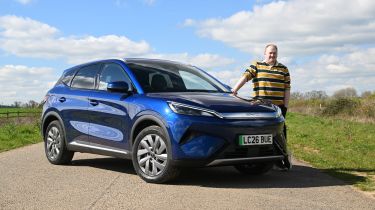
The new BYD Atto 3 Evo does offer some worthwhile improvements over the original, especially the more competitive (but not class-leading) range, Google tech, extra practicality and much faster charging abilities. However, this fairly-ordinary family SUV is not equipped to handle the nearly 450bhp it’s bewilderingly been bestowed with, and its driving manners need some work. The quality doesn’t feel up to the standard we’d expect of the almost £43k price tag either. The cheaper rear-drive model is a better value proposition, but the ride is slightly worse, so it’s a bit of a catch-22.
It’s almost hard to believe BYD only came to the UK three years ago, because the Chinese colossus has launched 10 models, established more than 130 dealerships across the country and in 2025 alone it sold a little over 51,000 cars here – more than Citroen and Dacia, combined. That’s a frankly ridiculous rate of growth.
The brand is showing no signs of slowing down, though, with yet more new offerings on the way, however, it’s also going back to where things began by updating the first car it sold in the UK: the Atto 3 family SUV.
It might look like the Skoda Elroq, Renault Scenic and Smart #5 rival has just received a standard nip-and-tuck for a slightly more sophisticated look, but inside and especially under the metal things have evolved massively, hence the Evo badge.
Used - available now

2023 MG
HS
17,444 milesManualPetrol1.5L
Cash £14,130
2023 Mazda
CX-5
43,336 milesManualPetrol2.0L
Cash £18,000
2023 Mercedes
EQA
30,040 milesAutomaticElectric
Cash £23,220
2026 Toyota
Yaris
13,336 milesAutomaticPetrol1.5L
Cash £16,990The Atto 3 sits on the same ‘e-platform 3.0’ as before, but its 60.4kWh battery has been replaced by a new 74.8kWh unit that’s increased the car’s range from 260 to 316 miles. Although that’s still not as far as those rivals we mentioned, and others, can cover. The Scenic, for instance, boasts up to 381 miles of range.
The BYD does now have the upper hand when it comes to charging speeds. The original version peaked at a rather disappointing 110kW, but thanks to the addition of an 800V electrical system the Evo can hit 220kW, making it capable of a 10-80 per cent charge in 25 minutes. That’s 10 minutes faster than the old car, not forgetting the additional 15kWh of battery capacity.
Meanwhile, instead of having 200bhp and being front-wheel drive-only, entry-level models are now powered by a 303bhp e-motor mounted on the rear axle that cuts the 0-62mph time down from a leisurely 7.1 seconds to 5.5 seconds.
While that sounds plenty for a family SUV, BYD clearly disagrees because it’s created a dual-motor, all-wheel-drive version with 443bhp and 560Nm of torque. That’s 108bhp more than the Skoda Elroq vRS musters up, and very nearly as much as the Tesla Model Y Performance. All that grunt allows this circa-two-tonne family runabout to do 0-62mph in 3.9 seconds, which is not far behind the Tesla either, and makes it just as quick as a Porsche 911 Carrera.
Of course, there are plenty of family-friendly electric cars that can embarrass a sports car away from the lights. However the ones that are as powerful as this BYD, like the Model Y Performance, benefit from extensive chassis tuning and in some cases additional features like adaptive suspension.
Rather concerningly, the biggest change to the Atto 3’s chassis has been a slightly more sophisticated five-link rear-suspension set-up, but both the rear- and all-wheel-drive version get this. Despite having about 50% more power than the base model, the dual-motor gets no additional tuning.
Unsurprisingly it's ludicrously quick, and if you’re not careful you’ll easily find yourself going way beyond the speed limit if you dare to floor the throttle. Most people will find themselves using a fraction of this car’s available power at most, no more than gently tapping the throttle rather than smashing it to the floor – if they want to keep their driving licence.
The Atto 3 does a very good job absorbing the impacts from the most craterous of potholes, however the ride is jittery and unsettled. It is quite remarkable how this car makes what looks to be a smooth road (at least by UK standards) feel like a rutted farm track. Don’t assume the rear-drive model is any better though – we actually found the ride in that version is harsher and a bit more bouncy.
Initially you think that the Atto 3 has good body control as it doesn’t lean too much through a corner, however when you change direction for the next one the car tips a lot more. Needless to say this is not a car that suits or is perhaps even capable of handling this much power, and it does affect your confidence behind the wheel.
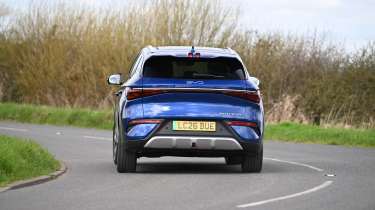
Since we drove the revised Atto 3 in Spain in February, BYD’s engineers have had a play with the software to try and improve the steering, brake pedal feel and throttle response, however there’s clearly still work to be done. The steering, for starters, is still a bit rubbery, vague and unnecessarily heavy, even in ‘Comfort’ mode. Meanwhile the brakes apply sharply and suddenly when you start to push the pedal.
Rivals like the Elroq or Scenic feel more composed and are generally much better to drive than either version of the Atto 3 Evo. At least across our test route through villages, country roads and dual-carriageways, we managed to average 3.6mi/kWh which is pretty good, and at that rate we would get around 270 miles of range from a full charge – not far off the car’s official figure.
As well as the powertrain upgrades, the interior has been redesigned and is now more like the smaller Atto 2’s. So the rippling dashboard is gone along with some of this car’s other oddities that have made the cabin a much less interesting place to be. But this conservative new design will be less polarising too, we suppose, and the bizarre ‘guitar string’ door pockets are still here to provide some character.
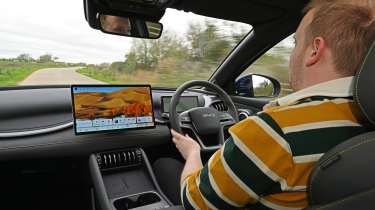
There’s a larger 8.8-inch driver’s display behind the steering wheel (also new) paired with a huge new 15.6-inch touchscreen that can’t rotate between landscape and portrait mode like the unit it replaced, however we don’t think anyone’s going to miss that feature. Especially as the new display is bigger and more responsive. Better still, it has Google Maps built-in, plus Google’s voice assistant and more apps available through the Play Store, that will improve the user experience for those who don’t like to connect their phones via Apple CarPlay or Android Auto.
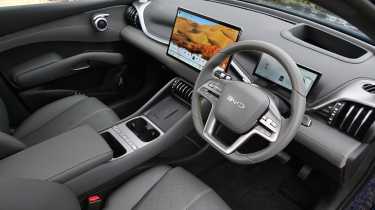
This car doesn’t have a fully Google-powered or developed infotainment system like the Scenic – it’s still BYD’s own and it could be more intuitive. But all the widgets and shortcut icons are customisable, and while the climate control icons are relatively small and quite fiddly, there’s a workaround for that. You can adjust the cabin temperature by placing three fingers anywhere on the screen and dragging them up or down; going left or right, meanwhile, changes the fan speed.
More subtle but no less important changes include the headrests no longer being integrated into the front seats, so they can be adjusted. The large kettlebell-inspired gear selector that used to be on the centre console is now gone too, replaced by a column-mounted one that unlocked a useful space for a ventilated wireless charging pad.
Build quality is a mixed bag, because while there’s a nice thunk to the doors and some soft-touch plastics, the steering wheel is covered in a poor leather imitation and the airbag cover in the centre feels especially cheap. Space in the second row is impressive, with lots of headroom and legroom for this size of SUV. Visibility is also good, and there’s a couple of USB-C chargers back there, too.
BYD has even fettled with the boot and managed to find an additional 50 litres of space, so there’s now 490 litres on offer. That expands to 1,390 litres with the rear seats down. There’s not much in the way of under floor storage, but the 95-litre frunk in the nose – which the Atto 3 never had before – certainly makes up for that and provides plenty of space for the charging cable. Those spaces combined offer a little more luggage capacity than a Elroq or Scenic, but falls short of larger cars such as the Citroen e-C5 Aircross that can swallow up to 650 litres worth of stuff.
The base rear-drive Design model starts from £38,990, meaning it costs about the same as a mid-range Elroq or Scenic which, again, are better to drive and offer more range. At least the standard kit is generous, with those two large displays, 360-degree camera system, ambient lighting, electric heated leather front seats and 18-inch alloy wheels.
The higher-spec Excellence model adds a head-up display, heated rear seats and a panoramic sunroof, as well as all-wheel drive, but it also costs nearly £43,000, putting it in the same price bracket as the Tesla Model Y. It simply doesn’t offer the quality, technology or road manners to justify that high a price tag. Especially when you consider how many more impressive or better value-for-money cars are available for less.
| Model: | BYD Atto 3 Evo Excellence AWD |
| Price: | £42,730 |
| Powertrain: | 74.8kWh battery, 2x e-motor |
| Power/torque: | 443bhp/560Nm |
| Transmission: | Single-speed automatic, all-wheel-drive |
| 0-62mph/top speed: | 3.9 seconds/124mph |
| Range: | 292 miles |
| Max. charging: | 220kW (10-80% in 25 mins) |
| Size (L/W/H): | 4,455/1,875/1,615mm |
| On sale: | Now |