PHEV megatest: Britain's 16 favourite plug-in hybrid systems tested
It’s PHEV boom time. So we tried the systems offered in 59 cars, testing their EV range and efficiency, to reveal the ones you should buy

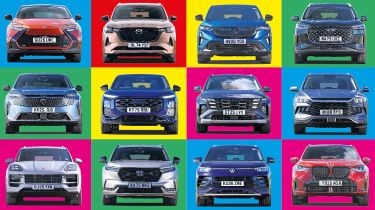
Car buyers are switching on to plug-in hybrids like never before: in 2026, their sales growth has more than doubled that of pure electric cars. But which one should you buy?
This guide seeks to answer that question. We assembled 16 PHEV drivetrains, from every major car group on the market, in the world’s most popular bodystyle, the SUV. Over three days with consistent temperatures around 16-17 degrees centigrade, we drove them, then drove them some more.
The first part of the route, in pure EV mode, established each car’s electric range with a full battery, and majored on urban driving through Bedford and St Neots, linked by 70mph A-road runs. When every battery was flat, we stopped the cars, zeroed the trip, then headed back. This run included more motorway miles to see what the fuel economy was once the power cell has been exhausted.

Our testers then crunched the data for all 16 cars, and debated their dynamics, refinement levels and packaging merits, to come up with a final five for a shoot-out on Bedford’s streets and bypasses.
All told, these drivetrains are available in 59 cars on the UK market alone, so we’re confident in saying that this is the most comprehensive guide yet to the plug-in hybrid market. We hope you find it entertaining – and useful.
Ultimate guide to plug-in hybrids
UK plug-in hybrid registrations are up a huge 46 per cent over last year; market share has climbed from under 10 to 13 per cent. Sales of pure electric cars are rising, too – up 22 per cent – but from a much higher base.
Used - available now

2024 Peugeot
5008
2,556 milesAutomaticDiesel1.5L
Cash £22,497
2024 Land Rover
Defender 110
74,669 milesAutomaticDiesel3.0L
Cash £41,230
2022 Kia
Niro
26,823 milesAutomaticPetrol1.6L
Cash £14,720
2024 Cupra
Formentor
43,789 milesAutomaticPetrol1.5L
Cash £16,460Sales data shows the switch to electrified cars continues to gather momentum, despite the feast-or-famine perception of electric car sales. But there’s been a definite surge in PHEV sales, with consumers embracing them backed by broader choice from car makers.

The geopolitical climate is clearly fuelling the move to cars with plugs. Some European car makers believe rising fuel prices, triggered by the Iran war closing the Strait of Hormuz in March and April, has begun a seismic shift towards plug-in cars, which are far cheaper to run – if you can charge at home.
Another huge influence is the Chinese car market, the world’s biggest. There, ‘new energy vehicles’ – EVs, PHEVs and range-extender plug-in hybrids – account for more than half of registrations, more than seven million vehicles a year. A domestic price war is encouraging Chinese car manufacturers to look to export markets for more profitable sales, boosting the number of electrified cars for European buyers.
Which is right for me: PHEV or BEV?
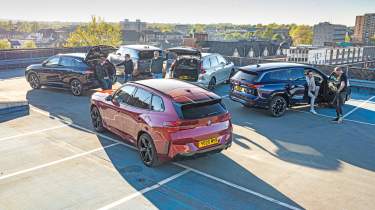
Almost every mainstream car maker sells a plug-in hybrid: a rare exception is Nissan, whose lack of electrified drivetrains has contributed to financial losses and uncertainty over its future. It does sell the Qashqai e-Power but this is a range-extender (REx), where a petrol engine acts as a generator to charge an onboard battery, powering an electric motor driving the wheels. Chinese RExs typically offer a bigger battery and plug-in capability, furthering their combined range.
The key question for anyone considering a plug-in is: can you charge it conveniently? If you have a driveway or garage that can house a wallbox, or can charge cheaply at work, then electrified cars make financial sense with their lower running costs. The big energy providers typically have EV tariffs, offering overnight charging at less than 10p per kilowatt-hour.
If you can charge, the question shifts to EV or plug-in hybrid? And with mass adoption of electric cars running behind projections, makers have boosted their plug-in hybrid line-ups. It’s an excellent bridging technology, giving punters some of the benefits of electric cars – smooth, quiet and zero-emission running in electric mode – but with combustion power to fall back on when the battery goes flat.
There is a downside, however: you’re hauling electric components around with limited electric assistance, impacting economy. Our test logged mpg figures when electric drive was depleted: compare those with the petrol variant’s efficiency for an indication whether going PHEV might help your running costs.
But our advice is unequivocal: don’t buy a plug-in hybrid and use it without charge, because electric drive is critical to efficiency. You’ll end up as your petrol station’s favourite customer – irritatingly frequently, given that PHEV fuel tanks are typically smaller to create space for battery packs. And fast-charging on the go isn’t easy: of the 16 cars in our test, only the Range Rover, Chery and VW Group cars are compatible with DC chargers.
What’s special about the latest plug-in hybrids?
BMW’s X5 xDrive45e was Europe’s first PHEV to pass 50 miles of pure electric range, thanks to a usable 21.6kWh battery. Since then, bigger batteries and greater electric ranges have proliferated, incentivised by regulation.
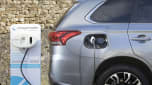
Car makers face large fines if they don’t meet CAFE (Corporate Average Fuel Emissions) targets across Europe. With the X5 45e rated from 27-39g/km of CO2 on the WLTP cycle, and this test’s Range Rover Sport P460e even lower at 16g/km, every PHEV sale helps with the target and creates headroom to sell higher-CO2 cars.
However, because PHEVs do emit CO2 – and in far higher quantities than on the 14.4-mile WLTP test cycle – they are inadmissible in car manufacturers’ obligations to meet the UK’s Zero Emissions Vehicle (ZEV) mandate.
But plug-in hybrid end users, particularly company car drivers, can qualify for tax breaks here. They can save thousands of pounds on Benefit-in-Kind tax if they drive a PHEV with a big EV range. There’s a minor discount on road tax too, plus lots of capital allowance benefits for companies putting plug-ins on their fleets.
The tax position is part of the big picture why plug-in hybrid cars have such momentum. There are still obstacles to their widespread uptake – including higher acquisition prices and the charging conundrum – but the attraction of ever-increasing electric range means that PHEVs will continue to make sense, especially as the technology matures.
Britain’s favourite plug-in hybrids rated 16 to 1
Here's how the top PHEV systems ranked in reverse order...
16. Mazda CX-80
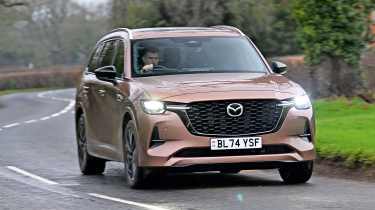
| PHEV Facts | Mazda e-SKYACTIV PHEV |
| Price: | £50,085 |
| Powertrain: | 2.5-litre turbo four-cylinder PHEV, 323bhp, 500Nm |
| Usable battery capacity: | 17.8kWh |
| Tested electric range (claimed/tested): | 38/30.5 miles |
| Tested hybrid economy: | 33.4mpg |
| PHEV also in: | Mazda CX-60 (plus CX-70 and CX-90 in US) |
- In a nutshell: The unholy trinity of tiny range, poor economy and lame dynamics
CX supposedly stands for crossover extreme, but X-rated feels more appropriate, with all four testers ranking the Mazda CX-80 last. The bulky seven-seater’s hybrid system combines a big 2.5-litre engine, electric motor and eight-speed automatic transmission with a 17.8kWh battery, officially good for 38 miles.
Plenty of our contenders are sprightly in electric mode; not the Mazda, despite having a 175bhp e-motor. It feels slow and heavy, chewing up charge merely accelerating to highway speeds. Press too hard and the engine gruffly kicks in, although performance perks up. On our electric run with lots of urban driving, the CX-80 managed just 30.5 miles and was outlasted by the smaller batteries of the Toyota and Hyundai cars on test.
Things didn’t get much better on our hybrid stint back to the start line. Only our Porsche Cayenne and Range Rover Sport fared worse than the Mazda’s 33.4mpg, but they’re both packing six-cylinder power and 3-500kg more mass. Plus they, like every car here, are much sharper to drive.
The Mazda’s nose wanders around like a distracted toddler, and body control is so loose that correcting it or cornering triggers plentiful roll, or pitching under braking. The steering feels wooden and is irritatingly slow in manoeuvres, while the ride is brittle. By the end of our stint, we hated the CX-80 so much that even the hollow indicator sound became annoying. Avoid.
15. BYD Sealion 5
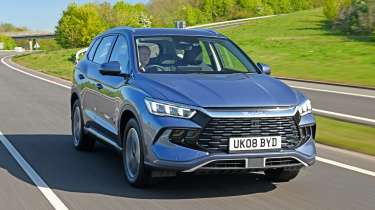
| PHEV Facts | BYD DM-I Sealion 5 |
| Price: | £32,995 |
| Powertrain: | 1.5-litre petrol four-cylinder PHEV, 209bhp, 300Nm |
| Usable battery capacity: | 18.3kWh |
| Tested electric range (claimed/tested): | 53/40 miles |
| Tested hybrid economy: | 50.4mpg |
| PHEV also in: | BYD Seal 6, Seal U, Atto 2 |
- In a nutshell: Where plug-in and range-extender technology collide, imperfectly
Of all the plug-in hybrids on test, BYD’s Sealion 5 drives closest to a range-extender (where the petrol engine acts as a generator and doesn’t actually power the vehicle’s wheels). It uses a 1.5-litre petrol engine to top up the battery (as well as spin the wheels under heavier loads), but crucially it doesn’t let the Comfort spec’s 18.3kWh pack fall below 25 per cent charged.
This is a double-edged sword, though. It means the Sealion 5 comes fourth from bottom on our EV test, vanishing 12 miles of its projected 53-mile range into thin air. The flipside? The Chinese model’s mission to maximise EV power lands it on the podium in ‘hybrid’ running, with economy of 50.4mpg.
The petrol engine only produces 94bhp, and it’s obvious when it rouses during motorway cruising, plus the BYD feels outgunned by rivals when it comes to mid-range acceleration.
But it’s dynamics that plunge the Sealion 5 to the depths. The Comfort spec is totally mislabelled, with a rigid ride that amplifies road imperfections. And the steering is horrible with an unresponsive firmness off the dead ahead and some seriously inconsistent feeling.
The Sealion 5 is the second cheapest of our 16 SUVs, and has the longest battery mileage warranty. You may find yourself attracted to BYD’s marketing promise of 631 miles of combined range, but that sounds like a long sentence to very average motoring.
14. Peugeot 3008
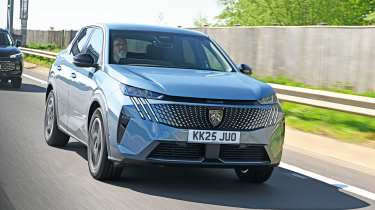
| PHEV Facts | Peugeot PHEV 135 3008 |
| Price: | £40,865 |
| Powertrain: | 1.6-litre turbo four-cylinder PHEV, 193bhp, 300Nm |
| Usable battery capacity: | 17.9kWh |
| Tested electric range (claimed/tested): | 50/46.1miles |
| Tested hybrid economy: | 42.7mpg |
| PHEV also in: | Peugeot 308, 408, 5008, DS No4, Citroen C5 Aircross |
- In a nutshell: Stylish SUV is let down by unrefined drivetrain
The Peugeot 3008’s plug-in hybrid drivetrain is used across the Peugeot, Citroen and DS brands, and it’s about as welcome as Japanese knotweed spreading around your house. The system sandwiches together a 1.6-litre petrol engine, 123bhp electric motor and seven-speed dual-clutch transmission – which should make for seamless shifts by pre-engaging the next gear.
But not on our hybrid run, where the thump of swapping cogs was transmitted to the cabin under acceleration and braking. Only the Honda has less combined firepower than the Peugeot’s 193bhp, not that it feels slow. Acceleration is fine with the 3008 pulling away on e-power, but by 20mph the droning engine has stirred and you’ll be wishing for a longer electric range from the 17.9kWh usable battery.
We achieved 46 miles running in zero-emissions mode, then averaged 42.7mpg, both middle of the pack figures. But the 3008’s dynamic performance drags it down. The steering inconsistently switches from firm and heavy to light and waggly, the body sags into dips and the suspension clatters through 20mph potholes.
Worst of all are the brakes, which react with a Gallic shrug when they’re requested to wipe off speed; that’s no laughing matter when it feels like you’re about to rear-end a colleague in a BYD.
13. Volvo XC60
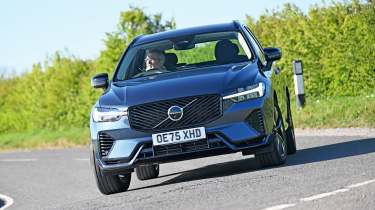
| PHEV Facts | Volvo T6 Hybrid XC60 |
| Price: | £61,260 |
| Powertrain: | 2.0-litre turbo four-cylinder PHEV, 253bhp (+145bhp e-motor), 250Nm (+309Nm e-motor) |
| Usable battery capacity: | 14.7kWh |
| Tested electric range (claimed/tested): | 49/41.3 miles |
| Tested hybrid economy: | 36.0mpg |
| PHEV also in: | Volvo V60 (and uprated T8 in XC60/XC90) |
- In a nutshell: XC60 majors on performance, but feels very dated
The Volvo XC60 is an automotive pensioner, launched way back in 2017 and with a plug-in hybrid system last updated in 2022. This is Volvo’s lower-powered T6 hybrid system (there’s a T8 too), although it packs plenty of performance by combining a 253bhp 2.0-litre turbo engine and a 145bhp electric motor.
Press the throttle in EV mode and the motor responds snappily, effortlessly powering the mid-sized SUV up to motorway speeds, with lots of grunt in the overtaking range. Nestle into the padded seats and it’s a refined cruiser, with only a touch of wind noise around the Swedish SUV’s wing mirrors. The T6 powertrain racked up a so-so 41.3 miles in electric mode, but its range prediction was a claimed 49 miles.
Performance is equally strong from the turbo four-cylinder engine, and it’s pretty smooth too. But given that emphasis, it’s little surprise that the Volvo only returns fuel economy of 36mpg , which is 5mpg off its BMW X3 rival in this test, for instance.
And dynamically it’s a deadbeat. It rolls like a drunken sailor, and corners like it’s on rails – rails laid in a straight line, that is. The steering is baggy and slow to respond, not helped by a wandering nose on the A1M, and ride comfort is nothing special. There’s also a weird reluctance to acknowledge this is half-EV, with no battery percentage readout or informative graphics to celebrate its versatility. This makes the XC60 feel old – which it most definitely is.
12. Hyundai Tucson
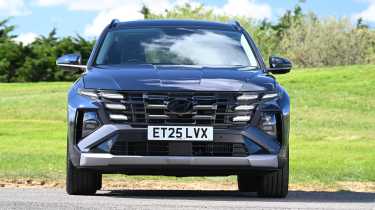
| PHEV Facts | Hyundai PHEV Tucson |
| Price: | £36,680 |
| Powertrain: | 1.6-litre four-cylinder petrol PHEV, 249bhp, 304Nm |
| Usable battery capacity: | 13.8kWh |
| Tested electric range (claimed/tested): | 43.5/33.2 miles |
| Tested hybrid economy: | 43.4mpg |
| PHEV also in: | Hyundai Santa Fe, Kia Sportage, Kia Sorento |
- In a nutshell: Tucson’s real-world performance is relegation material
The Hyundai Tucson definitely got its mojo back with the current model: it drives neatly, has a high-quality cabin and is still eye-catching (although massive sales have dulled the peculiarity of that headlight-and-grille mash-up).
But the plug-in hybrid Tucson is lacklustre. Its test figures are all at the relegation end of our league table with the 33.2-mile real-world electric range falling well short of Hyundai’s claimed 43.5 miles. No surprise with a 13.8kWh battery that sounds closer in size to an electric toothbrush’s, and one which also reanimated the engine with 14 per cent charge remaining.
The Tucson claws back some favour in the way it drives. The 90bhp e-motor has enough shove and it’s sufficiently punchy not to engage the engine at motorway speeds. And unlike its Chery Tiggo 8 and BYD rivals, Hyundai has finessed the Tucson’s chassis, unlocking positive steering and a composed, springy ride. You can even get a four-wheel-drive version, but it’s only for snow-belt dwellers because it has no more power, is 0.2 seconds slower to 62mph and has four miles less range.
11. Mercedes GLC
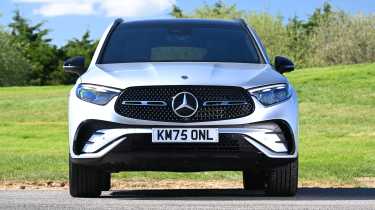
| PHEV Facts | Mercedes 300e |
| Price: | £59,975 |
| Powertrain: | 2.0-litre four-cylinder petrol PHEV, 309bhp, 550Nm |
| Usable battery capacity: | 25.3kWh |
| Tested electric range (claimed/tested): | 78/64 miles |
| Tested hybrid economy: | 35.2mpg |
| PHEV also in: | Mercedes C 300 e, E 300 e, CLE 300 e |
- In a nutshell: Great in electric mode – but then the battery goes flat…
It was looking so good for the Mercedes GLC after our first electric run: its 64 miles of range was bettered only by the Range Rover Sport, which packs half as much battery again as the 300 e. Indeed if the Merc’s 78-mile claimed range was true, it could drive from Birmingham to Manchester – or on our test route from Bedford to Peterborough and back again.
This plug-in hybrid is available in a host of Mercs but we picked the brand’s global best-seller, which remains on sale alongside its all-new EV sibling. With 309bhp, performance is good, 0-62mph takes 6.7 seconds, and the 4Matic four-wheel drive system is standard.
But south of Peterborough hybrid mode kicked in, and the Merc snatched mediocrity from a potential winning position. The throttle is firm, which made us wonder if we were in some Eco mode purgatory (we weren’t).
The gearbox does some odd hunting for cogs, the steering is vague and the 35.2mpg average is unimpressive. Inside, the clear and classy displays are great, but losing 150 litres of boot space to package the batteries is anything but. Still, in true Mercedes style, the GLC is a quiet and comfortable cruiser.
10. Toyota C-HR
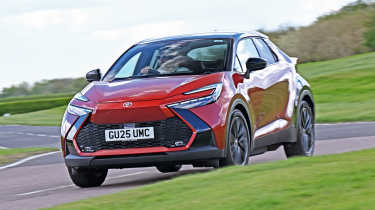
| PHEV Facts | Toyota PHEV C-HR |
| Price: | £39,295 |
| Powertrain: | 2.0-litre four-cylinder petrol PHEV, 220bhp, 190Nm (+208Nm e-motor) |
| Usable battery capacity: | 13.6kWh |
| Tested electric range (claimed/tested): | 41/34 miles |
| Tested hybrid economy: | 51.8mpg |
| PHEV also in: | Toyota Prius |
- In a nutshell: All Toyota’s hybrid economy goodness – but who forgot the battery?
For a company that engineered hybrid-based global domination with the Prius and its pals, Toyota hasn’t made much impact with plug-ins. But the C-HR displays many of its hybrid cousins’ strengths.
In reliable Toyota fashion, it only misses its predicted range estimate by one mile. Just one problem: that range is 34 miles, due to the smallest battery on test. Fair enough. But the 2.0-litre petrol engine saves the C-HR’s blushes somewhat because it’s extraordinarily economical. Indeed, its 51.8mpg is the silver medallist from our 16 PHEV contenders.
And although Toyota hybrid models have become less thrashy over the years, this 220bhp drivetrain isn’t as quiet as the Honda CR-V’s, with its clever stepped transmission. The C-HR’s hybrid integration is hardly a masterclass, though: it adds a punishing 200kg of weight, the boot loses 137 litres – black marks in the smallest car here – and the Japanese model’s battery warranty is even less generous than the Mercedes’, at three years or 60,000 miles.
However, the C-HR has plenty of character. The driving position feels novel with its far-flung windscreen and swoopy dashboard. But a digital driver’s display with just a modicum of logic wouldn’t go amiss, Toyota. And the back seats are about as luxurious as a prison cell.
9. Porsche Cayenne
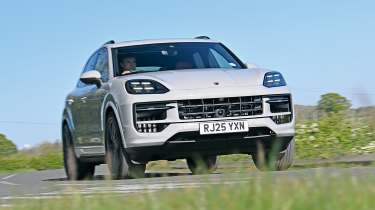
| PHEV Facts | Porsche e Hybrid |
| Price: | £86,300 |
| Powertrain: | 3.0-litre turbo V6 PHEV, 464bhp, 650Nm |
| Usable battery capacity: | 21.8kWh |
| Tested electric range (claimed/tested): | 48/42.8miles |
| Tested hybrid economy: | 32.9mpg |
| PHEV also in: | Porsche Cayenne Coupé, Panamera |
- In a nutshell: Step this way for the most dynamic plug-in hybrid
The Porsche Cayenne e-Hybrid drives so crisply it should be badged Walkers/Lays. Silky steering, laser-guided cornering, a great comfort-and-body-control-spectrum thanks to standard active damping... the Cayenne is unsurprisingly the finest SUV to drive (although it’s one of the loudest at cruising speeds).
Porsche’s base hybrid drivetrain also performs strongly: it’s non-zero-sum-game once the battery expires leaving a raging-bull V6 to monster consumption and emissions. In hybrid mode, the Cayenne maintains an electric buffer, to sail up to 50mph roundabouts or strive to keep the engine silent around town. But it’s no eco one-trick pony: clomp the throttle to instantly summon the electric motor’s 460Nm of torque, and prepare for the tyres to have a minor meltdown.
And the snarling V6, orchestrated by a slick-shifting eight-speed transmission, is a lovely thing to have on board for when the going gets quick. It’s all very different to the other six-cylinder car on test, the Range Rover Sport, which obsesses over smoothness and comfort (and weighs 240kg more).
The Porsche has the third-biggest battery in this line-up, although its 43-mile electric range ranks only 10th. And only the Range Rover fares worse than its 32.9mpg hybrid economy return. But that figure wasn’t exactly helped by slightly more dynamic cross-country driving than in other cars. After all, you would, wouldn’t you?
8. Renault Rafale
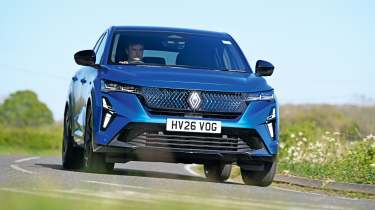
| PHEV Facts | Renault PHEV Hyper Hybrid E-Tech |
| Price: | £44,995 |
| Powertrain: | 1.2-litre turbo three-cylinder PHEV, 296bhp, 230Nm (+205Nm e-motor) |
| Usable battery capacity: | 22kWh |
| Tested electric range (claimed/tested): | 65/49.8miles |
| Tested hybrid economy: | 42.7mpg |
| PHEV also in: | This is the only game in town |
- In a nutshell: Tiny engine, big French car, but somehow it comes together
Renault is fundamentally not serious about plug-in hybrids: the Rafale is the only one in its portfolio, and future investment is going into range-extender technology instead.
Worryingly, the Rafale – a 4.7m-long, 2.4-tonne coupé-SUV – has a tiny, 1.2-litre three-cylinder turbo underwriting its hybrid system. But combined with a couple of motors and a hang-on electric rear axle, the Rafale packs 296bhp and four-wheel drive. It’s the most curious drivetrain here.
We had to keep a close eye on the electric run, with the e-motors trying to call in petrol reinforcement under hard acceleration or on hills. The Rafale traveled nearly 50 miles in zero-emissions mode, which is some way off its 65-mile claimed range. But the small, hybridised engine is capable of plenty of electric running around town, helping the Renault return a decent 42.7mpg economy with the battery depleted. And the Rafale is surprisingly enjoyable to chip around in.
It has long-travel suspension with adaptive dampers which, apart from the odd fidget, let the body ebb and flow, though it can feel a touch heavy and roly-poly in fast corners.
The calm steering gives the Renault a grown-up feel, and rear-wheel steering helps pivot the car in tight manoeuvres. And unlike its Peugeot 3008 rival, the brakes actually work. The Rafale is a civilised way to travel – or it would be, if anyone bought it.
7. Chery Tiggo 8
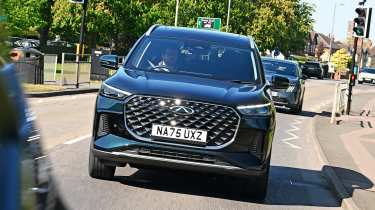
| PHEV Facts | Chery Tiggo 8 |
| Price: | £32,875 |
| Powertrain: | 1.5-litre turbo four-cylinder PHEV, 201bhp, 365Nm |
| Usable battery capacity: | 18.4kWh |
| Tested electric range (claimed/tested): | 56/49 miles |
| Tested hybrid economy: | 60.1mpg |
| PHEV also in: | Chery Tiggo 4, 7, 8, Omoda 7, Jaecoo 7 |
- In a nutshell: Superbly economical drivetrain in a wayward floatmobile
China’s Chery claims to offer the world’s “most advanced plug-in hybrid system”. We’re swallowing the hype. After depleting the battery over 49 miles, the Tiggo 8 then topped 60mpg on our hybrid run, thrashing the second most efficient car in this test – the Toyota C-HR –by 8mpg.
It combines a 1.5-litre petrol engine, with a forensic approach to efficient combustion, turbocharging and thermal management, with two motors, one for power delivery, the other for regeneration. Crucially it has Chery’s own three-speed automatic transmission and fiendishly complex power electronics, all optimised in the pursuit of efficiency.
Not that the Super Hybrid System is gutless, far from it. It responds quickly and punchily to kick down, without the Toyota’s flaring revs. And it uses the engine to maintain a decent battery reserve, so there’s always electric power for easy running, extra performance or to minimise consumption.
It’s a brilliant drivetrain – in search of acceptable dynamics. The pillow-soft Tiggo 8 rides like a budget Range Rover, which combined with lashings of lean and blowaway light steering, makes for wayward handling in corners or under hard acceleration, and loose body control. Shame, because the Tiggo 8 is a proper seven-seater, whereas VW’s plug-in Tayron has to ditch its rearmost seats for batteries. Additional DC charging is a rare perk, too.
6. Audi Q3 Sportback
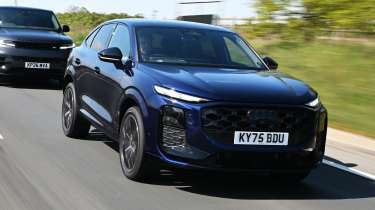
| PHEV Facts | Audi Q3 e hybrid |
| Price: | £48,050 |
| Powertrain: | 1.5-litre turbo four-cylinder PHEV, 268bhp, 400Nm |
| Usable battery capacity: | 19.7kWh |
| Tested electric range (claimed/tested): | 73/54 miles |
| Tested hybrid economy: | 43.2mpg |
| PHEV also in: | Audi Q3, Cupra Formentor, Leon, Terramar; 201bhp version in Audi A3, VW Golf, Tiguan, Tayron, SEAT Leon, Skoda Kodiaq, Superb, Cupra models listed above |
- In a nutshell: The dynamic and efficient Audi charmed all our testers
One hybrid drivetrain, two power outputs, five brands: the VW Group spreads its base plug-in hybrid system far and wide. Audi’s Q3 Sportback gets the punchier 268bhp version (compared with the 201bhp VW Tayron also in this test), and this plush Launch Edition Plus spec includes sports suspension, 20-inch rims and adaptive damping.
And the dynamic Q3 is great to drive. The steering has a lovely fluidity without the stickiness sometimes afflicting the bigger VW; you can precisely ease the Q3 into fast corners and feel it sweetly hold its line. The suspension’s breadth covers easygoing motorway cruising and taut around-town alertness, although the Tayron edges it on pure comfort and quietness. The Audi’s brakes and throttle are pretty tactile, too.
The Q3’s extra performance comes from a tuned-up 1.5-litre engine. The digital driver’s display has a helpful power gauge, to avert igniting petrol power in EV mode: at 70mph it ticks over at 30 per cent. And the Audi managed an impressive 54 miles in zero-emissions mode, the fifth best figure.
In hybrid running, the four-cylinder engine is nicely free-revving, although it’s not as quiet as the Mercedes for example. And even when we drain the battery it can still pull away on electric power and feed volts into the drivetrain, accompanied by a pleasing e-motor whine. Overall the Q3 averaged 43.2mpg, making it the most efficient of the premium-brand contenders.
5. Range Rover Sport
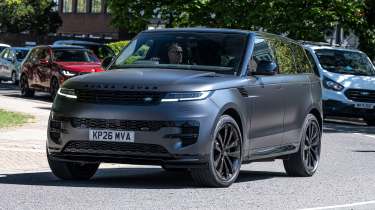
| PHEV Facts | Range Rover P460e |
| Price: | £90,315 |
| Powertrain: | 3.0-litre six-cylinder petrol PHEV, 454bhp, 550Nm |
| Usable battery capacity: | 31.8kWh |
| Tested electric range (claimed/tested): | 73.9/65 miles |
| Tested hybrid economy: | 31mpg |
| PHEV also in: | Range Rover |
- In a nutshell: A huge electric range and comfier than your favourite sofa
The Range Rover Sport’s driving position is twinned with Mount Snowdon. Nestle back into its padded seats, look down on the other SUVs in this test and drink in the luxury. A near-£100k price tag serves up the largest battery and something rare in this company: 50kW DC charging to keep it topped up.
And you’ll need to: the 2.6-tonne Rangie came rock bottom by averaging 31mpg once the battery was depleted. Not that it loses much of the EV mode’s blissful calm: gearshifts are still creamy smooth, the straight-six engine barely perceptible. And when the battery was fully charged, the Sport P460e covered 65 miles, the second highest range on test. If your daily use case is fewer miles, you could pretty much use the P460e as an electric car – contradicting those who see Range Rovers as weapons of massive consumption.
There’s just one electric motor, but it has 215bhp and 450Nm of torque, which is plenty. Floating on the car's adaptive air suspension, in a bubble of tranquility, electric power seems a perfect power source. A petrol V8 Sport might be more engaging to drive, for sure, but this plug-in hybrid is a masterclass in relaxation.
4. BMW X3
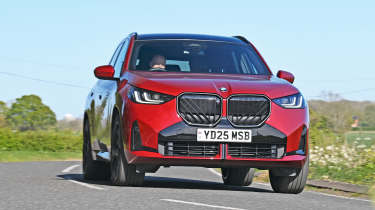
| PHEV Facts | BMW 30e |
| Price: | £58,345 |
| Powertrain: | 2.0-litre four-cylinder petrol PHEV, 295bhp, 450Nm |
| Usable battery capacity: | 19.7kWh |
| Tested electric range (claimed/tested): | 54/53.5 miles |
| Tested hybrid economy: | 41mpg |
| PHEV also in: | BMW 330e |
- In a nutshell: Efficient and sharp to drive, the X3 is a great all-rounder
BMW has been at the leading edge of plug-in hybrid development for 13 years, with the X3 30e packing the company's fifth-generation technology. That means up-to-date battery chemistry and an electric drive unit combining the motor, transmission and power electronics.
It makes for an excellent drivetrain, even if it’s totally in the shadow of its new, electric iX3 sister car. Unlike the straight-six-shooting X5 50e, the X3 has a wimpy four-cylinder petrol unit, which sounds pretty strained if you work it hard. Better to keep the battery charged and use the 181bhp e-motor to power the 30e along.
While the BMW’s closest rival, the Mercedes GLC, displays an aloof, almost spongy ride, the X3 is a much sharper steer, although the 21-inch wheels and lowered-suspension M Sport model make for a pretty taut feel.
While its Mercedes and Volvo rivals guzzled so much fuel that they averaged mid-30s mpg on test, the Beemer clocked 41 miles to the gallon. Couple that with 53.5 miles of pure electric travel and the X3 only narrowly missed out on a place on the podium.
3. Honda CR-V
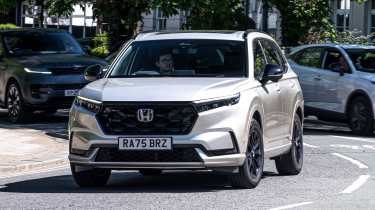
| PHEV Facts | Honda ePHEV |
| Price: | £50,675 |
| Powertrain: | 2.0-litre four-cylinder petrol, 181bhp, 335Nm |
| Usable battery capacity: | 17.7kWh |
| Tested electric range (claimed/tested): | 49/42 miles |
| Tested hybrid economy: | 49mpg |
| PHEV also in: | That’s your lot |
- In a nutshell: A damn good plug-in hybrid – more please, Honda!
Honda’s product planners move in mysterious ways: the excellent Prelude coupé running a leftfield hybrid engine is one of many examples. Another is the limited availability of this excellent plug-in drivetrain, restricted to just the CR-V in the UK (and unavailable in the US).
Despite having a relatively small battery, the CR-V travelled a respectable 42 miles in electric mode. Afterwards, the Honda’s efficient Atkinson-cycle four-cylinder engine (of Civic and Accord fame) springs into action, cleverly acting as a generator to send power to the electric motor while also driving the front wheels at higher speed – all of which is imperceptible from the driver’s seat. With this set-up, the CR-V delivered 49mpg – way above the 45.6mpg Honda says the plug-in hybrid will do without charge.
With a total of 181bhp and 335Nm, the CR-V has the least punch here and its nose-heavy handling is no match for the Prelude's. But drive in a smooth manner and its comfort is rather enjoyable. There’s also the cabin, which is largely shared with the Civic: no bad thing. The tiny central touchscreen looks like someone’s stapled their phone to the dash, but key functions are operated with tactile, sturdy switchgear. How novel: we told you Honda moved in mysterious ways.
2. Volkswagen Tayron
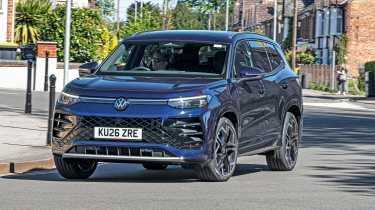
| PHEV Facts | VW TSE eHybrid |
| Price: | £45,360 |
| Powertrain: | 1.5-litre turbocharged four-cylinder petrol PHEV, 201bhp |
| Usable battery capacity: | 19.7kWh |
| Tested electric range (claimed/tested): | 73/58 miles |
| Tested hybrid economy: | 44.9mpg |
| PHEV also in: | Audi Q3, Cupra Formentor, Leon, Terramar; 201bhp version in Audi A3, VW Golf, Tiguan, Tayron, SEAT Leon, Skoda Kodiaq, Superb, Cupra models listed above |
- In a nutshell: Family-focused Tayron is a smart choice
The Volkswagen Tayron shares its plug-in hybrid mechanicals with the Audi Q3, but this is the detuned version, with a 201bhp output. It packs an extra mile of range – whoopee – but sacrifices 1.3 seconds in the 0-62mph benchmark sprint. So it’s fair to say this lower-powered system is very relevant in such a family-oriented SUV.
This may be a sporty-looking Tayron in R-Line Edition trim, but if you want dynamism, go for the Audi. The Volkswagen is all about comfort, with a body that bobs around and light, detached steering. In fact, go for cheaper trims and smaller wheels to maximise this, along with the fantastic optional DCC adaptive damping system with 15 settings from stiff to supple.
As long as you’re not gunning it, the Tayron’s powertrain feels identical to the Audi’s. There’s a proper surge to be felt from the 114bhp electric motor, while the petrol engine is smooth with the six-speed automatic gearbox providing well timed shifts. And the Tayron was the most consistent high-performer in our tests, ranking fourth with its 58-mile electric range, and sixth for hybrid fuel efficiency with almost 45mpg.
Topping up the Tayron battery is easy, too, thanks to 40kW DC charging and a big readout that helps you select the battery charge percentage and projected refuel time. But it does have one weakness compared with the Chery: the Tayron’s seven-seat capability is sacrificed in the PHEV version, with the rear perches making way for the plug-in’s battery.
1. MG HS Plug-in Hybrid
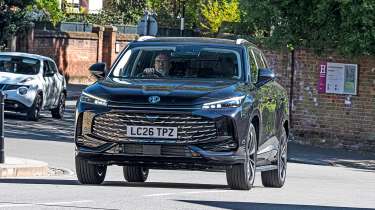
| PHEV Facts | MG Plug-In Hybrid |
| Price: | £32,495 |
| Powertrain: | 1.5-litre turbo four-cylinder PHEV, 295bhp, 350Nm |
| Usable battery capacity: | 23.2kWh |
| Tested electric range (claimed/tested): | 75/68.1 miles |
| Tested hybrid economy: | 46.3mpg |
| PHEV also in: | MG S9 |
- In a nutshell: Our top plug-in hybrid – and it’s made in China
The best plug-in hybrid drivetrain is Chinese – from Shanghai Automotive’s heritage British brand MG. This shouldn’t be a surprise, given that the country’s pro-electric industrial policy has made it the global epicentre of ‘new-energy vehicles’. But MG beating the best of Japan and Europe, plus two compatriots, sums up why the Chinese insurgents pose a great challenge to legacy car makers.
Just like a good horror movie baddie, the MG HS’s battery was the one we couldn’t kill – almost. It travelled the furthest on pure electric power – a whopping 68 miles – despite six of its rivals having bigger packs. It feeds a tractable, 206bhp electric motor, punchier than some of its rivals’ combined petrol/electric power. All that grunt effortlessly hustles the 1,875kg SUV up to motorway speeds, with a sweet sci-fi whine at low speeds giving way to peaceful 70mph cruising. Overtaking in the MG is a doddle, too.
And as with the best systems here, it subtly replenishes the battery to assist the hushed, efficient petrol engine. So at urban speeds the MG frequently runs like an EV, which helped the HS achieve 46.3mpg on our hybrid test run.
It’s not just the drivetrain that appeals. The MG – far more so than its BYD and Chery rivals – is a normal, easygoing car to drive. The digital interfaces aren’t baffling, with information clearly presented and functions logically grouped. The HS's ride-handling balance is fine: the springy ride is comfortable and the HS rolls progressively in corners, following the lead of its nicely weighted, linear steering.
However, the MG is not perfect: maximum AC charging has only just been boosted to 6.6kW, and the lane assist can induce sticky steering and pings mercilessly if you get too close to the white line. But, fundamentally, the MG HS is a decent car, at a terrific price, and one that wouldn’t feel out of place in Volkswagen’s line-up. The people’s car from the People’s Republic is the best plug-in hybrid you can buy right now.
Now read our in-depth test of the top 5 PHEVs...
Tester’s notes: the inside line on the PHEV megatest
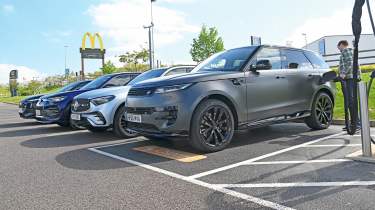
By Dean Gibson
One of the first plug-in hybrids to reach the mass market was the Mitsubishi Outlander, and I’ve been in the fortunate position to drive most PHEVs that have appeared on the market since.
While the official WLTP tests have been refined to produce more accurate fuel economy figures, they can still appear somewhat far-fetched, with quoted mpg in the hundreds of miles. So from an early stage, we’ve consistently taken a ‘worst-case’ approach to PHEV fuel economy.
In the past it was simple: run the battery down, then drive the car on combustion power alone to see what the return is.
That was the basic principle for this test, although as we found out, progress with PHEV tech meant that many more EV miles were needed to get the batteries drained, while some cars offered a larger electric ‘reserve’ to boost efficiency in petrol mode.
You’re only going to make financial savings when running a PHEV by keeping the battery charged. In the past, some PHEVs let you recharge with the engine while on the move, although this was massively inefficient.
The obvious option is to charge overnight via a home wallbox, or during the day when the car is in an office car park. The majority of our test cars feature a basic Type 2 socket, so AC charging is the only option, although the BMW, Mercedes, Porsche and Volvo have 11kW three-phase capability for quicker top-ups.
The Range Rover, Audi, Volkswagen and Chery all come with CCS sockets and can take a maximum DC charging rate of 40kW (or 43kW for the Range Rover). This is a little slow when compared with most full EVs.
Then there are the ethics of PHEV charging – when you have the option of using petrol power, is it better to leave chargepoints free so that the EVs that need them can get access?
Performance PHEVs
Performance SUVs are a bit of a paradox in themselves: how can you have two-metre-tall cars weighing well in excess of two tonnes providing thrills behind the wheel? Well, a few of our entrants in this test have tried to deliver this with varying degrees of success.
The BMW X3, which has long been the best model in its class for driving fun, feels a bit more muted in plug-in hybrid form, not helped by its underwhelming four-cylinder engine as opposed to the non-PHEV M50’s excellent straight-six.
Meanwhile, the Range Rover Sport is almost an oxymoronic name given the model’s preference for refined cruising, and having the largest battery on test means it weighs well over 2.5 tonnes.
The Porsche Cayenne is the one we declared as the finest to drive, but that PHEV system means it’s also 370kg heavier than the regular ‘S’ version, and that’s a noticeable difference despite the German machine’s already portly kerbweight.
Financial matters
By Tom Jervis
Official list prices can be somewhat indicative of a car’s cost, but most buyers now tend to rely on finance or leasing deals. These truly can reshape how expensive (or not) a particular model is, making some look a little more financially prudent than others.
The standout of our top five is almost certainly the MG HS which, at just £278 per month on Auto Express Buy A Car, undercuts the next-cheapest contender, the Volkswagen Tayron, by £200. In contrast, the Honda CR-V will set you back £645 on lease, bearing in mind a six-month initial payment and 8,000-mile annual limit.
This makes the Honda more expensive to lease than the BMW, which can be had for just £583 per month – palatable given the level of luxury and performance the X3 offers. Unsurprisingly, the Range Rover is in another league altogether at more than £1,000 per month, although choosing a lower-spec offering than our Dynamic SE test car could save you hundreds.
The importance of BiK
By Max Adams
It’s all about the numbers with plug-in hybrids, and beyond real-world electric range, and the fuel economy you’ll get without a charged battery, there’s another figure to factor in: BiK. Benefit-in-kind (BiK) taxation is very important for company-car drivers, and PHEVs offer significant cost advantages compared with regular petrol and diesel models.
Most of the cars on our list fall into the 10 per cent BiK bracket, with the Audi Q3, MG HS, Mercedes GLC, Range Rover Sport and VW Tayron rated at seven per cent, due to low CO2 emissions and lots of EV range.
But the Mazda CX-80’s poor EV range means it’s in the 14 per cent category, while a small CO2 penalty for the Toyota C-HR puts it in the 17 per cent class. That means it’ll cost you thousands more to drive the Toyota compared with the best PHEVs on our list.
Ford Explorer is an EV interloper
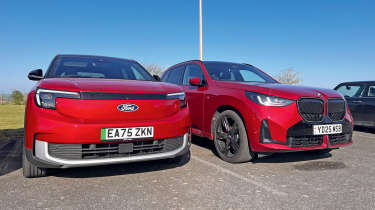
With my X3 30e long-termer in parc fermé every night, I needed another way to get to our test centre – and a Ford Explorer slotted into the breach. No, Ford didn’t send us the wrong test car (it was unable to fulfil our request for the outgoing Kuga PHEV), and it proved to be a pure electric palate cleanser after a day down the plug-in hybrid rabbit hole.
The Explorer’s agility, 282bhp punch and clarity of purpose made for a lovely thrash home. Its refinement across the entire trip meant the Ford delivered a simplicity the PHEVs lacked. It utterly dispatched the many fast, sweeping corners, sweet steering and braced suspension keying the car into each curve, rear wheels powering us through. But the spongy brakes are rubbish.
Driving the Explorer got me thinking: if you’ve got the wallbox to facilitate charging a PHEV, then why not go pure electric? The top-spec Premium model’s £55k price tag might be a factor…
Don't miss out! See more of Auto Express in your Google Top Stories. Click here...