Long-term test: BMW X3 30e xDrive M Sport
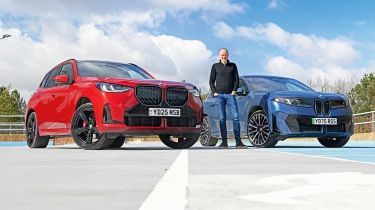
Final report: Just before it left our test fleet, the plug-in hybrid X3 met up with the new Neue Klasse iX3 to see how BMW’s ICE model shapes up against the cutting-edge EV


Verdict
Over eight months, the BMW X3 30e’s economical drivetrain has been its standout feature. Capable of more than 50 miles of EV range and in excess of 50mpg, the plug-in hybrid is a good choice for people not ready to make the pure-electric jump. It handles like a BMW but its Achilles’ heel is a firm ride, so ensure you try before you buy.
- Mileage: 7,378
- Efficiency: 59.3mpg
If any car could have an inferiority complex, it would be BMW’s X3. During the eight months we’ve spent in the 30e plug-in hybrid, the all-electric iX3 has arrived, the first of a ‘Neue Klasse’ of BMWs with a fresh design language, digital cockpit and the firm’s sixth-generation electric tech.
Where do all the iX3’s acclaim and awards leave the part-electrified X3, the SUV that sits between old and new BMW? We’re first to get the two together – both in M Sport trim and costing around £60k before options – to find out if electric humbles hybrid, and reflect on more than 5,000 miles in the 30e.
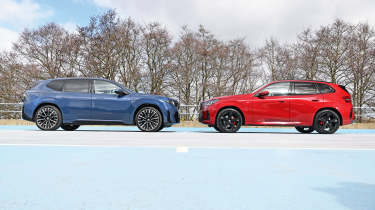
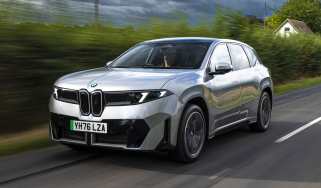
For all the talk of the Neue Klasse design, the shared family DNA is obvious: these are non-identical twins. The iX3 is a trifling 2.5cm longer and lower. It has squarer wheelarches and smarter flush door handles but the starkest contrast is up front, with BMW’s kidney grille pinched into slitty nostrils and flanked by a wide illuminated vizor that incorporates the headlights.
Used - available now


But the X3 visually holds its own, with its £2,300 M Sport Pro package adding the ‘iconic glow’ grille and red brake calipers that are more visible than the iX3’s blue equivalent, topped off by the exquisite £875 Fire Red paint that twinkles in the sunshine. BMW designers are no mugs: the X3 doesn’t look antiquated, and its form is ripe for bringing it further in line come facelift time.
But twins make way for cousins generations apart inside, the X3 claustrophobic, the iX3 light, airy and dripping with digital tech. The EV’s seating position feels like driving your kitchen table: you tower over the low-set dash, which sweeps away into the Panoramic iDrive, a thin digital info strip sweeping across the windscreen’s base. It’s brilliant: the speedo is bang in your eyeline, eliminating the need for a digital driver’s display. This boosts the feeling of open-ness, along with the light upholstery.
Despite several months of exposure to my clambering kids, the X3’s cabin still looks plush with its beautiful ambient light strips and knitted dash fabric, which feels as enticing as a coral reef if you lean your elbows on the door tops. The black upholstery makes for a gloomy place, though, so thank heavens for the £1,800 panoramic glass roof.
Without the need to package a petrol engine, the electric car’s space advantage is very clear. In the X3’s rear, my shins nudge up against the seat backs and the middle seat is compromised by the transmission tunnel: no such privations in the roomy iX3, even though its twin-motor arrangement matches the 30e’s four-wheel drive. And its deeper, 520-litre boot offers 60 litres more than the X3’s, which has no underfloor charging cable stowage due to the hybrid’s battery. The EV boasts a generous 58-litre ‘frunk’.
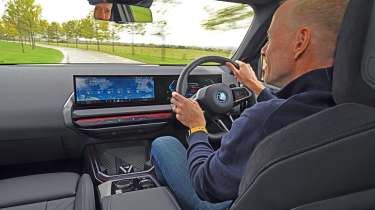
With its 19.7kWh battery, the 30e has an official 53-mile electric range, a figure we exactly ratified in on-road testing. That’s pretty good. During its time with us, the X3 covered 5,136 miles – and half of those were electric powered, according to the data treasure trove in the My BMW app. Convenient home wallbox charging meant our in-town miles were zero emission, with the 181bhp e-motor effortlessly sailing the X3 around.
But things are quite different when the battery is depleted, like when we get to BMW’s HQ in Hampshire to meet up with the iX3. My family racked up lots of 120-250-mile trips, each one beset by my plug-in hybrid take on range anxiety – range guilt – when the bliss of EV running dissipates for petrol consumption.
The secret to maximising electric input is to use the BMW’s navigation, but there’s no round-trip function to preserve some volts for key points on the way back, if indeed that would boost economy. And with the 30e incapable of DC charging, and AC chargers either non-existent or inoperable at my destinations, there were more than 2,000 miles where the petrol engine was taking more than 90 per cent of the strain.
And there’s no joy to be had when the gruff 2.0-litre engine roars into action under heavy load. Nonetheless over its eight months with us, the X3 30e averaged 59.3mpg. Superior to a diesel, and with the benefit of zero-emission miles, I should take that as a win.
Except the iX3 throws it into sharp relief. The 50 xDrive has a mighty 108.7kWh battery for a 457-mile range: even discounted by real-world use, that would still give the 30e’s petrol/electric combo a run for its money. And with the EV able to juice 231 miles in 10 minutes on a 400kW DC charger, the gap between PHEV and EV refuelling is shrinking.
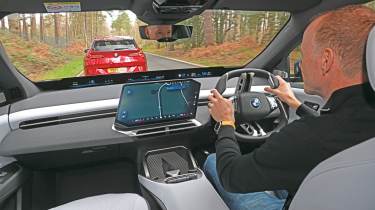
Pressing the EV’s tactile accelerator triggers a similar whirr to the 30e’s, but performance is anything but. The 0-62mph dash takes just 4.9 seconds in the EV, with the hybrid taking another 1.3 seconds to catch up. And, gallingly for BMW, my wife actually skewered the 30e for feeling slow and cumbersome during overtakes across Salisbury Plain.
Kick down and there’s a noticeable pause while the X3 computes which power source should respond and drops a few cogs: you need to yank the left ‘Boost’ paddle to engage maximum attack from both power sources, with the engine rasping encouragingly as the 30e unleashes urgent, punchier acceleration.
The crux of it: the hybrid feels heavier and more cumbersome than the EV, despite its 2,140kg weight offering a 220kg advantage. The nose is slightly slower to turn in but the biggest difference is in how the pair ride: the PHEV thumps into potholes and jars over ridges, yet the iX3, although still taut and grippy, has so much more compliance and composure. It was telling that my normally unobservant kids moaned about the 30e’s ride.
That said, there’s a lot of shared dynamic DNA. Both have crisp brake-pedal response, with BMW rightly boasting about the iX3’s smooth regenerative braking that intuitively slows the car as you lift off when approaching roundabouts. Both are refined motorway cruisers, with the 30e suppressing engine noise nicely at 70mph. And both steer like a BMW, with well judged weighting and linear responses, yet the iX3’s silky fluidity edges it.
It’s an extremely revealing morning. Despite its uncharismatic engine, BMW’s 30e hybrid drivetrain is one of the best available. But you need a wallbox to get the most from it. And if you can charge conveniently, you might as well go all-in on electric. You’ll get more performance, more space and a comfier ride from the iX3 – for almost the same money. The Neue Klasse is a class above.
BMW X3 30e xDrive M Sport: third report
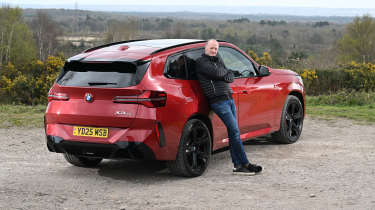
Our BMW's harsh ride detracts from an otherwise great family package
- Mileage: 7,094
- Efficiency: 57.3mpg
“Dad, please can you drive smoothly,” is a frequent plea from the BMW X3’s back seats. This is not, dear reader, because I’m cornering on the door handles, or making jerky gearshifts by yanking the paddles behind the steering wheel to manipulate the four-cylinder engine: no, this is typically on a motorway cruise.
It’s because of the X3’s Achilles’ heel: a ride that’s tougher than my grandmother’s roast beef. This is an X3 M Sport, which means suspension subtly lowered over 21-inch rims, with fairly skinny 40-section rubber. These are accompanied by stiff springs and extra anti-roll to manage the 2,140kg weight of this twin-engined SUV, including the 19.7kWh battery feeding the electric motor.
Manhole, gas-main repair, expansion joint, sudden crest; the X3 mainlines the lot straight into the cabin. The most wince-inducing impacts come when the wheels crash into a pothole: I find myself longing for my old Citroen C5 Aircross’s progressive hydraulic bump stops, and its ability to soak up energy at the suspension’s extremes.
I dread any journey north up the A41, because its moon-like topography has me feeling like John Bonham’s drum kit at the end of a marathon Led Zeppelin concert.
There is an upside though. Find a fast, sweeping corner, with no dawdling vehicles ahead, and the X3 carves through, the scant body-roll well contained, the loaded wheels braced reassuringly, the grip plentiful. But this is a rare occurrence for a motoring journalist, let alone the life of a typical SUV-driving family. Everyone will savour the nicely judged steering: light, responsive and measured, without any of that silly dartiness that feels out of place in an SUV.
We’ve racked up more than 1,600 miles in the past five weeks, with the X3 spending plenty of time on motorways. It’s pretty quiet at 70mph, with only a rustle of wind noise while electric power sweeps us along. Spring weather means the projected maximum EV range has extended up to 57 miles, but once exhausted by a long run a gentle four-cylinder drone underwrites our progress.
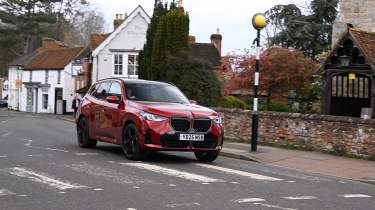
That’s preferable to stabbing the accelerator and shocking it to high revs: its gruff tone, like so many 2.0-litre turbos, is far from melodious. I’m a sucker for the spaceship e-motor whine, but if you don’t like this confected ‘Iconic Sound’, simply turn it off.
This trim’s standard sports seats are firm but supportive and comfortable over long distances. The kids love the £1,350 Comfort Plus Pack’s heated outer rear seats, and they frequently haul up its sun blinds – or hang bags from their upper hooks. Empowering them with controls to adjust the rear zone climate also stops us getting pestered – a bit.
But we’re learning just how difficult it is to slow-charge a plug-in hybrid away from our home wallbox, despite very good intentions. Only 44 per cent of our 1,100 miles in March were on eDrive, and this has slumped to 24 per cent so far with April’s Easter journeys. Fuel economy has dipped from 55.8mpg to 42.4mpg accordingly – that’s diesel SUV levels.
Personally I wish the X3 had DC charging, so I could power it up on the public network. Deputy editor Richard Ingram, who ran a 530e, reckons this is a red herring, given the circa 80p cost per kWh. It’s an interesting thought: better to spend £15 to boost economy by 20mpg – or go it alone on petrol currently costing up to £1.62 a litre round my way? On this X3 it’s a moot point, but it’ll be interesting to see if BMW fits it to the next-generation PHEV.
BMW X3 30e xDrive M Sport: fourth fleetwatch report
A trip to Blackpool showcases the best, and worst, of the BMW X3’s PHEV efficiency
My annual pilgrimage to Blackpool was a tale of two trip computers. Setting off fully charged, the X3 30e xDrive covered 68 of the 224 miles on electric power, registering almost 52mpg. There followed a fiasco in the north west, where I tried in vain to find a usable 7kW charger. The upshot: 33mpg on the return journey, with electric assistance just five per cent of the time. Such is the duality of PHEV life.
BMW X3 30e xDrive M Sport: third fleetwatch report
The BMW X3’s 360-degree parking cameras make light work of parking in narrow spaces
Tempting fate here, but six months in, the X3’s exterior still looks pristine. Alloy wheels faced far more jeopardy before the advent of parking cameras, accessed on the BMW by a shortcut icon behind the iDrive controller (which is only ever used as a fidget toy by my 11-year-old). One click and it’s easy to navigate the Starbucks drive-thru or the minefields of narrow car parks. I wish BMW would eliminate the black ghosting in the 360-degree view though: it makes precise reversing around my driveway’s low wall a hit-and-miss affair. Thankfully it’s the latter so far…
BMW X3 30e xDrive M Sport: second report
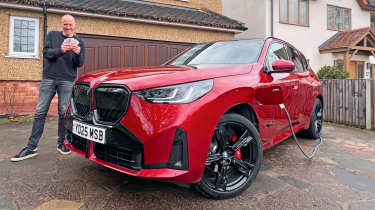
Our man wrestles with PHEV guilt, but loves the running costs
- Mileage: 4,418 miles
- Efficiency: 64.0mpg
Shame. That’s the feeling when my Spotify Wrapped drops every December: my most-played stars are Taylor Swift, Dua Lipa, Olivia Rodrigo and George Ezra. I appear to have the music taste of a 10-year-old girl.
BMW is also using the ‘Wrapped’ approach to get inside the heads of its drivers. According to the My BMW app’s 2025 review, I drive the X3 plug-in hybrid on electric power 52 per cent of the time. And now for more shame: that drags me just inside the bottom half of all X3 30e owners for eDrive contribution.
Capturing and sharing this data is a great way to try to nudge owners to charge their cars. The oft-levelled criticism is that people buy plug-in hybrids as a tax dodge and then run them on empty, but that doesn’t appear to be a widespread offence among 30e owners.
They’d be crazy to do so, because maximising e-power can drive down a PHEV’s running costs below a petrol or diesel SUV’s. I’ve visited a fuel pump just three times in four months, spending £185.90. While the 50-litre tank yields a circa-380-mile range, regular wallbox charging and electric driving stretches that to more than 600 miles.
My Intelligent Octopus Go tariff is 7p per kWh at night, so it costs less than £1.50 to charge the BMW’s 19.7kWh battery – and the stats say I’ve done that 38 times. Add up all the fuel bills and the 30e has cost about 12p a mile to run over 2,000 miles.

There’s another massive upside in my book: zero tailpipe emissions in eDrive. As a keen runner and a father of three, I get dismayed when we’re engulfed by noxious fumes belched from ageing diesel vehicles. I reckon plug-in hybrids make a good case on cost and emission grounds. But you need a wallbox to unlock their potential – and if you have one of those, why not go the whole hog to electric?
More and more people do see plug-in hybrids as a stepping stone to EVs; they were the UK’s fastest growing engine type in 2025. And their 11 per cent share of new-car registrations more than doubled diesel’s.
The BMW Group hybrid has come a long way too. In 2017 my wife and I bought the first MINI Countryman PHEV, which had a 7.6kWh battery and did about 15 miles on a full charge. The 30e triples that range, even in winter.
But ease of use has gone backwards. The MINI had a physical eDrive switch to simply toggle between pure electric, petrol and electric power and charging the battery. Now, I have to tap through three screens to access that ‘Drivetrain and Battery’ menu, uncovering absolute word salad: ‘Electric automatically’ and ‘Activate maintain battery charge once’ are unintelligible, especially when concentrating on driving.
BMW’s software engineers have decided that humans are the weak link in hybrid operation, and they’re probably right. Yet I’d like more transparency and control. My initial EV-intensive runs to our Bedford office would drain the battery; I wanted more of a petrol/electric mix.
Finding that dreaded menu and using BMW’s navigation instead of Google Maps has helped preserve more charge: ideally I’d like to split the e-range over the round trip, and I’ll report back if whole-route planning helps in this endeavour.
Because long trips crank up the guilt once the electric wears out. We have a 120-mile run down to the west country to see my car-loving father-in-law coming up: the 30e does a pretty good job of stretching battery power to average 58mpg. It wouldn’t be so bad if the plug-in hybrid BMW had DC charging capability, so I could prepare it for the return leg. Or maybe I’m being too hard on the X3 – and myself. After all, my Olivia Rodrigo listening is much more shameful…
BMW X3 30e xDrive M Sport: second fleetwatch
BMW’s PHEV X3 may weigh over two tonnes, but utilising the BOOST feature makes overtakes a lot easier
“This car hasn’t got much puff,” said my wife, after the X3 summoned the thrust to overtake a dawdler or two on a long straight across Salisbury Plain. The 30e’s 2,140kg mass (plus 200kg of occupants) and its uncertainty over whether to deploy electric and/or combustion power mean the hybrid doesn’t launch like many BMWs. That’s why there’s a cheeky BOOST paddle: one pull, a slight pause, then the driver’s display lights up like Fortnums and Mason at Christmas and the X3 gives it all it’s got. The result? Far more clinical overtakes.
BMW X3 30e xDrive M Sport: first fleetwatch
BMW has integrated Google Maps into the X3's head-up display, but there’s room for improvement
What witchcraft is this? The X3 that’s just joined our fleet relays Google Maps’ instructions in its head-up display, a very welcome first for one of my long-termers. But while BMW has raised the tile size of its apps and listed them by category, they’re still not user-friendly. Ditto the way the camera relay ghosts out areas and switches views at crucial times. Let’s hope BMW’s upcoming Neue Klasse software launching in the new iX3 electric SUV rights these wrongs.
BMW X3 30e xDrive M Sport: first report
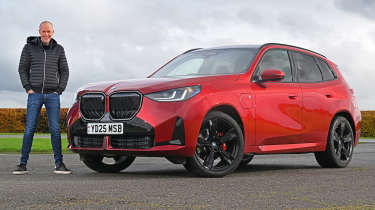
Mid-size plug-in hybrid SUV makes a good start on our fleet, thanks in part to a serious spec sheet
- Mileage: 2,710 miles
- Efficiency: 64.8mpg
Plug-in hybrids: the best-of-both worlds or the devil’s work? Given its Fire Red paint and matt black 21-inch alloys, the X3 30e M Sport is a dead-ringer for South Park’s Satan, but fuel efficiency is borderline angelic.
We’ve travelled 468 miles so far and there’s still one-third of the first tank remaining. That’s because my home wallbox keeps the 19.7kWh battery topped up, costing about £16 on electricity so far. Fully charged the 30e is good for 50 miles of EV range, quietly undertaking school runs and shopping trips while emitting zero emissions.
The 181bhp motor sandwiched between the engine and eight-speed automatic transmission has plenty enough grunt to hustle the X3 along. And that’s a good thing because there’s little pleasure to be had from the four-cylinder turbo kicking in. It sounds rather wheezy and – like many hybrids – can trigger some indecision about whether the car should engage electric or combustion mode, particularly if you come on and off the throttle swiftly at roundabouts or junctions.
My mission is to avoid using petrol almost as much as I did in my previous long-termer, the all-electric Volkswagen ID.7, and our 64.8mpg average is a good start. One long journey was a weekday cruise to Gaydon’s British Motor Museum. The M Sport suspension has an underlying tautness but comfortably shrugs off potholes and crests, and the car is pretty quiet at motorway speeds. Setting off fully charged, the 30e returned 76.3mpg but drained the battery on the outward leg, leading to 47.8mpg over the 182-mile round trip.
The standard, figure-hugging M sports seats are plumper than November turkeys but a lot more vegan. The £1,350 glass sunroof lifts the dark cabin, which has a few characterful touches compared with our previous BMW 530e long-termer. There are huge side pods housing the door handle and an air vent with an elaborate slider control, and the big, angled central cubby contains a wireless charging smartphone plinth and two cup-holders.
The X3 range starts at £51,605 for the 20 petrol xLine, with the diesel only £1,135 more. It’s an almost £6k jump to the plug-in 30e xLine, with our M Sport version costing £59,015 – before a lot of options. The aforementioned paint and wheels are £875 and £2,150 respectively, and we’ve got three option packs. M Sport Pro Pack (£2,300) adds the Iconic Glow kidney grille, red brake calipers and the dechromed, high-gloss black exterior finishes. Completing the external mods are a £1,025 tow bar and £450 sun protection glass.
The £1,350 Comfort Plus Pack includes rear window blinds, plus heated seats all round, cooled front perches with lumbar support, and Harman Kardon surround sound. The silky M steering wheel gets £250 heating, and while the £450 woven fabric upholstery looks great, I roll elbows-out van driver-style and it’s like resting your arm on a cheese grater.
The £2,275 Technology Pack polishes things off with a driver-monitoring camera, head-up display, automated parking and stop-and-go driver assistance. The total cost of these options is a remarkable £13,975 – almost the price of a new Dacia Sandero.
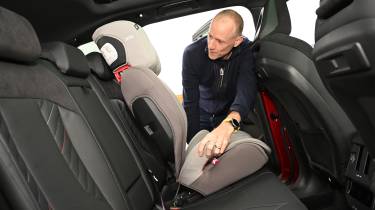
The X3 is, of course, BMW’s mid-size SUV and space is adequate: two six-footers can sit in tandem with about an inch of rear kneeroom. The wide, shallow boot has no load lip, but the hybrid battery prevents any proper underfloor stowage, so carrying the charging cable will nibble into its modest 460-litre capacity.
| Rating: | 4.0 stars |
| Model tested: | BMW X3 30e xDrive M Sport |
| On fleet since: | September 2025 |
| Price new: | £59,015 |
| Powertrain: | 2.0-litre 4cyl turbo petrol PHEV |
| Power/torque: | 295bhp/450Nm |
| CO2/BiK: | 23g/km/9% |
| Options: | Technology Pack (£2,275), M Sport Pro Pack (£2,300), Comfort Plus Pack (£1,350), matt black 21-inch alloys (£2,150), Fire Red paint (£875), tow bar (£1,025), sun protection glass (£450), heated steering wheel (£250), woven fabric upholstery (£450) |
| Insurance: | Group: 38 Quote: £1,414 |
| Mileage/efficiency: | 7,378/59.3mpg |
| Any problems? | None so far |
*Insurance quote from AA (0800 107 0680) for a 42-year-old in Banbury, Oxon, with three points.
Buy a car with Auto Express. Our nationwide dealer network has some fantastic cars on offer right now with new, used and leasing car deals to choose from...